
Uncategorized
Why Benue Assembly Members Are Refunding Money To EFCC – Speaker

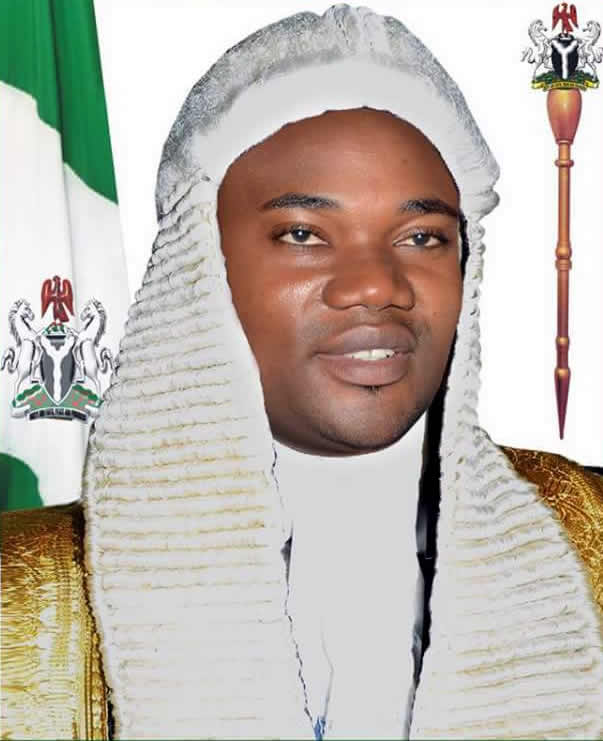
Rt. Hon Terkimbi Ikyange is the Speaker of the Benue State House of Assembly who represents Ushongo Constituency on the platform of the All Progressive Congress, (APC). In a media interaction recently, Hon. Ikyange dispelled allegations that the leadership of the assembly was involved in N750m Car Scam and why some members are refunding money to EFCC. Toryila KAJO was there for nationalTrail
What has necessitated this media interaction?
I have read many stories especially in the social media in recent times that Benue State House of Assembly Makurdi which I lead is involved in what they described as N750m ‘Car scam’. Today, I have called you so as to put records straight on this matter. As far as I am concerned, there is no financial scam in the Benue State House of Assembly that I lead. The figure of N750m mentioned, I still find it difficult to know where these writers got it from. The truth remains that when we came on board as 8th Assembly, I made a request to the executive arm of government for cars for honorable members and contract was awarded to that effect. At the moment, I didn’t know the exact contract sum awarded to that contracting firm. Thereafter, I received my official jeep from the contractor just like other principal officers of the House and for close to one year, we have been using the vehicles. Part of 2015, I also made another request to the governor that members of the House are entitle to car loan of N5.6m as provided by the law. However, due to current economic realities, that amount could not purchase even a Hilux vehicle that could be used in our rural communities during oversight functions. The governor then awarded the contract for the purchase of these Prado Jeeps at the cost of N317m and how the State Executive Council sat and considered the bidding and how it arrived at the contractor, I was not there and therefore wouldn’t know. I came to understand that, then, the value of Prado Jeep in the market was higher than the amount of money the contractor requested for the purchase by 1.5m to N2m because I was made to also understand that was the final amount after the deduction of VAT, withholding Tax and 1% was about N12.5m whereas a Prado Jeep was sold between N13m to N14m as the case may be. Therefore, the contractor could not do otherwise but supplied nine of the vehicles and could not get additional ones. With this development, members became agitated and we began to look for a possible way of solving the problem. So, members met and agreed that since the award of contract for the purchase of vehicles for them which was not forthcoming, the contractor should give them the amount of money voted for the vehicles to enable them purchase vehicles of their choice and at the end of the day, individual members received money from the contractor based on the agreement they reached. Some members later bought Land Cruiser Jeep, some Hilux Van without knowing that it was an offense under economic law. After some times, an invitation came from the Economic and Financial Crimes Commission (EFCC), and on reaching Abuja, they demanded to know how our vehicles were purchased. After individual members explanation, EFCC operatives said what we did was a faulty process; observing that the ideal thing to do was for the contractor to go back to the governor with a complaint that money released per jeep was not enough for the purchase of the facility and then request for upwards review of the contract sum. The EFCC therefore, demanded that those members who collected cash from the contractor should refund it to them for onward refund to the Benue state treasury for the purchase of vehicles for members who were not given. So, from the N317m of which there were some cash collection, 12 were PDP, 8 APC and 1 Labour Party members involved and of the nine vehicles brought by the contractor, APC got 8 and PDP 1.
What is the true position of the alleged N500 million traced to your Bank Account?
It is rather very funny when I read the story in the Nigerian Pilot Newspaper. I don’t know where the Reporter got his source of information. How do you imagine that Benue State House of Assembly which is not autonomous and depend on the Executive Arm of government for money to carry out its function, a Speaker would have gotten such an amount to be lodged in his Bank Account? Or, is it that when the N1.5billion monthly allocation coming from the Federation Account to the state, the governor will say, Mr. Speaker, take N500m? If that is so, what about other 29 members or are they sharing money in the state? Or is it EFCC that gave such information to the Nigerian Pilot Reporter? Sometimes they will call you and said I have information on you, should I publish it? There are some people out to tarnish the image of the leadership of the Assembly. We made up our mind that whatever the provocation and distraction from our desire to legislate for good governance, we will not deviate. So, I have no N500m in my bank account and I only hear of such amount on radio and newspapers. I have one account with Zenith Bank which is functional and that of Fidelity Bank which is dormant at the moment and verifiable by anyone wishing to do so.
There are allegations of members planning to impeach the Deputy Governor over Car money. What’s your take on this?
Well, some of my members were mentioned in the purported impeachment plan which I’ m not aware. Let me tell you that APC has wrestled power from the then ruling PDP in the state in which the governorship result margin was just 100,000 votes. So, APC government in the state is not comfortably enjoying power. With this, do you think the PDP will sit and be clapping or thanking APC? During our inauguration, APC had 14 members with PDP 15 and 1 Labour but with his sympathy to the PDP thereby making PDP 16 against 14 APC members. Before our inauguration, some PDP house members at a function in Oturkpo granted interview to Channels Television alleging that governor Samuel Ortom was bribing them with N5m and a Prado jeep each for them to vote for an APC person to emerge as a Speaker and other principal officers. On our inauguration, APC was able to lobby and canvass for support and some PDP members voted in favor of the APC which led to my emergence as the Speaker. But today, the house is sharply divided along party line during plenary as seen by actions of some members. So, the allegations of planned impeachment of the State Deputy Governor, Benson Abounu is a creation of the PDP to cause confusion.
Why is it that PDP members were not present at the press conference you are holding?
I want to say that if an issue is before the house and we need to speak about it, the house will mandate the House Standing Committee Chairman on Information to speak on its behalf. When Hon. Kester Kyenge (PDP) resenting Logo constituency was addressing a press conference with you, did you see APC members there? The allegation he made at the conference against the house leadership, certainly the house will invoke some of its rules to reply him. As far as I am concerned, no member is shut out of this media conference. If Hon. Kyenge is asked by the Justice Kpojime Panel to refund a huge amount of money to government coffers, you know that he will not fold his hands but will fight back just like Hon. Paul Biam of Ukum constituency who is to cough out N350m. Don’t forget that both of them were coming to become the speaker and the chance is not there hence their unruly behaviors at plenary but we will always use the House Rules to apply on any member’s misbehavior. PDP members are not here because they are behaving as usual even though this allegation of N750m concerns the entire house members.
Why did the House collect N146m for the tour of local government councils for staff verification exercise but abandoned it midway without refunds to the state treasury?
Yes, members collected this money for that purpose and toured up to ten council areas but met resistance from staff who complained that the executive arm of government had carried out same exercise without paying them the bailout money. Therefore, unless they are paid, they won’t subject themselves to another exercise. Members of the house saw reasons with the affected staff and decided to put the exercise on hold until they are fully paid their arrears of the bailout before the house will resume the exercise. Part of this money was for the procurement of biometric Machines, training of the staff and their allowances for the job they were going to carry out and allowances for 30 members of the house going for the exercise. As a Speaker, I am entitled to about 12 staff and they are to have allowances for each night of the exercise. So, we will complete the exercise with time so as to ascertain the staff strength at that tier of government in the state.
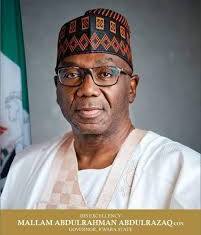
Stephen Olufemi Oni, Ilorin
Kwara State Governor AbdulRahman AbdulRazaq has been hailed for the conferment of the prestigious Sadauna of Ilorin Emirate title on him by His Royal Highness, the Emir of Ilorin, Alhaji (Dr.) Ibrahim Sulu-Gambari, CFR.
Giving the commendation on Tuesday in a statement in Ilorin, the state capital, Alhaji Yakubu Garba Gobir, who is the Sarkin Gobir and Madawaki of the Ilorin Emirate, described the recognition and honour on Governor AbdulRazaq as well deserved, timely and apt, giving his huge contributions to the growth and development of Ilorin Emirate and Kwara State as a whole.
Gobir specifically commended the Emir of Ilorin for conferring this distinguished title in recognition of the qualities and contributions of the new Sardauna, noting that it is a solemn call for greater responsibility, leadership, loyalty and devoted service to the Emirate and its people.
He added: “The title of Sardauna occupies a position of profound significance in the history, heritage and traditions of the Ilorin Emirate. I commend His Royal Highness, Alhaji (Dr.) Ibrahim Sulu-Gambari, CFR, the Emir of Ilorin, for conferring this distinguished title in recognition of the qualities and contributions of the new Sardauna.
“The title embodies courage, leadership, loyalty and devoted service to the Emirate and its people. Your elevation is therefore not merely a mark of honour; it is also a solemn call to greater responsibility and continued service.
“As a fellow title-holder in the Ilorin Emirate, I am particularly delighted to welcome you into this distinguished circle of traditional leadership. I am confident that you will bring to the office the same qualities of leadership, dignity and unwavering commitment to public service that have distinguished your tenure and career.
“At a time when our Emirate and our State require men and women of character, wisdom and courage to advance the interests of our people, I am certain that you will make a meaningful contribution to the enduring unity, progress and development of the Ilorin Emirate.”
Gobir offered prayers for a successful, impactful and enduring tenure for the new Sadauna, adding:
“May Almighty Allah grant you wisdom, sound health and strength, and may He make your tenure as Sardauna of Ilorin a source of lasting honour to you, your family and the entire Ilorin Emirate.”
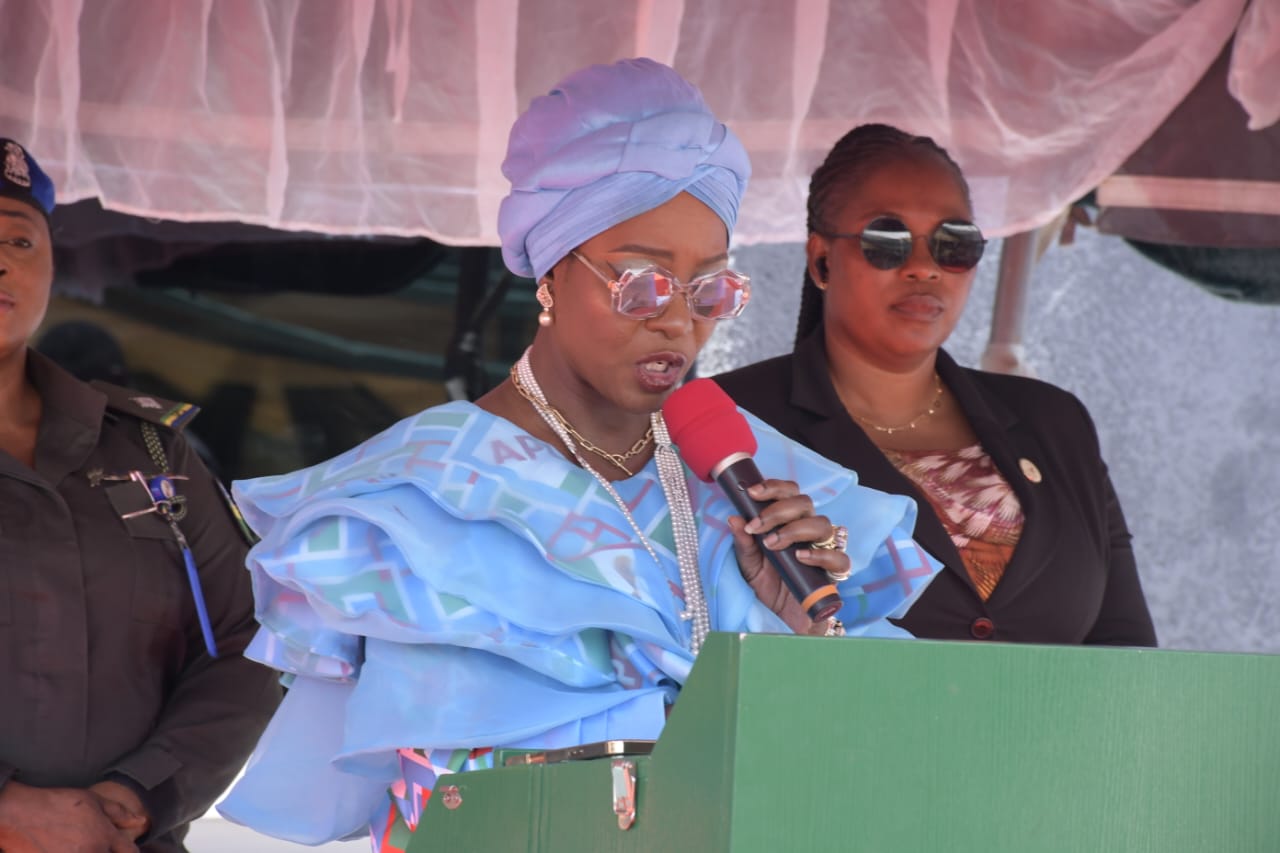
Stephen Olufemi Oni, Ilorin.
The wife of President Bola Ahmed Tinubu, Senator Oluremi Tinubu, has commissioned a TETFund/Renewed Hope Initiative-backed ICT Experience Centre at the Kwara State University (KWASU), Malete.
It would be recalled that KWASU is one of the six tertiary institutions selected for the pilot phase of this intervention, with one institution representing each of the Nigerian six geopolitical zones.
Represented at the commissioning on Tuesday by the wife of the Vice-President, Nana Shettima, Tinubu said the project is a testament to the federal government’s commitment to advancing education, digital inclusion and enhancing graduate employability.
“The TETFund/Renewed Hope Initiative ICT Experience Centre we are commissioning today represents opportunity, innovation, knowledge, and the future of young people in Kwara State and beyond.
She said: “This initiative aligns with the Renewed Hope Agenda of the administration of His Excellency, President Bola Ahmed Tinubu, GCFR, which places emphasis on youth empowerment, education, innovation, and economic transformation. Mr President is committed to creating opportunities that will equip Nigerian youths with knowledge and skills required to thrive in a modern and competitive world.”
Senator Tinubu said the facility was designed as a modern technology centre equipped with ICT laboratory, interactive digital display, conference facility, and exhibition spaces, adding that it would be an environment for learning, creativity, research, and technology advancement.
According to her, the ICT centres had been commissioned at the Ekiti State University on May 28, University of Cross Rivers State on September 4, Anambra State Polytechnic on September 10, adding that the Centres at Kaduna State University and Taraba State Universities would be commissioned soon.
“The next phase of this intervention will cover 15 institutions in Adamawa, Bayelsa, Borno, Delta, Edo, Enugu, Imo, Katsina, Nasarawa, Niger, Ondo, Osun, Rivers, Yobe, and Zamfara states which construction is currently ongoing. This expansion demonstrates the administration’s commitment to ensuring that more Nigerian youths, irrespective of their locations, have access to digital learning opportunities,” she said.
She encouraged the students to take ownership of the facility, maximise the opportunity it provides, and use technology positively to enhance their lives, community, and the nation.
In his speech, the Executive Secretary of Tetfund, Architect Sonny Echono, said the centres are being established across selected Universities, Polytechnics and Colleges of Education, with the Kwara State University, Malete proudly hosting the facility in the North-Central Zone.
“Through practical training and digital skills acquisition, TETFund seeks to enhance graduate employability, foster innovation and position Nigeria to participate more effectively in the global
technology-driven economy,” he added.
Echono also said that the ICT Experience Centre is designed to equip students and lecturers with critical digital skills in Artificial Intelligence, Cybersecurity, Robotics and Software Development.
He added: “The Centre being commissioned today is one of the foremost ICT Experience Centres being delivered across the country, and the third to be commissioned this year. The Centre is equipped with modern digital devices, Computer systems and relevant software to facilitate training, practical learning and skills development. The facility is appropriately furnished and
fully air-conditioned, with supporting power and municipal infrastructure.”
Also speaking, the Vice Chancellor of the University, Professor Shaykh- Luqman Jimoh, said the new facility represents vision, belief, and an investment in the Nigerian youth to better shape the future of our
nation.
The Vice Chancellor described the ICT Experience Centre as an investment in human capital, in innovation, in entrepreneurship, and, most importantly, it is an investment in the future of Nigeria.
“This Centre will provide opportunities for our students to develop practical digital skills and engage with contemporary technologies. Importantly, it is our hub for interdisciplinary engagement.
“This ICT Experience Centre is therefore a timely, critical, and strategic infrastructure that will definitely enhance research, teaching, learning, entrepreneurship, and community service. This intervention is at the core of what this university seeks from partners and donors: synergies that add value and impact on today and the future,” he started.
KWASU Vice Chancellor also assured that the ICT Experience Centre would be put to maximum use for the benefit of students, researchers, and the University
community, adding that the “KWASU community would engage with the facilities in this Centre, we will use it. We will explore, experiment, learn, and innovate in i
:
Uncategorized
2027: Violent ;Kaduna as ADC, APC Supporters Trade Accusations….APC Calls For Police Investigation into the Vandalisation, attacks on its Office

By Hassan Agboola
Tension is mounting in Kaduna State ahead of the 2027 general elections, following renewed exchanges between supporters of the African Democratic Congress (ADC) and groups backing the administration of Governor Uba Sani.
The latest development came on Tuesday when ADC governorship candidate, Isa Ashiru, addressed supporters in Kaduna and, according to an account of his remarks, declared that the party was prepared to respond to attacks against its members.
Ashiru was also quoted as saying that it was Governor Uba Sani, rather than President Bola Ahmed Tinubu, who was responsible for the continued detention of former Kaduna State Governor, Nasir El-Rufai.
However, available public records show that El-Rufai’s detention followed proceedings before the Independent Corrupt Practices and Other Related Offences Commission (ICPC), with the commission stating that his continued custody was based on a court-issued remand order.
The controversy over El-Rufai’s detention has nevertheless become a major political issue in Kaduna and beyond. The ADC has repeatedly criticised the handling of the former governor’s case and alleged political persecution, while other political actors have made different claims about the circumstances surrounding his detention.
Rising political temperature
Ashiru’s emergence as the ADC governorship candidate has added another dimension to the political contest in Kaduna. He defeated other aspirants at the party’s governorship primary in May 2026 and is now preparing for another governorship contest after previously representing the PDP in the 2019 and 2023 elections.
The political atmosphere has been further complicated by disagreements within the ADC and accusations from different groups over the party’s leadership and candidates.
A Southern Kaduna political group, for instance, recently questioned Ashiru’s candidacy and the choice of his running mate, allegations rejected by an ADC official.
The situation has also produced incidents involving ADC supporters and security personnel. In one recent incident, police dispersed an ADC solidarity walk in Kaduna, while the party subsequently accused opponents of attacking its members and warned that political violence could escalate ahead of the 2027 elections.
The former governor remains an important factor in the emerging political contest. El-Rufai was taken into custody in February 2026 after responding to an invitation from the ICPC. His family subsequently demanded his release, while the anti-graft agency maintained that his detention was authorised by a court.
Since then, the issue has increasingly featured in political statements by the ADC and its supporters, with the party accusing the Federal Government of political persecution and calling for the former governor’s release.
The development has created a new political fault line involving the ADC, the APC-led Kaduna State Government and supporters of the former governor.
While allegations have been exchanged over who is responsible for political violence in Kaduna, the competing narratives should not be confused with established findings. The ADC itself has recently rejected the suggestion that it has a monopoly on political violence and accused unnamed opponents of introducing thuggery into the 2027 political process.
With the 2027 election campaign yet to fully commence, the increasingly combative language from ISA Ashiru and his supporters has raised concerns about the possibility of further confrontation.
The immediate challenge before the political parties, security agencies and community leaders is therefore to ensure that political disagreements do not degenerate into violence, particularly in a state with Kaduna’s history of politically and communally sensitive conflicts.
As at the time of filling tid report the All progressive congress, APC , Kaduna state in a statement has condemned the attacks on its office and called for police investigation
Certainly. I’ll retain the substance of the report while correcting grammar, tightening the structure, and presenting it as a clean newspaper hard-news story.
Writing
APC Condemns Violent Attacks on Members, Party Offices in Kaduna
The Kaduna State chapter of the All Progressives Congress (APC) has condemned alleged violent attacks on its members and the vandalisation of party offices and properties in the state.
The party also called on the police and other security agencies to investigate the incidents and ensure that those responsible are brought to justice.
In a statement, the Kaduna State APC Publicity Secretary, Sani Dan-Azare, alleged that some of the party’s members and supporters had been attacked, while some party and support-group offices were vandalised.
He also alleged that vehicles belonging to some party members were damaged during the incidents.
The APC described the attacks as unacceptable and urged security agencies to conduct a thorough and impartial investigation to establish the circumstances surrounding the incidents.
The party called on its members and supporters to remain calm and law-abiding, stressing that they should not resort to retaliation or take the law into their own hands.
The APC said it remained committed to peaceful political engagement and urged all political actors in Kaduna State to conduct their activities within the bounds of the law.
It further appealed to security agencies to strengthen security around party offices and other sensitive locations to prevent further incidents.


Changsha brings millennia-old heritage into modern life

Gov AbdulRazaq Lauded Over Conferment Of Sadauna Of Ilorin Title

FG Commissions KWASU ICT Centre To Enhance Graduates Employability

-
 Uncategorized6 years ago
FG, states urged to harness flooding for ranching, others with technology – Agbaje
-
 Headlines11 years ago
Breaking: EFCC seals Borno House of Assembly, as Hon members take to their heels
-
 News12 years ago
Nigeria Security Operatives Stage Manhunt For Homosexual Perpetrator
-
 News10 years ago
How 21-year-old Girl fled community over accusation of lesbianism
-
 News11 years ago
Yobe Gov Moves Against Deputy
-
 Opinion7 years ago
7 signs she has friend zoned you
-
Technology5 years ago
Online job placement company headhunts women
-
 Headlines10 years ago
Borno Dep Gov Abducts Another Church Leader