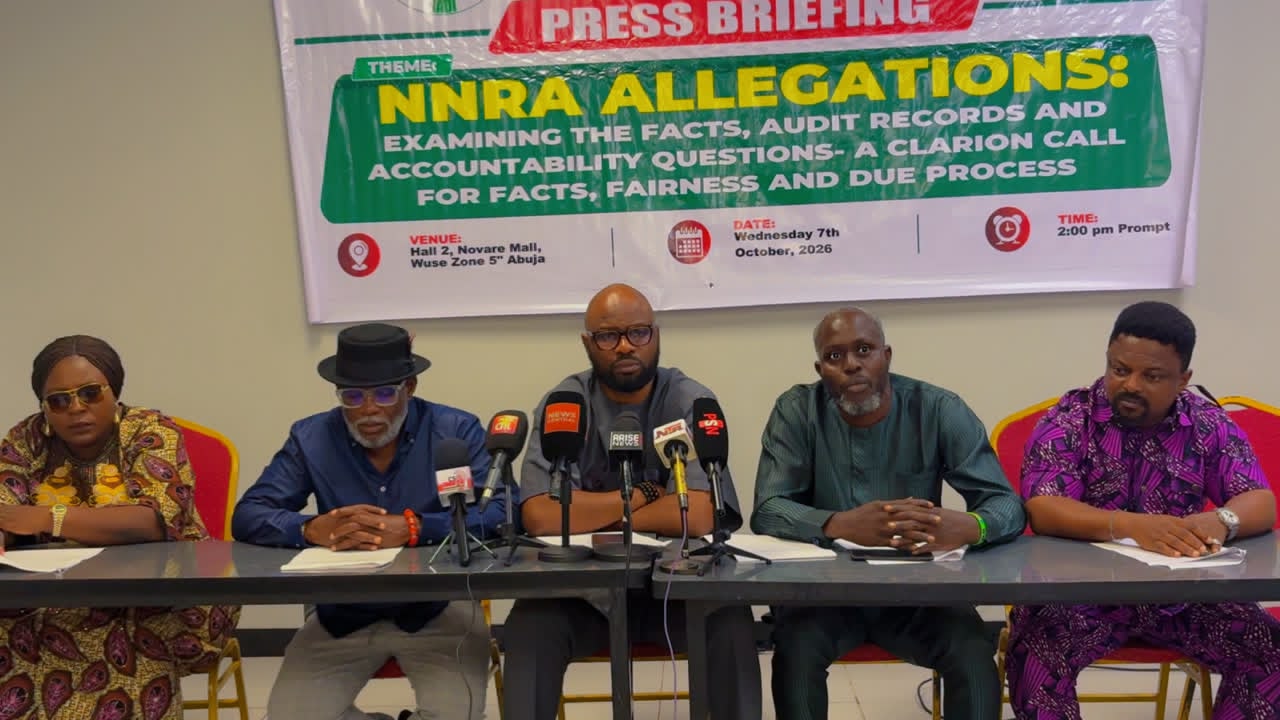
The Integrity Advocacy for Development Initiative (IADI) has called for a thorough, evidence-based examination of allegations of financial misconduct involving the Nigerian Nuclear Regulatory Authority (NNRA), warning against treating audit observations and media reports as established cases of fraud.
IADI Executive Director, Comrade Ofomhi Christopher, made the call on Wednesday at a press briefing in Abuja titled, “On the Allegations Concerning the Nigerian Nuclear Regulatory Authority (NNRA): Facts, Clarifications and the Need for Evidence-Based Accountability.”
The group was reacting to a publication by Secrets Reporters dated October 1, 2026, which alleged that about N6.69 billion was involved in contract fraud and misappropriation at the NNRA.
It also referred to a protest held on October 5 by Global Integrity Watch (GIW) at the NNRA headquarters, where the organisation demanded accountability, responses to audit observations and Freedom of Information requests, as well as changes in the leadership of the regulatory authority.
Christopher said while the allegations deserved scrutiny, they should not be treated as established facts without verification of the underlying records.
According to him, the public deserves to know the specific audit observations, periods and transactions involved, the nature of the contracts, the status of the projects or services, responses provided by the NNRA and whether the issues had been resolved or referred for further investigation.
“An audit observation is a serious matter requiring explanation and verification, but it is not, by itself, a judicial finding of fraud or personal misappropriation,” he said.
The IADI chief also referred to an explanation reportedly provided by the NNRA Director-General concerning the authority’s 2024 capital budget.
He said the explanation put the NNRA’s total 2024 capital budget at about N2.7 billion, comprising approximately N200 million belonging directly to the authority and about N2.5 billion for constituency projects, with an additional N200 million regional project bringing the figure referenced to about N2.9 billion.
Christopher, however, stressed that the explanation should not be regarded as conclusive, urging that it be tested against appropriation documents, budget releases, project records, procurement documents, payment records and audit reports.
“That is how responsible accountability should work: a claim is made, the response is heard, the records are examined, and the evidence determines the conclusion,” he said.
On allegations concerning unexecuted projects, the organisation called for physical verification of the specific projects, while allegations of inflated contract prices should be subjected to scrutiny of contracts, bills of quantities, procurement records and relevant price benchmarks.
It also urged that allegations concerning contractors be examined through relevant procurement and ownership records, while any claim of diversion or misappropriation should be established through the financial trail.
Christopher said where audit authorities had raised observations on expenditure, the public should be informed of the precise observations, the affected institution’s response and the current status of the issues.
The organisation also addressed the October 5 protest by GIW, acknowledging the constitutional right of civil society organisations to peaceful assembly and association under Section 40 of the Constitution.
It, however, urged CSOs to exercise such rights responsibly and within the law.
On Freedom of Information requests, IADI said there should be a distinction between the right to protest and the legal mechanism available where an FOI request is not answered.
The organisation noted that the Freedom of Information Act provides a judicial mechanism for applicants who have been denied access to information, adding that Section 20 allows an applicant to approach the court for a review.
IADI clarified that it was not suggesting that CSOs must obtain a court order before organising peaceful protests.
Rather, Christopher said, where non-compliance with an FOI request was the central grievance, the statutory and judicial mechanisms should be considered alongside legitimate civic action.
“An unanswered FOI request may justify further action to obtain the information. It does not, by itself, establish that fraud, misappropriation or any other wrongdoing has occurred,” he said.
The group also urged organisers of protests at government agencies to take public safety, access to government premises and the safety of protesters, workers and other citizens into consideration.
At the same time, it cautioned government institutions against using the possibility of confrontation as a justification for suppressing lawful civic expression.
“The answer to institutional disagreement should be law, evidence and due process, not intimidation or retaliation,” Christopher said.
He stressed that IADI was neither seeking to shield the NNRA from scrutiny nor dismiss legitimate questions concerning public expenditure at the authority.
He called on relevant audit and oversight bodies to state the status of the observations in question, the responses received from the NNRA and whether the matters had been resolved, sustained or referred for further investigation.
The organisation also encouraged CSOs pursuing accountability to make full use of available legal and institutional mechanisms while retaining their legitimate right to peaceful civic action.
“The public deserves accountability. But the public also deserves accuracy, fairness and evidence.
“A headline is not a verdict. An allegation is not evidence. An audit observation is not automatically a finding of personal guilt,” Christopher said.
He added that public institutions should not expect their expenditure to escape scrutiny merely because questions were raised through the media or civil society.
“Let the records be examined. Let the questions be answered. Let the evidence speak,” he said.