
Foreign
China’s marine economy continues to expand with diverse highlights

By Kong Dechen
China’s gross ocean product grew 5.8 percent year on year to 7.2 trillion yuan ($1 trillion) in the first three quarters of 2023, indicating that the country’s marine economy has maintained its positive overall recovery momentum.
The country’s traditional marine industries have shown strong growth momentum. In the first three quarters of this year, China remained a global leader in terms of seagoing vessel market share, with new orders for seacraft growing faster and shipbuilding companies seeing continuous rebound in their economic benefits, according to Cui Xiaojian, deputy director of the National Marine Data and Information Service.
“New orders for seagoing vessels, seacraft output, and the number of sea ship orders in the hands of shipbuilders nationwide increased by 40.2 percent, 23.3 percent and 34.3 percent year on year, respectively,” Cui said.
“In particular, there has been a significant increase in the number of high-tech and high value-added ships delivered during the period. And a batch of container vessels with a TEU (20-foot equivalent unit) capacity of 24,000, LNG dual-fuel powered bulk carriers, and gas carriers were also delivered during the first three quarters,” Cui added.
The country’s marine tourism industry has strode into a new stage of full recovery, witnessing a 121 percent year-on-year growth in marine passenger volume in the first three quarters of this year, which has exceeded the level of the same period in 2019.
China’s marine resource supply capacity has steadily improved. In the first three quarters of 2023, 1,219 projects of sea area and island use were approved nationwide, up 4.6 percent year on year. These projects involve combined investment totaling over 600 billion yuan.
The country has made continuous efforts to increase its offshore oil and gas reserves and production. In the first three quarters of 2023, its offshore crude oil and natural gas production grew by 4.6 percent and 9.7 percent, respectively, compared to the same period last year, while multiple projects were completed and commenced production in the country.
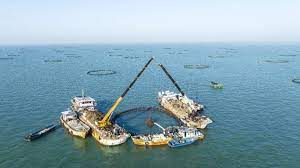
The construction of the country’s “blue granary” has been steadily advanced in the first three quarters of this year, when the growth rates of domestic marine aquatic products output and mariculture output both exceeded 5 percent year on year.
The country’s ever-growing emerging marine industries and continuously improving capability of marine scientific and technological innovation have become the highlights of its marine economic growth in the first three quarters of this year.
China’s marine engineering equipment manufacturing industry has continued to improve. The industry’s value of delivered orders for marine engineering equipment increased by 50 percent year on year in the first three quarters of 2023, accounting for 64.3 percent of the international market share of marine engineering equipment.
Meanwhile, seawater desalination projects in Hebei province, Tianjin municipality, Shandong province, Jiangsu province, Zhejiang province and other regions across the country have been steadily advanced, with the scale of projects under construction and newly started exceeding 300,000 tonnes per day.
The country has constantly made breakthroughs in the development of marine renewable energy.
It has accelerated the construction of offshore wind power projects. In the first three quarters of 2023, the combined capacity of relevant projects under construction and newly started was about 19.4 million kilowatts, an increase of about 2 million kilowatts over the same period last year.
At the same time, the capacity of offshore wind power projects newly connected to China’s power grids and the country’s power output from offshore wind power projects during the period posted year-on-year increases of 14.8 percent and 19.2 percent, respectively.
Following the stable commercial operation of tidal energy projects, ocean thermal energy and wave energy have also entered project operation or power generation testing successively.
China has continuously made new progress in its basic research in marine science. It has launched the intelligent test task support ship Xiang Zhou Yun; put into service the undersea seismic data exploration and acquisition equipment Haimai, or “Sea Pulse”; and developed the first domestic 6,000-meter deep in-situ corrosion damage monitoring experimental cabin.
Production technologies in China’s marine industry have also experienced continuous improvement. The country’s first set of domestic 18-megawatt offshore wind turbine main shaft bearings has successfully rolled off production line; its 2,500-tonne self-propelled jack-up offshore wind power installation platform Haifeng 1001 was officially delivered; and the construction of the main hull structure of the Haiyang Shiyou 122, Asia’s first cylindrical floating production storage and offloading (FPSO) facility, has been completed in China.
“In the first three quarters, foreign trade cargo throughput at coastal ports increased by over 10 percent year on year. However, the total value of marine imports and exports decreased by 1.3 percent from the same period last year, due to factors such as falling prices of bulk commodities and exchange rate fluctuations,” said He Guangshun, director of the marine strategic planning and economics department of China’s Ministry of Natural Resources.
China’s maritime trade routes have become increasingly dense, effectively facilitating the development of the Belt and Road Initiative.
Liaoning Port Group in northeast China’s Liaoning province launched a new route shipping steel from South America to Yingkou Port in Yingkou city, Liaoning province; Dalian Port in Dalian city, Liaoning province, put into operation a shipping route linking Dalian and the Philippines; and the opening ceremony of the shipping route between China’s Fangchenggang Port and Cambodia’s Dara Sakor international port was held at Fangchenggang port, a part of Beibu Gulf Port in south China’s Guangxi Zhuang autonomous region.
The infrastructure of coastal ports in China has continued to be upgraded. The Phase II project of a 300,000-tonne crude oil wharf of Yantai Port in Yantai, east China’s Shandong province, was officially put into operation; Beibu Gulf Port has significantly improved port cargo handling timeliness, accuracy and cargo transfer efficiency through its intelligent cargo handling system; Qingdao Port in Qingdao, Shandong province, has officially put into use its first automated ship loader, greatly improving loading and unloading efficiency…
With China’s macro policies continuously boosting the confidence of business entities, the country’s marine industry will enjoy a stronger endogenous driving force, and China’s marine economy is expected to maintain its momentum for steady growth throughout the year, He noted.

By: Fabian Apechihin
U.S. President Donald J. Trump has directed lawmakers to launch an immediate investigation into reports of widespread killings of Christians in Nigeria, describing the situation as a “Christian genocide.”
In a statement released Friday evening via his Truth Social platform, Trump expressed grave concern over the violence, blaming radical Islamist groups for what he called a “mass slaughter.”
“Christianity is facing an existential threat in Nigeria. Thousands of Christians are being killed. Radical Islamists are responsible for this mass slaughter,” he wrote.
The U.S. President announced that he is designating Nigeria a “Country of Particular Concern,” citing alarming figures of killings within the country compared to global totals.
“When Christians, or any such group, are slaughtered like is happening in Nigeria — something must be done! I am asking Congressman Riley Moore, together with Chairman Tom Cole and the House Appropriations Committee, to immediately look into this matter and report back to me,” Trump stated.
He added that the United States “cannot stand by while such atrocities are happening,” pledging that his administration remains ready “to protect Christian populations around the world.”

By: Fabian Apechihin
Polish Member of the European Parliament (MEP), Dominik Tarczyński, has once again drawn global attention to what he described as the ongoing persecution and killings of Christians in Nigeria.
In a post on his verified 𝕏 account on Monday, Tarczyński shared an image of a blood-stained Nigerian flag alongside a viral video showing a pastor conducting a burial ceremony for victims of violence.
In the video, the pastor lamented the frequent killings, saying:
“We are tired of performing burial every day, and they expect us to remain silent. It has become an order, and the Nigerian government came out to deny the massacre, saying there is no genocide of Christians in Nigeria. United Nations, you’re watching me. The American Parliament is aware of what we are doing now. My special request is to President Trump to save our lives in Nigeria. They are killing more Christians. If they say they kill Muslims, the Muslims are killed by who? Muslims are killed by Muslims.”
Tarczyński’s post quickly went viral, sparking widespread reactions and renewed calls for the Nigerian government to intensify efforts to combat banditry and terrorism.
However, the Federal Government has repeatedly rejected claims of a religiously targeted genocide. In a recent statement, the Minister of Information and National Orientation, Mohammed Idris, described such allegations as “false, baseless, despicable, and divisive.”
Idris maintained that Nigeria’s security challenges are complex and not driven by religious motives, warning that framing the fight against terrorism as an anti-Christian campaign could deepen existing social and religious divides.
He reiterated the government’s commitment to protecting all Nigerians, regardless of faith or ethnicity, and called on international partners and media outlets to “refrain from narratives that distort the country’s security realities.”
By: Fabian Apechihin
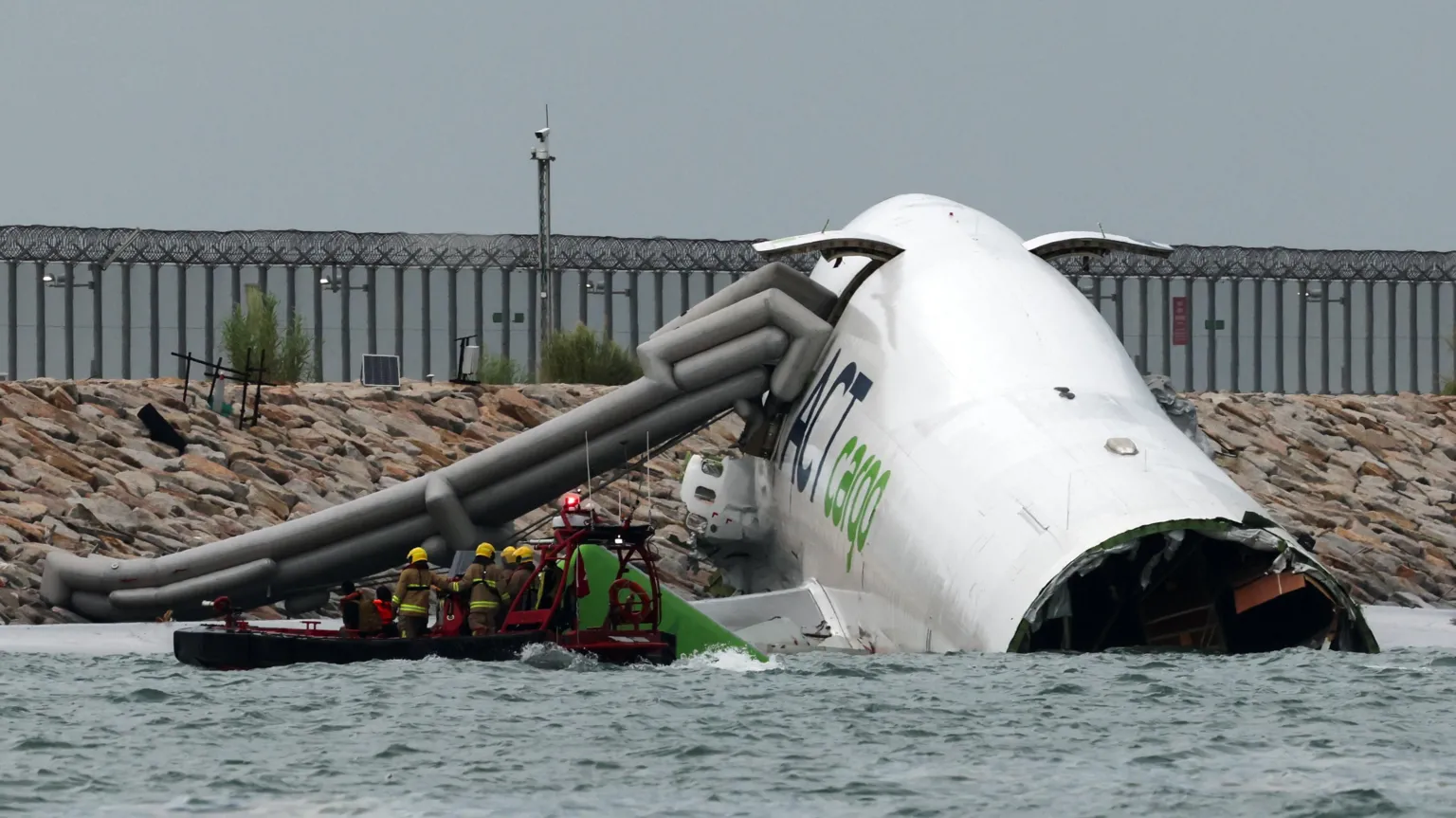
Two airport security officers were killed early Monday after a cargo plane skidded off the runway at Hong Kong International Airport, struck their patrol vehicle, and plunged into the sea.
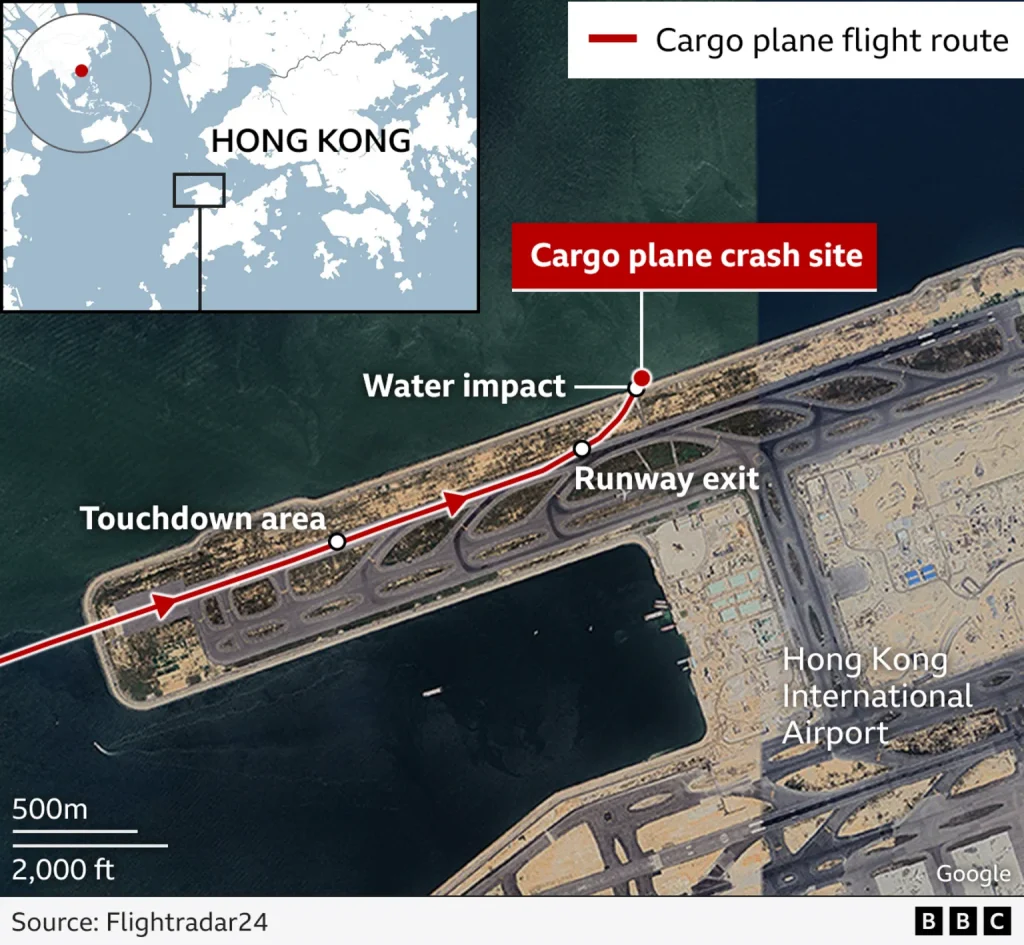
The incident involved Emirates flight EK9788, a Boeing 747 arriving from Dubai around 03:50 local time (19:50 GMT Sunday). The aircraft veered off the north runway, crashed through perimeter fencing, and collided with the patrol vehicle, pushing it into the water. Both occupants of the vehicle died, while the plane’s four crew members survived.
According to officials, the plane ended up partially submerged, making it one of Hong Kong Airport’s deadliest aviation accidents in years. Two other runways remain operational as investigations continue.
Airport operations executive director Steven Yiu said the patrol vehicle had been travelling on a service road outside the runway’s perimeter at a “safe distance” when the plane suddenly turned off course.
“Normally, the plane is not supposed to turn towards the sea,” Yiu said during a press briefing. He emphasized that the patrol car “definitely did not enter the runway” and that the aircraft had not sent a distress signal before landing.
Divers later recovered the bodies of the victims—two men aged 30 and 41—about five meters from the shore and seven meters underwater. One was confirmed dead at the scene, and the other died in hospital.
Hong Kong’s transport bureau expressed condolences to the victims’ families, describing the event as “deeply saddening.”
Emirates confirmed the accident, saying the cargo plane “sustained damage on landing in Hong Kong.” The airline noted there was no cargo onboard and that the aircraft had been wet-leased—meaning operated with crew and insurance—from Turkish carrier ACT Airlines.
Firefighters reached the scene within two minutes, rescuing all four crew members who had escaped via the aircraft’s emergency slides. Photos from the crash site show the plane broken in half, with part of its fuselage submerged in water.
Authorities are now searching for the plane’s flight data and cockpit voice recorders (“black boxes”). A police spokesperson said criminal investigations have not been ruled out.
The affected runway will remain closed pending the outcome of the investigation. At least 11 incoming cargo flights were cancelled on Monday, according to airport authorities.
This is only the second fatal aviation accident at Hong Kong International Airport since it relocated to Chek Lap Kok in 1998. The previous one occurred in 1999, when a China Airlines jet crash-landed during a typhoon, killing three people.


Oke-Ode Community Lauds Kwara Gov On Elesa’s Elevation To First Class Status

2026 KWIRS Tax Quiz Competition: Six Schools Emerge As Finalists

NNRA Allegations: IADI Demands Evidence, Says Audit Queries Not Proof of Fraud

-
 Uncategorized6 years ago
FG, states urged to harness flooding for ranching, others with technology – Agbaje
-
 Headlines11 years ago
Breaking: EFCC seals Borno House of Assembly, as Hon members take to their heels
-
 News12 years ago
Nigeria Security Operatives Stage Manhunt For Homosexual Perpetrator
-
 News10 years ago
How 21-year-old Girl fled community over accusation of lesbianism
-
 News11 years ago
Yobe Gov Moves Against Deputy
-
 Opinion7 years ago
7 signs she has friend zoned you
-
Technology5 years ago
Online job placement company headhunts women
-
 Headlines10 years ago
Borno Dep Gov Abducts Another Church Leader