
Foreign
China builds ecological monitoring network to better protect lucid waters, lush mountains


By Kou Jiangze, Yao Xueqing, Li Maoying, People’s Daily
Early in the morning, Shen Wei arrived at the Gehu Lake, upstream of the Taihu Lake in east China’s Jiangsu province, with a toolbox, to conduct routine water quality and aquatic organism monitoring. Meanwhile, Shen’s colleagues were sampling water from the lake with a water collector for the monitoring of planktonic algae.
After the sampling was completed, Shen, deputy chief of the ecological department of the Changzhou Environmental Monitoring Center, which initiated a comprehensive ecological monitoring network for water bodies on the plains of Changzhou, returned to the lab with his colleagues and started analyzing samples.
“We discovered Novaculina chinensis, a national second-class protected aquatic wild animal, and we have found it at multiple locations many times,” said Shen. According to him, this indicated that the ecological condition of Gehu Lake was improving.
The monitoring of planktonic algae also had some positive findings – diatoms, the dominant species in the winter lake, were at normal levels and varieties.
Ecological monitoring is essential for obtaining an objective and accurate understanding of the ecological conditions in a given area, implementing scientific ecological protection and restoration measures, and evaluating their outcomes.
Recently, China’s Ministry of Ecology and Environment, in collaboration with the Chinese Academy of Sciences, issued a work plan on national ecological quality supervision and monitoring for the 2023-2025 period.
According to the plan, China will set up a national ecological monitoring network and designate 55 sites as the first batch of national stations for monitoring ecological quality, including a station in Xishuangbanna, southwest China’s Yunnan province, and the comprehensive ecological monitoring network for water bodies on the plains of Changzhou.
The first batch of national stations for monitoring ecological quality cover major ecosystem types such as forests, wetlands, grasslands, deserts, oceans, cities, and farmlands. They span across 44 key ecological conservation and regulatory areas in China, as well as other important ecological regions and urban clusters with frequent human activities.
Compared to environmental monitoring, ecological monitoring features richer content, more complex indicators, and more diverse methods.
“The national ecological monitoring network takes species diversity and habitats as its monitoring objects, with the goals of highlighting supervision, finding problems, and accumulating data. It focuses on the composition, structure, and functions of biological communities and species, enabling comprehensive monitoring of all types of ecosystems within a 100 km radius of each monitoring station,” said Dong Mingli, an official with China’s Ministry of Ecology and Environment.
In the Xishuangbanna national nature reserve in Yunnan, Yuan Shengdong and other scientific researchers from the Xishuangbanna tropical rainforest ecosystem station walked into the depths of the dense forest to carry out routine field monitoring at designated plots, including measuring, marking, sampling, and recording.
For most of the year, the staff at this station are out in the field. “We collect millions of monitoring data every year, including various types such as biology, meteorology, hydrology, and soil,” said Yuan.
He further explained that studying the dynamics of tropical rainforests requires long-term data accumulation, as short-term observations do not yield immediate results. Therefore, researchers need to diligently work day by day to gather the necessary data for studying the changes in the rainforest ecosystem.
Dong said that the national ecological monitoring network takes monitoring stations as regional centers, monitoring plots as the primary objects, and ground mobile patrols as a supplement. Working in sync with remote sensing, it integrates satellite resources, manned and unmanned aerial vehicles, ground fixed and mobile patrol monitoring, and other observation methods to establish an integrated sky-ground ecological monitoring technology system, Dong explained.
It is learned that satellite remote sensing monitoring boasts a wide coverage. It can monitor land surface changes promptly and discover ecological damages, serving as the primary means for ecological supervision.
Unmanned aerial vehicles are flexible and responsive. They can carry visible infrared sensors, hyperspectral sensors, LiDAR and other payloads to conduct on-site investigations and technical calibrations of damage clues and changes of ecological types in key areas. This provides data support for the verification of ecological damages and validation of remote sensing parameters.
Ground monitoring mainly utilizes video surveillance, patrols, plot monitoring and other means to conduct real-time monitoring of key sensitive areas and discover problems like human interference.
Ecological monitoring not only aims to present the current status and changes in regional ecological quality but also focuses on enhancing the ability to proactively detect ecological issues.
“For example, cyanobacterial bloom is a prominent issue in the treatment of the Taihu Lake. The monitoring station utilizes historical data to study the competitive growth mechanisms of aquatic plants and cyanobacteria, providing technical support for scientific and precise artificial restoration of the ecological environment,” said Pan Chen, director of the Changzhou Environmental Monitoring Center.

By: Fabian Apechihin
U.S. President Donald J. Trump has directed lawmakers to launch an immediate investigation into reports of widespread killings of Christians in Nigeria, describing the situation as a “Christian genocide.”
In a statement released Friday evening via his Truth Social platform, Trump expressed grave concern over the violence, blaming radical Islamist groups for what he called a “mass slaughter.”
“Christianity is facing an existential threat in Nigeria. Thousands of Christians are being killed. Radical Islamists are responsible for this mass slaughter,” he wrote.
The U.S. President announced that he is designating Nigeria a “Country of Particular Concern,” citing alarming figures of killings within the country compared to global totals.
“When Christians, or any such group, are slaughtered like is happening in Nigeria — something must be done! I am asking Congressman Riley Moore, together with Chairman Tom Cole and the House Appropriations Committee, to immediately look into this matter and report back to me,” Trump stated.
He added that the United States “cannot stand by while such atrocities are happening,” pledging that his administration remains ready “to protect Christian populations around the world.”

By: Fabian Apechihin
Polish Member of the European Parliament (MEP), Dominik Tarczyński, has once again drawn global attention to what he described as the ongoing persecution and killings of Christians in Nigeria.
In a post on his verified 𝕏 account on Monday, Tarczyński shared an image of a blood-stained Nigerian flag alongside a viral video showing a pastor conducting a burial ceremony for victims of violence.
In the video, the pastor lamented the frequent killings, saying:
“We are tired of performing burial every day, and they expect us to remain silent. It has become an order, and the Nigerian government came out to deny the massacre, saying there is no genocide of Christians in Nigeria. United Nations, you’re watching me. The American Parliament is aware of what we are doing now. My special request is to President Trump to save our lives in Nigeria. They are killing more Christians. If they say they kill Muslims, the Muslims are killed by who? Muslims are killed by Muslims.”
Tarczyński’s post quickly went viral, sparking widespread reactions and renewed calls for the Nigerian government to intensify efforts to combat banditry and terrorism.
However, the Federal Government has repeatedly rejected claims of a religiously targeted genocide. In a recent statement, the Minister of Information and National Orientation, Mohammed Idris, described such allegations as “false, baseless, despicable, and divisive.”
Idris maintained that Nigeria’s security challenges are complex and not driven by religious motives, warning that framing the fight against terrorism as an anti-Christian campaign could deepen existing social and religious divides.
He reiterated the government’s commitment to protecting all Nigerians, regardless of faith or ethnicity, and called on international partners and media outlets to “refrain from narratives that distort the country’s security realities.”
By: Fabian Apechihin
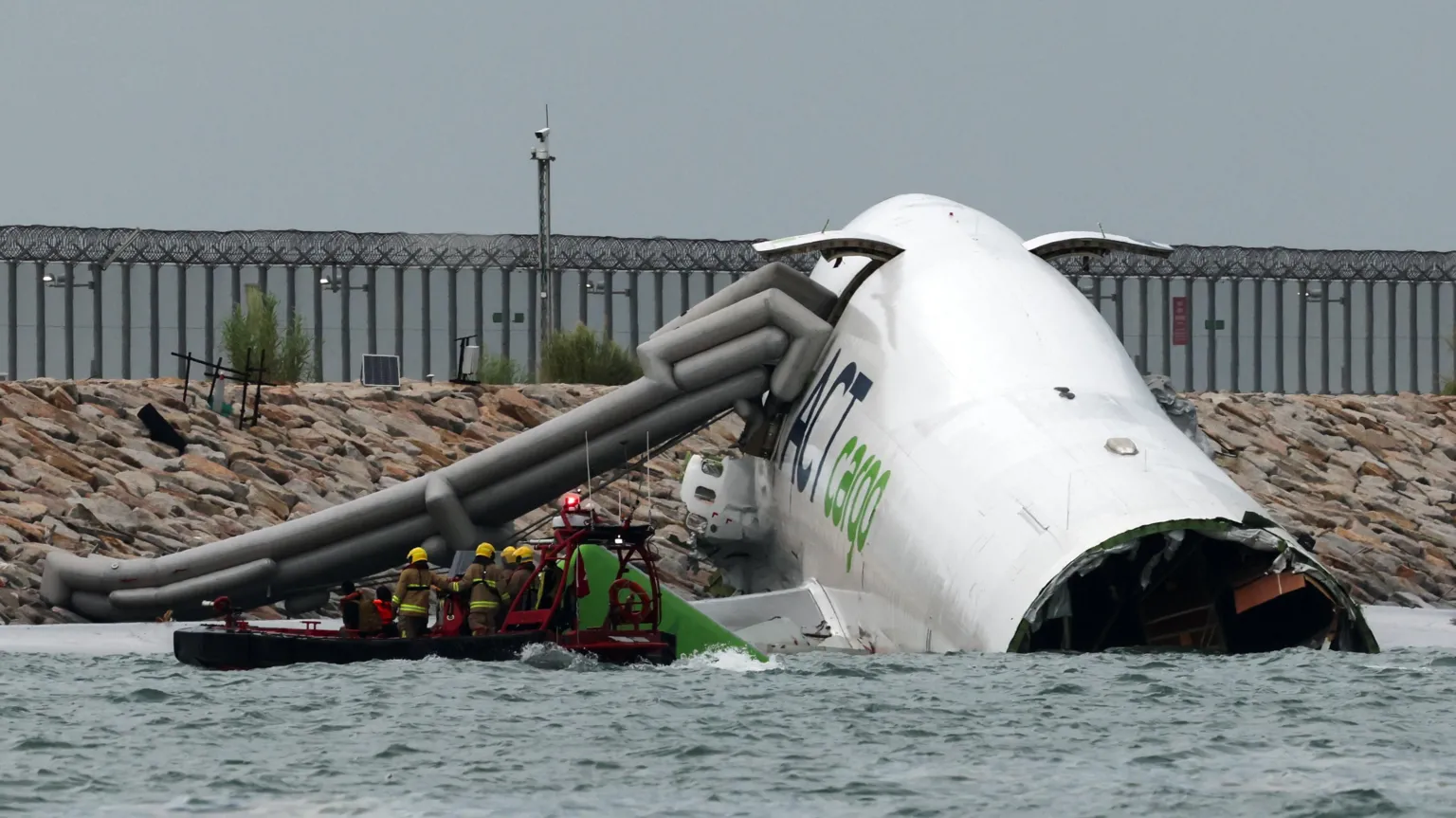
Two airport security officers were killed early Monday after a cargo plane skidded off the runway at Hong Kong International Airport, struck their patrol vehicle, and plunged into the sea.
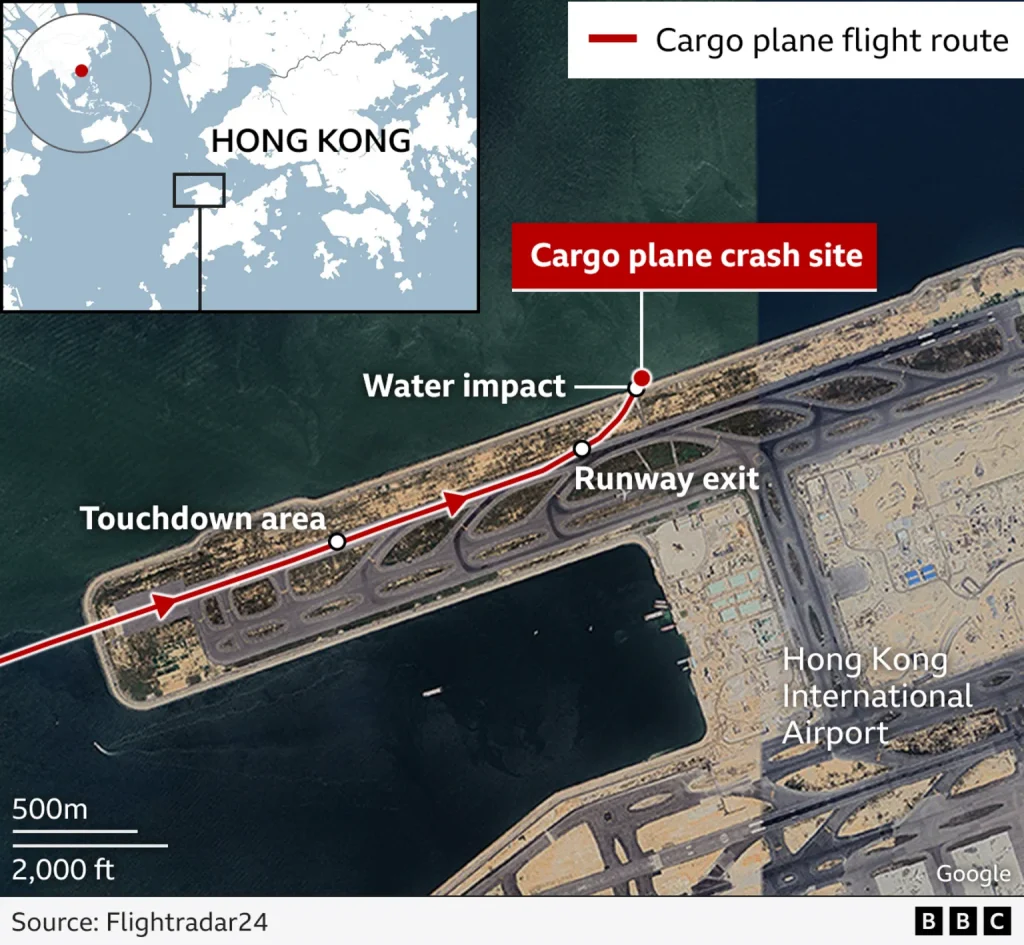
The incident involved Emirates flight EK9788, a Boeing 747 arriving from Dubai around 03:50 local time (19:50 GMT Sunday). The aircraft veered off the north runway, crashed through perimeter fencing, and collided with the patrol vehicle, pushing it into the water. Both occupants of the vehicle died, while the plane’s four crew members survived.
According to officials, the plane ended up partially submerged, making it one of Hong Kong Airport’s deadliest aviation accidents in years. Two other runways remain operational as investigations continue.
Airport operations executive director Steven Yiu said the patrol vehicle had been travelling on a service road outside the runway’s perimeter at a “safe distance” when the plane suddenly turned off course.
“Normally, the plane is not supposed to turn towards the sea,” Yiu said during a press briefing. He emphasized that the patrol car “definitely did not enter the runway” and that the aircraft had not sent a distress signal before landing.
Divers later recovered the bodies of the victims—two men aged 30 and 41—about five meters from the shore and seven meters underwater. One was confirmed dead at the scene, and the other died in hospital.
Hong Kong’s transport bureau expressed condolences to the victims’ families, describing the event as “deeply saddening.”
Emirates confirmed the accident, saying the cargo plane “sustained damage on landing in Hong Kong.” The airline noted there was no cargo onboard and that the aircraft had been wet-leased—meaning operated with crew and insurance—from Turkish carrier ACT Airlines.
Firefighters reached the scene within two minutes, rescuing all four crew members who had escaped via the aircraft’s emergency slides. Photos from the crash site show the plane broken in half, with part of its fuselage submerged in water.
Authorities are now searching for the plane’s flight data and cockpit voice recorders (“black boxes”). A police spokesperson said criminal investigations have not been ruled out.
The affected runway will remain closed pending the outcome of the investigation. At least 11 incoming cargo flights were cancelled on Monday, according to airport authorities.
This is only the second fatal aviation accident at Hong Kong International Airport since it relocated to Chek Lap Kok in 1998. The previous one occurred in 1999, when a China Airlines jet crash-landed during a typhoon, killing three people.


Changsha brings millennia-old heritage into modern life

Gov AbdulRazaq Lauded Over Conferment Of Sadauna Of Ilorin Title

FG Commissions KWASU ICT Centre To Enhance Graduates Employability

-
 Uncategorized6 years ago
FG, states urged to harness flooding for ranching, others with technology – Agbaje
-
 Headlines11 years ago
Breaking: EFCC seals Borno House of Assembly, as Hon members take to their heels
-
 News12 years ago
Nigeria Security Operatives Stage Manhunt For Homosexual Perpetrator
-
 News10 years ago
How 21-year-old Girl fled community over accusation of lesbianism
-
 News11 years ago
Yobe Gov Moves Against Deputy
-
 Opinion7 years ago
7 signs she has friend zoned you
-
Technology5 years ago
Online job placement company headhunts women
-
 Headlines10 years ago
Borno Dep Gov Abducts Another Church Leader