
Foreign
Achieving green, low-carbon transition calls for more quality production capacity

By Zhong Sheng, People’s Daily
Climate change is a challenge faced by the whole world. To respond to it and achieve green and low-carbon transition, it calls for support from more quality production capacity.
The new energy production capacity around the world today falls significantly short of meeting the demand of the market, especially huge latent demand in developing countries.
The narrative of so-called “overcapacity” in China’s new energy industry as well as the protectionist measures stemming from it hinder the development of green industries of the world and the concerted efforts made by the international community to respond to climate change.
The development of China’s new energy industry has made significant contributions to the global green and low-carbon transition, in response to the needs of countries to alleviate energy crises and address climate change.
In 2022, China’s exports of wind power and photovoltaic products resulted in a reduction of approximately 573 million tons of carbon dioxide emissions for other countries.
According to a report by the International Renewable Energy Agency, over the past decade, the average cost of electricity per kWh from wind power and photovoltaic projects around the world has cumulatively decreased by more than 60 percent and 80 percent respectively, and a significant portion of this achievement is attributed to China’s innovation, manufacturing, and engineering projects.
China’s green capacity has brought positive spillover effects to other countries. In Kazakhstan, the 60MW Shelek Wind Farm invested and built by a Chinese company helps reduce over 160,000 tons of carbon dioxide emissions on an annual basis. In the United Arab Emirates, the Al Dhafra Solar Project contracted by a Chinese company supplies electricity to 200,000 households and reduces carbon emissions by 2.4 million tons each year.
The claim that China is now simply too large for the rest of the world to absorb this enormous capacity just cannot hold water.
In order to achieve the temperature goals set out in the Paris Agreement and help countries fulfill their commitments to peak carbon emissions and achieve carbon neutrality, it is needed to increase investment in the clean energy sector and enhance the supply of new energy products globally.
For instance, the new energy vehicle (NEV) industry is seeing a huge demand globally. According to the International Energy Agency, the global demand for NEVs is expected to reach 45 million units by 2030.
Hungary’s Minister of Foreign Affairs and Trade Peter Szijjarto pointed out that overcapacity doesn’t exist, and there is indeed a lack of capacity.
China’s green capacity poses no threat to the development of other countries’ industries. Instead, it promotes their industrial growth through extensive cooperation and healthy competition.
According to Peter Fischer, chief economist of the Swiss daily Neue Zurcher Zeitung, it is with China’s assistance that the West has gained access to more cost-effective solar panels and wind turbines. Furthermore, China’s innovative NEVs can drive the transformation of European car manufacturers, which ultimately benefits consumers.
An article on the website of The Diplomat said that Southeast Asian nations are actively courting Chinese electric vehicle companies in a collaboration that not only strengthens the imperative transition away from fossil fuel vehicles, but also fuels economic growth through technological exchange.
It is contradictory to emphasize the urgency of addressing climate change while labeling China’s renewable energy industry as “overcapacity.” Such accusations of “overcapacity” are merely excuses for protectionism. Facts have long indicated that such practice benefits no one and will eventually backfire.
Adopting protectionist policies and setting up trade barriers not only disrupts the global investment landscape of green industries but also hampers the efficient allocation of green resources worldwide.
This leads to inefficient capacity and redundant construction, increasing the cost of low-carbon transition in countries that adopt these policies. Furthermore, it will hinder the global development of clean energy and impose significant negative impacts on the world economy.
As Bloomberg recently argued, despite implementing steel protectionist measures over the past decade, Washington has failed to prevent the decline in employment within the U.S. metal manufacturing industry. Instead, these measures have increased costs in other sectors of the U.S. economy and reduced competitiveness of the industry. If these measures were to be applied to the new energy sector, they would further weaken America’s ability to tackle climate change.
Blocking technological progress and suppressing high-quality production capacity is not the right path for economic development. China stands by its basic national policy of opening up and is ready to work with all parties to uphold fair competition and benefit from cooperation together.
It is hoped that relevant countries will maintain an open mindset, abide by market economy principles and international economic and trade rules, and provide a fair, transparent, open, and non-discriminatory business environment for Chinese enterprises.
(Zhong Sheng is a pen name often used by People’s Daily to express its views on foreign policy and international affairs.)


By: Fabian Apechihin
U.S. President Donald J. Trump has directed lawmakers to launch an immediate investigation into reports of widespread killings of Christians in Nigeria, describing the situation as a “Christian genocide.”
In a statement released Friday evening via his Truth Social platform, Trump expressed grave concern over the violence, blaming radical Islamist groups for what he called a “mass slaughter.”
“Christianity is facing an existential threat in Nigeria. Thousands of Christians are being killed. Radical Islamists are responsible for this mass slaughter,” he wrote.
The U.S. President announced that he is designating Nigeria a “Country of Particular Concern,” citing alarming figures of killings within the country compared to global totals.
“When Christians, or any such group, are slaughtered like is happening in Nigeria — something must be done! I am asking Congressman Riley Moore, together with Chairman Tom Cole and the House Appropriations Committee, to immediately look into this matter and report back to me,” Trump stated.
He added that the United States “cannot stand by while such atrocities are happening,” pledging that his administration remains ready “to protect Christian populations around the world.”

By: Fabian Apechihin
Polish Member of the European Parliament (MEP), Dominik Tarczyński, has once again drawn global attention to what he described as the ongoing persecution and killings of Christians in Nigeria.
In a post on his verified 𝕏 account on Monday, Tarczyński shared an image of a blood-stained Nigerian flag alongside a viral video showing a pastor conducting a burial ceremony for victims of violence.
In the video, the pastor lamented the frequent killings, saying:
“We are tired of performing burial every day, and they expect us to remain silent. It has become an order, and the Nigerian government came out to deny the massacre, saying there is no genocide of Christians in Nigeria. United Nations, you’re watching me. The American Parliament is aware of what we are doing now. My special request is to President Trump to save our lives in Nigeria. They are killing more Christians. If they say they kill Muslims, the Muslims are killed by who? Muslims are killed by Muslims.”
Tarczyński’s post quickly went viral, sparking widespread reactions and renewed calls for the Nigerian government to intensify efforts to combat banditry and terrorism.
However, the Federal Government has repeatedly rejected claims of a religiously targeted genocide. In a recent statement, the Minister of Information and National Orientation, Mohammed Idris, described such allegations as “false, baseless, despicable, and divisive.”
Idris maintained that Nigeria’s security challenges are complex and not driven by religious motives, warning that framing the fight against terrorism as an anti-Christian campaign could deepen existing social and religious divides.
He reiterated the government’s commitment to protecting all Nigerians, regardless of faith or ethnicity, and called on international partners and media outlets to “refrain from narratives that distort the country’s security realities.”
By: Fabian Apechihin
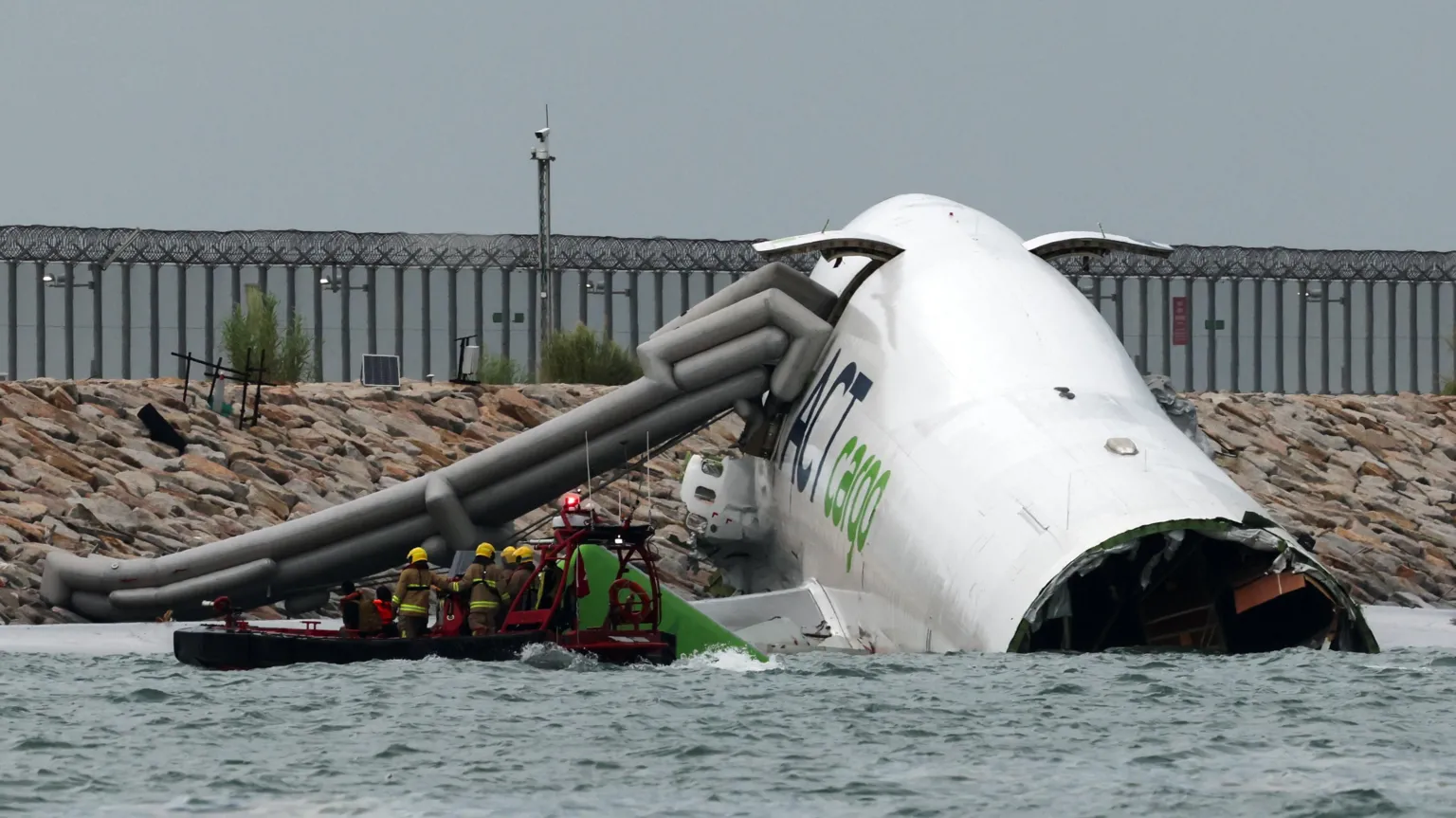
Two airport security officers were killed early Monday after a cargo plane skidded off the runway at Hong Kong International Airport, struck their patrol vehicle, and plunged into the sea.
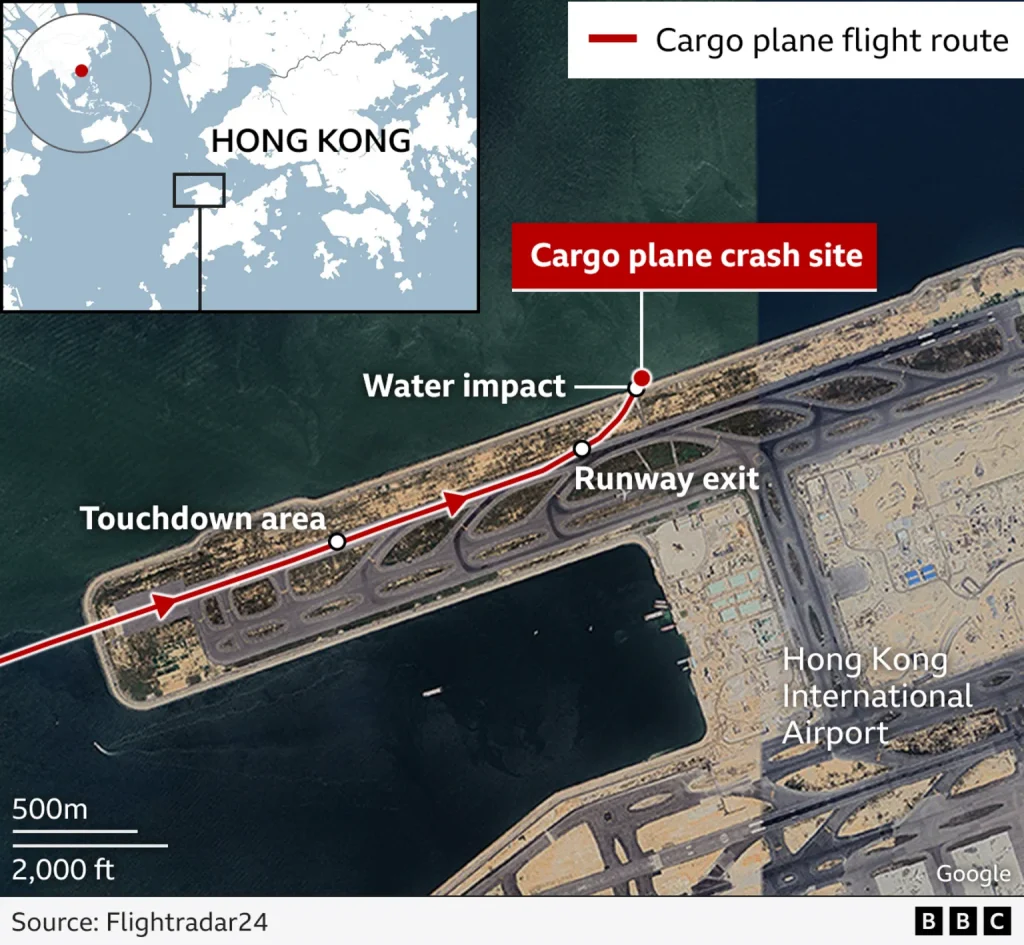
The incident involved Emirates flight EK9788, a Boeing 747 arriving from Dubai around 03:50 local time (19:50 GMT Sunday). The aircraft veered off the north runway, crashed through perimeter fencing, and collided with the patrol vehicle, pushing it into the water. Both occupants of the vehicle died, while the plane’s four crew members survived.
According to officials, the plane ended up partially submerged, making it one of Hong Kong Airport’s deadliest aviation accidents in years. Two other runways remain operational as investigations continue.
Airport operations executive director Steven Yiu said the patrol vehicle had been travelling on a service road outside the runway’s perimeter at a “safe distance” when the plane suddenly turned off course.
“Normally, the plane is not supposed to turn towards the sea,” Yiu said during a press briefing. He emphasized that the patrol car “definitely did not enter the runway” and that the aircraft had not sent a distress signal before landing.
Divers later recovered the bodies of the victims—two men aged 30 and 41—about five meters from the shore and seven meters underwater. One was confirmed dead at the scene, and the other died in hospital.
Hong Kong’s transport bureau expressed condolences to the victims’ families, describing the event as “deeply saddening.”
Emirates confirmed the accident, saying the cargo plane “sustained damage on landing in Hong Kong.” The airline noted there was no cargo onboard and that the aircraft had been wet-leased—meaning operated with crew and insurance—from Turkish carrier ACT Airlines.
Firefighters reached the scene within two minutes, rescuing all four crew members who had escaped via the aircraft’s emergency slides. Photos from the crash site show the plane broken in half, with part of its fuselage submerged in water.
Authorities are now searching for the plane’s flight data and cockpit voice recorders (“black boxes”). A police spokesperson said criminal investigations have not been ruled out.
The affected runway will remain closed pending the outcome of the investigation. At least 11 incoming cargo flights were cancelled on Monday, according to airport authorities.
This is only the second fatal aviation accident at Hong Kong International Airport since it relocated to Chek Lap Kok in 1998. The previous one occurred in 1999, when a China Airlines jet crash-landed during a typhoon, killing three people.


NNRA Allegations: IADI Demands Evidence, Says Audit Queries Not Proof of Fraud

Alao-Akala’s Widow Urges Full Implementation Of LG Autonomy

PRESS STATEMENT BY AREWA DISCUSSION GROUP TITLED; PHRANK SHUAIBU: THE FACE OF A DUBIOUS, ROGUISH MERCHANT OF COUNTERFEITS

-
 Uncategorized6 years ago
FG, states urged to harness flooding for ranching, others with technology – Agbaje
-
 Headlines11 years ago
Breaking: EFCC seals Borno House of Assembly, as Hon members take to their heels
-
 News12 years ago
Nigeria Security Operatives Stage Manhunt For Homosexual Perpetrator
-
 News10 years ago
How 21-year-old Girl fled community over accusation of lesbianism
-
 News11 years ago
Yobe Gov Moves Against Deputy
-
 Opinion7 years ago
7 signs she has friend zoned you
-
Technology5 years ago
Online job placement company headhunts women
-
 Headlines10 years ago
Borno Dep Gov Abducts Another Church Leader