
News
BDC operator admits owing $90,000 to Chinese accused of money laundering, exonerates Nigerian for dealing in Crypto Currency transaction


In set above are two learned senior advocates of Nigeria, SANs: Mr. Edwin Anikwem, (left) counsel to Genting International Company Limited, (the 4th defendant), and Mr. Clement Onwuenwunor, counsel to the second defendant, Engr. Friday Audu…….. after the court session on Tuesday, July 8, 2025 at the Federal High Court, Ikoyi, Lagos.
By Ibeawuchi Uwaleke, (Advocatenewsng.com), 09064186047.
A Bureau De Change operator and the second prosecution witness procured by the Economic and Financial Crimes Commission, EFCC, Mr. Alhassan Garba in the N3.4 billion money laundering charge preferred against two Chinese and a Nigerian, admitted on Tuesday July 8, 2025 that he is still owing $90,000 USD to Mr. Huang Haoyu, (Aka Ken), one of the two Chinese standing trial at a Federal High Court, Ikoyi Lagos.
The witness equally exonerated the Nigerian charged along with the Chinese, Engineer Friday Audu for being part of the WhatsApp group he was relating with in the transaction of USDTN Crypto Currency Wallet from where he made several transfers to a company, Genting International Company Limited, also accused in the money laundering case.
Mr. Garba was led in evidence by counsel to Audu, Mr. Clement Onwuenwunor, a Senior Advocate of Nigeria, SAN who took on the witness in a cross examination to ascertain how he knew Audu and how his client, the second defendant, was robed in a case of dealing in Crypto Currency Wallet transaction he knew nothing about.
When Mr. Onwuenwunor SAN, asked Alhassan whether he still stands by the statement he made to EFCC implicating Audu as the person who told him what to say at EFCC and what not to say, as well as introducing him to one Mr. Sen, a Chinese, who is now at large, he claimed that he still stands by his statement, but however affirmed that Audu was not one of the people who he was dealing with in Crypto Currency transaction and also said it was not Audu that introduced him to Mr. Sen.
He gave the name of the person who was sending him the Dollars he was changing into Naira and transferring to Genting International Company Limited bank account with Union Bank as Huang Haoyu, Aka, Ken, the first defendant in the suit. He equally now accepted, under further cross examination, that it was not Friday Audu, the second defendant, who introduced him to Mr. Sen, but instead it was Mr. Ken who he had personal contact with.
When the learned Silk put it to him that all the statements he made to EFCC were all lies as he was now contradicting himself from the statements after he requested the Registrar of the court to bring the statements from the court’s record and showed them to the witness, he stammered the answer in response and claimed that what he was saying was the truth.
Under further cross examination on how he knew Mr. Sen whom he has been doing business with for quite some time, he denied knowing Sen, but admitted that it was only in August 2024 that he transacted business in Crypto Currency with Mr. Sen, adding that all other times it was Mr. Ken who transacted business with him in Dollars.
On the $90,000 USD he is still owing Mr. Ken, one of the accused persons, and why he did not state the amount in his statement to EFCC, as he was pressured by counsel to Audu, Mr. Clement Onwuenwunor, SAN, Alhassan said he did not remember to include the amount in his statement, but admitted that the $90,000 USD was the exact amount which got stuck in transmission during the transaction, which he agreed till date, has not been reversed.
When asked further by Onwuenwunor SAN, whether the WhatsApp group he was transacting USDTN with, Audu was a member of the group, Mr. Garba answered emphatically no, adding that the second accused was not part of the Dollar transactions, but was aware when the Naira equivalent was transferred to the Genting International Company Limited bank account, a company he facilitated its registration for Ken with the Corporate Affairs Commission, CAC, as sports betting concern.
Asked whether his business in dealing in Crypto Currency and in Dollar exchange transactions is genuine and registered with the relevant authorities, Alhassan said: “I work with Hugo Vice Bureau De Change as a staff, I am not the owner. I have been in the business for over 10 years now.
“Our Bureau De Change is registered to transact business in foreign exchange and we have the certificate. We also have Schmo certificates to deal in Crypto digital currency. All the certificates are still valid. All these certificates we also submitted to EFCC when we were requested to present them there.”
On the transfer that was made on September 4, 2024, of a certain amount to Genting International Company account, Alhassan claimed that he was not the one that made the transfer, adding that the Crypto Wallet Account he used to receive the Dollar transfers or made transfers with did not belong to him, but to one Jonathan Ifesinachi.
Mr. Edwin Anikwem, SAN, counsel to the company, Genting International company Limited, stepped in immediately after Mr. Onwuenwunor SAN concluded his cross examination on behalf of the second defendant, and after reviewing the whole charge on the money laundering case, asked Alhassan whether all the Dollars he received from the Crypto Currency Wallet account and converted into Naira equivalent which he transferred into Genting company account was reported one way or the other as an illegal money or money laundered into Genting International Company account as being alleged by the prosecution. His answer was an emphatically ‘no’. “There was no such thing, and all the money I converted and transferred into Genting account are not illegal money, that I know”.
The cross examination on Alhassan Garba continues on Thursday, July 17, 2025 when the court sitting before Justice Daniel Osiagor of the Federal High Court, Lagos division adjourned the matter to give opportunity to Mr. Adeniyi Joshua, counsel to the third defendant, Mr. An Hongxa, a Chinese, who was not in court at the last adjourned date, to take his turn to cross examine the second prosecution witness.
At the court on Tuesday, July 8, 2025 also was Mr. Emeka Okpoko, SAN, counsel to the first defendant, Mr. Haoyu, a Chinese, leading another senior lawyer, Mr. Nnaemeka Amaechina and they took their turn to cross examine the second prosecution witness, Alhassan on July 1, 2025.
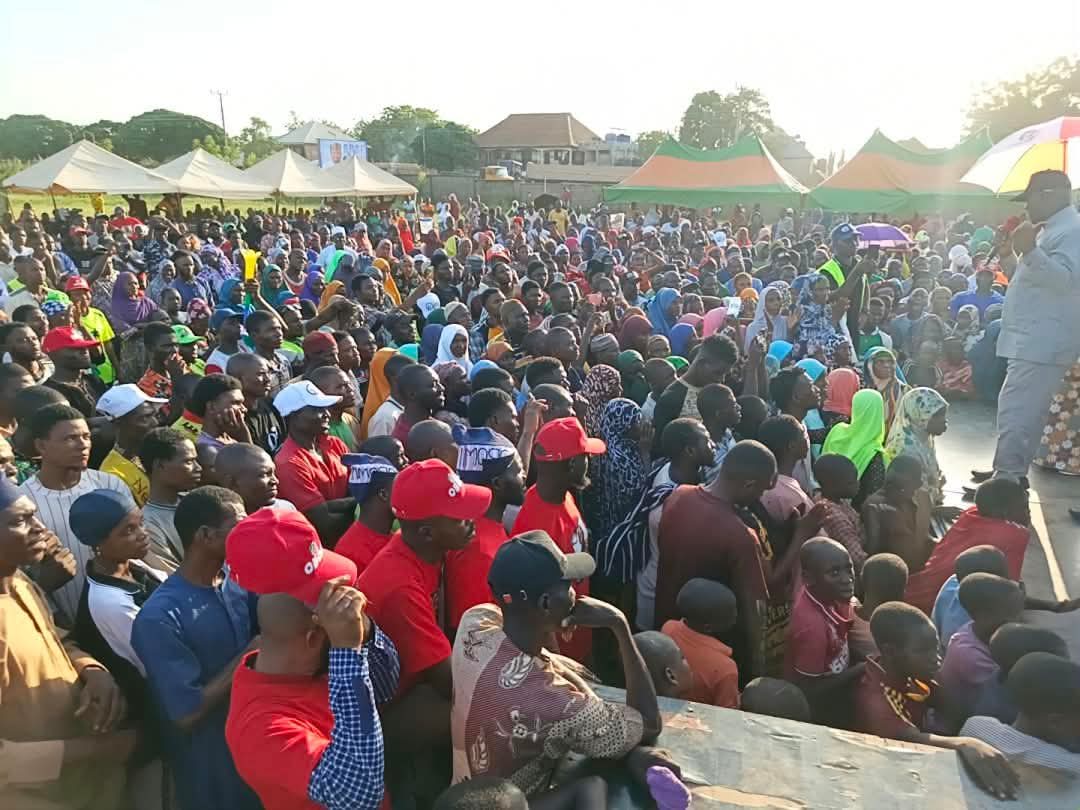
The governorship candidate of the Peoples Democratic Party (PDP) in Nasarawa State, Dr David Emmanuel Ombugadu, has lamented what he described as the multidimensional poverty confronting residents of the state, citing poor schools, bad roads, a weak healthcare system and high youth unemployment.
Ombugadu stated this on Tuesday during his campaign rally in Keana Local Government Area, where he outlined his development priorities and promised to address the challenges if elected governor in the 2027 governorship election.
He argued that the condition of public infrastructure, inadequate access to quality healthcare and education, and the high number of unemployed youths had compounded the difficulties facing residents, insisting that the state needed a development approach that directly improved the people’s living conditions.
The PDP candidate said his administration would prioritise road infrastructure, education, healthcare and employment generation, with a focus on communities whose development needs had remained pressing.
He also promised to promote tourism by reviving traditional festivals and exploiting the state’s cultural heritage to create economic opportunities for residents.
Ombugadu specifically pledged to revive the Arago Fishing Festival and other traditional fishing festivals, saying the initiative would help attract visitors, promote local culture and stimulate economic activities in host communities.
He said tourism could become an important source of income and employment if the state’s cultural attractions were properly developed and promoted.
On road infrastructure, the governorship candidate promised to improve connectivity between communities in Nasarawa State and neighbouring states, including Plateau, Taraba and Benue.
He explained that the proposed roads would enable communities separated by state boundaries to reconnect with their kinsmen, while facilitating the movement of people, agricultural produce and other goods.
Ombugadu cited communities with cultural, family and economic ties across state boundaries, including Tiv communities in Awe Local Government Area, arguing that improved road networks would strengthen those relationships and expand commercial activities.
He described the proposed projects as part of a border-community development policy intended to reduce isolation, improve accessibility and encourage cooperation between neighbouring populations.
The PDP candidate maintained that infrastructure development should extend beyond major towns to rural communities, where poor road networks can restrict access to markets, schools, healthcare facilities and other essential services.
He also linked the proposed development agenda to the need to create more opportunities for young people, who he identified as among those most affected by the state’s economic challenges.
Ombugadu urged residents to support the PDP in 2027, presenting his proposed interventions as a pathway towards improving living standards and addressing the development challenges he highlighted at the rally.

From Zwanke Zwanke, Lafia
Job creation for youths and support for women-owned businesses have emerged as key promises of the Peoples Democratic Party (PDP) in Nasarawa State as the party begins its campaign tour ahead of the 2027 governorship election.
The party made the pledge on Monday in Awe Local Government Area, where its governorship candidate, Dr David Emmanuel Ombugadu, and other candidates commenced the local government campaign tour.
The Acting Chairman of the PDP Campaign Council, Mr Mark Ogbole, said a PDP administration would create employment opportunities for young people and support women in business to improve household incomes and economic security.
He said the party was seeking the people’s mandate to serve them and address their concerns, rather than abandon them after winning elections.
Ogbole said the decision to begin the campaign in Awe reflected the party’s intention to conduct a peaceful campaign across Nasarawa State.
Earlier, Ombugadu promised to prioritise security and infrastructure development if elected governor in 2027.
He said residents, particularly farmers, must be able to access their farms and pursue their livelihoods without fear of attacks, adding that security would be the foremost priority of his administration.
On infrastructure, the PDP candidate pledged to construct and rehabilitate roads linking communities within the state and improving connections with neighbouring states.
He specifically mentioned the road linking Akiri to Plateau State and routes connecting Nasarawa with Benue, Taraba and Plateau states.
Ombugadu also promised to pursue the proposed Wuse-Taraba road link and other rural roads to improve transportation, facilitate trade and open up communities for economic activities.
He said his administration would develop local tourism, citing the Hunkuyi Fishing Festival and Awe Hot Spring as attractions with the potential to generate revenue and create employment opportunities for residents.
The candidate assured the people that the development plans and campaign promises presented in 2019 and 2023, alongside those being made ahead of the next election, would be implemented if he secured the mandate.
The state PDP Chairman, Dr Daniel Gimba, described the campaign flag-off as a demonstration of the party’s determination to provide what he called purposeful leadership and address the hardship facing residents.
He expressed confidence that the PDP would win the election overwhelmingly if the process was not rigged.
“Today is a historic and remarkable day. We have chosen to start our local government tour, marking our victory coming in 2027 by the grace of God. 2027, there is no going back,” Gimba declared.
Also speaking, the PDP senatorial candidate for Nasarawa South, Dr Mike Omeri, thanked party members and supporters for their confidence in the candidates.
“Together with you, we will campaign to win the election, and we will win this election,” Omeri said.
Editorial distinction
Version 4 approaches the campaign from the perspective of tourism, investment and alternative revenue generation.
Version 5 focuses on employment, women’s economic empowerment and social welfare, while retaining security and infrastructure as supporting issues.
My recommendation: Use Version 4 for a development-focused political report and Version 5 for a separate story on the PDP’s proposed social and economic agenda.

From Zwanke Zwanke, Lafia
The Peoples Democratic Party (PDP) governorship candidate in Nasarawa State, Dr David Emmanuel Ombugadu, has promised to harness the state’s tourism potential to generate revenue, create jobs and improve the livelihoods of rural communities if elected in 2027.
Ombugadu made the pledge on Monday in Awe Local Government Area during the flag-off of the PDP’s local government campaign tour ahead of the 2027 general elections.
He identified the Hunkuyi Fishing Festival and Awe Hot Spring as attractions his administration would develop to promote tourism and create economic opportunities for host communities.
The candidate said investment in local tourism would complement his proposed infrastructure development programme, particularly road construction and rehabilitation to improve access to rural communities and tourist destinations.
He promised to construct the road linking Akiri to Plateau State and improve strategic routes connecting Nasarawa with Benue, Taraba and Plateau states.
Ombugadu also mentioned the proposed Wuse-Taraba road link and other rural routes, saying improved connectivity would facilitate trade, strengthen inter-state relations and open up communities for economic activities.
He said security would be the foremost priority of his administration, stressing that farmers and other residents must be able to go about their daily activities without fear of attacks.
The PDP candidate assured the electorate that the development blueprints and promises made during his 2019 and 2023 campaigns, alongside those being presented ahead of 2027, would be implemented if he won the election.
At the event, the state PDP Chairman, Dr Daniel Gimba, said the party was determined to provide an alternative to the present administration and address the hardship confronting residents.
Gimba described Ombugadu as a man of integrity, transparency and hard work, expressing confidence that the PDP would win overwhelmingly if the election was not rigged.
“Today is a historic and remarkable day. We have chosen to start our local government tour, marking our victory coming in 2027 by the grace of God. 2027, there is no going back,” he declared.
The PDP senatorial candidate for Nasarawa South, Dr Mike Omeri, thanked supporters for the confidence reposed in the party’s candidates.
“Together with you, we will campaign to win the election, and we will win this election,” Omeri said.
The Acting Chairman of the PDP Campaign Council, Mr Mark Ogbole, said the party deliberately chose Awe to commence its peaceful campaign tour across the state.
He promised that a PDP administration would create employment opportunities for youths and support women in business, adding that the party was seeking power to improve the welfare of residents.

Why the world is looking east: The growing global appeal of China’s innovation ecosystem

China’s former revolutionary base areas embrace new chapter of development

China leads the world in innovation clusters

-
 Uncategorized6 years ago
FG, states urged to harness flooding for ranching, others with technology – Agbaje
-
 Headlines11 years ago
Breaking: EFCC seals Borno House of Assembly, as Hon members take to their heels
-
 News12 years ago
Nigeria Security Operatives Stage Manhunt For Homosexual Perpetrator
-
 News10 years ago
How 21-year-old Girl fled community over accusation of lesbianism
-
 News11 years ago
Yobe Gov Moves Against Deputy
-
 Opinion7 years ago
7 signs she has friend zoned you
-
Technology5 years ago
Online job placement company headhunts women
-
 Headlines10 years ago
Borno Dep Gov Abducts Another Church Leader