
News
STILL ON THE SOWORE, SAHARA REPORTERS’ DIATRIBE.


By: Inuwa Bwala
Even with the ethical degeneration in journalism, a good journalist would seek to reflect the what, where, when, who and how, as the basic ingredients of a good story.
I also expect stories to be attributed to reliable and verifiable outlets, or risk credibility crisis.
I have read Sahara Reporters’ highly opiniated and faulty portrayals of situations in Borno and I have also read so many responses to the allusions made against the Government of Borno State, and by implications, the Governor, Professor Babagana Umara Zulum.
It is not in my place to speak for the Government nor the Governor, but I find it necessary to scratch the surface of the ethical breaches in the said report, and perhaps caution on the need for professionalism by people who parade themselves as journalists.
Of course, Nigerians are not strangers to the place of Omoyele Sowore and Sahara Reporters: which he publishes, in the annals of journalism, but to brazenly stand facts on the head, without subjecting same to test, may have crossed the ethical red line and there is the need for caution.
There would not have been the need for rebuttals, but as witnesses to the facts of the true situation of things, one can understand the general anger of citizens and the attendant responses.
The report in question, besides failing to satisfy the basic nuances of journalism, smacks of prejudice against the Government under the leadership of Proffessor Babagana Umara Zulum.
I have not read in it, a statement from security agencies or the government reflecting the other side.
It is needless to state that, given the volatile security situation in Borno and the noticeable innitiatives of the Government to end the menace, the report is not only misleading but entirely negate the facts on ground, nay the spirit of citizens.
Journalism goes beyond sitting down somewhere, and relying on assumptions ostenssibly from pure political mischief makers, in the name of exclusives.
It us doing journalism more harm, to rely on assumptions rather than facts, in reporting a volatile area like Borno.
Quite contrary to the assertions contained in the report, one can confidently say that the said order from Governor Zulum for the arrest of minors protesting under the guise of #EndBadGovernance, were never given, rather, it was a spontaneous response by security agencies, to the apparent hijack of the protest for mischief.
It is a known fact that, those arrested in recent times, were youths, who have self styled themselves as Malians: copying terrorists styles, akin to the situation in Mali.
They were deeply involved in various social vices, including drugs, robbery, rape, abductions and even killings.
The group was an emergent gang that had been causing mischief in Maiduguri by harassing innocent residents.
The chlampdown on them was a big relief to residents of Maiduguri generally. Infact the media had been awash with reports of the atrocities of the group, and I am aware of several appeals made to the Governor, to take decisive steps to put an end to their activities.
On the issu of heavy spending on counter insurgency efforts, it does not seem the report derive facts from records.
I had expected the report to capture figures of the expenditure by the state, on the dis-armament, dis-orientation and re-intergration of repentant Boko Haram members.
But even without that, one may be tempted to ask, which option is more important? Using the Borno model of DDR, which has been acknowledged internationally, as one of the most effective approaches to ending the insurgency, or allowing the insurgents to continue their atrocities?
Having been in Borno since the start of the ibsurgency places people like me in a better position to admit that, with the pragmatic approach of the Borno state Government, in recent times, there is relative peace and stability.
Any journalist in Maiduguri, who have seen all the sides to the conflict, should be responsible enough to say, that, it is not an anathema if the state government spends fortunes to achieve peace.
I am aware of a law banning vandalism and political thuggery in Borno. Complaining about those caught vandalising Government property, amounts to supporting the action. Except if otherwise, Sower has a stake in the trade, I do not see anything wrong in sanctioning those who engage in the act.
I do not want to suspect that, Sowore and Sahara Reporters have an axe to grind with the Government or the Governor. It presupppses therefore, that development journalism should define the approach and not lend our pages to mischief.
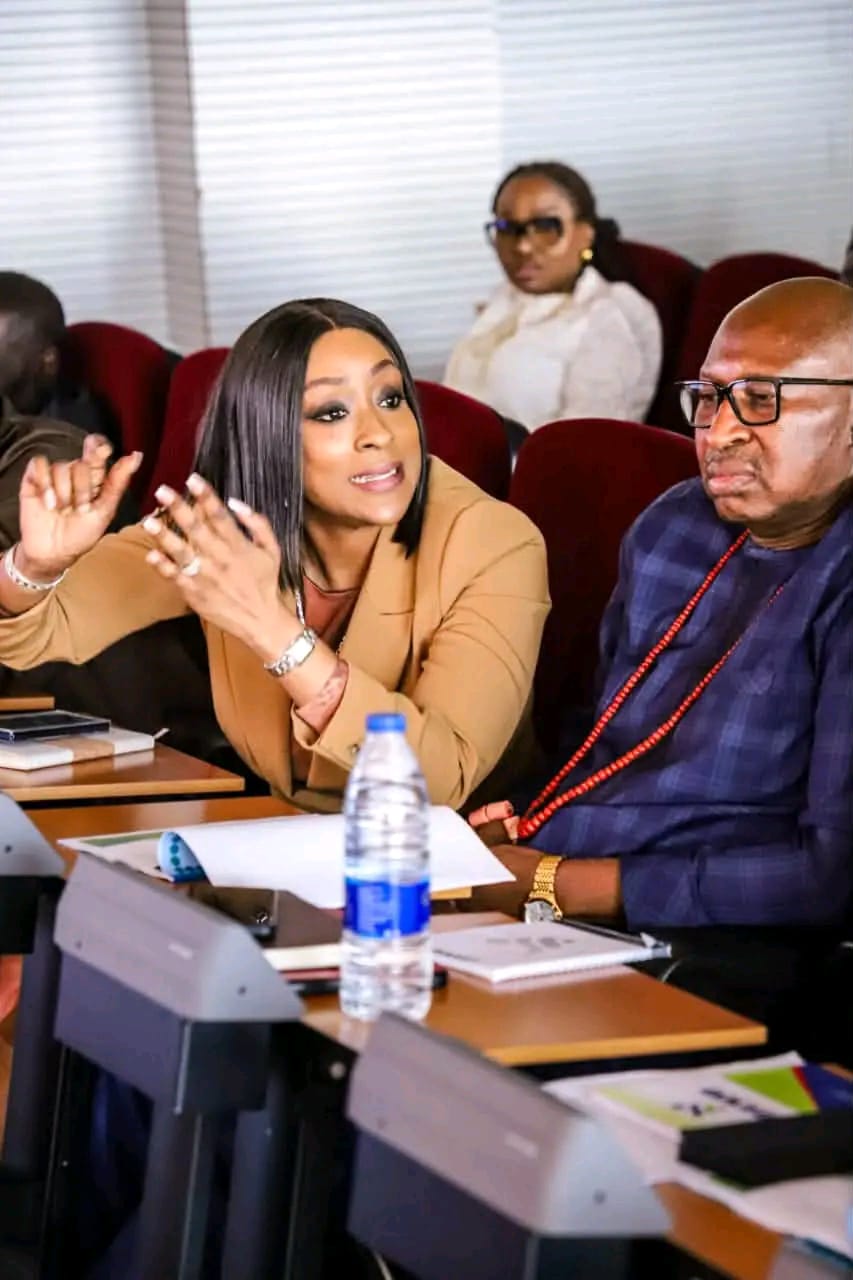
The Niger Delta Power Holding Company (NDPHC) has reaffirmed its commitment to transparency, accountability, and efficiency in project delivery by hosting a high-level refresher and sensitization training for its management team, staff, and stakeholders.Organized by the Human Resources Department at the company’s headquarters, the programme was designed to strengthen institutional capacity, refresh knowledge, and promote greater effectiveness in the discharge of responsibilities.The training was anchored on the theme “Operationalizing by Way of Experimenting the Procurement Processes While Navigating the Pre-Bidding Stage Through to Post Bidding”, and facilitated by DEVD Integrated Project Ltd. Discussions focused on procurement processes, emphasizing due process, compliance, and optimization in power sector project execution.Participants were guided through the critical stages of procurement, from pre-bidding to post-bidding, with facilitators stressing the importance of adherence to established procedures. The session also provided a platform for robust engagement on stakeholder collaboration, highlighting how effective partnerships can drive efficiency and accountability in project delivery.The initiative enjoyed strong backing from the NDPHC Executive Management (EXCO), led by Engr. Jennifer Adighije, FNSE, FINEEE, Managing Director/CEO. She was joined by her team: Engr. Bello Babayo Bello, FNSE, FINEEE, Executive Director (Networks); Engr. Abdullahi Kassim, Executive Director (Generation); Hon. Dr. Steven Andzenge, Executive Director (Legal Services); Hon. Chukwuma Umeoji, Executive Director (Corporate Services); Hon. Omololu Agoro, Executive Director (Finance & Accounts); and Hon. Patrick Obahiagbon, Executive Director (Strategy and Commercial). Their collective presence underscored the importance of the training to the company’s strategic vision and operational goals.Facilitators encouraged participants to apply the knowledge gained to improve operational efficiency and foster stronger collaboration across departments and with external stakeholders. They noted that the lessons learned would help strengthen the company’s institutional framework and ensure that projects are delivered in line with global best practices.The event brought together management staff and other relevant stakeholders, creating an opportunity to exchange ideas and refresh their understanding of procurement processes. It also reinforced NDPHC’s commitment to professional development, transparency, and accountability in its operations.By investing in capacity-building programmes such as this, NDPHC continues to demonstrate its resolve to enhance professional standards and institutional effectiveness. The company emphasized that the training reflects its broader vision of building a stronger, more accountable institution capable of delivering sustainable power solutions to Nigeria.The sensitization exercise forms part of NDPHC’s ongoing efforts to ensure that its workforce remains equipped with the skills and knowledge required to meet the demands of the power sector. It underscores the company’s belief that continuous learning and adherence to due process are essential for achieving its corporate objectives and delivering value to stakeholders.
News
Hon. Jafaru Yakubu Commends President Tinubu’s Approval of Mutum Biyu–Garba Chede Road Reconstruction
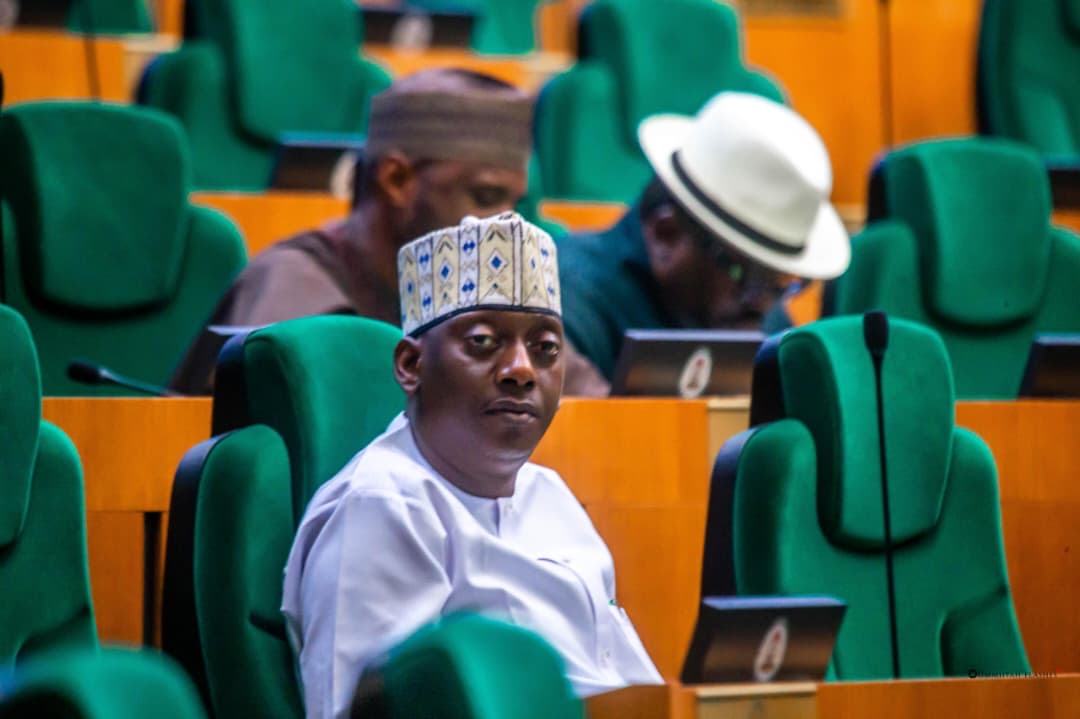
Hon. Jafaru Yakubu, Member of the House of Representatives and Chairman, House Committee on Nigeria–China Friendship Group, has commended President Bola Ahmed Tinubu GCFR for granting approval for the urgent rehabilitation and total reconstruction of the Mutum Biyu–Garba Chede Road, a 48km stretch in Taraba State.
Yakubu, who sponsored the motion in the House of Representatives calling for immediate intervention on the road, said the President’s approval is a bold and strategic response to the plight of commuters and communities along the corridor. He explained that the motion, which was debated and adopted by the House, underscored the dangers of continued neglect, including accidents, economic disruption, and the risk of total collapse.
He further acknowledged the National Security Adviser (NSA) Mallam Nuhu Ribadu for adopting a non-kinetic approach in addressing the crisis. According to Yakubu, the NSA’s intervention elevated the urgency of the project, treating infrastructure development as a vital instrument of peace, security, and stability. By drawing national attention to the road’s deterioration, the NSA highlighted the grave risks posed to lives, trade, agriculture, and access to healthcare.
The Mutum Biyu–Garba Chede Road, constructed in the early 1980s, has deteriorated severely due to age and lack of maintenance. With the collapse of the Namnai Bridge along the Jalingo–Wukari highway, the road became the sole alternative route for heavy-duty trucks, worsening its condition and exposing communities to untold hardship.
Hon. Yakubu assured his constituents that he will continue to work closely with the Federal Ministry of Works, FERMA, and the North East Development Commission to ensure the project’s swift execution. He emphasized that the House Committee on Works has already been mandated to conduct oversight and report back within four weeks, a step he believes will guarantee transparency and accountability in the delivery of the project.
“As Chairman of the Nigeria–China Friendship Group, I am deeply conscious of the importance of strategic partnerships in advancing national development. This reconstruction is not merely about infrastructure—it is about saving lives, strengthening commerce, and reaffirming government’s duty to serve its people. On behalf of my constituency, I extend profound gratitude to President Bola Ahmed Tinubu GCFR and the NSA for their steadfast commitment,” Yakubu declared.
The approval of this project, following Yakubu’s sponsored motion, is widely seen as a demonstration of leadership that listens and acts decisively. For communities in Mutum Biyu, Garba Chede, and adjoining areas, the reconstruction represents hope for safer travel, renewed economic activity, and restored dignity after years of neglect.
Analysts note that the development is not just about fixing a road but about reconnecting people, boosting agriculture, and reinforcing national cohesion at a time when infrastructure remains central to Nigeria’s growth agenda.
News
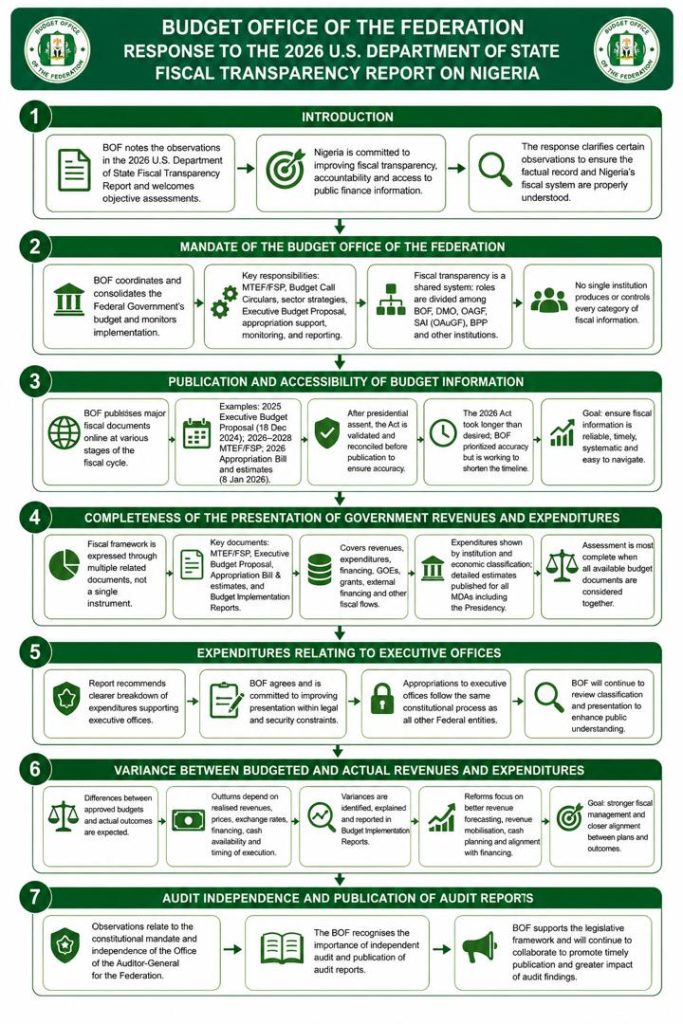
BUDGET OFFICE OF THE FEDERATIONRESPONSE TO THE 2026 U.S. DEPARTMENT OF STATE FISCAL TRANSPARENCY REPORT ON NIGERIA
- Introduction
The Budget Office of the Federation (BOF) notes the observations on Nigeria contained in the 2026 Fiscal Transparency Report of the United States Department of State. The Federal Government welcomes objective assessments of its public financial management system and remains committed to the continuous improvement of fiscal transparency, accountability and access to public finance information.
The Report acknowledges important areas in which Nigeria meets fiscal transparency requirements, including the public availability of the enacted budget and end-of-year fiscal information; the disclosure of debt obligations, including major state-owned enterprise debt; the legal and disclosure framework governing the sovereign wealth fund; and the existence and application of statutory procedures governing natural-resource extraction contracts and licences.
Other observations in the Report require clarification when considered in the context of Nigeria’s institutional allocation of responsibilities and the range of budgetary and fiscal information already in the public domain. The purpose of this response is therefore not to dispute the value of external scrutiny, but to ensure that the factual record and the structure of Nigeria’s fiscal system are properly understood. - Mandate of the Budget Office of the Federation
The BOF is responsible for coordinating the preparation and consolidation of the Federal Government’s budget, and for monitoring and reporting on its implementation within the framework established by law and government fiscal policy.
Its responsibilities include coordinating the preparation of the Medium-Term Expenditure Framework and Fiscal Strategy Paper (MTEF/FSP); issuing Budget Call Circulars; coordinating the preparation of Medium-Term Sector Strategies; coordinating the preparation and consolidation of the Executive Budget Proposal; supporting the appropriation process; monitoring budget implementation; and producing periodic Budget Implementation Reports.
These responsibilities form part of a wider public financial management system in which different institutions perform duties assigned to them by the Constitution and by statute. Debt recording and management fall principally within the remit of the Debt Management Office; government accounting, treasury and cash-management functions reside principally in the Office of the Accountant-General of the Federation; external audit is constitutionally assigned to the Office of the Auditor-General for the Federation; while federal procurement operates within the statutory framework administered by the Bureau of Public Procurement and individual procuring entities.
The observations in the Report are therefore best considered in the context of this institutional division of responsibility. Fiscal transparency is the product of an interconnected system; no single institution produces or controls every category of information on which an assessment of the entire system must depend. - Publication and Accessibility of Budget Information
The Report recommends that Nigeria make its Executive Budget Proposal widely and easily accessible to the public, including online. The BOF respectfully notes that the online publication of the Executive Budget Proposal and other major budget documents has, for several years, formed part of the Federal Government’s established budget process.
The BOF routinely publishes major documents produced at successive stages of the fiscal cycle. These include the MTEF/FSP, the Executive Budget Proposal and detailed estimates, Appropriation Acts, implementation guidelines, and periodic Budget Implementation Reports.
For example, the 2025 Executive Budget Proposal was published on the BOF website on 18 December 2024 alongside the 2025 Appropriation Bill. The 2026-2028 MTEF/FSP was similarly published, while the 2026 Appropriation Bill and its detailed estimates were placed on the BOF website on 8 January 2026.
The purpose of continuing reform, therefore, is not to create a practice of publication where none exists, but to make an established practice more timely, systematic and easier for users to navigate. Fiscal information is useful not merely because it exists, but because it is published at the appropriate time, clearly identified and readily connected to the other documents needed to understand the fiscal picture.
Following presidential assent to an Appropriation Act, the signed instrument is subjected to validation and line-by-line reconciliation against the version passed by the National Assembly before the final budget details are reflected on the Government’s financial management platform and released for public use. This process is intended to ensure that the figures, codes and statutory references placed before the public correspond with the instrument that has become law.
For the 2026 Appropriation Act, this process took longer than would ordinarily be desirable. The Budget Office considered it preferable to complete the necessary validation before publication rather than place in the public domain figures that might later require correction. That choice protected the integrity of the published record, but the delay also demonstrates the need to shorten the interval between presidential assent and public availability.
The lesson is therefore twofold: published fiscal information must be reliable, but that reliability must increasingly be achieved without sacrificing timeliness. The BOF is reviewing its internal sequencing, validation and publication arrangements with that objective in mind. - Completeness of the Presentation of Government Revenues and Expenditures
The Report recommends that the budget provide a substantially complete picture of government revenues and expenditures. Nigeria’s fiscal framework is expressed through several related documents rather than through a single instrument. The MTEF/FSP establishes the macroeconomic and fiscal assumptions underlying the annual budget. The Executive Budget Proposal, Appropriation Bill and detailed estimates set out proposed expenditure allocations, revenue assumptions and the financing framework. Budget Implementation Reports subsequently show performance against approved benchmarks.
Taken together, these documents contain extensive information on projected revenues, expenditure proposals, financing and the operations of Government-Owned Enterprises. The budget documentation also provides information on grants, external financing and other material fiscal flows within the Federal Government’s reporting framework.
Expenditure is presented through institutional and economic classifications, including allocations to ministries, departments and agencies. The Government also publishes detailed estimates relating to the Presidency and other institutions of government, subject always to the legitimate requirements of law, national security and operational confidentiality.
The BOF therefore considers that an assessment of Nigeria’s fiscal transparency is most complete when it examines the available budget documents as a body, rather than treating any one document as though it were intended to contain the entire fiscal account.
This does not remove the need for improvement. Citizens, investors and other users of fiscal information should be able to understand the broad relationship among revenue, expenditure, financing and fiscal risks without having to reconstruct the fiscal picture from numerous documents. The Office will therefore continue to improve consolidation, cross-referencing and presentation so that information already disclosed across different fiscal documents can be more readily understood as a coherent whole. - Expenditures Relating to Executive Offices
The Report recommends a clearer breakdown of expenditures supporting executive offices. The BOF agrees with the transparency objective underlying this recommendation.
Appropriations to offices and institutions within the Executive are subject to the same constitutional appropriation process that applies to other Federal Government entities. Detailed estimates are already published within the budget documentation. Where expenditures are currently aggregated within broader administrative, personnel or service-wide classifications, there remains scope to improve their presentation without compromising legitimate security, statutory or operational considerations.
The BOF will accordingly continue to examine the classification and presentation of such expenditures with a view to improving public understanding within the applicable legal and security framework. - Variance Between Budgeted and Actual Revenues and Expenditures
The Report observes that actual revenues and expenditures did not reasonably correspond with the enacted budget. The BOF considers that this observation would benefit from greater precision regarding the standard against which such correspondence is being assessed.
An appropriation is an authority to spend; it is not, in every circumstance, a guarantee that the entire amount appropriated will become available in cash. Actual fiscal outcomes depend on realised revenues, oil production and prices, tax collections, exchange rates, financing conditions, cash availability and the timing of expenditure execution. A difference between an approved budget and the eventual outturn must therefore be interpreted rather than merely observed.
The central transparency question is whether material deviations are identified, explained and reported. This is one of the purposes of the Budget Implementation Reports produced by the BOF, which compare revenue and expenditure performance against approved benchmarks and explain significant departures from the fiscal plan.
At the same time, persistent or unusually large differences between appropriations and outturns can weaken the usefulness of the budget as an instrument of economic management. The Government’s continuing reforms therefore place greater emphasis on realistic revenue forecasting, improved revenue mobilisation, stronger commitment controls, better cash planning and closer alignment between appropriations and available financing. - Audit Independence and Publication of Audit Reports
The observations concerning the independence of the Supreme Audit Institution and the publication of audit reports relate principally to the constitutional and statutory mandate of the Office of the Auditor-General for the Federation and to the wider legislative framework governing public audit.
The BOF supports a strong and independent external audit function as an essential component of fiscal accountability. It will continue to provide the budgetary and implementation information required within its mandate and to cooperate with the Office of the Auditor-General for the Federation and other oversight institutions.
Institutional or legislative questions concerning the independence, powers and publication obligations of the Supreme Audit Institution are, however, appropriately addressed in conjunction with the Office of the Auditor-General for the Federation, the National Assembly and other authorities responsible for the applicable legal framework. - Public Procurement Information
Federal procurement is governed by the Public Procurement Act and the institutional framework administered by the Bureau of Public Procurement, while procurement transactions are undertaken by individual procuring entities. The recommendation concerning the publication of accessible information on procurement contracts should therefore be addressed principally through that framework.
The BOF nevertheless recognises the close relationship among appropriation, procurement, commitment and payment. Greater interoperability among budget, procurement and treasury information systems would materially improve the public’s ability to follow expenditure from appropriation through procurement to eventual payment and delivery. The Office supports the continued development of such integrated public financial management arrangements. - Timeliness, Institutional Capacity and the Fiscal Responsibility Framework
Fiscal transparency should be treated as a continuing institutional obligation, not as an exercise undertaken solely in response to an external assessment. The experience of producing statutory fiscal reports has, however, brought into sharper focus a question that warrants attention beyond administrative improvement alone.
Fiscal reports are assembled from numerous sources across government. Their reliability depends on the timely submission of information, reconciliation among institutions, resolution of discrepancies and verification before publication. Where these processes repeatedly require more time than the statutory reporting period permits, the response should not simply be to normalise lateness.
Government must first improve the processes that can be improved: clearer responsibility for source data, earlier submission, greater automation, greater interoperability among systems and stricter reporting discipline.
However, where experience over time demonstrates that a statutory deadline no longer reasonably accommodates the number of institutions, datasets and verification steps required to produce a reliable report, there is also a legitimate case for reviewing the law itself.
The purpose of the Fiscal Responsibility Act is to strengthen fiscal discipline, accountability and transparency. Its reporting provisions should therefore impose deadlines that are demanding enough to compel administrative discipline, but sufficiently realistic to permit the publication of information whose accuracy can be defended.
The Federal Government should accordingly consider, through the appropriate legislative process, whether aspects of the reporting timetable under the Fiscal Responsibility Act require amendment in the light of experience since its enactment. Such a review should not weaken reporting obligations. Its purpose should be the opposite: to establish timelines that are credible, enforceable and capable of producing reports that are both timely and reliable. - Institutional Engagement and Continuing Improvement
The Fiscal Transparency Report can also serve as a basis for constructive technical engagement. The BOF considers it useful to deepen dialogue with the United States Government and other development partners on the methodology used in fiscal transparency assessments, particularly the treatment of multiple publicly available fiscal documents, the measurement of budget credibility, and the standards applied to timeliness and accessibility.
Such engagement should be approached as an opportunity for clarification and institutional learning rather than as a dispute over the assessment. The Office may also explore appropriate technical assistance arrangements to strengthen its capacity in fiscal reporting, information management, digital publication, interoperability and public accessibility. Any such cooperation should complement Nigeria’s own reforms and operate within the Government’s legal, institutional and information-security framework. - Conclusion
Nigeria accepts the principle at the heart of fiscal transparency: citizens and other stakeholders should be able, without unnecessary difficulty, to know what the Government intends to raise and spend, what the legislature has authorised, what was eventually received and spent, and how public resources were accounted for and audited.
Nigeria has already built a substantial architecture for making this information public. The question before us is therefore not whether disclosure exists, but how to make the existing system faster, clearer, more complete and easier to understand.
There are areas in which Government must improve its own processes. There are areas in which fiscal information already exists but must be assembled and presented more coherently. There are responsibilities that belong to institutions other than the Budget Office. There may also now be statutory reporting timelines whose continued practicality deserves examination in the light of experience.
A mature system should be able to acknowledge all four points without defensiveness.
The Budget Office therefore welcomes external assessments that assist Nigeria in strengthening its institutions. It also considers it important that such assessments take account of the full range of fiscal documents made publicly available and of the constitutional and statutory division of responsibilities among institutions.
The Federal Government remains committed to a budget system in which fiscal decisions are not only lawful and disciplined, but are also increasingly transparent, accessible, intelligible and capable of independent public scrutiny.
Tanimu Yakubu
Director-General
Budget Office of the Federation
Abuja
18 August 2026


Bandits Kidnap Kwara Community’s Monarch

Kwara APC Assembly Candidate, Oyinloye, Engages Constituents

Northern Students Honour Shehu of Borno’s Man- Auta.

-
 Uncategorized6 years ago
FG, states urged to harness flooding for ranching, others with technology – Agbaje
-
 Headlines11 years ago
Breaking: EFCC seals Borno House of Assembly, as Hon members take to their heels
-
 News12 years ago
Nigeria Security Operatives Stage Manhunt For Homosexual Perpetrator
-
 News10 years ago
How 21-year-old Girl fled community over accusation of lesbianism
-
 News10 years ago
Yobe Gov Moves Against Deputy
-
 Opinion7 years ago
7 signs she has friend zoned you
-
Technology5 years ago
Online job placement company headhunts women
-
 Headlines10 years ago
Borno Dep Gov Abducts Another Church Leader