
News
Over 50 killed as Boko Haram/ ISWAP factions clash.

By: Special Correspondent
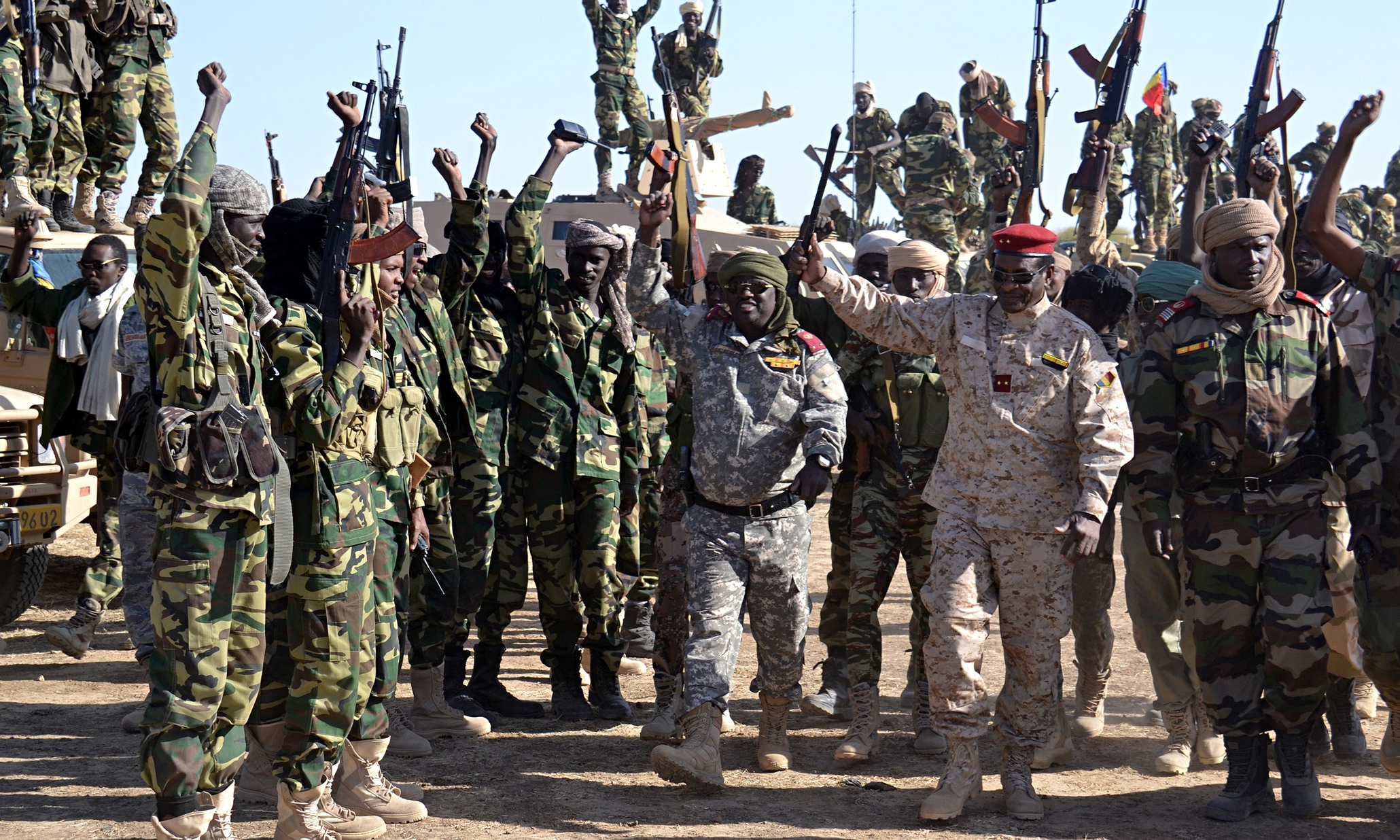
A deadly clash between the factions of Boko Haram the Jamā’at Ahl as-Sunna lid-Da‘wa wa’l-Jihād (JAS) and the Islamic State of West Africa Province (ISWAP) has resulted in the reported death of more than 50 fighters at Toumbun Gini, an island community in Abadam Local Government Area of Borno State.
Security sources told Zagazola Makama that the clash occurred on Sunday afternoon around 3 pm, following an attempted offensive by ISWAP fighters.
According to the source, ISWAP mobilised fighters using 10 high-powered watercraft and launched an attack aimed at reclaiming the island, believed to have recently fallen under the control of the rival JAS faction.
However, intelligence reportedly reached JAS leadership ahead of the assault, enabling them to set up a counter-ambush.
At exactly 1500 hours, ISWAP boats landed and what was planned as a surprise offensive quickly turned into a deadly trap. The first shots were decisive. JAS fighters overpowered them within minutes. ISWAP was routed,” the source said.
The source said over 50 ISWAP fighters were killed during the ambush, with seven of their boats seized. The remaining three vessels escaped with casualties. Video clips appearing to show the aftermath of the clash surfaced online on Sunday.
Zagazola described the clash as Day 5 of intensified rivalry between the two insurgent factions, which have been fighting over territorial dominance and control of resources in the Lake Chad islands.
The continued push by JAS against ISWAP could force surviving ISWAP fighters deeper into mainland communities bordering Kukawa, Monguno and Marte LGAs, increasing security risks for civilians and security personnel.
The rivalry has however, weakened both factions, reducing their ability to launch coordinated large-scale attacks. However, this fragmentation also poses a different challenge: smaller, unpredictable cells that are harder to track.
What is happening on Lake Chad today is a conflict within a conflict and Nigerian troops remain in the middle of the battlefield. The fighting could be leveraged strategically by intensifying pressure on both groups simultaneously.
“This is the best time for the Nigerian military to tighten the corridor and deny both factions space to regroup,”said Rivalry.
Clashes between rival jihadist factions Boko Haram and ISWAP have escalated tenssion in the Lake Chad region.
Our correspondent reports that, the Jama’atu Ahlis Sunna Lidda’awati wal-Jihad (JAS) and the Islamic State West Africa Province (ISWAP) have intensified their rivalry across strategic island strongholds and riverine settlement routes in Abadam and Kukawa Local Government Areas of Borno State.
Between 5 and 8 November 2025, Boko Haram’s Jama’atu Ahlis Sunna Lidda’awati wal-Jihad (JAS) launched a fierce coordinated assault on its rival faction, Islamic State West Africa Province (ISWAP), across a stretch of islands identified as Sahel 1, Dogon Chuku, Mangari, and linked riverine basins spanning Tumbun Gini – Tumbun Dalo – Tumbun Shanu – Mangari – Dumba in Abadam and Kukawa local government areas of Borno State.
The fighting was intense. The objective was clear. JAS wants to erase ISWAP. Sources revealed that JAS fighters, led by commanders Hassan Buduma and Mohd Hassan, mobilised multiple watercraft loaded with fighters and heavy weapons, moving in waves from Tumbun Gini through the upper river basin to Tumbun Dalo, Tumbun Shanu, Mangari, Dumba and surrounding islands, a chain of sandy enclaves where humanitarian presence is almost non-existent.
In a scene described as “an amphibious assault in insurgent style,” JAS fighters attacked ISWAP from the water, surprising them at dawn. “This is not a misunderstanding, this is a takeover,”said one intelligence source familiar with the region.
However, after days of sustained fighting,
ISWAP fighters were forced to abandon their river camps scrambling for their lives.
The number of casualties remains unknown, but ISR reportedly picked up heat signatures of several bodies floating and others buried in shallow sand pits.
Multiple sources also confirmed that JAS deployed several motorized watercraft in a multi-axis assault, overrunning ISWAP clusters and pushing surviving fighters off the island perimeter into mainland hideouts around Ali Jillimari, Metele, Kangarwa, and Gudumbali in North of Borno.
While both groups share an extremist ideology, the battle has nothing to do with religion. It is about power. Control of the Lake Chad islands means control of millions of naira collected through extortion of fishermen and traders, they will also take control of the Arms and fuel smuggling corridors through Niger, Chad and Cameroon. They will also have mobility advantage where the water channels provide a perfect cover from air surveillance.
ISWAP had dominated these islands since 2021, after the death of Boko Haram leader Abubakar Shekau. But water levels have receded this season, opening new land routes and exposing old fishing settlements.
At the core of this escalation is not ideology — but dominance. JAS, according to intelligence intercepts, has vowed to “totally eliminate ISWAP presence in the Lake Chad islands”, and seize ISWAP’s lucrative supply corridors interfacing Niger, Chad and Cameroon.
JAS reportedly plans to push further south toward ISWAP headquarters within Marte and Ngala LGAs, a strategic move that, if successful, would reverse ISWAP’s dominance for the first time since 2021. Once ISWAP regroups on the mainland, it will retaliate violently to reclaim the islands. The group has never allowed a territorial defeat to stand.
Zagazola report that the clashes represent a transition from sporadic skirmishes to a full territorial campaign. More ambushes, roadside bombs and abductions along access routes linking Metele, Kangarwa and the Maiduguri–Damasak MSR, should be anticipated.
The emerging trend suggests that both factions will now lunched retaliatory raids on each other’s strongholds, attack supply lines, including river transport. Communities in Kukawa and Abadam especially fishermen, transport boat operators, and seasonal farmers will bear the immediate consequences.
The Lake Chad Basin has always held strategic value a place where borders blur and armies struggle to manoeuvre. But this new insurgent rivalry marks a turning point. For the first time in years, Boko Haram and ISWAP are not just fighting the state. They are fighting over who gets to rule the shadows.
And somewhere in the middle caught between gunboats, ideology and hunger are the civilians of the Lake Chad islands, whose lives continue to be shaped by a war they did not choose and cannot escape.
Zagazola Makama is a Counter Insurgency Expert and Security Analyst in the Lake Chad Region
By Emmanuel Kuza
A chieftain of the Peoples Democratic Party (PDP) in Nasarawa State, Abuga Ovie, has described the name Ombugadu as a political brand, saying the popularity and wide acceptance of the name have made David Emmanuel Ombugadu a major force in the state’s political landscape.
Ovie, who stated this in an interview on Tuesday, said what started as opposition from some of Ombugadu’s biological brothers and people he described as fathers and uncles who betrayed him for personal political interests had now assumed a wider dimension, with political parties allegedly joining the battle against him.
According to him, the latest development was an attempt to undermine the political value of the Ombugadu name by presenting another person with the same surname, describing it as an indication of how far some political actors were prepared to go to weaken the PDP governorship candidate.
“Ombugadu is a brand, not a title. The people are not fools. They know their own. You cannot simply bring another person bearing the same name and expect the people to forget the political identity that Ombugadu has built over the years,” he said.
He further alleged that a former governor was working to introduce a political associate who had served as Accountant-General of Nasarawa State into the political equation, with the alleged objective of destabilising the PDP and weakening its chances by ensuring that the party fields a less competitive candidate in 2027.
“The plan, as we understand it, is to destabilise the PDP and make sure the party presents a weak candidate, thereby creating an advantage for the former governor’s preferred candidate. But all those efforts have proved abortive because the national leadership of the PDP stood its ground and refused to lose its best bet for the 2027 governorship election,” Ovie said.
The PDP chieftain said the resolve of the national leadership to retain Ombugadu had demonstrated the confidence the party had in his capacity to win the governorship election, despite what he described as attempts by some political actors to frustrate his ambition.
Ovie urged political parties and their leaders to resolve their internal differences instead of concentrating their efforts on Ombugadu, whom he compared to David in the Bible, saying he remained focused despite betrayal and opposition from those close to him.
“Ombugadu is like David in the Bible. Even when his brothers forsook him, he remained focused. Today, despite the people who have betrayed him, he remains focused and has a blueprint that can rescue Nasarawa State,” he said.
He said political parties should concentrate on presenting their programmes and convincing voters about how they intend to address the challenges confronting the state rather than expending their energy on attempts to stop Ombugadu.
“Political parties should fix their problems instead of wasting their strength fighting Ombugadu. Let everybody bring their blueprint before the people and explain what they intend to do for Nasarawa State,” he said.
Ovie maintained that the 2027 election should be about ideas, competence and the future of Nasarawa State, rather than attempts to manipulate political structures or undermine individuals perceived to enjoy strong grassroots support.
He urged the people of the state, particularly the Eggon community, to remain politically vigilant and resist what he described as efforts to make them settle for less, insisting that voters would ultimately determine who enjoys their confidence at the polls.
Reduce repeated references to Ombugadu

By Israel Adamu, Jos
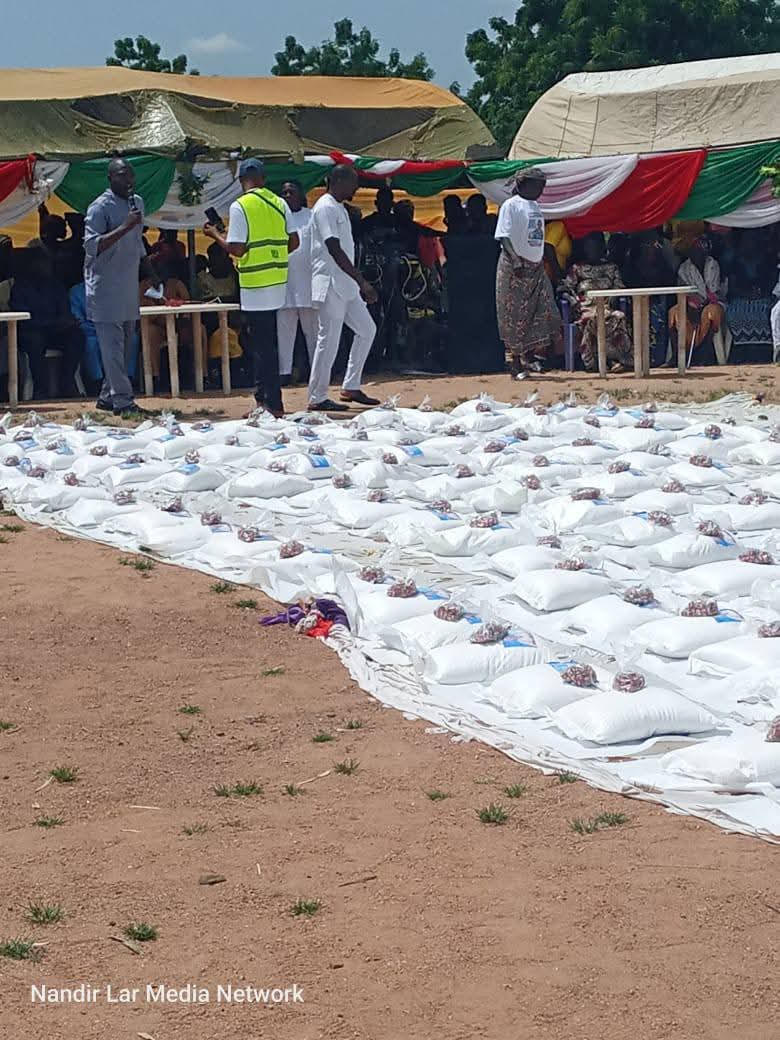
Two hundred widows from communities across Langtang North Central State Constituency of Plateau State have benefited from an empowerment outreach organised by Gimbiya Gani Nandir Lar under the Jagoran Talakawa movement.
The outreach, held at Pilgani in Langtang North Local Government Area, was aimed at supporting vulnerable women and drawing attention to the challenges faced by widows, particularly those struggling to provide food, pay school fees and meet other basic needs for their families.
The organiser, Nandir Lar, who is the All Progressives Congress, APC, candidate for Langtang North Central State Constituency, said the gesture was motivated by compassion and concern for vulnerable members of the society.
She stressed that the outreach was not a political programme but an expression of love and support for humanity.
Nandir Lar said: “The plight of widows may not always make headlines, but their struggles are real, painful and deserving of our collective attention.
“This is simply an expression of compassion and love for humanity. It is not a political programme.
“Our constituency is home to people with diverse needs, including mothers, widows and young people who are seeking opportunities to improve their lives.”
Former Provost of the Federal College of Education, Pankshin, Amos Chirfat, commended the initiative, saying it had brought smiles to the faces of vulnerable women in the constituency.
Minority Leader of the Langtang North Legislative Council, Dirya Sheni, also commended Nandir Lar for supporting widows and other vulnerable members of the community.
At the end of the outreach, each of the 200 beneficiaries received a 10-kilogramme bag of corn flour, seasoning and N10,000 cash

By Francis Wilfred
The Special Control Unit against Money Laundering (SCUML), and the Real Estate Developers Association of Nigeria (REDAN) have expressed commitment to ensure a full compliance with the Anti Money Laundering/Counter Finance on Terrorism/Counter Proliferation Financing, (AML/CFT/CPF) laws within the Nigeria’s real estate sector.
They made the resolve during a stakeholders’ engagement held on Thursday, September 10, 2026
The engagement focused on Mutual Evaluation readiness, risk-based supervision, beneficial ownership transparency, customer due diligence, internal controls and stronger collaboration between SCUML and the real estate sector.
Assistant Commander of the EFCC, ACE 1 Ibinabo Amachree, speaking on behalf of SCUML highlighted the strategic role of real estate operators in protecting the integrity of Nigeria’s financial system, particularly given the sector’s vulnerability to money laundering and other financial crime risks.
Amachree encouraged REDAN members to move beyond registration to ensure that compliance is embedded in their day-to-day operations. He mentioned the areas to include: understanding institutional risks, knowing customers and beneficial owners, identifying politically exposed persons, conducting appropriate sanctions screening, maintaining effective internal controls and meeting applicable reporting obligations
He, therefore, reaffirmed readiness to working closely with REDAN and other stakeholders to improve compliance, build capacity and promote a stronger culture of accountability across the real estate sector
“The message is clear: effective compliance is not just about meeting regulatory requirements; it is about protecting businesses, strengthening the real estate sector and safeguarding the integrity of Nigeria’s financial system”, she said.
In his remarks, the Chairman of REDAN, Lagos state, Mr Tony Kolawole pledged readiness to partner with SCUML in ensuring compliance with AML/CFT/CPF in the real estate sector to uphold financial integrity.
The engagement also provided an opportunity for REDAN members to share practical regulatory and operational challenges affecting the sector, reinforcing the importance of continuous dialogue between regulators and industry stakeholders.


Changsha brings millennia-old heritage into modern life

Gov AbdulRazaq Lauded Over Conferment Of Sadauna Of Ilorin Title

FG Commissions KWASU ICT Centre To Enhance Graduates Employability

-
 Uncategorized6 years ago
FG, states urged to harness flooding for ranching, others with technology – Agbaje
-
 Headlines11 years ago
Breaking: EFCC seals Borno House of Assembly, as Hon members take to their heels
-
 News12 years ago
Nigeria Security Operatives Stage Manhunt For Homosexual Perpetrator
-
 News10 years ago
How 21-year-old Girl fled community over accusation of lesbianism
-
 News11 years ago
Yobe Gov Moves Against Deputy
-
 Opinion7 years ago
7 signs she has friend zoned you
-
Technology5 years ago
Online job placement company headhunts women
-
 Headlines10 years ago
Borno Dep Gov Abducts Another Church Leader