
Uncategorized
OPINION; WHY DANGOTE DESERVES THE SUPPORT OF NIGERIANS.


By: A G Abubakar
For once, the cry for accountability shifted from the realm of the ordinary folk to that of the upper class. Dangote, the world’s richest Black man, had cause to question the integrity of one Engineer Farouk Ahmed, who until recently was the Chief Executive Officer of Nigeria’s Midstream and Downstream Petroleum Regulatory Agency (NMDPRA), regarding the motives behind some of the regulatory agency’s decisions. The latter purportedly responded with a public refutation of the allegations, for which he later issued a disclaimer.
However, and regardless of the said disclaimer, the development seemed to have awoken national consciousness on the dangers of systemic corruption. It also provides a glimpse into a classic intra-elite class war that could herald a renewed action against injustices in governance. But, before examining Engineer Farouk’s reaction (now disowned) a bird’s-eye view of Dangote and his empire would put the discourse in proper context. Dangote’s business model may not be the best, but no model is perfect. Capitalism and entrepreneurship were born out of the desire for profit maximisation—an approach precipitated by the 18th-century Industrial Revolution and fine-tuned by the post–World War II Bretton Woods system. Entrepreneurship under capitalism brooks no sentiment—no emotions, no morality. Give-back initiatives and corporate social responsibility (CSR)—grants, trusts, and foundations—remain largely discretionary.
Dangote does not operate differently. He favours monopoly and is ruthless with competitors. Abdul Samad Isiaka Rabiu of BUA Group and Cletus Ibeto of Ibeto Cement had to stand up to him to protect their cement business interests. As a Nigerian who built his empire within a compromised and corrupt system, Dangote has also mastered the art of “manipulation.” His hostile takeover of struggling ventures such as BCC, Gboko Cement, Savannah Sugar Company, National Salt Company (NASCON), and others was facilitated by successive governments’ patronage and lubrication. Today, he is worth over $30 billion in personal fortune and operates one of the world’s largest oil refineries. Other entities within the Dangote Group have also flourished beyond Nigeria’s shores. Dangote Cement has subsidiaries in Benin, Cameroon, Ghana, South Africa, Zambia, among others.
Despite Dangote’s Machiavellian approach to business, his sense of patriotism has never been in doubt. While many who made fortunes from Nigeria’s economic environment tend to invest abroad, Dangote chose instead to invest his wealth at home. Data from the World Bank indicate that Nigeria loses between $10 billion and $18 billion annually to illicit financial flows (IFF)—funds that could significantly transform the economy. Dangote, however, invested in domestic manufacturing. The Dangote Refinery has the capacity to refine 650,000 barrels of crude oil per day and produce about 3 million tonnes of fertiliser annually. At full capacity, it is alleged to be the largest single-train refinery in the world.
His circle of associates cuts across ethno-religious lines, just as the geographic spread of his enterprises does. Shrewd and highly calculating, Dangote has navigated the many dichotomies that have characterised Nigeria—ethnicity, faith, culture, and prejudice. But like most mortals, he has at times become a victim of his own success and the vagaries of a broken society. Nothing brought this to the fore more than the arrival of the Dangote Refinery (DR). The project strained his relationship with government and regulatory authorities, particularly the leadership of the NMDPRA under Engineer Farouk Ahmed.
From crude oil supply to quality control, pricing, licensing of pms importers and labour relations, Dangote was kept under sustained pressure. At one point, he became so frustrated that he openly offered to sell off the refinery. In his words: “I am now 67 years old; little life is left for me. What I am doing is for the nation, not for personal comfort.”
It appears Dangote may have pinned down one of his tormentors-in-chief—the former CEO of the NMDPRA. He removed the gloves and accused the agency’s leadership of subjecting him to unnecessary obstacles driven by unwholesome practices. He specifically accused the CEO of corruption, citing an alleged $5 million expenditure on his children’s secondary education in Switzerland.
While the accusations may carry emotional undertones, Engineer Farouk Ahmed’s now disclaimed public response did little to allay suspicion. The alleged refutation, titled “A Question of Integrity: Engineer Farouk Ahmed Responds,” arguably reinforced the case against him—at least in the court of public opinion, even after it was denied – maybe as an after thought. It could also be that a proxy did it in good faith to save his refutation.
Engineer Ahmed’s career reached a defining moment in 2012 when he attained management cadre as a General Manager. He became Deputy Director (Downstream) in 2015 and was eventually appointed CEO of the NMDPRA in 2021. Coincidentally—or perhaps not—the period between 2012 and 2025 coincided with the worst episodes of PMS scarcity in Nigeria. It was a time when Nigerians slept at filling stations, black-market fuel thrived, and adulteration and hoarding became big business. There is little to celebrate about that era.
Fuel subsidy payments nearly bankrupted the government, especially during Buhari’s second term. Over-invoicing and padding became rampant, forcing the Tinubu administration to remove the subsidy shortly after assuming office. Records from the Nigeria Extractive Industries Transparency Initiative (NEITI) show that Nigeria spent ₦15.57 trillion on fuel subsidy between 2006 and 2023, much of it in questionable payments. In 2021 alone, ₦1.43 trillion—about 2% of GDP—was paid out. Engineer Farouk Ahmed was part of the system during this period.
With or without the disclaimer, Dangote’s allegation to the effect that Ahmed spent about $5 million as fees to give Secondary education to his kids, should still command public interest. Until Ahmed is cleared authorities claimed (though disowned) merit-based scholarships rebate that covered between 40% and 65% of the costs could still be part of Ahmed’s future short of accepting the alleged $5 million. But, then even a net fee $2.5 million, the amount would still be beyond the legitimate earnings of a full time public servant. This is because, if adjusted for inflation, the $2.5 million translates to roughly ₦15 billion. His reported annual gross emolument of ₦48 million as CEO pales in comparison to such expenditure.
As one commentator aptly observed: “Even if he earned ₦48 million annually for 35 years and somehow spent nothing—not one kobo—the total would be about ₦1.6 billion. That figure does not come close to the ₦30 billion reportedly spent on his children’s education.” School fees ordinarily constitute only a fraction of household expenditure. One wonders what level of investment Engineer Farouk Ahmed might have accumulated—through proxies or fronts—in real estate, equities, or other assets beyond what is captured in statutory asset declarations to the Code of Conduct Bureau.
It is also good that Engineer Farouk Ahmed’s issued disclaimer would distance him from the reference to his “family business.” That could have been a hard assertion to crack. Sokoto, where Ahmed came from, is historically known more as the Seat of the Caliphate, in reverence to the theocratic governance established by Usman dan Fodio between 1804 and 1903. Until the advent of modern politics, Sokoto, along with offshoots like Zamfara and Kebbi, was not known for producing dollar millionaires. Family businesses in Nigeria rarely survive their founders, as they are often limited to trading and haulage rather than sustainable investments.
The continued survival of Farouk Ahmed’s ancestral business empire until 2018, when his father passed on, is indeed commendable. Still, the numbers do not add up. The existence of a multibillion-naira corporate entity—firm, trust, foundation, or industry— in Sokoto should have been common knowledge. No such evidence has been presented, nor did the “disowned response” provide details on such. In fact until the return to civil rule in 1999 that created “politipreneurs” billionaires in the likes of Bafarawa, Wamakko, Tambuwal etc, Sokoto couldn’t boast more than a couple.
Dangote may not be a saint—nobody really is. But he has openly blown the whistle against what he perceives as an attempt to undermine his interests, reinforcing the notion that “the rich also cry.” His stance against corruption and impunity should resonate widely. The same scrutiny should be extended to state governors, local government chairmen, legislators, royal fathers, bank executives/owners, and captains of industry. Many of them harbour “Farouk Ahmeds” within. A united front is required to hold them accountable. Impunity and injustice have already triggered enough existential crises in Nigeria. If nothing is done to kill systemic corruption, corruption will eventually kill the nation.
The World Bank and the IMF have repeatedly warned of the fiscal damage caused by IFF and corruption in Nigeria, largely to no avail. However, government consciousness appears to be rising. The Minister of State for Finance, Doris Uzoka-Anite, recently acknowledged this while addressing global finance leaders on safeguarding sustainable development finance. She decried Nigeria’s estimated annual IFF losses of $17.7 billion. With figures like Dangote and the government seemingly aligned, the fight against corruption should be mounted in earnest.
If Dangote’s accusations amount to nothing, then the burden lies on the state to prove it. But if they hold even in part, Nigeria has been handed a rare opportunity to confront corruption where it hurts most—at the top. This moment must not be wasted. When the rich finally cry foul, the institutions of state must respond, not with silence or symbolism, but with courage. Either corruption is confronted now, or it continues its quiet work of destroying the nation.
Dangote is no saint, but saints do not build nations—institutions do. His whistle-blowing has shifted the anti-corruption debate from the margins to the centre of power. Nigeria must seize this moment to prove that accountability is not selective and that no office is too high for scrutiny. If this opportunity slips away, then corruption will remain what it has always been: the strongest institution in the land.
For years, ordinary Nigerians cried against corruption and were ignored. Now the cry comes from the elite, and the nation listens. This convergence must lead to action. The legislature, judiciary, and security agencies must rise beyond ritual investigations and cosmetic asset declarations. Nigeria stands at a crossroads: confront systemic corruption decisively or continue its slow, deliberate march toward national failure.
It must begin with the legislature, judiciary, and security agencies. The hapless public is watching. They cried long before the rich joined them. As the nation awaits further actions regarding Dangote’s allegations against Engineer Farouk Ahmed, the relevant institutions like the Code of Conduct Bureau, EFCC, ICPC, and the National Assembly shall do the needful – investigate him and his ilk, serving or outside government, hopefully beyond judicial theatrics.
A. G. Abubakar
agbarewa@gmail.com
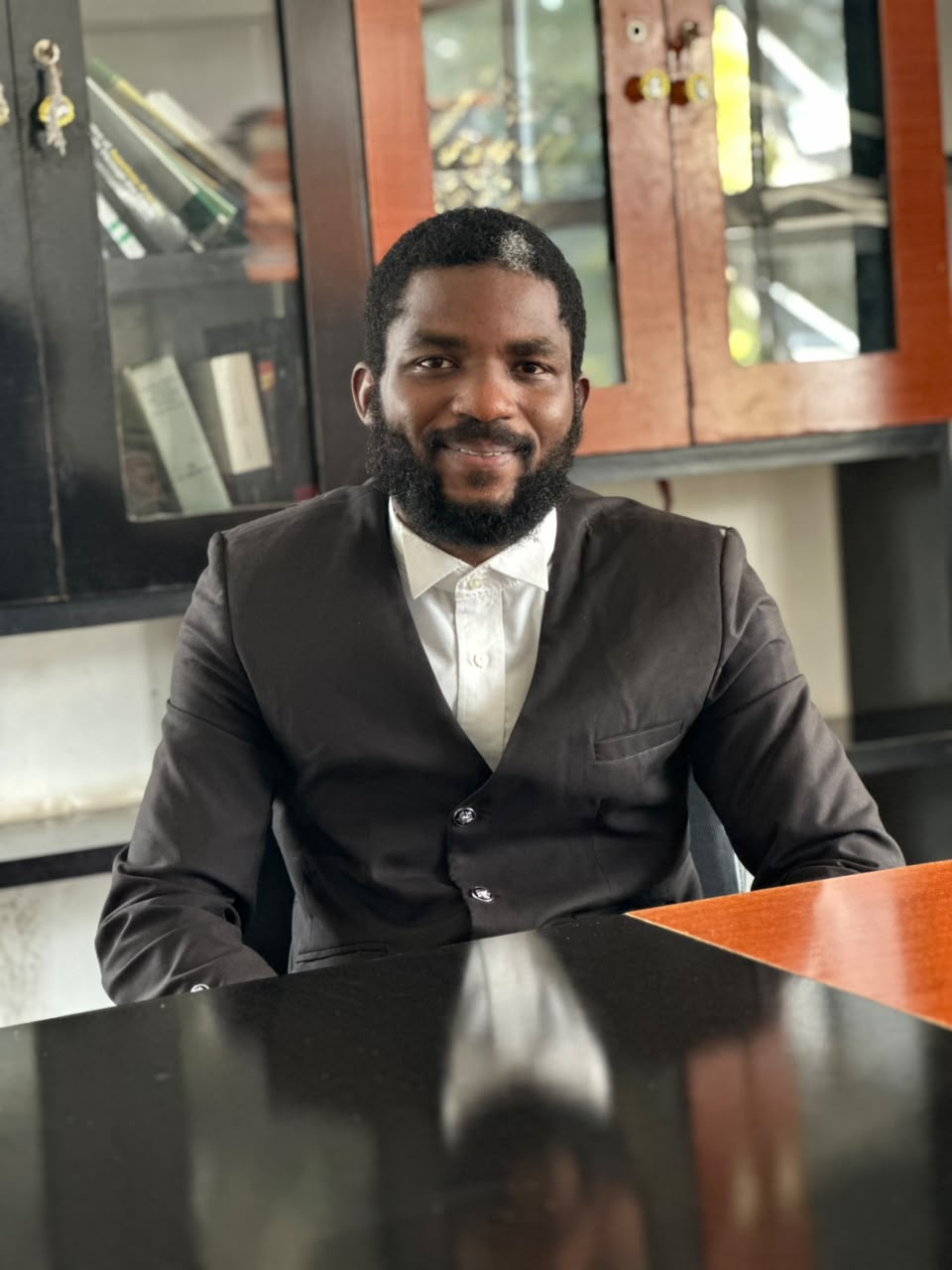
A legal practitioner, Mr M. D. Zarewa, has said that a bank cannot freeze or restrict a customer’s account without a valid court order.
Zarewa said it was prevalent in the society for law enforcement agencies to give directives to banks to freeze customers’ accounts whenever there was a pending case before them, adding that banks often complied with such directives.
He, however, said such practice was alien to Nigeria’s jurisprudence, stressing that banks were enjoined not to interfere with or restrict the activities of any customer’s account without a valid court order.
According to him, it is trite law and settled beyond argument that a bank cannot freeze a customer’s account without a valid court order.
He said the position was entrenched in the case of GTB Plc v. Olachi & Anor (2025) LPELR-81833(CA), where the Court of Appeal held that “whether frozen or restricted, neither can be done without the valid order of a Court of Law.”
Zarewa further cited GTBank v. Adedamola (2019) 5 NWLR (Pt. 1664) 30 at 43, Paras. E-F, where the court held:
“Before freezing customer’s account or placing any form of restraint on any account, the bank must be satisfied that there is an Order of Court.
“By the provisions of Section 34 of the Economic and Financial Crimes Commission Act 2004, the Economic and Financial Crimes Commission has no power to give direct instructions to banks to freeze the account of a customer without an Order of Court. So doing, constitutes a flagrant disregard and violation of the rights of a customer.”
The lawyer said any customer whose account had been frozen or restricted without a valid court order could institute a suit against the bank for grossly violating his or her rights.
He said such a customer could particularly seek redress for the violation of the right to own movable and immovable property and seek compensation from the court.
Furthermore, Zarewa said the law was trite that where there was a wrong, there was a remedy, as captured in the Latin maxim, Ubi jus ibi remedium.
Stephen Olufemi Oni, Ilorin
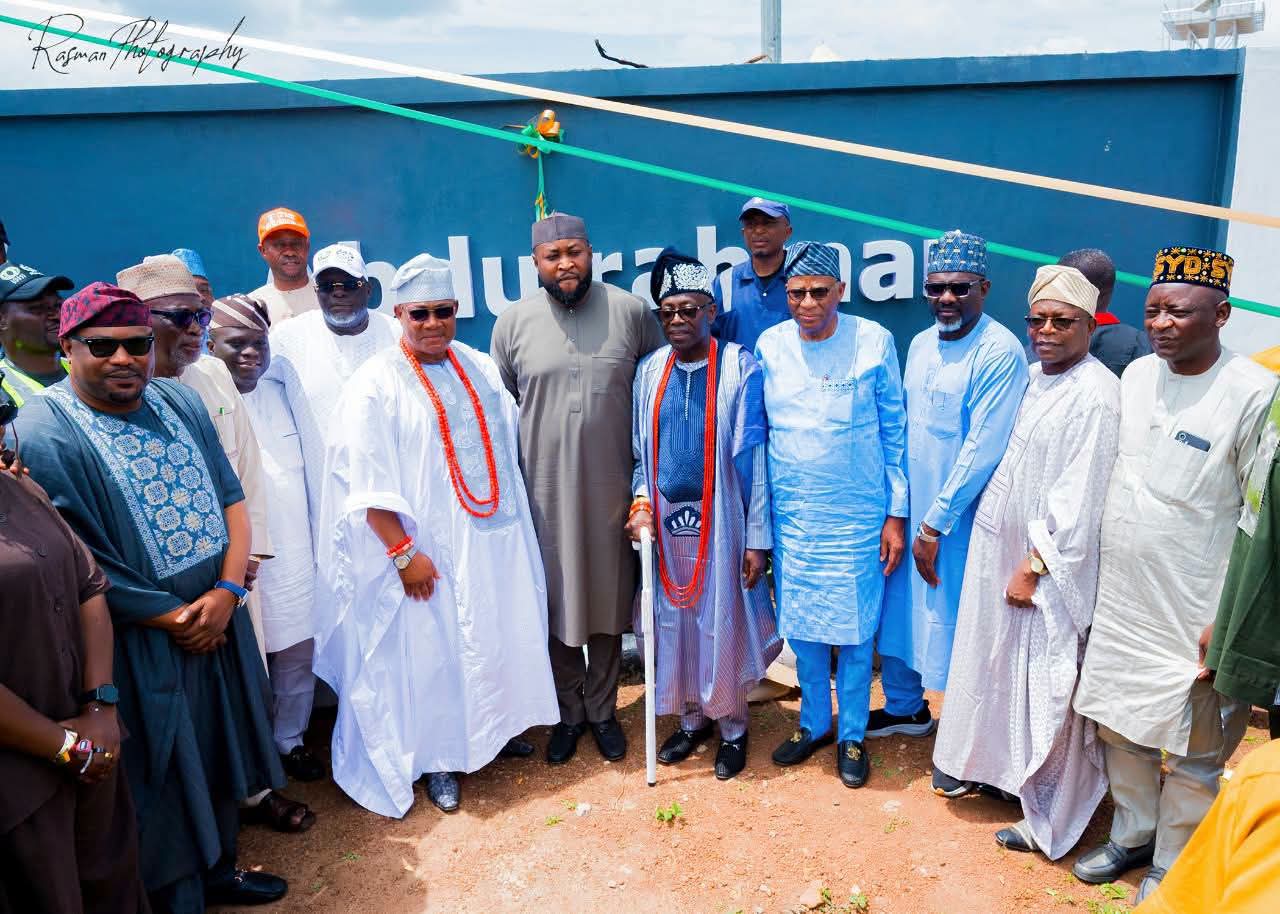
Kwara State Governor AbdulRahman AbdulRazaq has inaugurated the ‘AbdulRahman AbdulRazaq Morire Housing Estate’ in Ijagbo, Oyun Local Government Area of the State.
Speaking at the groundbreaking of the housing estates, which included 210 units of two-bedroom terrace apartments, 200 units of three-bedroom units and 54 units of four-bedroom terrace duplexes, the
Governor, noted that housing should not be seen or regarded as a luxury, but rather as a fundamental human requirement and cornerstone of dignity, security, and family stability, lamenting the daunting challenge of addressing housing deficits across the country.
He said: “Dear Kwarans, housing is not a luxury. Basic housing is a
fundamental human need and a cornerstone of dignity, security,
and family stability. Yet, across Nigeria and indeed in Kwara State,
the challenge of addressing housing deficit is daunting.
“This administration believes that inadequacy of proper shelter
for Nigerians is not merely a problem of not building enough
houses. Indeed, several studies have attributed the housing deficit in Nigeria to a complex mix of causes, key among them being high costs and rising costs of building materials, weak finance, difficult land systems, infrastructure gaps, institutional limitations, among others.
“On behalf of the people of Kwara, I thank the management of ISHI
Homes Limited for this partnership and for choosing Kwara State
as the location for this important development.”
Represented by the Commissioner for Housing and Urban Development, Dr Segun Ogunsola, the Governor applauded the developer for recognising his administration’s contributions to mass housing development in the State.
“The administration has consistently placed housing development high on its agenda. The government recognises access to decent and affordable housing as essential to the wellbeing of the people.
“The State Government has also been in active collaboration with
institutional partners including the Federal Ministry of Housing
with a view to increasing housing stock in the State.
“Recently, we acquired a housing estate with over 130 flats at
Ogbondoroko in Asa LGA of the State. Government has approved
that the estate be onboarded onto the administration’s social
support scheme,” he disclosed.
AbdulRazaq said the commitment was reflected in the development of the Kwara Smart City and other mass housing initiatives across the State.
The Governor disclosed that his reforms in land administration have reduced the processing time for Certificate of Occupancy (C of O) from 180 days to 35 days.
AbdulRazaq said the improved turnaround time demonstrated the administration’s commitment to making land administration more transparent, efficient and investor-friendly.
Earlier in his remarks, the Chief Executive Officer (CEO) of ISHI Homes, Dr Olayinka Ilufoye, said the project was intended to democratise home ownership and make decent and affordable housing accessible to the people of Kwara South senatorial district.
Ilufoye said the estate was meant for civil servants, traders and other Nigerians who can access it through the National Housing Fund (NHF).
“The name AbdulRahman AbdulRazaq Morire, which translates to ‘I have seen goodness’, is a deliberate expression of our faith, hope and expectation.
“We believe this estate will become a testimony of prosperity, progress and abundance in Kwara South,” he said.
Ilufoye pledged that the company would remain committed to transparency, accountability, quality construction and timely delivery.
The Executive Chairman of the Kwara State Geographic Information Service (KWGIS), Alhaji Sulyman Abdulkareem said the state government has consistently placed housing development high on its development agenda.
He commended the state government for ensuring access to land, facilitating the prompt issuance of titles and certificate of occupancy.
Abdulkareem pointed out that by providing timely approval for mortgage transactions, the Governor is creating the conditions necessary for housing development to thrive in Kwara State.
Stephen Olufemi Oni, Ilorin
Nigeria, and the world at large, are in dire need of exemplary leaders like the late Founder of the Ansarul Islam Society of Nigeria, Sheik Muhammad Kamalu-deen al- Adabbiy.
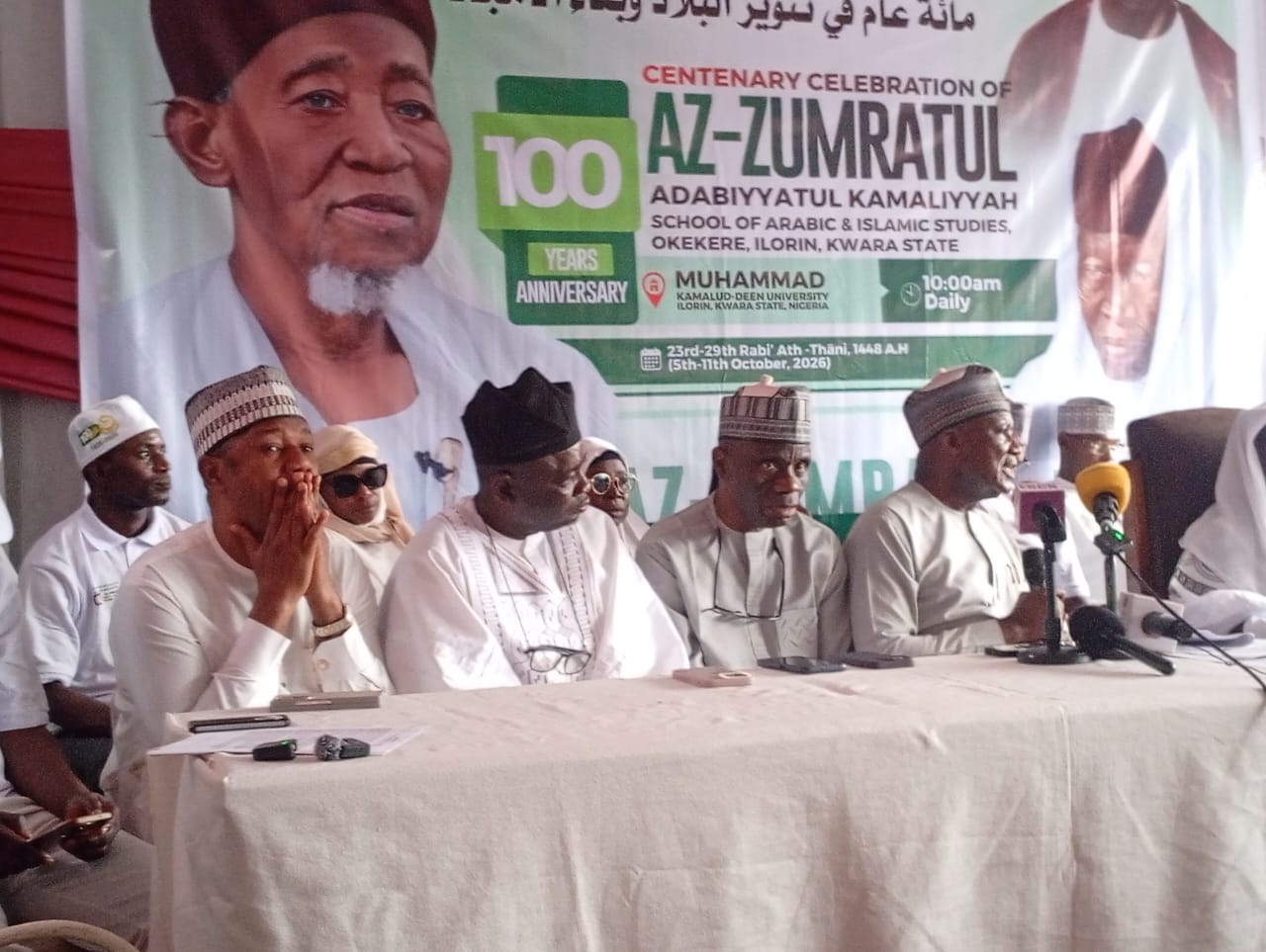
This was the submission of various scholars at a media briefing in ilorin, the Kwara State capital, to usher in the Society’s week-long activities to commemorate the 100 years of the establishment of the Az-Zumratul Adabiyatul Kamaliyyah School of Arabic and Islamic Studies, in Okekere, Ilorin.
The school was fouded by the late Sheik Kamalu-deen in 1942.
Born in 1905, the late Sheik Kamalu-deen was one of Nigeria’s foremost Islamic scholars and educational piooneers who transformed deep Islamic religoius learning into education and also advocated the acquisition of western education .
He also served as a Councillor and Member of the Ilorin Native Authority Transition Committee between 1958 and 1961and was appointed as the first grand mufti of Ilorin by the Emir of Ilorin.
The late Kamalu-deen al- Adabbiy died in 2005 at the aged of 100 years, leaving behind impactful legacies in the propagation of Islamic religion, scholarship, education and leadership.
Addressing journalists at the ancient hall of the Az-Zumratul Adabiyatul Kamaliyyah School of Arabic and Islamic Studies in Okekere, Ilorin, the spokesperson, Prof Kamil Kamaldeen, said the late sheikh was “non discriminatory” in all his policies, a virtue he said was lacking in most leaders today.
“We are here to celebrate the legacies of the late Sheikh Muhammad Kamalu-deen al-Adabbiy not to tell his history, at a time when the world continues to need what he stood for. We are in a world today that we are looking for leaders who will serve without puting themselves first, no matter where we come from,” he said
The Registrar was flanked by the Vice Chancellor of the Muhammad Kamalu-deen University, Prof AbdulRasheed Jimoh, General Overseer of the Az-Zumratul school, Sheik Mustapha Kamalu-deen al- Adabby, Grand Khadi of the Kwara State Sharia Court of Appeal, Justice Abdulateef Kamaldeen, National Missioner of Ansarul Islam Society of Nigeria, Sheik Abdulmumini Ayara, retired Grand Khadi of the Kwara state Sharia Court of Appeal, Justice Idris Haroon and a foremost islamic Scholar, Sheik Sharafadeen Ajara .
Others included the President of Az-Zumratul alumni association, Ustaz Abdullahi Oni-Tolotolo, and the Principal of the School.
They noted that the late Sheikh Kamalu-deen had through his preachings, established educational structures and selfless leadership qualities, produced worthy ambassadors in all spheres of disciplines, urging leaders at all levels to invest heavily in education .
“No society loses from investing in education, it can only gain, no society loses when you build skills, you can only gain,” they added.
The Scholars also charged leaders to take a cue from the late Sheikh Kamalu-deen whom they said was always willing to collaborate with scholars and leaders of like minds in a bid to bring advancement and progress to his community, citing his link with Al-Ahhar University, Cairo, as beneficial in advancement of higher Islamic studies in Ilorin.


Bank Cannot Freeze Customer’s Account Without Valid Court Order — Zarewa

Gov AbdulRazaq Inaugurates 464-Unit Housing Estate In Kwara

Scholars Hail Late Sheik Kamalu-deen’s Legacies iN Education, Leadership

-
 Uncategorized6 years ago
FG, states urged to harness flooding for ranching, others with technology – Agbaje
-
 Headlines11 years ago
Breaking: EFCC seals Borno House of Assembly, as Hon members take to their heels
-
 News12 years ago
Nigeria Security Operatives Stage Manhunt For Homosexual Perpetrator
-
 News10 years ago
How 21-year-old Girl fled community over accusation of lesbianism
-
 News11 years ago
Yobe Gov Moves Against Deputy
-
 Opinion7 years ago
7 signs she has friend zoned you
-
Technology5 years ago
Online job placement company headhunts women
-
 Headlines10 years ago
Borno Dep Gov Abducts Another Church Leader