
China
Over 200 million green mobility trips made daily in China

By Han Xin, People’s Daily
At 8 a.m., in Beijing’s Chaoyang district, a resident surnamed Wang scanned a QR code to unlock a shared bicycle. He mounted his phone on the handlebars using a navigation app and began cycling the six kilometers to his pet shop.
“Cycling gets me to work while fitting in some exercise at the same time. It’s an efficient two-in-one solution,” Wang said.
His experience is far from unique. According to online local services provider Meituan, over the past five years, users of its shared bicycles and e-bikes have clocked up a total of 46.2 billion kilometers of rides, reducing carbon emissions by roughly 2.64 million tons. Shared two-wheelers have become deeply embedded in urban life and are now a preferred commuting option for millions.
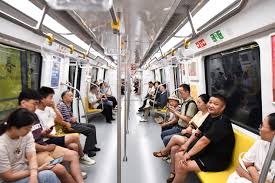
Subways, buses, and bicycles — these multi-modal travel combinations have quietly become a daily routine in many Chinese cities. In 2025, over 200 million trips across China were made via green mobility modes each day.
“Green mobility refers to an eco-friendly, low-carbon, high-capacity, and efficient transport system centered on urban public transport and non-motorized transport,” explained Chen Xumei, chief engineer at the China Urban Sustainable Transportation Research Center, China Academy of Transportation Sciences.
Transport accounts for roughly 10 percent of China’s total carbon emissions, with road transport being the dominant contributor. Promoting green mobility is therefore critical to easing traffic congestion and advancing energy conservation and emissions reduction.
In Chen’s view, green mobility in Chinese cities has evolved from a policy-driven initiative into a public preference.
The scale keeps expanding. At present, around 100 million people ride urban rail transit, another 100 million take ground buses, and 24 million use shared bicycles each day nationwide.
According to a 2024 report on green mobility development in typical Chinese cities, green mobility accounts for an average of 73.9 percent of all trips across 36 surveyed cities, rising to 75.4 percent in megacities. Urban commuting patterns are steadily becoming greener.
A large pool of potential users remains untapped. As metropolitan areas grow rapidly, cross-city commuter populations keep rising.
A 2025 report on commuting in major Chinese cities found that about 100 million people commute in China’s 22 megacities and super-large cities, with around 4 percent traveling across city boundaries.
Nearly 90 percent of people who currently rely on motorized transport but do not yet take urban public transit said they would consider reducing their use of private cars and taxis if public transport became more efficient and convenient.
What has driven the widespread adoption of green mobility? Behind this trend lies the continuous improvement of urban public transport infrastructure.
For example, Metro Line 11 in Guangzhou, south China’s Guangdong province, links five major downtown areas, with an average daily ridership exceeding 550,000. Custom shuttle buses serving the Beijing-Tianjin-Hebei region connect multiple districts around Beijing, delivering more than 5 million passenger trips in total. The ever-expanding, increasingly interconnected public transport network shrinks travel time between cities and extends the reach of green mobility.
After years of development, an efficient and eco-friendly urban public transport infrastructure system has taken shape. In 2025, 54 cities operated over 11,000 kilometers of urban rail lines. For urban buses, the total length of operating routes stood at 1.776 million kilometers, and new-energy buses made up 87.5 percent of the fleet.
Beyond hardware, public transport also offers a smoother riding experience. Chengdu in southwest China’s Sichuan province has rolled out “on-time bus” routes, using intelligent arrival-time forecasting and real-time electronic stop signs to help passengers plan their waits.
Hangzhou, in east China’s Zhejiang province, deploys a “public transport large model” for intelligent scheduling and passenger flow monitoring, enabling more precise arrival predictions in core districts.
Better transfer connections and smarter operations — digital upgrades have effectively boosted the competitiveness of green mobility across China.
Widespread public recognition for green mobility stems not only from robust hardware, but also from an enabling environment.
Riding a shared bike to the metro, taking the metro for three stops, and then walking 800 meters from the station to the office — that’s how Shanghai resident Wang Chen gets to work every day, and this trip earns Wang about 600 “carbon points” in his personal account in Amap, a popular navigation app in China.
“I only need 4,400 more points to redeem a transit pass,” Wang said. He once thought carbon reduction had little to do with him, but now contributes through his daily commute and finds it rewarding.
In 2020, Beijing pioneered a carbon inclusion mechanism: residents earn recorded and calculated carbon emission reductions for walking, cycling and riding buses or subways.
“In recent years, many regions have rolled out carbon accounts and carbon inclusion initiatives. The goal is to shift mindsets from ‘we ought to do this’ to ‘we want to do this’, making green mobility a voluntary choice,” said Li Yutao, researcher at the institute of comprehensive transportation of China’s National Development and Reform Commission.
When every travel choice can be tracked, quantified and rewarded, green mobility moves beyond an abstract concept and becomes a tangible lifestyle, Li added.
By People’s Daily reporters
The Pinglu Canal officially opened to navigation on Sept. 16. As a landmark infrastructure linking the Belt and Road Initiative and the New International Land-Sea Trade Corridor, it is China’s first major canal constructed since 1949 to directly connect inland waterways to the sea.
Stretching 134.2 kilometers, this waterway offers southwest China its shortest, most cost-effective, and most convenient outlet to the sea, carving a new landmark into China’s extensive inland river network.
The Xijiang River, a major inland waterway in southern China, and the Beibu Gulf, an inlet of the South China Sea, were once separated by rolling mountain ranges. In the past, exports shipped by water from southwest China had to take a detour via Guangzhou Port in Guangdong province, adding more than 500 kilometers to the journey. With the completion of the Pinglu Canal, the river and sea, once divided by mountain barriers, are now connected for the very first time.
In Baise, located in southern China’s Guangxi Zhuang autonomous region, Su Yonghui, head of the logistics management department of leading aluminum producer Geely Material, did the math.
“In the past, imported raw materials had to be transported from Qinzhou Port in the Beibu Gulf using both rail and road. Shipment volumes were limited, and freight costs were high. Now, with waterway transport, our overall logistics costs have fallen by 30 percent, saving us more than 10 million yuan ($1.49 million) a year,” he said.
In Nanning, the capital of Guangxi Zhuang autonomous region, a cross-border industrial and supply chain for new energy batteries has drawn industry chain leaders BYD and Do-Fluoride, alongside over 50 upstream and downstream enterprises. The full industrial chain generates an output value exceeding 60 billion yuan.
“With the canal open, logistics costs will drop, market response will quicken, and the competitiveness of enterprises will further rise,” said Bi Guochu, director of the Nanning municipal bureau of industry and information technology.
The figures tell a clear story of lower costs and greater efficiency.
“Logistics costs are expected to fall by 18 to 30 percent, and in the longer term, the canal is expected to save the regions along its route more than 5 billion yuan in freight costs every year,” said Li Yuntao, deputy director of the investment and development department of the Pinglu Canal Group.
Two major markets highlight the potential for mutual benefit.
On one side is China, home to over 1.4 billion people; on the other is ASEAN, with a population of nearly 700 million.
“A new major corridor for mutual benefit has been added between these two huge markets,” said a diplomatic envoy in China from an ASEAN country after an inspection tour of the Pinglu Canal.
“The marine-oriented economy is rooted in industry. An ‘artery-and-branch’ layout of marine-oriented industries is precisely suited to Guangxi’s interconnected network of land, sea, rivers and canals,” said Huang Lanxi, director of the policy research office of the Communist Party of China Guangxi Zhuang Autonomous Regional Committee.
He noted that the Pinglu Canal Economic Belt serves as an artery, concentrating industries that handle large volumes of cargo and are well suited to port and waterway transport. Other parts of the region form the “branch veins,” with numerous industrial parks and enterprises serving as “fine veins” deeply integrated into the division of labor across industrial chains.
But the network supporting this “artery-and-branch” layout extends far beyond the Pinglu Canal.
Across Guangxi, 65 major land corridors connect the region with other parts of China, sea access points, and border ports. The autonomous region also operates 50 ASEAN-bound container shipping routes, air links to ASEAN nations, and 12 international terrestrial fiber-optic cables for cross-border digital communications.
With coordinated development across land, sea, air, and digital connectivity, Guangxi is positioning itself as a hub facilitating market operations for both domestic and international dual circulation.
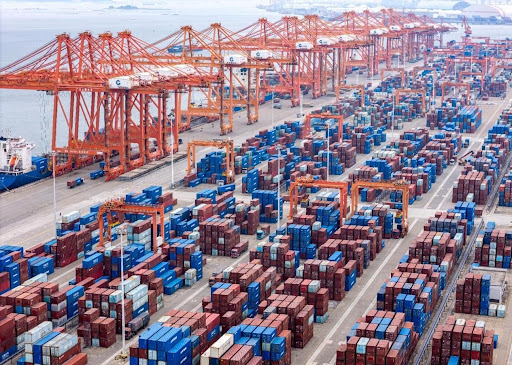
Large vessels now berth at the docks, and cranes swing into action. The Dalanping first operating area of Qinzhou Port, part of the Beibu Gulf Port, is a hive of activity.
In May 2026, 122 loaders and other pieces of equipment manufactured by Liugong Group, a Chinese multinational construction machinery company based in Liuzhou, Guangxi Zhuang autonomous region, were shipped to Jakarta, Indonesia.
In July, a new shipping route to Aqaba Port in Jordan began operations, sending more than 2,600 new energy vehicles from Chongqing and other parts of China directly to the Middle Eastern market.
“After the canal opens, inland waterway transport will be connected with the ocean shipping network, further enhancing the capacity and efficiency of the port,” said Chen Shengchang, general manager of the operating area.
The physical canal is now open, while an invisible network of connectivity is also becoming increasingly seamless.
The Guangxi Maritime Safety Administration has helped establish China’s first waterway designated as equivalent to an A-class navigation area. Inland vessels meeting the required qualifications can, under specified conditions, sail directly to deep-water berths at Beibu Gulf Port, solving the “last mile” problem between river and sea. Meanwhile, the Pinglu Canal Group has developed a smart canal sensing system that enables comprehensive monitoring across land, water, air, and space.
Technology is not only making canal operations more efficient but also providing new support for ecological conservation.
At the point where the river meets the sea, engineer Chen Zhu monitored the smart fishway at the Qingnian water control hub.
Two barbel chubs were swimming upstream against the current. Their swimming speed, body length, and body width were captured by the system in real time.
The Qingnian water gate, built in 1959, has long provided water resources for local communities but also blocked fish migration. As the old gate was replaced with a new structure, an innovative composite fishway, the first of its kind in China, was built alongside the Qingnian water control hub.
“Fish from both the sea and the river can find their way home here,” Chen said.
He added that the difference in water level between the upstream and downstream sides of the hub is nearly 10 meters. To allow fish to move gradually between the different levels, the fishway was carefully designed with a winding, three-loop vertical-slot structure.
So far, 78,474 fish have been recorded swimming upstream and 119,987 swimming downstream, with more than 10 species successfully completing their migration.
The canal excavation involved moving 315 million cubic meters of earth and rock. With such a massive volume of material, where could it all go?
Professor Xiao Jianzhuang, president of Guangxi University, led a team specializing in the resource utilization of solid waste. The team visited the project site more than 90 times and explored a range of ways to reuse the excavated material, including land formation, green building materials, mine-pit restoration, and land reclamation.
Through seven disposal and utilization technologies, more than 98 percent of the excavated soil and rock was put to productive use rather than treated as waste.
At an open stretch of land along the canal, Tang Xiaofu, an associate professor at Guangxi University, stepped into a greenhouse and picked a plump winter melon.
The land was formed using soil excavated during the canal construction to fill valleys, then improved and fertilized using scientific methods.
“We grow tomatoes in winter and melons in spring. The annual output value can reach 50,000 yuan per mu (about 667 square meters),” Tang said.
More than 10,000 mu of such farmland has now been developed along the canal.
“Building the Pinglu Canal to high standards and with high quality means respecting and protecting nature,” said Hu Ya’an, an academician of the Chinese Academy of Engineering who has been deeply involved in the canal’s construction.
In his view, the Pinglu Canal not only is a new example of ecological conservation in major engineering projects around the world, but also sets a new benchmark for quality in canal construction worldwide.
By Zheng Yangyang, People’s Daily
Taiyuan, the capital of north China’s Shanxi province, is a nationally designated historical and cultural city and the birthplace of Jin culture and the spirit of Shanxi merchants. Nestled against mountains to the east, west, and north, and bisected from north to south by the Fenhe River, the city has long been celebrated as a “city of splendid beauty.”
Today, Taiyuan stands as a modern city with a thriving ecosystem, vibrant energy, and a seamless blend of ancient heritage and contemporary progress. It embodies the qualities of a livable, business-friendly, and tourist-welcoming destination.
The clear waters of the Fenhe River reflect a remarkable ecological transformation
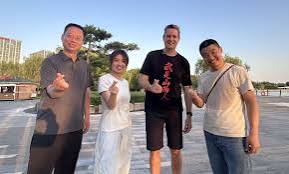
A healthy natural environment has become one of Taiyuan’s defining hallmarks. For Andy Edgren, an American who has maintained a deep connection with the city for more than four decades, the transformation of the Fenhe River is especially striking.
Once plagued by water shortages, shrinking ecological space, and pollution, the river now flows with clear water, lined by lush green banks. Its revival reflects not only improvements in Taiyuan’s environment but also signals a fundamental shift in the development philosophy and way of life of this historically industrial city.
“The city has changed so much. When my father and younger brother saw what the Fenhe River looks like today, they could hardly believe it!” Andy said.
Andy first came to Taiyuan with his father in the 1980s. Both worked as English teachers at Shanxi University and lived in the city for more than three years. Since then, he has returned to Taiyuan about 50 times, staying for several months on each visit.
As the second-largest tributary of the Yellow River and the mother river of Shanxi, the Fenhe River had fallen into dire straits by the end of the 20th century: flooding in the rainy season, near-dry conditions in the dry season, and polluted water at other times. To restore the river’s ecosystem and improve the urban living environment, Taiyuan has carried out comprehensive management of the Fenhe River for more than 20 years.
Today, the Taiyuan section of the Fenhe River features 12 cascade impoundment lakes and 6.67 million square meters of artificial wetlands. The river maintains a stable water surface of 11.5 square kilometers and remains clean year-round, with a storage capacity of 30 million cubic meters that helps reinforce its ecological defenses.
“One of my favorite things to do in Taiyuan is to take an evening walk along the Fenhe River with friends. When the lights on the buildings and bridges along the river come on, they keep changing colors, like a rainbow,” Andy said. “I like Taiyuan. It’s a very livable city.”
The spirit of Shanxi merchants fuels entrepreneurial vitality
Three years ago, Mexican entrepreneur Mauro Arturo Salazar Zavala, known locally as Maodou, settled in Taiyuan with his wife, Yang Miao. It marked the start of his connection with the city. As Taiyuan undergoes industrial transformation, expands cross-border e-commerce, and grows its digital economy, it is emerging as a new hub linking inland China with domestic and international markets.
During his research, Maodou discovered that Taiyuan has assembled suppliers and specialty goods from all over Shanxi. Iconic local offerings including mature Shanxi vinegar, millet and other coarse grains, and intangible cultural heritage handicrafts align closely with consumer tastes in Latin America, boasting unique advantages for export. This inspired him to reframe his entrepreneurial approach and pivot to exporting Shanxi’s distinctive products.
In his search for quality goods, Maodou also found a “key” to understanding Taiyuan and Shanxi — the spirit of Shanxi merchants.
During the Ming and Qing Dynasties (1368-1911), Shanxi merchants set out from Taiyuan and expanded their markets through integrity, cooperation, and mutual support. They sold Shanxi products across China and overseas, building a vast commercial network that connected far-flung markets. Their legacy helped shape Taiyuan’s open, inclusive, and outward-looking character.
Since the beginning of this year, Taiyuan has established a specialized cross-border digital industry park and promoted the integrated development of cross-border e-commerce and local specialty industrial clusters. The city continues to improve its foreign trade ecosystem and attract new talent to the sector.
“I can see Taiyuan’s e-commerce and trade ecosystem is becoming ever more vibrant, with a rising number of practitioners. We exchange experiences, share resources, and support one another, just as the ancient Shanxi merchants did,” Maodou remarked.
Rich cultural heritage connects the city’s past and present
For Andy and Maodou, Taiyuan’s enduring appeal also lies in its rich cultural heritage. They have visited ancient buildings, museums, and historical neighborhoods, recording the city’s transformation through their cameras while showing overseas audiences a more diverse and multifaceted Taiyuan.
At the Taiyuan Northern Qi Dynasty Mural Museum — China’s first mural museum built at the original site of the murals — Maodou put on a virtual reality headset and immersed himself in the process of archaeological excavation and mural conservation.
“Modern technology allows visitors to gain a more direct and clearer understanding of burial murals,” he said. “Technology has not diminished the weight of history. Instead, it has made this ancient civilization more tangible and accessible.”
The museum is one example of Taiyuan’s broader efforts to protect and make innovative use of its cultural heritage. The city currently has 2,237 above-ground cultural heritage sites and 541 sites under protection at various levels. It is also home to 108 museums.
Strolling along Bell Tower Street, visitors can see historical buildings alongside modern businesses, while traditional lanes have embraced new forms of commerce, including restaurants, live performances, and cultural and creative products.
“Today’s Taiyuan has both an ancient history and a vibrant modern side. I’m particularly drawn to the way the city brings together quiet charm and youthful energy,” Maodou said.
A city renewed
The ecological renewal along the Fenhe River, new opportunities created by cross-border e-commerce, and the fresh vitality brought to ancient buildings and historical streets by cultural development — all these changes are giving Taiyuan a new look.
For more than four decades, Andy has returned to Taiyuan time and again, sharing the city’s story with foreign friends around him on each visit.
“I tell them they really should come to China and see Taiyuan for themselves,” he said.
China
Xiong’an builds full-cycle ecosystem for aerospace information and satellite internet industries
By Shao Yuzi, People’s Daily
Xiong’an New Area in north China’s Hebei province is accelerating the development of its aerospace information and satellite internet industries. A growing industrial ecosystem now covers research and development, manufacturing, testing, launch, and in-orbit applications.
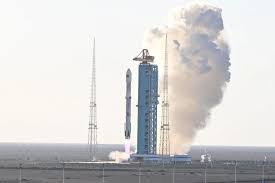
The latest milestone came on Aug. 19, when the Honghu-03 satellite, also known as Xiong’an-1, was successfully launched into orbit aboard a Zhuque-3 Y2 reusable rocket from the Dongfeng commercial space innovation pilot zone in Jiuquan, northwest China.
At the satellite intelligent operation and management center of Hongqing, China’s only fully integrated satellite constellation solution provider with full ecosystem capabilities, in the pilot production base of the Xiong’an Science and Technology Innovation Center, when telemetry signals from Xiong’an-1 appeared on a large display screen, staff members erupted in cheers.
As the first satellite developed and launched by Xiong’an New Area to enter orbit, Xiong’an-1 incorporates dozens of advanced technologies. Its successful launch marked the completion of a full-cycle industrial chain in the aerospace information and satellite internet sectors of Xiong’an New Area, spanning research and development and manufacturing to in-orbit applications.
Just a few years ago, aerospace information and satellite internet were still relatively new concepts in Xiong’an. In 2021, China Satellite Network Group Co., Ltd. (China SatNet) was established there. In October 2024, the group officially relocated its headquarters to Xiong’an New Area. As a “chain leader” tasked with spearheading China’s development of aerospace information and satellite internet, the company has generated strong demonstration and spillover effects.
“China SatNet is here, so we came here too. Being closer to the chain leader helps us iterate our products faster,” said Chen Wei, chairman of CHIP LINKING INNO, a company focused on the R&D and production of high-end optoelectronic devices.
Chen spent more than a decade conducting research at the Institute of Semiconductors under the Chinese Academy of Sciences. Sensing an opportunity in the emerging industry, he led a team to Xiong’an in 2023 to advance the R&D and production of key components for satellite laser communications, including lasers, amplifiers, and communication modules.
When Chen started his business in Xiong’an, the aerospace information and satellite internet industries were still in their infancy, with a relatively weak industrial foundation. What gave him confidence, however, were the new area’s clear and forward-looking industrial planning, supportive policies for talent and full-cycle services for businesses.
“Xiong’an connects innovation with industry. Companies across the upstream and downstream segments are gathering and developing here, and there will be even more platform resources in the future,” Chen said.
Today, CHIP LINKING INNO is far from the only company that has made its way to Xiong’an.
At the pilot production base of the Xiong’an Science and Technology Innovation Center, technicians at the satellite intelligent manufacturing workshop of Blue Arrow Hongqing (Xiong’an) Space Technology Co., Ltd. were testing a visual recognition system on an intelligent production line. Hongqing is currently applying AI and other emerging technologies to continuously improve production-line efficiency.
The development of industrial platforms is advancing in parallel. Equipment installation and commissioning have been completed at a shared satellite intelligent manufacturing center and shared satellite testing center in the second phase of the pilot production base. Nearby, construction is also moving ahead on a satellite super factory and a supporting base for the final assembly of commercial satellites.
“Once these industrial platforms become operational by the end of this year, Xiong’an will have the capacity to produce 300 satellites annually,” said an official with the industry, information technology, science and technology, and data bureau of Xiong’an New Area.
“Xiong’an New Area has made aerospace information and satellite internet the first industrial chain to receive priority deployment. We are creating favorable conditions, building platforms, opening up application scenarios, providing policy support, improving the business environment, and upgrading services to attract more companies and foster industrial clustering,” the official told People’s Daily.
“Our goal is to build Xiong’an into an important source of innovation for China’s commercial space industry and satellite internet sector, as well as a key supplier for the development of low-Earth-orbit constellations,” the official added.
Innovation resources are also rapidly gathering. Xiong’an is now home to 69 companies across the aerospace information industrial chain and nine innovation platforms.
As one of China’s pilot cities for the large-scale application of the BeiDou Navigation Satellite System (BDS), Xiong’an is also making active use of aerospace information technologies to support urban development and accelerate the rollout of “BeiDou +” applications.
At a smart construction site in the start-up area of Xiong’an New Area, construction equipment such as road rollers and asphalt pavers are equipped with the BDS. They can automatically plan their routes and adjust their operating pace, with positioning accuracy controlled to within centimeters.
Baiyangdian Lake, the largest freshwater lake on the North China Plain, is another example. In Anxin county, all 24 rural tourism piers and more than 1,500 vessels have been equipped with dedicated BeiDou terminals. High-precision BeiDou positioning enables continuous monitoring of vessel movements and intelligent scheduling of water-based tourism services.
Today, “satellite internet + BeiDou” is being applied in a range of scenarios in Xiong’an, including underground spaces, smart construction sites, and the low-altitude economy.
And BeiDou is only one part of the picture. An increasing number of aerospace information technologies are being put to practical use in Xiong’an.
Recently, CHIP LINKING INNO’s research team joined forces with a payload company in the new area to explore ways of bringing laser communications “from the sky to the ground.”
Baiyangdian Lake is dotted with numerous scattered islands, making it difficult to lay fiber-optic cables between them. The team is therefore building laser communication links to replace fiber optics, with a transmission range of up to 10 kilometers.
“Satellite internet technology is bringing about a transformation from the sky to the ground,” Chen said.
Looking ahead, his team will continue to tackle key technologies for ultra-high-speed laser communications while exploring a wider range of applications, with the aim of bringing the benefits of satellite internet technology to households across the country.


Pinglu Canal connects rivers, sea, and new opportunities

Taiyuan in North China takes on a new look

Xiong’an builds full-cycle ecosystem for aerospace information and satellite internet industries

-
 Uncategorized6 years ago
FG, states urged to harness flooding for ranching, others with technology – Agbaje
-
 Headlines11 years ago
Breaking: EFCC seals Borno House of Assembly, as Hon members take to their heels
-
 News12 years ago
Nigeria Security Operatives Stage Manhunt For Homosexual Perpetrator
-
 News10 years ago
How 21-year-old Girl fled community over accusation of lesbianism
-
 News11 years ago
Yobe Gov Moves Against Deputy
-
 Opinion7 years ago
7 signs she has friend zoned you
-
Technology5 years ago
Online job placement company headhunts women
-
 Headlines10 years ago
Borno Dep Gov Abducts Another Church Leader