
Uncategorized
China, Africa to keep deepening industrial chain cooperation


By Wan Yu, People’s Daily
A report titled “Chinese Investment in Africa 2023” was recently released in Beijing. By analyzing over 90 Chinese companies and 20 China-Africa cooperation projects, the report explores the impact of the China-Africa policy framework and existing cooperation models on the African industrial chain.
It particularly emphasizes the role of Chinese enterprises in the development and transformation of the African industrial chain, and highlights the future potential of China-Africa industrial chain cooperation.
The report showcases a wide range of examples to demonstrate the contributions made by Chinese companies to the transformation and development of Africa’s industrial chain in various sectors such as agriculture, manufacturing, digital economy, pharmaceuticals, logistics, and infrastructure. These examples include a hybrid rice demonstration project in Madagascar, a fiberglass production line set up by Chinese company Jushi in Egypt, the cross-border e-commerce platform Kilimall in Central Africa, the Nairobi-Malaba railway in Kenya, and the 150 MW Noor III Concentrated Solar Power project in Morocco.
Wu Peng, director-general of the Department of African Affairs of China’s Foreign Ministry, noted that China is leveraging the Belt and Road Initiative (BRI) and the Forum on China-Africa Cooperation (FOCAC) to strengthen its alignment with the African Union’s Agenda 2063 and the development strategies of African countries.
According to him, the focus is on promoting African industrialization through investment cooperation, enhancing the value-added of African resources, and expanding the share of African manufacturing in the global supply chain.
“The investment and economic cooperation between Africa and China is continuously expanding, with steady growth in bilateral trade volume and a gradual increase in the value-added of African products. This is highly encouraging,” said Arkebe Oqubay, former special adviser to the Prime Minister of Ethiopia.
He emphasized that China attaches great importance to strengthening clean energy cooperation with Africa and has become one of the main partners of Africa in clean energy development.
Sharing the green and low-carbon practices in industrial parks in Hawassa and other parts of Ethiopia, Oqubay stated that with strong support from Chinese investment, Ethiopia is gradually enhancing its green infrastructure development, and the Ethiopian government actively supports Chinese companies’ investment and projects in the country.
As of the end of 2022, China’s direct investment stock in Africa had exceeded $47 billion, with over 3,000 Chinese companies investing and operating in Africa. In the first half of this year, China’s direct investment in Africa exceeded $1.82 billion, a year-on-year increase of 4.4 percent. Chinese companies’ confidence in the African market continues to strengthen, and they are keeping expanding the areas of investment in Africa.
Wang Dong, deputy director-general of the Department of West Asia and Africa Affairs of China’s Ministry of Commerce, noted that Chinese companies’ investment in Africa has expanded from traditional sectors such as construction, mining, manufacturing, wholesale, retail, and agriculture to new sectors including trade logistics, digital economy, clean energy, healthcare, green development, and finance, and Chinese companies have also invested in industrial parks and economic cooperation zones in many African countries.
The effects of agglomeration continue to emerge, promoting industrialization and agricultural modernization in Africa, Wang added.
The report highlights that China-Africa industrial chain cooperation has facilitated the transformation and development of African industrial chains through six major models: industrial alignment and capacity cooperation, investment in industrial parks, infrastructure development and strengthening of industrial foundations, technology transfer and talent development, demand stimulation and supply promotion, as well as institutional innovation and practical exploration.
Deputy executive secretary and chief economist at the United Nations Economic Commission for Africa Hanan Morsy said both the Chinese and African markets hold immense potential, and the close cooperation between the two sides in the field of trade and economy is fueling the intrinsic growth of Africa.
“The investment by Chinese companies is a focal point of interest for many African countries,” said Ibrahima Sory Sylla, Ambassador of Senegal to China, adding that as African industrialization continues to progress, Chinese investment in the industrial chain is driving the continent’s industrial transformation.
“The FOCAC continues to play a crucial role in promoting investment in Africa, and African countries are looking forward to more investment from Chinese companies,” he noted.
Over the past 10 years since the BRI was proposed, the initiative has received active support and enthusiastic participation from African countries. Africa has become one of the most important partners of China for Belt and Road cooperation, and almost all countries on the continent have joined the BRI. The connectivity cooperation between China and Africa has accelerated, driving the development of the entire industrial chain.
According to Jeffrey Sachs, director of the Center for Sustainable Development at Columbia University, the positive development of China-Africa economic and trade relations is mutually beneficial for both parties and crucial for the global economy as a whole. The BRI, along with China-Africa economic and trade cooperation and the African Continental Free Trade Area, complement each other and create a favorable trade environment. This will bring about more market opportunities, help address poverty and other issues faced by Africa, and promote the process of African integration.
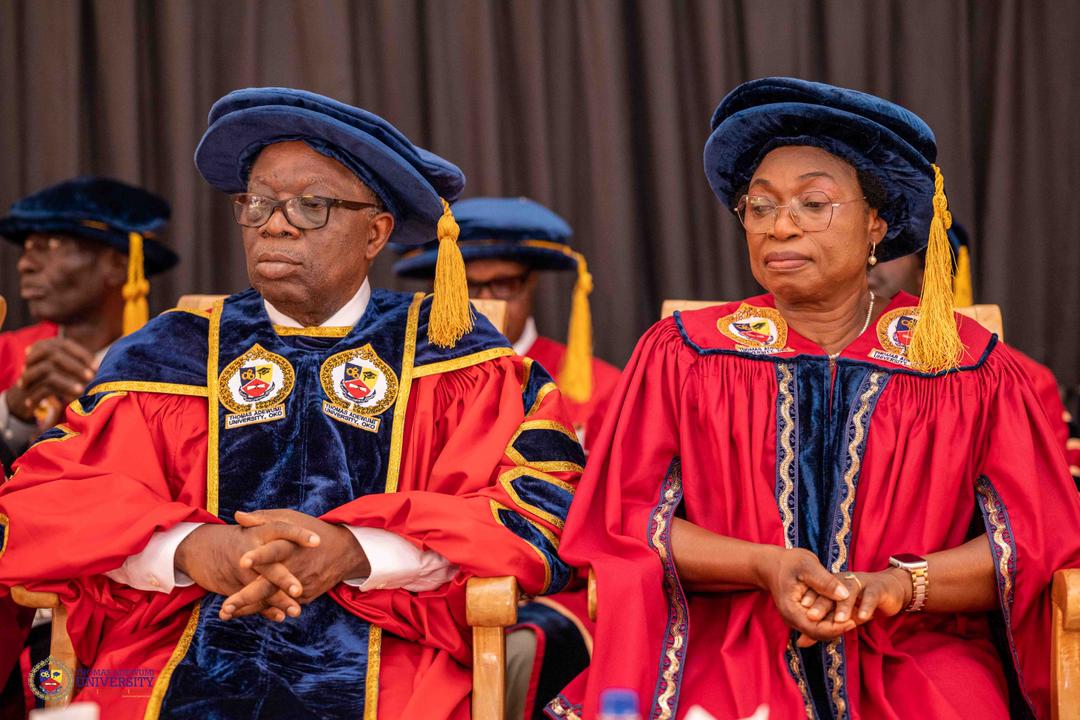
- As 16 graduands make First Class
Stephen Olufemi Oni, Ilorin
The Thomas Adewumi University (TAU), Oko-Irese, in the Irepodun local government area of Kwara State, has reaffirmed its commitment to strengthening quality education, innovation, and globally competitive learning.

Speaking at the institution’s 2nd Convocation ceremony in Oko-Irese, the Vice Chancellor of the University, Professor Francisca Onaolapo Oladipo, said TAU is living up to its ranking as the fastest growing institution in Science, Technology, Engineering, Medicine, and Innovation (STEM-i) ecosystem by surpassing more than 100 percent in its number of graduating students at the second convocation.
She said: “TAU emerged on April 8, 2021, as Nigeria’s fastest-growing Science, Technology, Engineering, Medicine and Innovations (STEM-i) ecosystem. Today, we rank 1st among the 20 private universities that were licensed in
2021, 4th among the 14 Universities in Kwara State, 5th among Nigeria’s over 170 private Universities and 50th nationally, an impressive rise reflecting our unwavering commitment to excellence.
”What a Moment of Extraordinary Significance today, we stand at a crossroads far more significant than words can adequately capture. Exactly one year ago, we gathered at this very Auditorium to celebrate our inaugural Convocation, a ceremony that marked the graduation of 26 pioneering students who dared to believe in a vision when others saw only impossibility. Those 26 trailblazers proved that Thomas Adewumi University was not just a dream, but a reality rooted in excellence. Today, as we honour 63 outstanding graduates, we witness something far more profound than numerical growth.
“This 142% increase in our graduating class is not merely a statistic to be recorded in annual reports, it is a declaration that Thomas Adewumi University has transcended the realm of promise and entered the domain of proof.
“We have moved from potential to performance, from aspiration to achievement, from vision to velocity.
This year, 63 graduands from 4 Faculties and 11 academic programmes are being conferred. It is noteworthy that we have 16 First Class graduates, 40 in Second Class Upper Division, and 7 in Second Class Lower Division. These results reflect the quality of training and mentorship provided at Thomas Adewumi University, and we are proud to contribute these innovators to both the Nigerian and global workforce, confident that they will make a meaningful
impact.
”Preparing Globally Competitive Graduates, these 63 graduands are not merely degree holders, they are comprehensively prepared global professionals equipped with exceptional advantages that set them apart from their peers nationwide. Through our international partnerships, these graduates have obtained additional microcredentials from MIT, Harvard, Stanford, Columbia, Berkeley, and Yale, world-class certifications from Alison, UK, RUDN professional University, Russia, World Bank’s Saylor Academy, Google, ICAN, and the Global Partnership for Sustainable Development initiatives in Data Science and Artificial Intelligence.
“Our Coursera collaboration provided them with additional industry certifications, while partnerships with Microsoft, IBM SkillsBuild, and MIT OpenCourseWare through our Global Campus initiative democratize access to cutting-edge knowledge. They are thus fully equipped to embark on meaningful and innovative careers in today’s technology-driven world.”
Earlier in his Convocation Lecture, titled “Crowdfunding Opportunities forstartups: Equiping Nigerian graduates for a sustainable future”, Dr. Bayo Williams Olugbemi charged the graduads on the mindset of job creation, saying “as a graduate, your future is not defined by what Nigeria gives you, but by what you create. The idea of crowdfunding is the idea of hope. It is proof that when people come together, ideas once impossible become achievable.
“I urge you not to think only about searching for jobs. Instead, think about creating value, and if capital is a barrier, remember: “The crowd can be your first investor.”
In his goodwill message, the Executive Secretary of the National University Commission, Professor Abdullahi Ribadu, represented by Esther I. Eyo, Esq commended the resilience of TAU management said “NUC acknowledges TAU sustained progress in advancing quality teaching, impactful research, innovation, and community engagement, all of which align with our national aspiration for a globally competitive and knowledge-driven university system.
“It would interest you to know that, in the accreditation exercise conducted in 2023, Thomas Adewumi University achieved a 100% Full Accreditation status across all programmes assessed a laudable feat that reflects the University’s strong commitment to maintaining high academic standards.”
Also speaking, the Founder/Chancellor of the institution, Dr. (Engr) Johnson Adewumi, urged the graduands to be good ambassadors of the University, adding: “Remember that your degree is not an end but a beginning, go forth with courage, humility, and a sense of responsibility. Strive to illuminate whatever space you occupy with the light of integrity, excellence and service.”
Highlight of the event was the conferment of an honorary doctorate degree on two distinguished personalities; Engr Oluseyi Afolabi and Pastor Oladokun Olatunde.
End
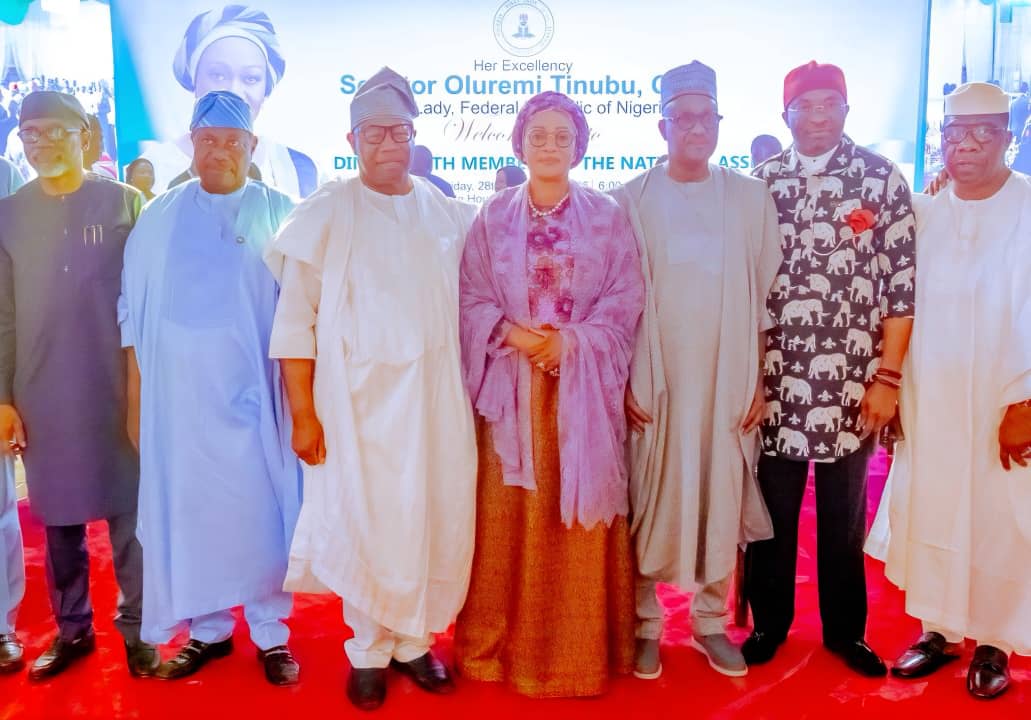
L-r Speaker, House of Representatives, Tajudeen Abbas; President of the Senate, Godswill Akpabio and Nigeria’s First Lady, Senator Oluremi Tinubu, during the dinner for members of the National Assembly by the First Lady yesterday. Photo: Senate President’s Office.

By Hassan Taiye
Senator Ali Ndume has criticised what he described as the excessive use of security convoys by top government officials, including President Bola Tinubu, warning that the practice leaves ordinary citizens exposed and vulnerable.
Speaking on Politics Today on Channels Television on Thursday, Ndume said many public office holders move with security details that are unnecessarily large, even when their positions do not warrant such heavy protection.
He recalled visiting the residence of a colleague and finding “more than 10 policemen” attached to him, despite the lawmaker being junior to him in the National Assembly.
Ndume further argued that the presidential convoy itself is excessively large, stressing that security efforts should be focused on protecting the overall environment rather than individual personalities.
He said: “I went to one of my colleagues’ house for dinner. And I saw more than 10 policemen. He is even my junior in the National Assembly. Some of them, if you see them coming, you will pull back thinking that maybe it’s the President or the Vice President that is coming.
“
You can see even the president, the convoy that the president goes about with is too much. Secure the place and when the president goes, you withdraw. Secure Abuja and the president can even drive out, you know, himself.
But when you secure personalities, and this is what is happening in Nigeria, then others, common people, as we call them, become vulnerable, and we don’t care. So if you secure Abuja, then you can drive at night. And let me tell you, this is what is happening in most countries”.
The lawmaker’s comments come just days after President Tinubu ordered the withdrawal of police officers from VIP escort and guard duties.
In a statement, the Special Adviser to the President on Information and Strategy, Bayo Onanuga, said the directive was aimed at redeploying police manpower to core law enforcement responsibilities.


The Most Shocking A/Court ‘Judgment’ in Nigerian History: An unfortunate precedent that should not be allowed to stand

TAU reaffirms commitment to globally competitive learning

photo

-
 Uncategorized5 years ago
FG, states urged to harness flooding for ranching, others with technology – Agbaje
-
 Headlines10 years ago
Breaking: EFCC seals Borno House of Assembly, as Hon members take to their heels
-
 News11 years ago
Nigeria Security Operatives Stage Manhunt For Homosexual Perpetrator
-
 News9 years ago
How 21-year-old Girl fled community over accusation of lesbianism
-
 News10 years ago
Yobe Gov Moves Against Deputy
-
 Opinion7 years ago
7 signs she has friend zoned you
-
Technology4 years ago
Online job placement company headhunts women
-
 Headlines10 years ago
Borno Dep Gov Abducts Another Church Leader