
Foreign
China sees rapid offshore wind power development


Ding Yiting, People’s Daily
In the sea area of northern Fujian province of China, rows of hundred-meter-high white wind turbines spin steadily, delivering green energy to thousands upon thousands of households.
Recently, the world’s first 16-megawatt offshore wind turbine was successfully connected to the grid here, taking China’s offshore wind power development, manufacturing and operating capabilities to new heights.
By the end of 2022, China’s cumulative installed capacity of offshore wind power exceeded 30 million kilowatts, ranking first globally for two consecutive years. This figure accounted for around half of the world’s total.
The cumulative capacity was around 390,000 kilowatts at the end of 2012, and by the end of 2017, that figure surged to around 2.79 million kilowatts. This shows that despite a late start, China’s offshore wind power has developed rapidly and entered a large-scale development phase.
There are several key features of the 16-megawatt offshore wind turbine. Its single blade is 123 meters long and the total sweep area of the blades is equivalent to the area of seven football fields. The turbine’s hub is 152 meters in height, equivalent to the height of a 50-story building.
It can generate over 66 million kilowatt-hours of green electricity annually, which can meet the electricity consumption of 36,000 three-member households for a year.
The wind turbine has made important technological breakthroughs in the R&D and manufacturing of key core components such as ultra-long lightweight blades, large shaft bearings and miniaturization of ultra-large capacity generators.
From the 1.5-megawatt offshore wind turbine built in China’s Bohai Sea in 2007 with blades shorter than 40 meters, to today’s 16-megawatt offshore wind turbine, China’s offshore wind power growth has been marked by a progression toward larger units.
According to Yu Chenguang, general manager of the offshore business unit of Goldwind, a global leader in clean energy, energy conservation, and environmental protection, 125 wind turbines each with a power generation capacity of 8 megawatts are needed to sustain the operation of a one-million-kilowatt offshore wind project.
Only 63 wind turbines each with a power generation capacity of 16 megawatts are needed to support the same project, Yu added, saying that this reduces the area of sea demanded by over 35 percent and foundation costs by over 40 percent.
Besides, the 16-megawatt wind turbine increases energy capture efficiency, generating over 6 percent more electricity than two 8-megawatt turbines combined, Yu said. Overall, the cost of electricity generation can be reduced by about 12.5 percent.
This is just an epitome of China’s rapid development of the offshore wind industry.
Qin Haiyan, secretary general of the Chinese Wind Energy Association, said China now has independent capabilities in offshore wind turbine design, R&D, manufacturing, installation, commissioning and operation.
China’s production of generators, wheel hubs, and towers, along with key components such as blades, gearboxes and bearings, accounts for over 70 percent of the global market.
In September 2022, Baihetan, an independently built offshore wind power installation platform with a lifting capacity of 2,000 tons, was delivered and put into operation, greatly enhancing offshore wind turbine construction and installation capabilities.
Relying on large-scale development and technological progress, the economic efficiency of offshore wind power has been greatly improved.
Qin said from 2010 to 2021, the cost of generating electricity with offshore wind farms dropped by nearly 56 percent, adding that the average kWh cost of offshore wind power projects has been lowered to about 0.33 yuan (about $0.05) at present, and the cost will be as low as other sources of electricity by 2025.
China’s offshore wind power enjoys broad development prospects.
There are abundant resources for its development. China has around 18,000 kilometers of mainland coastline, with rich offshore wind energy resources.
“Around 2.78 billion kilowatts of wind resources can be exploited. They exist in waters up to 200 km from shore, in ocean depths less than 100 meters deep, and up to 150 meters above the sea surface. The resources span both nearshore waters along the coast and distant waters farther offshore,” Qin remarked.
“At present, the cumulative installed capacity of offshore wind turbines is only more than 30 million kilowatts, and the utilization rate is less than 1.1 percent. The future development potential is huge,” Qin added.
China’s eastern and coastal areas lead the country in power consumption, but other energy resources are mainly concentrated in the western and northern regions. Developing offshore wind power projects off the coast enables the coordinated use of various energy resources.


By Ding Yasong, People’s Daily
For Jin Yipeng, vice dean and professor at the College of Veterinary Medicine of China Agricultural University, clinical practice rarely unfolds in a conventional operating room. His patients — some of the world’s most endangered species — are often found deep in mountain forests or high on alpine plateau.
Specializing in wildlife medicine, Jin has devoted his career to the rescue and treatment of endangered animals, from giant pandas to snow leopards. Over the years, each successful rescue has left behind not only medical records but also vivid moments captured on his phone.
Scrolling through the photos, the 47-year-old recalled each encounter. “This is Tangtang, a giant panda — when released back into the wild, a butterfly landed on its back,” he shard. “And this is Meng’er; the discoloration around its eyes was later resolved.”
Jin smiled as he spoke of Yimao, a male panda: “Now when Yimao sees me, it sometimes rolls over and sits close beside me. That kind of mutual trust — it feels really rewarding.” Among the animals he has treated, giant pandas account for the largest share.
“Our team began rescuing giant pandas in 2008 at the Foping National Nature Reserve in Shaanxi,” Jin recalled.
“As a male, Yimao often gets injured in fights,” Jin explained. Once, Yimao was bitten by another panda — its teeth were loosened and displaced, its face covered in blood, and immediate treatment was needed.
Startled, Yimao fled ahead, with Jin and his team chasing after it at full speed. The panda eventually stopped by a stream, exhausted. To avoid alarming it further, Jin laid down in the icy water.
“It was winter, and I was wearing a down jacket,” Jin recalled. “I half swam, half crawled through the stream for over 20 minutes, inching closer until I was within about four meters. I then shot it with a blow dart to administer anesthesia and carried out the subsequent treatment.”
Over more than a decade, Jin has conducted over 10 medical examinations and treatments of varying complexity on Yimao. Now 21 years old — considered elderly for a giant panda — Yimao has seen its foraging ability decline significantly.
In May 2025, Jin’s team launched a field-based rehabilitation and health maintenance program for wild giant pandas. “We assigned a full-time veterinarian to locate Yimao daily, supplement its nutrition through dietary therapy, and administer targeted medication,” Jin said. “The animal’s recovery has been very encouraging.”
“Recent follow-up examinations show that all indicators are close to normal,” he added. “We hope this approach will help extend its lifespan.”
Why did Jin choose to dedicate himself to wildlife rescue? He has a clear answer.
In 2007, Jin went to the United States as a visiting scholar to study wildlife medicine, marking the beginning of his professional journey in this field.
“After returning to China, I interned at a wildlife breeding institution,” he said. “During one giant panda rescue operation, I realized the limits of our treatment capabilities — we still need to consult foreign experts and follow overseas medical standards.”
“That moment solidified my resolve to change the situation,” Jin recalled.
Over more than decade-long career, Jin has treated more than 1,000 wild animals, ranging from giant pandas and snow leopards to Asian black bears and Chinese mountain cats.
In early 2019, his team received an emergency case at the the Qinghai Wildlife Rescue and Breeding Center in northwest China’s Qinghai province: a severely injured elderly male snow leopard, near shock from life-threatening wounds. Jin and his team immediately rushed to Xining, Qinghai’s provincial capital. “During the examination, we found that its left eye had a corneal perforation caused by trauma, and the right eye had a severe cataract that required surgical treatment,” Jin added.
Performing phacoemulsification cataract surgery on a wild snow leopard was unprecedented. “While this technique is routine for domestic cats and dogs, the real challenge was designing a suitable intraocular lens,” Jin said. “We contacted every manufacturer but found no existing snow leopard lens molds.”
Undeterred, Jin adapted equine three intraocular lenses — ordering three from overseas and modifying them based on years of research. The successful surgery restored the snow leopard’s vision.
“Just two years ago, we performed another cataract surgery on a snow leopard,” Jin stated proudly. “This time, we used China’s first domestically developed snow leopard-specific intraocular lens — a technologically superior and more cost-effective breakthrough.”
Through years of hands-on rescue work, Jin has witnessed the rapid development of wildlife medicine in China.
“In the early days, we could only perform basic examinations using stethoscopes and test strips,” he said. “Today, we have wildlife medical vehicles, portable ultrasound devices, and X-ray machines with fully independent intellectual property rights, enabling on-site examinations and treatment directly in the field.”
In recent years, Jin has devoted considerable effort to preventive conservation. At the Foping National Nature Reserve in Shaanxi, he has gone door to door vaccinating villagers’ dogs.
“Unvaccinated domestic can transmit fatal diseases to pandas and other wildlife,” Jin explained. “Small preventive measures yield significant protection,” Jin observed. He remains committed to raising public awareness, fostering a shared societal responsibility for wildlife conservation.
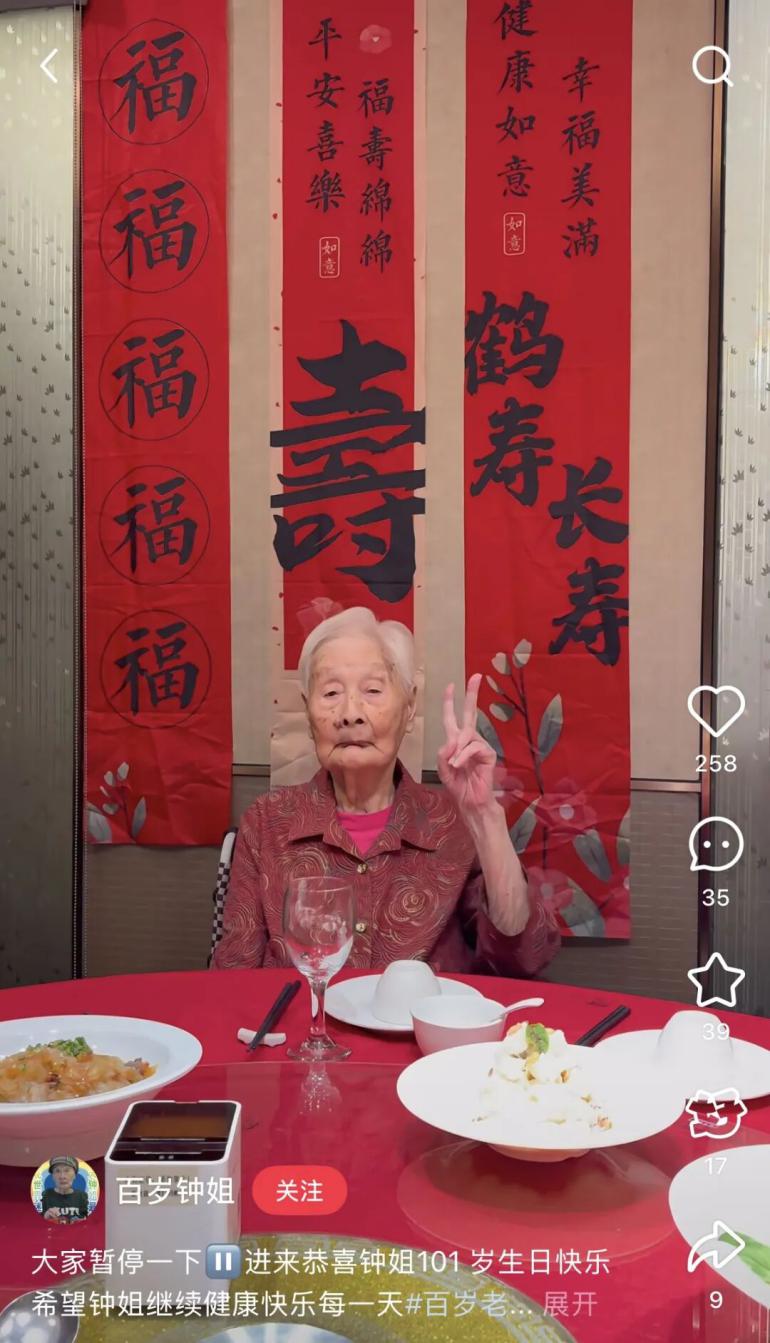
By Zhong Wenyu
My name is Zhong Wenyu. I am 100 years old ~and~ live in Shanghai. On winter afternoons, I sit by the window, basking in the sun. A cup of hot milk tea rests on the coffee table, and my fingers glide across the screen of my tablet — I’m nearly finished with this level of the match-three game.
My youngest daughter likes to tease me, calling me a “playful old child.” But I feel there is still a little girl inside me, curious about the world.
I love food and enjoy trying new things.
When it comes to eating, I like to keep up with young people. Knowing my fondness for good food, my children often bring home novel treats — burgers, fried chicken, all kinds of desserts. I taste whatever they hand me. If it’s good, my eyes light up: “This is nice, let’s get more next time.” If it doesn’t suit my palate, I simply say nothing more.
I especially love crabs. Dipped in ginger and vinegar sauce, they are incredibly fresh. Although I have almost no teeth left and my gums are shallow — doctors advise against dentures for me — none of this stops me from enjoying good food.
Recently, my granddaughter set up a social media account for me called Baisui Zhongjie, which means centenarian sister Zhong, and filmed a short video: I sit at the dining table, fully focused on eating a marinated crab, slowly turning the shell in my hands and picking it clean, savoring every bit of meat. After the video was posted online, it received many warm messages from young people I had never met.
My daughter often says that I don’t watch what I eat and don’t quite live up to their ideas of healthy eating. But the truth is, at my age, being able to indulge a little within reason and savor such simple pleasures feels like a gift — a small blessing from life itself.
As one grows older and less mobile, it becomes all the more important to find small joys — life cannot be too dull.
I love reading. In the past, my favorites were Chinese novelist Jin Yong’s martial arts novels, which I would read page by page with a magnifying glass, utterly absorbed. As heavy books became difficult to hold, my daughter replaced them with a tablet.
At first, I watched TV dramas on it. My daughter joked that drama producers couldn’t keep up with my speed of viewing them. Later, my granddaughter taught me how to play games — solitaire, match-three games. Sliding my fingers across the screen and watching colorful blocks disappear is quite entertaining.
During pleasant spring and autumn days, my children wheel me outdoors. I prefer supermarkets and wet markets over parks. When I spot snacks or household items I’ve never seen before, I point them out and my children put them into the shopping cart. This joy of “discovery” makes me feel closely connected to the world.
With an open mind, everything looks agreeable.
Though I enjoy new foods, my daily rhythm is unwavering: I rise at 8 a.m., sleep before midnight, eat three meals punctually, and rest eight full hours. This routine has endured for decades.
When asked about longevity, I reflect that it comes down to “not holding on too tightly” — to opinions, grievances, or rigid ways. Among neighbors, I’ve never sow discord; in decades, we’ve never quarreled. With my children, I highlight their mutual virtues, encouraging the family to view each other’s struggles and strengths with kindness.
I follow the news closely. Last year’s September 3rd military parade — I watched every moment. Seeing my country getting strong, the soldiers marching in perfect formation, the formidable new equipment brought profound reassurance. When the Global Leaders’ Meeting on Women was held in Beijing, I followed the live broadcast intently. Over these 100 years, Chinese women’s status has undergone seismic transformation..
My daughter once asked, “Mom, do you really understand all this?”
Of course I do. I’ve lived through much.
Born in Chongqing in 1925 during the Chinese People’s War of Resistance against Japanese Aggression, I carried wounded soldiers on stretchers with classmates. Later I met my husband, moving from Hangzhou to Shanghai where we settled. Only those who’ve heard the thunder of war truly cherish peace..
That’s why I seek the bright side. Late-night neighbor noises? Perhaps a child needs care. Community renovation racket? It’s for better living. Whether neighborhood matters or national affairs, I tell my children: “Life is hard for all — we should be more understanding.”Life remains this vibrant at 100. Each dawn brings anticipation — what new wonders will today hold? That warm afternoon milk tea awaits. Such a rich, flavorful life is never quite enough.

By Wang Donghui, Zheng Zhiwen, Li Kaixuan, Shang Rongzheng, People’s Daily
As night falls, the Harbin Ice and Snow World in Harbin, northeast China’s Heilongjiang province transforms into a luminous spectacle, resonating with laughter and cheers from enthusiastic crowds. This vibrant scene transcends mere winter festivities — it embodies the dynamic growth of China’s surging ice-and-snow tourism. On Jan. 1, 2026 alone, Harbin received more than 1.4 million visitors, up 11.4 percent year on year.
The “Harbin phenomenon” reflects the robust expansion of China’s ice-and-snow economy. Between 2016 and 2024, the size of China’s ice-and-snow industry surged from 364.7 billion yuan ($52.37 billion) to 980 billion yuan, with an average annual growth rate of 21.09 percent. The number is expected to surpass the one-trillion-yuan mark in 2025. For three consecutive winter seasons, over 300 million trips have been made to ice and snow-related destinations in China.
Upgraded products, stronger supply
Advances in materials science and industrial innovation are driving recognition of domestically produced winter sports equipment among Chinese consumers.
At the Lake Songhua Resort in Jilin city, northeast China’s Jilin province, a young visitor, Tang Wenhao, examined a newly introduced snowboard made of carbon fiber. “It’s domestically made, lightweight, and easy to use,” he said after receiving the board from staff of Xifei, a homegrown brand.
“Xifei” is a registered trademark of Jilin Chemical Fiber Group, one of China’s major carbon fiber producers. In recent years, the company has set its sights on the winter sports equipment market, leveraging its integrated industrial chain to develop carbon-fiber skis and snowboards.
“We began developing carbon-fiber snowboards in 2023,” said Zhou Zhiyou, deputy director of market development at the company’s sales center. “Our products are benchmarked against leading international brands, but are offered at more affordable prices.”
According to Zhou, carbon-fiber boards are about 30 percent lighter than conventional models, while offering three to five times greater strength and improved resistance to impact.
Industry experts confirm China has established a comprehensive winter sports equipment ecosystem spanning 15 major categories — from individual gear to venue facilities, catering to both professional and recreational needs. The sector is transitioning from contract manufacturing to independent R&D and standards development, fueled by smart technologies and advanced materials.
Innovative Operations Models
China’s winter sports boom is overcoming traditional climate limitations, expanding southward through year-round indoor facilities in cities such as Guangzhou, Chengdu and Shenzhen. These venues serve dual purposes as urban leisure destinations and professional training hubs.
Southern cities are developing competitive differentiation through creative projects. At the ICE PANDA, an indoor ice-climbing venue in Chengdu, southwest China’s Sichuan province, the crisp sound of ice axes striking the wall echoes through the hall as enthusiasts, guided by coaches, savor the thrill of scaling icy heights.
“Ice climbing is an extreme sport that combines strength, technique and courage. It tests physical ability and offers visual spectacle,” said Li Changchen, the venue’s general manager. As China’s first indoor ice-climbing facility, the venue features professional-grade ice walls about 12.5 meters high, with slopes ranging from 60-degree inclines to 90-degree vertical faces, offering suitable challenges for both beginners and seasoned climbers.
Enthusiast Jiang Shou noted: “Urban venues dramatically reduce barriers to entry compared to outdoor climbing, which requires significant equipment and travel investment. With Chengdu’s proximity to snow-capped mountains, our ‘indoor training + outdoor application’ model offers exceptional practicality.”
Refreshed Consumption Experiences
At dusk, a group of tourists clad in specially designed suits that are both cold- and water-resistant floated serenely on the surface of a frozen lake, immersed in a tranquil blue stillness. They struck creative poses as a drone rose overhead and captured the moment.
This is “ice floating,” a new ice-and-snow program introduced this winter in Altay, northwest China’s Xinjiang Uygur autonomous region.
According to Cheng Hou, head of an ice-floating tourism studio in Altay, the project is designed to immerse visitors in nature while promoting relaxation. Openings are carved into sealed ice lakes, allowing tourists to float effortlessly and savor the poetic beauty of winter.
“Since being launched, it has been extremely popular, especially among young people. We expect to welcome around 10,000 visitors over the winter,” Cheng said.
In recent years, Xinjiang has stepped up policy support for winter tourism, diversifying relevant offerings and building distinctive tourism brands. In Altay alone, a range of new activities has been introduced, including ice fishing, ice-and-snow theme parks, and horse riding on snow. Ski resorts have also added hot-air balloons, paragliding and snowmobiles, expanding the “skiing-plus” model and enriching the supply of ice-and-snow tourism products.
This winter season, Xinjiang rolled out more than 500 featured cultural and tourism events. During the 2026 New Year holiday, the region received 1.68 million visitors, generating total tourism spending of 1.53 billion yuan.


Audi: Trajectory of Success and Changing the Narrative

We’ve Known Each Other Since the 90s; I’m Qualified to Call Him a Scumbag – El-Rufai

Electronic Transmission: This Is Just a Warning Protest, We’ll Wait Till Tomorrow – Isaac Fayose

-
 Uncategorized5 years ago
FG, states urged to harness flooding for ranching, others with technology – Agbaje
-
 Headlines10 years ago
Breaking: EFCC seals Borno House of Assembly, as Hon members take to their heels
-
 News12 years ago
Nigeria Security Operatives Stage Manhunt For Homosexual Perpetrator
-
 News9 years ago
How 21-year-old Girl fled community over accusation of lesbianism
-
 News10 years ago
Yobe Gov Moves Against Deputy
-
 Opinion7 years ago
7 signs she has friend zoned you
-
Technology4 years ago
Online job placement company headhunts women
-
 Headlines10 years ago
Borno Dep Gov Abducts Another Church Leader