
Climate
Climate Change: Media tasked on use of arts to address menace


Stephen Olufemi Oni, Ilorin
Journalists, bloggers, content creators and social media influencers across Nigeria have been enjoined to embrace the use of arts in reporting climate issues in order to improve public understanding and knowledge about the topical issue.
The Executive Director of Pristine SACC Education and Technology Initiative, a nonprofit organisation,
Mrs. Umar Aisha, made the call at the opening of a one-day workshop, tagged “Climate Change Reporting through Arts and Journalism”, for journalists, photographers, bloggers and content creators in Kwara State, lamenting that despite the obvious impacts of climate crises across the world, many people still lack basic knowledge of the troubling issue.
According to the Executive Director, the workshop was intended to explore ways through which Arts and Journalism could be employed to promote the communication and understanding of climate change issues among the populace.
She said: “Our organisation has observed that despite the obvious impacts of climate crises, many people still lack basic knowledge of climate change issues, thereby hindering them from taking actions to address climate change.
“It is for this reason we have decided to host this workshop to enlighten journalists, photographers, content creators and social media influencers to combine the use of arts in reporting climate issues as the evocative power of art makes the message more accessible and emotionally resonant.”
Speaking on the theme of the workshop, ‘Bridging Arts and Journalism: A New Approach to Climate Reporting’, a Communication and Development professional, Almustaqim Balogun, said by blending the evocative power of art with journalism, climate reporting can reach broader audiences and inspire actions to combat climate change.
He disclosed that several studies have revealed that lack of basic knowledge about climate change is one of the most significant perceived barriers to taking actions.
According to him, in Africa, climate change communication faces several challenges, including limited access to reliable information, literacy gaps, language and cultural barriers, and competing socio-economic priorities.
Balogun said arts and storytelling could be used to close the gap between scientific knowledge and public understanding of climate change issues by crafting climate narratives that resonate on a personal and communal level, fostering the agency needed to take climate action.
He said: “Storytelling humanises issues and can be a powerful tool for communicating climate change to non-expert audiences. Additionally, art forms such as photography, music and filmmaking have long been a powerful tools for raising awareness about social justice issues and inspiring action. It can evoke strong emotional responses and transform complex, abstract issues into more relatable and compelling forms.
“By enabling people and communities to comprehend the issue, increase awareness, promote discussion, and affect behavioural change, effective communication through the combination of art and journalism can aid in closing the knowledge gap between science and action on climate change.”
Also speaking on the need to incorporate storytelling into climate reporting, a climate change literacy advocate, Abeedah Alabi, pointed out storytelling’s ability to connect with people emotionally, translate complex climate issues into relatable experiences and amplify marginalised voices affected by climate change.
She equally highlighted how artistic approaches such as visual art, illustrations, poetry and spoken word, digital art and animation and film documentaries could be used to enhance the communication and public understanding of climate issues.
Alabi also spoke on the role of young people in driving climate solutions, saying that “as inheritors of the planet, young people should be more invested in long-term sustainability, ensuring the health of the environment for future generations.
“We must work to bring fresh perspectives and creative solutions to address complex climate challenges.”

Stephen Olufemi Oni, Ilorin
Kwara State Governor AbdulRahman AbdulRazaq has reiterates that his administration’s commitment to collaborating with relevant organisations to tackle the challenges of climate change and encourage community acceptance for the options so adopted.
Governor AbdulRazaq stated this in Ilorin, the state capital, at a stakeholders engagement and sensitization on climate change policy and action plan for the state, organized by the state Ministry of Environment.
“The reality of climate change, though global, is now a part of our days and livelihood, especially because of unchecked negative human interference on the environment through activities that encourage greenhouse gas emission as it occurs with felling of trees and burning them for charcoal production, refuse burning and indiscriminate waste disposal into water channels and drainages, amongst many of such acts,” the Governor said.
AbdulRazaq, who spoke through his Senior Adviser and Counsellor, Alhaji Sa’adu Salau, said most people do not know that the consequences of climate change go beyond unkempt, unsafe, and unhygienic community outlook, which promotes diseases and deters progress in all ramifications.
He said that poor management of the environment also affects farm yields, crop production, and food security on account of erratic rainfall patterns and eventually the overall well-being of everyone.
“It is for these reasons that our government has been giving approval to proposals, which aim at tackling some of its immediate and remote effects,” the Governor said.
“You would recall that as a state we are supporting the use of clean energy in the form of compressed natural gas. We paid relevant counterpart funds to key into the World Bank Supported Agro-Climatic Resilience in Semi-Arid Landscape (ACRESAL) Project through which climate specific interventions are being undertaken to combat afforestation, reclaim degraded lands, support agricultural development and environmental friendly initiatives.”
The Governor said the stakeholders’ engagement and sensitization meeting was organized to align the state with Goal-13 of the United Nation’s Sustainable Development Goals.
He assured that his administration remains committed to elevating the status of the communities, their infrastructure and the people living there.
The event, which was themed: “Fostering a Healthier Environment through Action on Pollution and Climate Resilience for Sustainable Living”, was attended by the relevant stakeholders in the environmental sector including members of the state executive council, the media practitioners, environmental experts, religious leaders of both faith, marketers and transporters, amongst others.
Commissioner for Environment, Hon Nafisat Musa Buge, in her opening remarks, said the programme was part of the concluding phase of additional efforts that the ministry was putting to engage the public and organized groups that are directly or indirectly related to the environmental sector in the state.
She said the apparent increase in population within the state, especially the metropolis, calls for necessary actions, plans, and eventually the adoption of effective strategies to address the inevitable challenges that are being encountered and that will be encountered.
“There is a need for the stakeholders to be alive to their responsibilities on issues related to waste management, noise pollution, proper water channelization, availability of adequate trees and vegetation to support the carbon sink or absorb the carbon dioxide that we exhale, and other emergent environmental issues,” Buge said.
Prof Emmanuel Oladipo, a climate change specialist from University of Lagos and keynote speaker, said the functioning of ecosystems and the delivery of ecosystem services are both impacted by biodiversity loss.
He blamed the biodiversity loss crisis on human activities like land-use changes, pollution, and deforestation, which he noted have reduced the variety of animal and plant species and destroyed natural habitats.
“Meaningful and sustainable economic development and environmental degradation must be attacked simultaneously within a well defined State agenda that leverages from global and national agenda and based on a comprehensive and well integrated policy framework, using climate change as an entry point,” he submitted.
Other speakers at the event included Grand Khadi of Kwara State Justice Abdullateef Kamaldeen who spoke through Justice Abdulraheem Sayi; Prof L. T. Ajibade of the Department of Geography, University of Ilorin; Prof Yusuf ‘Lanre Badmus of the University of Ilorin; Pastor Moses Ademola Popoola of CSMC District Headquarters, Ilorin; and Dr Mahmud ‘Yinka of Federal Neuro-Physiatric Budo Egba; and among others.
End

Stephen Olufemi Oni, Ilorin
A Nigerian humanitarian leader, Ameen Abdul, has reiterated the need for an urgent climate action to help in the gamut of efforts to address the troubling issue that has continued to generate global concern.
The humanitarian leader gave the admonition at the recent International Federation of Red Cross and Red Crescent Societies (IFRC) Disaster Risk Reduction and Climate Change Adaptation (DRR/CCA) Framework for Action retreat in Entebbe, Uganda.
The retreat, according to the humanitarian leader, attracted regional and global stakeholders, who took turns to discuss how African communities can prepare for disasters and adapt to worsening climate impacts.
At the event, delegates exchanged ideas and presented strategies aimed at strengthening community resilience in the face of rising climate-related risks.
Abdul, while speaking at the forum, stressed that climate action could no longer be postponed.
“Building stronger, safer, and more resilient communities begins with intentional action today, not tomorrow,” he said.
The Nigerian humanitarian added that humanitarian leaders and institutions had a moral duty to go beyond crisis response and take proactive steps to protect future generations.
Abdul’s participation at the retreat further cemented his role as one of Africa’s leading voices for climate resilience.
It would be recalled that a symbolic tree-planting exercise was carried out to reinforce the collective responsibility of leaders and citizens to protect the planet.
The effort, it was learnt, aligns with the Pan-African target of planting five billion trees by 2030, a goal participants, including Abdul, pledged to support.
END.
By: Zagazola Makama
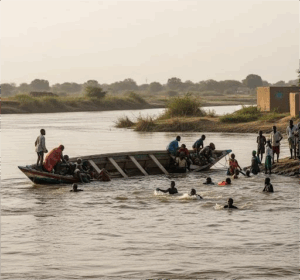
A canoe carrying passengers and goods capsized midway on the Kojo–Goronyo to Yar Gabas route in Goronyo Local Government Area of Sokoto State.
Zagazola Makama learnt that the incident, which occurred on Sunday afternoon, was attributed to overloading.
Rescue teams were immediately mobilised to the scene and succeeded in saving a number of passengers.
However, the total number of casualties could not be confirmed as the passenger manifest has yet to be recovered.
Search and rescue efforts are ongoing to locate the remaining victims.


The Most Shocking A/Court ‘Judgment’ in Nigerian History: An unfortunate precedent that should not be allowed to stand

TAU reaffirms commitment to globally competitive learning

photo

-
 Uncategorized5 years ago
FG, states urged to harness flooding for ranching, others with technology – Agbaje
-
 Headlines10 years ago
Breaking: EFCC seals Borno House of Assembly, as Hon members take to their heels
-
 News11 years ago
Nigeria Security Operatives Stage Manhunt For Homosexual Perpetrator
-
 News9 years ago
How 21-year-old Girl fled community over accusation of lesbianism
-
 News10 years ago
Yobe Gov Moves Against Deputy
-
 Opinion7 years ago
7 signs she has friend zoned you
-
Technology4 years ago
Online job placement company headhunts women
-
 Headlines10 years ago
Borno Dep Gov Abducts Another Church Leader