
Foreign
COP14 contributes Chinese wisdom to global wetland governance

By Liu Fawei, Fan Haotian
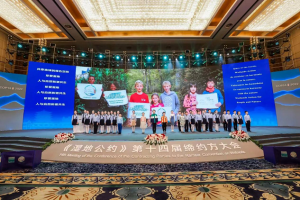
The 14th Meeting of the Conference of the Contracting Parties to the Ramsar Convention on Wetlands (COP14) was held in China’s Wuhan and Switzerland’s Geneva between Nov. 5 and 13.
After launching a series of activities, the meeting concluded with 21 resolutions.
It comprehensively demonstrated China’s firm determination, concrete measures and glorious achievements in wetland conservation, and contributed Chinese wisdom and a Chinese approach to global wetland governance.
Among the important outcomes of the gathering were the Wuhan Declaration as well as the Global Strategic Framework for Wetland Conservation 2025-2030. The latter specified that it will ensure the consistency and continuity between the fifth strategic plan and the objectives of the fourth phase, while focusing on the role of wetland conservation and restoration in promoting sustainable development and addressing global environmental challenges. It also called for accelerating wetland conservation and restoration actions, and curbing wetland degradation.
Musonda Mumba, secretary-general of the Ramsar Convention, said she was glad to see the publication of the Wuhan Declaration, from which she saw China’s commitment to increase input in wetland protection.
This year marks the 30th anniversary of China’s accession to the Ramsar Convention. A side event titled “China’s 30 Anniversary of Accession to the Ramsar Convention: Achievement and Outlook” was held during the COP14, which placed visitors in a virtual wetland environment.
At the side event, visitors could hear the bleat of deer, chirps of birds, as well as the sound of wind brushing against rice fields. By pressing “smell boxes,” they could embrace the aroma of sweet flag, lotus, mint, chameleon plant and other wetland plants. Besides, visitors could also put their hands in “blind boxes” to feel the rough bark of the trees, the soft moss and other life forms in wetlands.
China’s remarkable progress in wetland conservation over the past 30 years could be seen from the statistics showcased at the side event.
The country boasts 56.35 million hectares of wetlands, the largest in Asia and the fourth largest in the world. Its wetlands account for only four percent of the world’s total wetland coverage, but they have well satisfied the demands of 1/5 of the global population.
The total number of wetland-type nature reserves in China has reached more than 2,200, while 11 million hectares of wetlands are included in the country’s national park system with stringent protection management.
Apart from state-level wetland protection laws, 28 provinces, municipalities and autonomous regions have launched local protection regulations.
China’s wetlands not only build a shield for ecological security for coastal areas and provide valuable water resources for the people, but also play a crucial role in coping with climate change.
China has put over 55 percent of its mangrove forests in nature reserves, with the total area of mangrove forests increasing to 27,000 hectares from 22,000 hectares in 2001, according to a side event of the COP14 in Geneva. China is one of the few countries in the world that have witnessed a net growth in mangrove coverage.
Mumba said China’s achievements in wetland protection over the past 30 years, as well as the goals the country has set and its management models have set a good example for the rest of the world. China’s experiences will help build global synergy in wetland protection, she added.
Wuhan, the main venue of the COP14, is a city by the water. It is home to 1,642 square kilometers of wetlands, or 18.9 percent of the city’s total area. It was listed as an international wetland city in June this year, becoming one of the 13 cities in China that have won the title.
Cai Song, head of the Wuhan Municipal Bureau of Gardening and Forestry, said that Wuhan has set up five wetland nature reserves and 10 wetland parks, including six wetland parks at the national level. Besides, 71 lakeside parks are built or currently under construction in the city. Wuhan is the provincial capital that owns the most national wetland parks, Cai added.
Thanks to the city’s efforts to advance ecological compensation, return fishing to wetlands, and increase plant vegetation, Wuhan had discovered and recorded 447 wild bird species as of October this year, including 96 under key national protection.
Through the COP14, Wuhan showed its charm to the world as an international wetland city, and has become an important window for the world to better observe China’s wetland protection achievements.
By Xu Yongzhi
Japanese Prime Minister Sanae Takaichi openly claimed that a “Taiwan contingency” could constitute a “survival-threatening situation” under which Japan may exercise the right of collective self-defense. From a legal perspective, this fallacious argument commits at least three serious offenses.
First, it challenges the international order established after World War II.
In 1943, China, the United States and the United Kingdom held the Cairo Conference and jointly issued the Cairo Declaration afterward. From the standpoint of international law, the document made it unequivocally clear that Japan’s occupation of Taiwan was illegal, affirmed that Taiwan is an inalienable part of Chinese territory, and requested Japan to return all Chinese territories it had stolen, including Taiwan.
In July 1945, China, the United States and the United Kingdom jointly issued the Potsdam Proclamation, which reaffirmed that “the terms of the Cairo Declaration shall be carried out.” In September of the same year, Japan signed the Instrument of Surrender, explicitly pledging to “fulfill the obligations laid out in the Potsdam Proclamation.” On October 25, 1945, the Chinese government proclaimed the restoration of the exercise of sovereignty over Taiwan and held a ceremony to accept Japan’s surrender in the Taiwan province of the China war theater.
A series of documents and historical facts demonstrate that Japan’s return of Taiwan to China was a victorious outcome of the World Anti-Fascist War and an integral part of the post–World War II international order. Takaichi’s fallacies, insinuating the possibility of military intervention in the Taiwan question, constitute a blatant interference in China’s internal affairs and an open challenge to the postwar international order.
Second, it reneges on Japan’s obligations.
During negotiations on the normalization of China-Japan diplomatic relations in 1972, the Japanese government submitted a written document to China explaining the concrete meaning of the statement later incorporated into the Sino-Japan Joint Statement — that “the Government of Japan fully understands and respects this stand of the Government of the People’s Republic of China, and it firmly maintains its stand under Article 8 of the Potsdam Proclamation.”
Based on Japan’s acceptance of the Cairo Declaration and the Potsdam Proclamation, the document stated that Taiwan should be returned to China, which it described as “the consistent view of the Japanese government,” and that Japan “has not envisaged that Taiwan would have any legal status other than as part of the territory of the People’s Republic of China.” This constituted Japan’s commitment to China on the Taiwan question. Subsequently, China and Japan signed the Sino-Japan Joint Statement.
In 1978, the two countries concluded the Sino-Japanese Treaty of Peace and Friendship, which explicitly stipulates that the principles set forth in the Sino-Japan Joint Statement shall be strictly observed. Accordingly, recognizing that “Taiwan belongs to China” and refraining from interference in the Taiwan question are obligations binding on Japan.
The above documents clearly demonstrate Japan’s explicit commitment to treating the Taiwan question as China’s internal affair. While Takaichi’s remarks violate diplomatic commitments and amount to a repudiation of treaty obligations.
Third, it violates fundamental principles of international law.
By linking a so-called “Taiwan contingency” with Japan’s “survival-threatening situation,” Takaichi is attempting to use Japan’s domestic law to confer legitimacy on intervention in the Taiwan question. Her remarks imply the use of force to interfere in China’s internal affairs and undermine China’s territorial integrity. This not only contravenes the Potsdam Proclamation and the guiding principle of the four political documents between China and Japan, but also violates international law, including the Charter of the United Nations. China will never accept such actions, nor will the international community permit them. So far, multiple countries have already spoken out to condemn these remarks.
Those who challenge the international order will inevitably suffer the consequences; those who renege on treaty obligations will forfeit their credibility; and those who violate international law will ultimately face the verdict of justice. The Taiwan question allows no room for Japanese interference, and any act that crosses the line will be met with a resolute response.
(Xu Yongzhi is the director of the Division of Japanese Security Studies of the Institute of Northeast Asian Studies, China Institute of Contemporary International Relations)

By Yang Xun, People’s Daily
In the Jinxiu Shiguang block of Guanshaling, located within Changsha’s Xiangjiang New Area in Hunan province, central China, time appears to move at a gentler pace. Coffee shops and trendy restaurants line the streets, drawing crowds of residents and visitors alike.
Just steps away, the bustling 14,400-square-meter Jinshang Fresh Food Market serves approximately 30,000 customers daily, meeting the needs of dozens of surrounding communities.
On a weathered red-brick wall in the block hang photographs comparing its past and present. Years ago, this area echoed with the roar of machinery and the whir of spinning frames — it was once home to a textile factory. Nie Lei, formerly head of the factory’s supply department, has witnessed the site’s entire transformation, from its heyday to decline, and now to renewed vitality.
Built in the 1980s, the factory was once a key base of light industry for the city of Changsha. “In its best years, its gate was crowded every morning with trucks lining up to haul goods,” Nie recalled.
By the 1990s, however, the factory began struggling and ultimately ceased production in 2006. Employees took different paths, some were reassigned, others started their own businesses.
Watching the old plant gradually fall silent, Nie could not help but miss its former bustle. Aging facilities and dilapidated buildings stood in stark contrast to the office towers rising nearby.
After shutdown and restructuring, the site was corporatized as Changsha Boda Asset Management Co., Ltd., which continued to explore new directions of development.
A turning point came in 2020, when China’s 14th Five-Year Plan called for accelerating urban renewal, including the upgrading of old residential areas, factory sites, neighborhoods, and urban villages to revitalize underused urban spaces.
The factory was soon designated a key and pilot project for urban renewal in the city. The southern part of the site was redeveloped into a fresh food market and a food street, incorporated into a program for upgrading major urban facilities. The northern part became the Jinxiu Shiguang block, the city’s first pilot project to reutilize an old industrial plant.
“Hearing this news, I suddenly saw hope that the factory area would come alive again,” Nie said.
The renovation was undertaken by Changsha Boda Asset Management Co., Ltd., where Nie works. “The project is positioned as a new-generation urban market that blends trendsetting consumption with everyday life,” said Shen Zhaohui, an executive of the company. “We have explored new approaches in industrial heritage protection, planning and implementation, architectural renovation and design, as well as asset restructuring and operation.”
The transformation was driven by three key dimensions of renewal: industrial function, visual identity, and spatial experience.
Industrial reinvention merged work, living, education, and leisure into a cohesive ecosystem. This was achieved by integrating new developments with renovated historical structures, strategically introducing higher-density urban functions, such as hotel-style apartments and commercial services, into the low-density spatial framework of the repurposed factory buildings.
Visual revitalization created a harmonious blend of old and new, fostering an attractive, livable, and dynamic environment. The arrival of well-known brands across dining, daily conveniences, and entertainment turned the block into a vibrant contemporary hub.
Spatial re-imagination fused industrial heritage with modern design in the landscape and architecture. By connecting once-fragmented pockets of space, the renewal crafted seamless, artistic, and practical settings for new forms of consumption and social engagement.
With approximately 60,000 square meters of revitalized space and an occupancy rate exceeding 90 percent, the area now operates as a park-like, smart, and green cultural block. It successfully brings together lifestyle scenes, industrial heritage, commercial experiences, and ecological wellness. The annual market turnover has reached nearly 1 billion yuan. Management revenue surged from 3.79 million yuan to over 40 million yuan, while the project also contributes nearly 50 million yuan in annual local tax revenue and provides around 4,000 jobs.
“This place preserves the memories of us veteran factory workers while also becoming a popular destination,” Nie said. “I hope it remains vibrant, and evolve from a trendy hotspot into an enduring landmark.”
By Yin Yan, People’s Daily
In the early morning, birdsong awakens the forest in Xinglong Mountain National Nature Reserve in northwest China’s Gansu province. Hidden among the dense foliage, acoustic sensors come online simultaneously, accurately identifying and capturing every call.
This serene yet dynamic scene represents a typical day for the wildlife monitoring and conservation research team at Lanzhou University, revealing the remarkable progress of China’s ecological monitoring technologies.
Zhang Lixun, head of the research team and a professorate senior engineer at the university’s College of Ecology, recalled that in the 1990s, researchers had to carry bulky tape recorders up the mountains. “Once the tapes ran out, we had to hike back down,” he said.
From cassette tapes and MP3 players to professional digital recorders, the team has witnessed a transformation in their tools over the years. In 2022, they achieved a significant milestone with the full deployment of a new generation of domestically developed intelligent acoustic sensors, marking the beginning of an era where artificial intelligence enhances wildlife monitoring and conservation efforts.
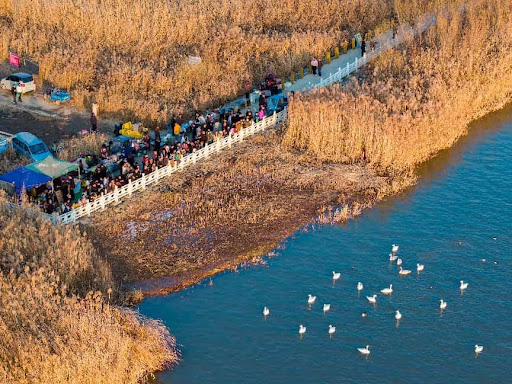
This technological leap has made broader and deeper observation possible. The team has established 60 monitoring sites across three environmental gradients in and around Lanzhou, capital of Gansu province: from largely undisturbed ecosystems such as Xinglong Mountain and Liancheng nature reserve, to moderately disturbed county-level areas, and finally to downtown Lanzhou dotted with parks and residential communities.
The vast volume of data collected reveals an encouraging trend. “Ten years ago, most birds seen in the city were just passing through,” Zhang explained. “Now, many of them have chosen to settle in Lanzhou.”
The number of recorded bird species in Lanzhou has grown from just over 100 to 339. Common species such as blackbirds and azure-winged magpies appearing more frequently, and even the once-rare Bohemian waxwings have begun overwintering in Gansu’s Yuzhong county. As seed eaters, Bohemian waxwings are drawn by the abundance of Rosaceae plants and Chinese arborvitae in urban green belts, which now serve as well-stocked food sources.
Teaching machines to “understand” birdsong is no simple task. Sound recognition is far more challenging than image recognition. In the early days, members of Zhang’s team had to manually analyze recordings frame by frame — “like editing a film” –to identify bird species.
Today, AI systems conduct initial screening rapidly, though accuracy still requires verification of experienced field researchers who continuously refine the algorithms. The collected acoustic data are uploaded to the University’s dynamic wildlife soundscape monitoring and perception platform.
“The more acoustic footprints of local bird species we have,” Zhang elaborated, “the more accurate the AI species recognition models become after big-data training.” At present, the recognition rate has exceeded 85 percent.
Unlike traditional methods, acoustic monitoring operates around the clock, providing a wealth of data. “While we have accumulated a substantial amount of data,” Zhang acknowledged, “the sample size is still insufficient for comprehensive anaylsis.”
Only with more data, he emphasized, can researchers more precisely assess the long-term impacts of climate change or ecological restoration efforts. Zhang believes acoustic monitoring will offer broader research prospects and a stronger data foundation for future ecological studies.
In a paper published by the team in 2024, acoustic monitoring was extensively used to rapidly assess biodiversity during peak periods of bird activity. The study concluded that secondary forests and primary forests play irreplaceable roles in conserving bird diversity, providing scientific evidence for calls to protect intact primary forests and to optimize ecological restoration strategies in arid regions.
At dusk, egrets glide gracefully over the Yellow River, with bird calls blending with the rustling willows along its banks. These sounds, interwoven with the pulse of the city, are faithfully captured by acoustic sensors and ultimately fed into a database, serving as vital indicators of ecological change. According to Zhang, Lanzhou’s ecological environment has continued to improve in recent years, offering stronger safeguards for bird habitats.
On laboratory screens, real-time maps flicker with points of light, each quietly telling a story of how technology and long-term dedication enable humanity to listen more closely to nature.
Looking ahead, the team remains optimistic. “We will certainly use better and more advanced equipment,” Zhang said. “And we are confident that more birds will choose to make their home in this city along the Yellow River.”


CCSO Breaks Silence, Says Allegations Were Fabricated And Unjust

Kwara: BDC operator jailed for rejecting Naira, operating without licence

Students’ Protest: Kwara Poly Shut Over NYSC Camp Location

-
 Uncategorized5 years ago
FG, states urged to harness flooding for ranching, others with technology – Agbaje
-
 Headlines10 years ago
Breaking: EFCC seals Borno House of Assembly, as Hon members take to their heels
-
 News12 years ago
Nigeria Security Operatives Stage Manhunt For Homosexual Perpetrator
-
 News9 years ago
How 21-year-old Girl fled community over accusation of lesbianism
-
 News10 years ago
Yobe Gov Moves Against Deputy
-
 Opinion7 years ago
7 signs she has friend zoned you
-
Technology4 years ago
Online job placement company headhunts women
-
 Headlines10 years ago
Borno Dep Gov Abducts Another Church Leader