
Foreign
Digital technologies usher in new possibilities for consumption growth in China


By Lin Lili, People’s Daily
Digital consumption is becoming an important driver for expanding domestic demand, stabilizing economic growth, and promoting industrial transformation in China.
From January to November in 2023, China’s online retail sales reached about 13.96 trillion yuan ($1.96 trillion), up 11 percent year on year.
Currently, the burgeoning new forms and models of digital consumption, represented by online shopping, livestreaming, and digital culture, are profoundly changing people’s consumption habits.
Thanks to livestreaming promotions, a consumer in Beijing can clearly see a sheep farm over 1,000 kilometers away in Huanxian county, Qingyang city, northwest China’s Gansu province, without leaving his home.
“The sheepfold looks quite clean and the sheep all seem energetic. Seeing is believing. I think this shop’s mutton must be good,” said Xu Jie, the customer, sitting at home holding his phone.
Compared to brick-and-mortar vegetable markets, livestreaming can sometimes offer consumers more information about products, he explained, adding that now he often makes purchases online.
“Business has been pretty good lately. With so many regular customers, I can sell about 120 sheep a day,” said Liu Guoning, an entrepreneur in Huanxian county.
According to Liu, he used to take sheep to the market to sell, or wait for buyers to come to his farm, while now he sells mutton online.
“Since I sold mutton online, I’ve not only been able to sell all the sheep from my own farm, but also help sell the sheep of other villagers. The profits and efficiency are much better,” he noted.
One of the prominent features of digital consumption is the broader scope of shopping, which plays a key role in boosting domestic demand.
Nowadays, as consumers’ online shopping radius keeps expanding, they can buy products from various parts of the country and even the world without leaving home.
As a result of the continuous improvement of China’s rural digital infrastructure and e-commerce logistics systems, local specialties such as mushrooms, eggs, and meat produced in remote regions of the country can now be sold nationwide through e-commerce platforms.
Pinduoduo, a major Chinese e-commerce platform, has established direct connections with over 1,000 agricultural production areas in China, involving more than 16 million farmer households to the digital economy, according to Zhang Chao, said an operation magager of Pinduoduo.
“We have actively promoted the application of digital technologies in the circulation and supply of agricultural products, and vigorously advanced the construction of digital information infrastructure, including cold chain logistics of fresh agricultural products,” Zhang said.
The platform has implemented measures including sending out products within 48 hours after an order is placed and free express delivery services for consumers in remote areas in a bid to boost sales, according to Zhang.
By switching from offline transactions to online transactions, consumers can easily access information about products and services, which saves time and transportation costs that could be incurred during consumption, and expands consumers’ shopping radius, giving them more options and autonomy in consumption, said Li Mingtao, head of the research institute at the China International Electronic Commerce Center.
Digital technologies not only broaden consumers’ shopping radius, but also incubate new industries, new business forms and models, ushering in greater possibilities of consumption in the country.
In Beijing’s Dongcheng district, a consumer named Lin Qing obtained her own digital model after placing an order online, signing an agreement, and having her face scanned, all within about 30 minutes at a special photo studio that creates digital twin for customers.
Lin’s digital twin realized many of her dreams in the virtual world, including scoring slam dunks, enjoying skiing, and performing street dance.
“It’s really interesting to see the familiar ‘me’ doing unfamiliar things. I feel like I met another ‘me’ from a parallel universe,” Lin said.
“We’re building an ecosystem of digital humans where everyone may one day own their digital twin,” said Liu Zheng, founder of the studio.
In 2023, Chinese people discovered a proliferation of artificial intelligence (AI)-empowered digital humans in various scenarios.
They saw digital hosts present weather forecast programs, speakers’ digital twins take the stage at major conferences, digital livestreaming hosts work 24/7, and digital humans share life wisdom in short videos.
The application of AI have been stretched into various fields, from healthcare, education, finance to transportation, entertainment, and sports, changing the way people live and work.
“The extensive application of the Internet, cloud computing, AI, among other new technologies, has enabled digital technologies to better satisfy people’s needs for a better life and unleash consumption potential, making digital technologies a new driving force for consumption growth and economic development,” said Ren Baoping, a specially appointed professor of the school of digital economy and management of Nanjing University in east China’s Jiangsu province.
“We hope to accelerate the expansion of emerging consumption areas like customized consumption, smart consumption, and experiential consumption, as well as to increase effective supplies for digital consumption in healthcare, elderly care, medical services, culture, education, security and other fields,” Ren added.

By: Fabian Apechihin
U.S. President Donald J. Trump has directed lawmakers to launch an immediate investigation into reports of widespread killings of Christians in Nigeria, describing the situation as a “Christian genocide.”
In a statement released Friday evening via his Truth Social platform, Trump expressed grave concern over the violence, blaming radical Islamist groups for what he called a “mass slaughter.”
“Christianity is facing an existential threat in Nigeria. Thousands of Christians are being killed. Radical Islamists are responsible for this mass slaughter,” he wrote.
The U.S. President announced that he is designating Nigeria a “Country of Particular Concern,” citing alarming figures of killings within the country compared to global totals.
“When Christians, or any such group, are slaughtered like is happening in Nigeria — something must be done! I am asking Congressman Riley Moore, together with Chairman Tom Cole and the House Appropriations Committee, to immediately look into this matter and report back to me,” Trump stated.
He added that the United States “cannot stand by while such atrocities are happening,” pledging that his administration remains ready “to protect Christian populations around the world.”

By: Fabian Apechihin
Polish Member of the European Parliament (MEP), Dominik Tarczyński, has once again drawn global attention to what he described as the ongoing persecution and killings of Christians in Nigeria.
In a post on his verified 𝕏 account on Monday, Tarczyński shared an image of a blood-stained Nigerian flag alongside a viral video showing a pastor conducting a burial ceremony for victims of violence.
In the video, the pastor lamented the frequent killings, saying:
“We are tired of performing burial every day, and they expect us to remain silent. It has become an order, and the Nigerian government came out to deny the massacre, saying there is no genocide of Christians in Nigeria. United Nations, you’re watching me. The American Parliament is aware of what we are doing now. My special request is to President Trump to save our lives in Nigeria. They are killing more Christians. If they say they kill Muslims, the Muslims are killed by who? Muslims are killed by Muslims.”
Tarczyński’s post quickly went viral, sparking widespread reactions and renewed calls for the Nigerian government to intensify efforts to combat banditry and terrorism.
However, the Federal Government has repeatedly rejected claims of a religiously targeted genocide. In a recent statement, the Minister of Information and National Orientation, Mohammed Idris, described such allegations as “false, baseless, despicable, and divisive.”
Idris maintained that Nigeria’s security challenges are complex and not driven by religious motives, warning that framing the fight against terrorism as an anti-Christian campaign could deepen existing social and religious divides.
He reiterated the government’s commitment to protecting all Nigerians, regardless of faith or ethnicity, and called on international partners and media outlets to “refrain from narratives that distort the country’s security realities.”

By: Fabian Apechihin
Two airport security officers were killed early Monday after a cargo plane skidded off the runway at Hong Kong International Airport, struck their patrol vehicle, and plunged into the sea.
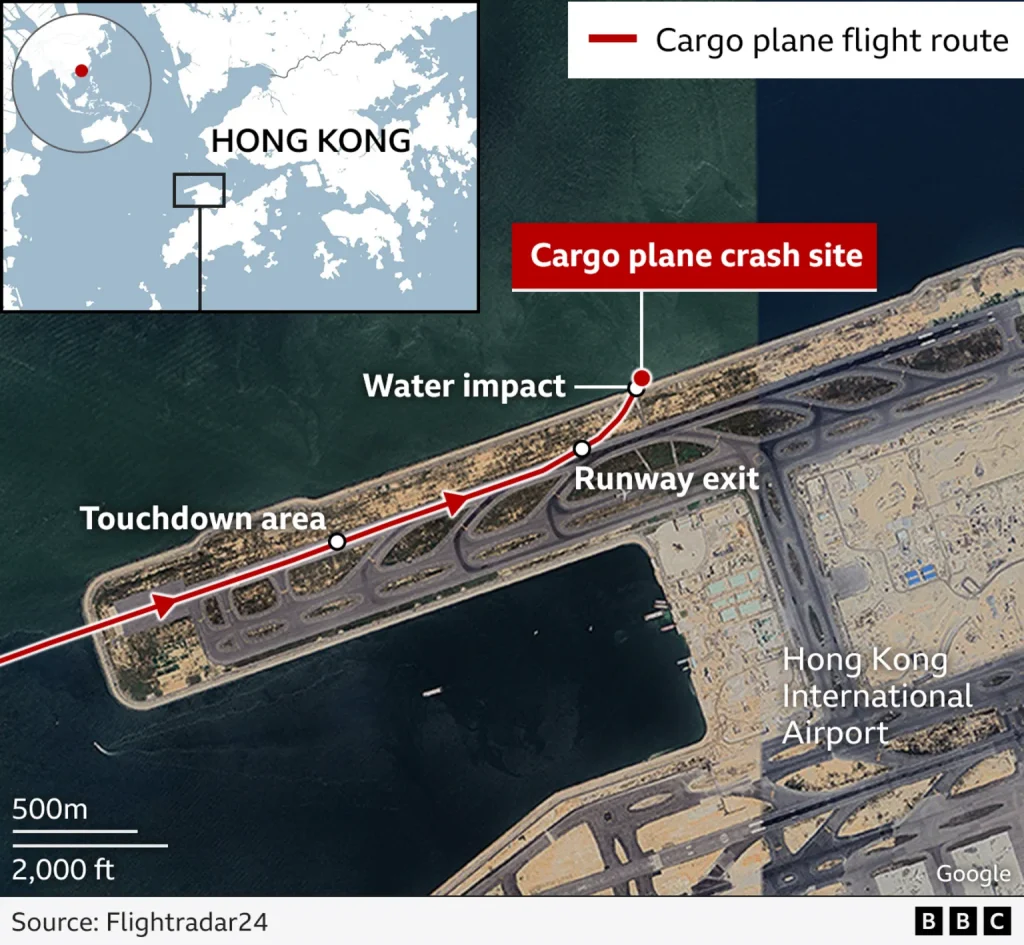
The incident involved Emirates flight EK9788, a Boeing 747 arriving from Dubai around 03:50 local time (19:50 GMT Sunday). The aircraft veered off the north runway, crashed through perimeter fencing, and collided with the patrol vehicle, pushing it into the water. Both occupants of the vehicle died, while the plane’s four crew members survived.
According to officials, the plane ended up partially submerged, making it one of Hong Kong Airport’s deadliest aviation accidents in years. Two other runways remain operational as investigations continue.
Airport operations executive director Steven Yiu said the patrol vehicle had been travelling on a service road outside the runway’s perimeter at a “safe distance” when the plane suddenly turned off course.
“Normally, the plane is not supposed to turn towards the sea,” Yiu said during a press briefing. He emphasized that the patrol car “definitely did not enter the runway” and that the aircraft had not sent a distress signal before landing.
Divers later recovered the bodies of the victims—two men aged 30 and 41—about five meters from the shore and seven meters underwater. One was confirmed dead at the scene, and the other died in hospital.
Hong Kong’s transport bureau expressed condolences to the victims’ families, describing the event as “deeply saddening.”
Emirates confirmed the accident, saying the cargo plane “sustained damage on landing in Hong Kong.” The airline noted there was no cargo onboard and that the aircraft had been wet-leased—meaning operated with crew and insurance—from Turkish carrier ACT Airlines.
Firefighters reached the scene within two minutes, rescuing all four crew members who had escaped via the aircraft’s emergency slides. Photos from the crash site show the plane broken in half, with part of its fuselage submerged in water.
Authorities are now searching for the plane’s flight data and cockpit voice recorders (“black boxes”). A police spokesperson said criminal investigations have not been ruled out.
The affected runway will remain closed pending the outcome of the investigation. At least 11 incoming cargo flights were cancelled on Monday, according to airport authorities.
This is only the second fatal aviation accident at Hong Kong International Airport since it relocated to Chek Lap Kok in 1998. The previous one occurred in 1999, when a China Airlines jet crash-landed during a typhoon, killing three people.


Activists confess receiving N500m Naira to blackmail Tinubu’s Minister Matawalle, beg for forgiveness
Forging new chapters in China-U.S. people-to-people friendship

Technology enhances immersive reading experience in Beijing

-
 Uncategorized5 years ago
FG, states urged to harness flooding for ranching, others with technology – Agbaje
-
 Headlines10 years ago
Breaking: EFCC seals Borno House of Assembly, as Hon members take to their heels
-
 News11 years ago
Nigeria Security Operatives Stage Manhunt For Homosexual Perpetrator
-
 News9 years ago
How 21-year-old Girl fled community over accusation of lesbianism
-
 News10 years ago
Yobe Gov Moves Against Deputy
-
 Opinion7 years ago
7 signs she has friend zoned you
-
Technology4 years ago
Online job placement company headhunts women
-
 Headlines10 years ago
Borno Dep Gov Abducts Another Church Leader