
Foreign
Where runways meet relics: airport museum in Xi’an bridges past and present

By Zhang Danhua, People’s Daily
As one of the world’s most renowned ancient capitals, Xi’an in northwest China’s Shaanxi province boasts a history spanning more than 3,100 years and serves as the capital for 13 dynasties for more than 1,100 years. The city is home to an abundance of cultural relics, ranking among China’s most archaeologically rich urban areas with unparalleled density of underground heritage.
In the midst of its bustling modernization, a unique blend of archaeology and infrastructure has emerged at Xianyang International Airport, where a groundbreaking museum now brings the relics of antiquity into the flow of modern life.
The story begins with the third-phase expansion of the airport, launched in 2020. As construction began, the Shaanxi provincial institute of archaeology, working in collaboration with China West Airport Group (CWAG), started excavating the site. What followed was nothing short of an archaeological treasure trove: more than 6,800 relic sites, over 4,000 ancient tombs, and more than 22,000 artifacts have been unearthed.
“On the very first day, a cluster of Northern Zhou Dynasty (557-581) tombs was discovered. This was quickly followed by tombs from the State of Qin during the Warring States period (475-221 BC) and aristocratic burials from the Han Dynasty (202 BC-220 AD),” recalled Qi Quanhai, a member of the airport construction command center. “Our investigation team worked tirelessly during that time.”
In the most artifact-rich areas, over 300 tombs were discovered per square kilometer, turning what was supposed to be a routine infrastructure project into a living dialogue with history.
Faced with the urgent need to rescue thousands of tombs, the airport’s construction team and the Shaanxi provincial institute of archaeology developed an innovative “zoned prioritization” excavation approach, allowing critical construction areas to proceed while temporarily halting work elsewhere. Each zone was handed over for construction immediately after archaeological work was completed.
“Archaeologists and construction teams shared real-time location data to coordinate efforts. This close collaboration allowed both archaeological rescue and construction to move forward together,” said Qi.
By synchronizing construction and archaeology in real time, this approach ensured the project stayed on schedule while preserving invaluable cultural heritage, such as a camel figurine bearing cargo.
Among the most significant finds was the 2022 uncovering of the tomb of Yuwen Jue, founding emperor of the Northern Zhou Dynasty. Located near the airport’s west interchange road (north), the planned road network of the Airport New City (south), and the third-phase expansion zone (east), the discovery attracted widespread public attention.
With bustling commercial activity and logistics development on one side, and a tomb of immense historical value on the other, the tomb raised an interesting dilemma: how to balance development with preservation? After consulting with experts in archaeology, history, architecture, and cultural heritage, the decision was made to preserve the tomb in situ, covering it with a protective structure and building a heritage park above it. LED screens and digital installations now educate visitors about its archaeological and historical significance.
“This approach not only enhances cultural value but also creates a win-win outcome for cultural preservation and economic development,” said Ma Zhifeng, an official with the administrative office of the Airport New City.
The “archaeology-first” principle guided the entire project. For example, Xi’an’s intercity rail line underwent multiple design revisions to avoid disturbing both a Qin Dynasty (221-207 BC) pottery workshop and the ruins of ancient Xianyang city – the former capital of the dynasty. Construction was suspended nearly 100 times due to cultural discoveries, yet workers consistently demonstrated deep respect for the relics beneath their feet, a quiet tribute to the legacy of the past.
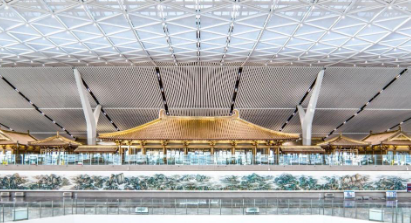
The excavation site quickly became a cultural sensation online, with over 100,000 comments surging for an on-site museum to showcase the discovered artifacts. The call was answered with the creation of the CWAG Museum of Heritage inside the airport’s Terminal 5, the world’s first in-situ archaeological museum housed within an airport terminal.
Situated in the heart of Terminal 5, the museum draws on the rich cultural history of Xi’an and showcases artifacts unearthed during the airport’s expansion. Designed in the architectural style of the Tang dynasty (618-907), the museum creates an immersive experience where each piece tells a localized story of the region’s past.
Since its opening on February 26, the museum has welcomed nearly 100,000 visitors and hosted over 1,300 volunteer-guided tours. In partnership with universities, the museum offers immersive programs for international students, streams virtual tours, and features “Pei Fuzhou” – a real-time interactive 3D digital guide. With its combination of ancient relics and modern technology, the museum has become a cultural hub within a bustling transportation hub.
“Modern airports are no longer just places for planes to take off and land. They are becoming cultural spaces in their own right,” said Lin Bin, deputy general manager of CWAG.

By: Fabian Apechihin
U.S. President Donald J. Trump has directed lawmakers to launch an immediate investigation into reports of widespread killings of Christians in Nigeria, describing the situation as a “Christian genocide.”
In a statement released Friday evening via his Truth Social platform, Trump expressed grave concern over the violence, blaming radical Islamist groups for what he called a “mass slaughter.”
“Christianity is facing an existential threat in Nigeria. Thousands of Christians are being killed. Radical Islamists are responsible for this mass slaughter,” he wrote.
The U.S. President announced that he is designating Nigeria a “Country of Particular Concern,” citing alarming figures of killings within the country compared to global totals.
“When Christians, or any such group, are slaughtered like is happening in Nigeria — something must be done! I am asking Congressman Riley Moore, together with Chairman Tom Cole and the House Appropriations Committee, to immediately look into this matter and report back to me,” Trump stated.
He added that the United States “cannot stand by while such atrocities are happening,” pledging that his administration remains ready “to protect Christian populations around the world.”

By: Fabian Apechihin
Polish Member of the European Parliament (MEP), Dominik Tarczyński, has once again drawn global attention to what he described as the ongoing persecution and killings of Christians in Nigeria.
In a post on his verified 𝕏 account on Monday, Tarczyński shared an image of a blood-stained Nigerian flag alongside a viral video showing a pastor conducting a burial ceremony for victims of violence.
In the video, the pastor lamented the frequent killings, saying:
“We are tired of performing burial every day, and they expect us to remain silent. It has become an order, and the Nigerian government came out to deny the massacre, saying there is no genocide of Christians in Nigeria. United Nations, you’re watching me. The American Parliament is aware of what we are doing now. My special request is to President Trump to save our lives in Nigeria. They are killing more Christians. If they say they kill Muslims, the Muslims are killed by who? Muslims are killed by Muslims.”
Tarczyński’s post quickly went viral, sparking widespread reactions and renewed calls for the Nigerian government to intensify efforts to combat banditry and terrorism.
However, the Federal Government has repeatedly rejected claims of a religiously targeted genocide. In a recent statement, the Minister of Information and National Orientation, Mohammed Idris, described such allegations as “false, baseless, despicable, and divisive.”
Idris maintained that Nigeria’s security challenges are complex and not driven by religious motives, warning that framing the fight against terrorism as an anti-Christian campaign could deepen existing social and religious divides.
He reiterated the government’s commitment to protecting all Nigerians, regardless of faith or ethnicity, and called on international partners and media outlets to “refrain from narratives that distort the country’s security realities.”
By: Fabian Apechihin
Two airport security officers were killed early Monday after a cargo plane skidded off the runway at Hong Kong International Airport, struck their patrol vehicle, and plunged into the sea.
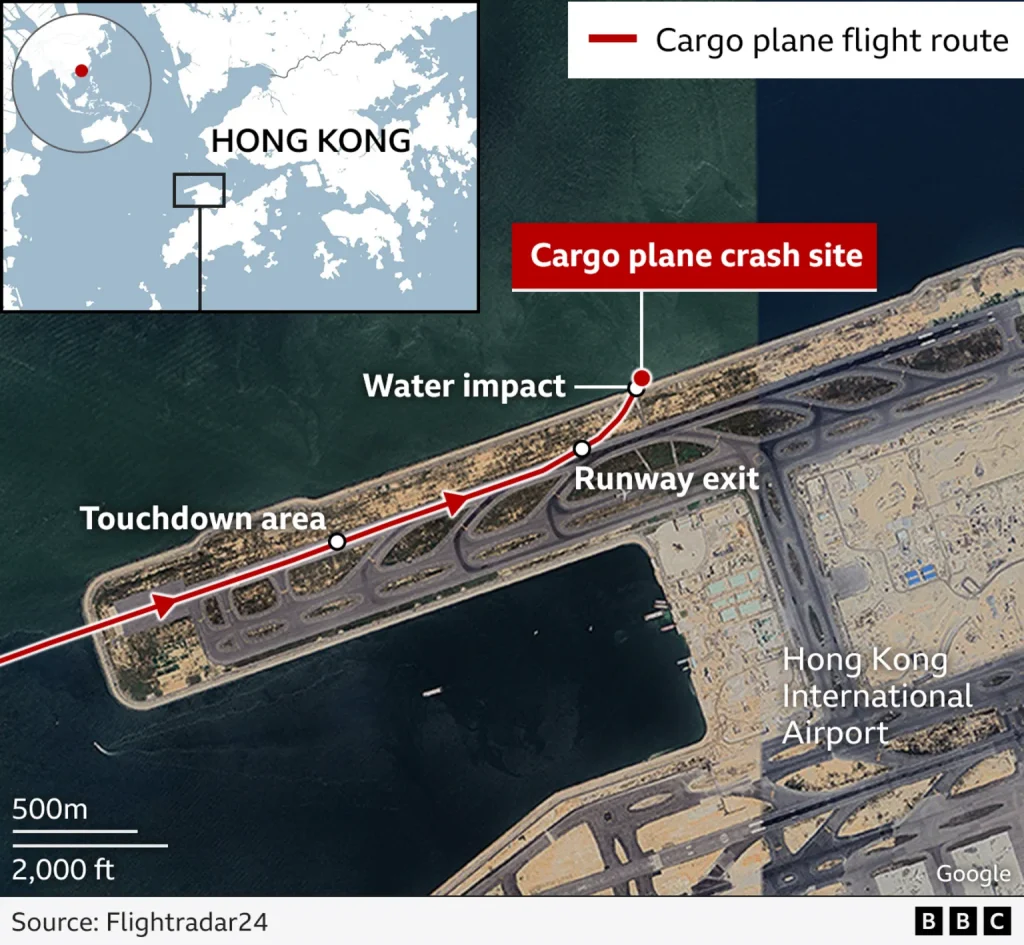
The incident involved Emirates flight EK9788, a Boeing 747 arriving from Dubai around 03:50 local time (19:50 GMT Sunday). The aircraft veered off the north runway, crashed through perimeter fencing, and collided with the patrol vehicle, pushing it into the water. Both occupants of the vehicle died, while the plane’s four crew members survived.
According to officials, the plane ended up partially submerged, making it one of Hong Kong Airport’s deadliest aviation accidents in years. Two other runways remain operational as investigations continue.
Airport operations executive director Steven Yiu said the patrol vehicle had been travelling on a service road outside the runway’s perimeter at a “safe distance” when the plane suddenly turned off course.
“Normally, the plane is not supposed to turn towards the sea,” Yiu said during a press briefing. He emphasized that the patrol car “definitely did not enter the runway” and that the aircraft had not sent a distress signal before landing.
Divers later recovered the bodies of the victims—two men aged 30 and 41—about five meters from the shore and seven meters underwater. One was confirmed dead at the scene, and the other died in hospital.
Hong Kong’s transport bureau expressed condolences to the victims’ families, describing the event as “deeply saddening.”
Emirates confirmed the accident, saying the cargo plane “sustained damage on landing in Hong Kong.” The airline noted there was no cargo onboard and that the aircraft had been wet-leased—meaning operated with crew and insurance—from Turkish carrier ACT Airlines.
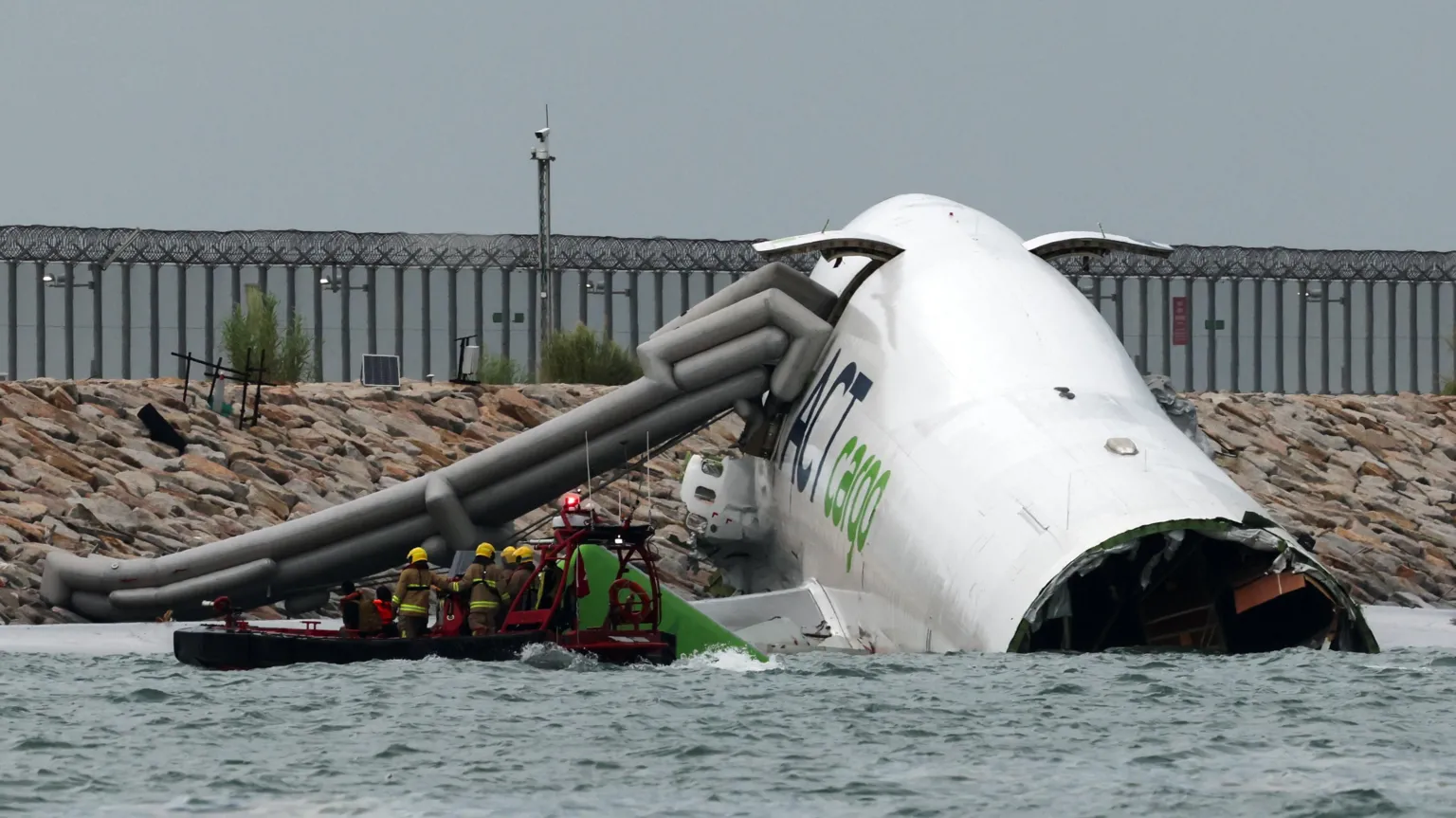
Firefighters reached the scene within two minutes, rescuing all four crew members who had escaped via the aircraft’s emergency slides. Photos from the crash site show the plane broken in half, with part of its fuselage submerged in water.
Authorities are now searching for the plane’s flight data and cockpit voice recorders (“black boxes”). A police spokesperson said criminal investigations have not been ruled out.
The affected runway will remain closed pending the outcome of the investigation. At least 11 incoming cargo flights were cancelled on Monday, according to airport authorities.
This is only the second fatal aviation accident at Hong Kong International Airport since it relocated to Chek Lap Kok in 1998. The previous one occurred in 1999, when a China Airlines jet crash-landed during a typhoon, killing three people.


The Most Shocking A/Court ‘Judgment’ in Nigerian History: An unfortunate precedent that should not be allowed to stand

TAU reaffirms commitment to globally competitive learning

photo

-
 Uncategorized5 years ago
FG, states urged to harness flooding for ranching, others with technology – Agbaje
-
 Headlines10 years ago
Breaking: EFCC seals Borno House of Assembly, as Hon members take to their heels
-
 News11 years ago
Nigeria Security Operatives Stage Manhunt For Homosexual Perpetrator
-
 News9 years ago
How 21-year-old Girl fled community over accusation of lesbianism
-
 News10 years ago
Yobe Gov Moves Against Deputy
-
 Opinion7 years ago
7 signs she has friend zoned you
-
Technology4 years ago
Online job placement company headhunts women
-
 Headlines10 years ago
Borno Dep Gov Abducts Another Church Leader