
News
Nigeria close to becoming a failed state – Financial Times

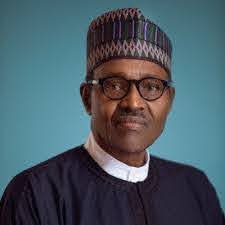
The Financial Times of London has described Nigeria as a country going backwards economically and plagued with terrorism, illiteracy, poverty, banditry, and kidnapping and risks becoming a failed state if things don’t take a drastic turn.
The UK-based newspaper said this in an editorial on Tuesday titled, ‘Nigeria at Risk of Becoming a Failed State’.
It said the abduction and subsequent rescue of over 300 schoolboys in Kankara, Katsina State, revived memories of the 276 Chibok schoolgirls abducted in Borno State in 2014.
According to the newspaper, while the government’s claim that no ransom was paid to the abductors of the schoolboys remains doubtful, other acts of criminality could not be overlooked.
The editorial read in part, “The government insists no ransom was paid. Scepticism is warranted. In a country going backwards economically, carjacking, kidnapping and banditry are among Nigeria’s rare growth industries. Just as the boys were going home, Nigerian pirates abducted six Ukrainian sailors off the coast.
“The definition of a failed state is one where the government is no longer in control. By this yardstick, Africa’s most populous country is teetering on the brink.”
The newspaper also questioned the claim by the President, Major General Muhammadu Buhari (retd.), that Boko Haram had been technically defeated.
It said contrary to the government’s claim, Boko Haram remained an ever-present threat
The Financial Times stated, “President Muhammadu Buhari in 2015 pronounced Boko Haram technically defeated’. That has proved fanciful. Boko Haram has remained an ever-present threat. If the latest kidnapping turns out to be its work, it would mark the spread of the terrorist group from its north-eastern base.
“Even if the mass abduction was carried out by ‘ordinary’ bandits — as now looks possible — it underlines the fact of chronic criminality and violence. Deadly clashes between herders and settled farmers have spread to most parts of Nigeria. In the oil-rich, but impoverished, Delta region, extortion through the sabotage of pipelines is legendary.”
The newspaper said security is not the only area where “the state is failing”.
The Financial Times added that Nigeria has more poor people than any other country even as Nigeria has the highest number of out of school children on earth.
The newspaper stated that as oil continues to lose its value, Nigeria’s economy would worsen.
“The population, already above 200 million, is growing at a breakneck 3.2 per cent a year. The economy has stalled since 2015 and real living standards are declining. This year, the economy will shrink 4 per cent after COVID-19 dealt a further blow to oil prices.
“In any case, as the world turns greener, the elite’s scramble for oil revenue will become a game of diminishing returns. The country desperately needs to put its finances, propped up by foreign borrowing, on a sounder footing,” it said.
The newspaper said Buhari, who has less than three years left in office, must use the remainder of his term, to redouble efforts at improving security.
It advised the government to restore trust in key institutions, among them the judiciary, the security services and the electoral commission, which will preside over the 2023 elections.
The Financial Times said the #EndSARS protests led by Nigerian youths, signaled a glimmer of hope for Nigeria’s teeming youth population
It added, “The broad coalition that found political expression this year in the EndSARS movement against police brutality provides a shard of optimism. At least Nigeria has a relatively stable democracy. Now Nigeria’s youth — creative, entrepreneurial and less tainted by the politics of extraction — should use that system to reset the country’s narrative.”
The newspaper concluded by saying that it was time for Nigeria to restructure its political system and concentrate on security, health, education, power and roads
“At the present trajectory, the population will double to 400 million by 2050. If nothing is done, long before then, Nigeria will become a problem far too big for the world to ignore,” it warned.


By Emmanuel Kuza
A chieftain of the Peoples Democratic Party (PDP) in Nasarawa State, Abuga Ovie, has described the name Ombugadu as a political brand, saying the popularity and wide acceptance of the name have made David Emmanuel Ombugadu a major force in the state’s political landscape.
Ovie, who stated this in an interview on Tuesday, said what started as opposition from some of Ombugadu’s biological brothers and people he described as fathers and uncles who betrayed him for personal political interests had now assumed a wider dimension, with political parties allegedly joining the battle against him.
According to him, the latest development was an attempt to undermine the political value of the Ombugadu name by presenting another person with the same surname, describing it as an indication of how far some political actors were prepared to go to weaken the PDP governorship candidate.
“Ombugadu is a brand, not a title. The people are not fools. They know their own. You cannot simply bring another person bearing the same name and expect the people to forget the political identity that Ombugadu has built over the years,” he said.
He further alleged that a former governor was working to introduce a political associate who had served as Accountant-General of Nasarawa State into the political equation, with the alleged objective of destabilising the PDP and weakening its chances by ensuring that the party fields a less competitive candidate in 2027.
“The plan, as we understand it, is to destabilise the PDP and make sure the party presents a weak candidate, thereby creating an advantage for the former governor’s preferred candidate. But all those efforts have proved abortive because the national leadership of the PDP stood its ground and refused to lose its best bet for the 2027 governorship election,” Ovie said.
The PDP chieftain said the resolve of the national leadership to retain Ombugadu had demonstrated the confidence the party had in his capacity to win the governorship election, despite what he described as attempts by some political actors to frustrate his ambition.
Ovie urged political parties and their leaders to resolve their internal differences instead of concentrating their efforts on Ombugadu, whom he compared to David in the Bible, saying he remained focused despite betrayal and opposition from those close to him.
“Ombugadu is like David in the Bible. Even when his brothers forsook him, he remained focused. Today, despite the people who have betrayed him, he remains focused and has a blueprint that can rescue Nasarawa State,” he said.
He said political parties should concentrate on presenting their programmes and convincing voters about how they intend to address the challenges confronting the state rather than expending their energy on attempts to stop Ombugadu.
“Political parties should fix their problems instead of wasting their strength fighting Ombugadu. Let everybody bring their blueprint before the people and explain what they intend to do for Nasarawa State,” he said.
Ovie maintained that the 2027 election should be about ideas, competence and the future of Nasarawa State, rather than attempts to manipulate political structures or undermine individuals perceived to enjoy strong grassroots support.
He urged the people of the state, particularly the Eggon community, to remain politically vigilant and resist what he described as efforts to make them settle for less, insisting that voters would ultimately determine who enjoys their confidence at the polls.
Reduce repeated references to Ombugadu

By Israel Adamu, Jos
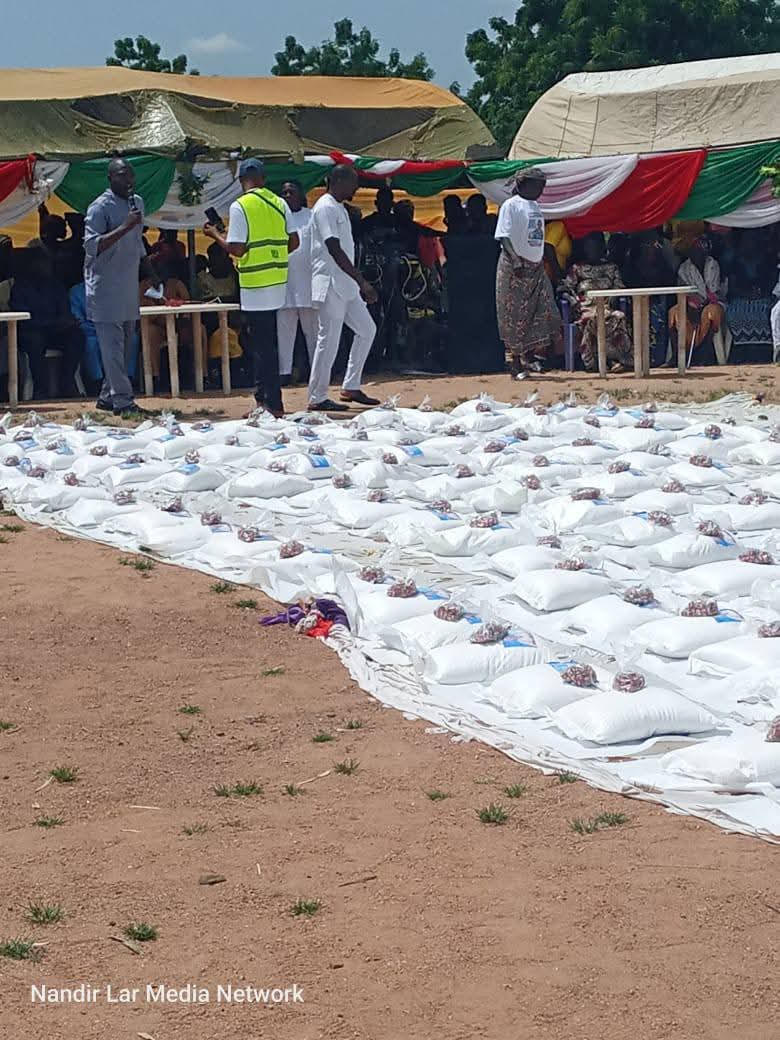
Two hundred widows from communities across Langtang North Central State Constituency of Plateau State have benefited from an empowerment outreach organised by Gimbiya Gani Nandir Lar under the Jagoran Talakawa movement.
The outreach, held at Pilgani in Langtang North Local Government Area, was aimed at supporting vulnerable women and drawing attention to the challenges faced by widows, particularly those struggling to provide food, pay school fees and meet other basic needs for their families.
The organiser, Nandir Lar, who is the All Progressives Congress, APC, candidate for Langtang North Central State Constituency, said the gesture was motivated by compassion and concern for vulnerable members of the society.
She stressed that the outreach was not a political programme but an expression of love and support for humanity.
Nandir Lar said: “The plight of widows may not always make headlines, but their struggles are real, painful and deserving of our collective attention.
“This is simply an expression of compassion and love for humanity. It is not a political programme.
“Our constituency is home to people with diverse needs, including mothers, widows and young people who are seeking opportunities to improve their lives.”
Former Provost of the Federal College of Education, Pankshin, Amos Chirfat, commended the initiative, saying it had brought smiles to the faces of vulnerable women in the constituency.
Minority Leader of the Langtang North Legislative Council, Dirya Sheni, also commended Nandir Lar for supporting widows and other vulnerable members of the community.
At the end of the outreach, each of the 200 beneficiaries received a 10-kilogramme bag of corn flour, seasoning and N10,000 cash

By Francis Wilfred
The Special Control Unit against Money Laundering (SCUML), and the Real Estate Developers Association of Nigeria (REDAN) have expressed commitment to ensure a full compliance with the Anti Money Laundering/Counter Finance on Terrorism/Counter Proliferation Financing, (AML/CFT/CPF) laws within the Nigeria’s real estate sector.
They made the resolve during a stakeholders’ engagement held on Thursday, September 10, 2026
The engagement focused on Mutual Evaluation readiness, risk-based supervision, beneficial ownership transparency, customer due diligence, internal controls and stronger collaboration between SCUML and the real estate sector.
Assistant Commander of the EFCC, ACE 1 Ibinabo Amachree, speaking on behalf of SCUML highlighted the strategic role of real estate operators in protecting the integrity of Nigeria’s financial system, particularly given the sector’s vulnerability to money laundering and other financial crime risks.
Amachree encouraged REDAN members to move beyond registration to ensure that compliance is embedded in their day-to-day operations. He mentioned the areas to include: understanding institutional risks, knowing customers and beneficial owners, identifying politically exposed persons, conducting appropriate sanctions screening, maintaining effective internal controls and meeting applicable reporting obligations
He, therefore, reaffirmed readiness to working closely with REDAN and other stakeholders to improve compliance, build capacity and promote a stronger culture of accountability across the real estate sector
“The message is clear: effective compliance is not just about meeting regulatory requirements; it is about protecting businesses, strengthening the real estate sector and safeguarding the integrity of Nigeria’s financial system”, she said.
In his remarks, the Chairman of REDAN, Lagos state, Mr Tony Kolawole pledged readiness to partner with SCUML in ensuring compliance with AML/CFT/CPF in the real estate sector to uphold financial integrity.
The engagement also provided an opportunity for REDAN members to share practical regulatory and operational challenges affecting the sector, reinforcing the importance of continuous dialogue between regulators and industry stakeholders.


Changsha brings millennia-old heritage into modern life

Gov AbdulRazaq Lauded Over Conferment Of Sadauna Of Ilorin Title

FG Commissions KWASU ICT Centre To Enhance Graduates Employability

-
 Uncategorized6 years ago
FG, states urged to harness flooding for ranching, others with technology – Agbaje
-
 Headlines11 years ago
Breaking: EFCC seals Borno House of Assembly, as Hon members take to their heels
-
 News12 years ago
Nigeria Security Operatives Stage Manhunt For Homosexual Perpetrator
-
 News10 years ago
How 21-year-old Girl fled community over accusation of lesbianism
-
 News11 years ago
Yobe Gov Moves Against Deputy
-
 Opinion7 years ago
7 signs she has friend zoned you
-
Technology5 years ago
Online job placement company headhunts women
-
 Headlines10 years ago
Borno Dep Gov Abducts Another Church Leader