
Foreign
China, ASEAN join forces to build an ever closer community with shared future

By Pang Geping, Li Zong, People’s Daily
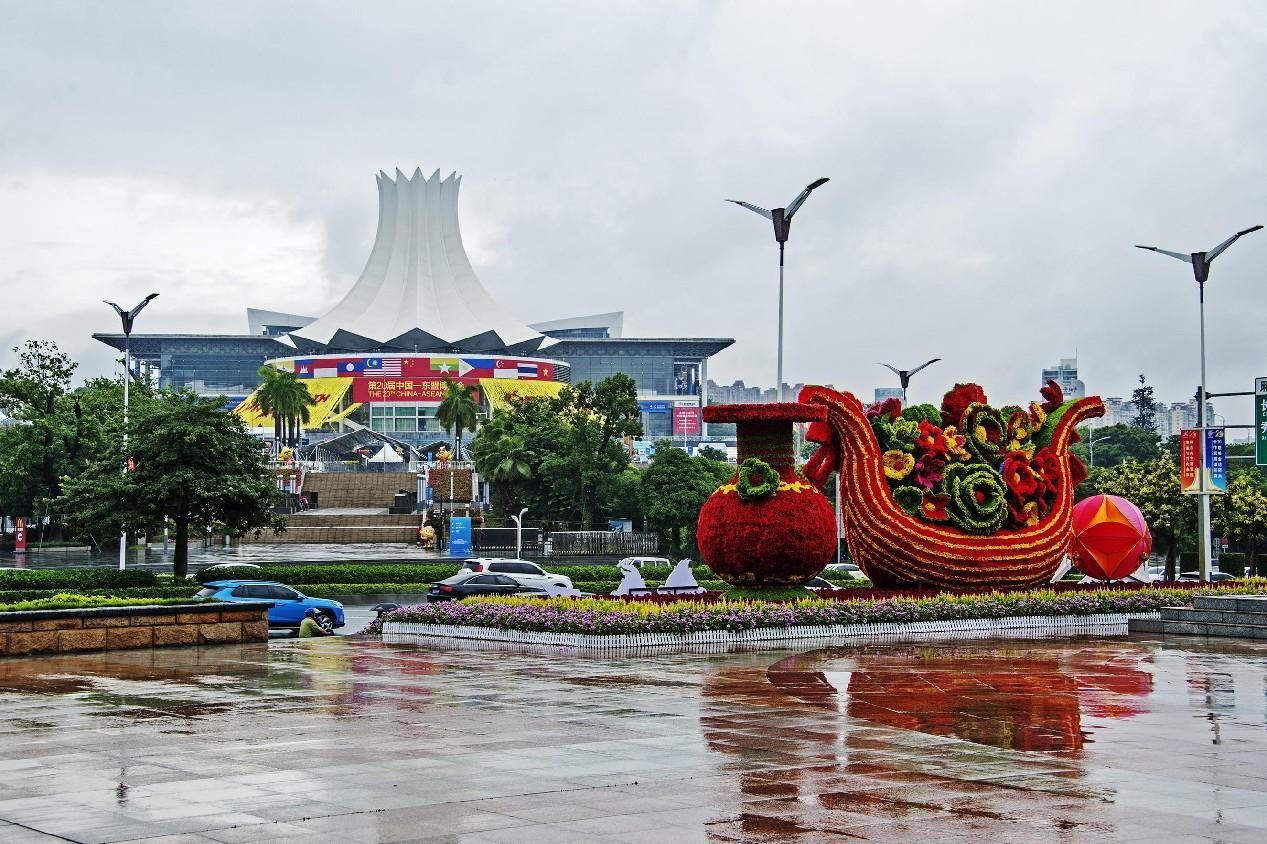
The 20th China-ASEAN Expo and China-ASEAN Business and Investment Summit was held on Sept. 16 in Nanning, capital of south China’s Guangxi Zhuang autonomous region.
Over the past 20 years, the expo and summit has built collaboration and cooperation mechanisms between China and ASEAN in multiple areas, injecting positive energy into the region and the world’s peace and stability, development and prosperity. It has served as a sound platform that strengthens communication and exchanges between the two sides.
In recent years, more and more featured products have entered the Chinese market via the China-ASEAN Expo, such as durians from Vietnam, mangosteens from Thailand and coffee from Indonesia.
The China-ASEAN Expo and China-ASEAN Business and Investment Summit has become an important platform for communication and cooperation between China and ASEAN, said Wei Zhaohui, secretary-general of the expo’s secretariat.
China and ASEAN established a strategic partnership at the China-ASEAN (10+1) leaders’ meeting in 2003, which marked a new chapter of friendship between the two sides.
At this meeting, China proposed to hold the China-ASEAN Expo in Nanning on an annual basis starting in 2004. In 2004, the first China-ASEAN Expo was successfully held and permanently settled in in Nanning, and the China-ASEAN Business and Investment Summit was also held.
The expo and summit has built a bridge of friendly cooperation in multiple fields, forming a new channel for China-ASEAN cooperation. It is a regional public product and international cooperation platform serving China and ASEAN, and even the Regional Comprehensive Economic Partnership (RCEP) and the Belt and Road Initiative.
The previous 19 sessions of the expo and summit were attended by a total of 182 Chinese and foreign leaders, over 3,800 ministerial-level guests and heads of international organizations, as well as more than 1.1 million merchants.
“Thanks to the China-ASEAN Expo and China-ASEAN Business and Investment Summit, the cooperation between the two sides has extended from trade in goods, investment, and services to more areas such as international capacity cooperation and cross-border industrial park construction,” said Zhai Kun, a professor in the School of International Studies, Peking University, adding that the expo and summit has also fostered exchanges in various fields including artificial intelligence, internet technology, and education.
As a result, the cooperation between the two sides is progressing towards a larger scope, with higher standards and at deeper levels, Zhai said.
High-level dialogue and negotiations, multi-level economic and trade activities, and wide-ranging high-level forums were held during the expo and summit. They have showcased the comprehensive cooperation between China and ASEAN over the past 20 years, which has not only brought benefits to the region, but also promoted global economic and trade development.
Last year, the RCEP came into effect, creating the world’s largest free trade bloc. “The expo has vigorously promoted the construction of the China-ASEAN Free Trade Area and the RCEP, opening up broader space for regional economic and trade cooperation, accelerating regional economic integration, and injecting strong impetus into regional prosperity and stability,” said Benjamas Tanvetyanont, Thai consul-general in Nanning.
Trade cooperation is an important witness to the progress of bilateral relations. Statistics show that the bilateral trade volume between China and ASEAN has increased from over $100 billion in 2004 to $975.34 billion in 2022.
China has maintained ASEAN’s largest trading partner for 14 consecutive years, while ASEAN has been China’s largest trading partner for 3 consecutive years. China-ASEAN economic and trade cooperation has steadily and continuously developed, becoming a successful example of regional cooperation in the Asia-Pacific region.
In recent years, with the construction and opening of more roads and railways, as well as the upgrading and transformation of various ports, the increasing logistics connectivity has accelerated the development of ASEAN countries.
China and ASEAN have joined hands to build a China-ASEAN community with a shared future, promoting common development and prosperity, and enabling over 2 billion people to live a better life. This serves as a vivid example of building a community with a shared future for mankind.
The annual throughput of the Beibu Gulf Port in Guangxi has exceeded 7 million twenty-foot equivalent units, and ASEAN products such as durians and frozen shrimps are entering the Chinese market via the port.
So far, the China-Laos Railway has transported over 20 million passengers. Besides, the agreed investment for the Malaysia-China Kuantan Industrial Park stood at about 46 billion yuan ($63.14 billion), with a cumulative industrial output value of over 60 billion yuan.
China and ASEAN are witnessing deepening and solidifying exchanges and cooperation in education, livelihood, and health. The two sides have sent over 200,000 students to each other.
Besides, Chinese universities have established majors in the official languages of the 10 ASEAN countries, and ASEAN countries have set up 42 Confucius Institutes and 39 Confucius Classrooms. Currently, all 10 countries have become popular destinations for Chinese tourists, and both sides are major sources of tourism for each other.
“In the past 20 years, the China-ASEAN Expo has played an increasingly prominent role as an international public product serving global trade. With the accelerated development and upgrading of the expo, the cooperation between China and ASEAN will undoubtedly flourish and yield even more fruitful results,” said Wei.

By Li Gang, People’s Daily
As artificial intelligence (AI) accelerates the transformation of global industries, a new form of digital trade is emerging in the southern Chinese city of Shantou: exporting computing services measured not in physical goods, but in AI tokens.
In late April, Shantou, Guangdong province completed full-chain verification for what has become known as “token exports” — a model in which computing power remains within China while high-value AI services are delivered to overseas users. Within just one month, average daily token usage surged from 100 million to the tens-of-billions level.
The practical application of this model is already well underway.
Recently, when a user in Singapore activated an AI-powered toy and gave a simple command — “Tell me a fairy tale” — the spoken command traveled through the network directly to a dedicated overseas computing zone inside a computing center in Shantou.
Local deployed AI agents wrap up speech recognition in under one second and craft custom story content, firing the finished audio back to the Singapore-based toy device in as little as 0.1 seconds.
The user repeated the process multiple times, eventually listening to five stories in total. Approximately 100,000 tokens were consumed during the interaction and billed in real time at a rate of 2 yuan ($0.3) per one million tokens.
When payment arrived, a complete commercial cycle was achieved, marking the successful realization of Shantou’s “token export” model.
Tokens represent the smallest discrete calculation unit for large AI models to process information. They have become a key indicator of intelligent computing capacity and, increasingly, a new carrier of value in the digital economy.
Inside the China (Shantou) Pilot Zone for Economic and Cultural Cooperation with Overseas Chinese, token exports are already transforming the economics of electricity.
Today, overseas users across multiple countries and regions in Southeast Asia are accessing token services generated in Shantou.
“Data flows in from abroad and all processed outputs head back overseas, with zero compromise to end-user experience,” explained Cai Qichen, an engineer at the Shantou Branch of wireless carrier China Mobile. “Token costs have already been integrated into product service packages, making future usage more convenient.”
According to estimates from toy manufacturer SHOWMAC based in Shenzhen, Guangdong province, using Shantou’s computing services reduces costs by more than 30 percent compared with directly purchasing overseas computing resources.
Meanwhile, inside computing centers, turning electricity into AI tokens delivers dramatic value appreciation. A kilowatt-hour of electricity, which comes at a cost of roughly 0.5 yuan($0.07) , can be transformed through AI computing into tokens and then exported at a price of 11 yuan($1.6), representing a twenty-two-fold increase.
As one of eastern Guangdong’s major offshore wind power bases, Shantou has already connected 1.2 million kilowatts of installed capacity to China’s power grid.
The electricity itself does not need to cross borders. Computing power remains within China. What gets exported instead are high-value digital services, turning electricity into a form of hard currency for cross-border digital trade.
Ultra-low network latency forms the technical backbone making token exports feasible.
“More than half of China’s outbound bandwidth carried by international submarine cables lands in Shantou, and the city is also home to five undersea trunk cables linking destinations worldwide,” said Hong Zhebin, chief technology officer of the international submarine cable landing station operated by the Shantou branch of wireless carrier China Telecom.
“The latency between Shantou and Singapore is only 32.7 milliseconds, quicker than the blink of an eye,” Hong added.
Hong Yu with the Shantou Branch of China Mobile, added that Shantou’s overseas computing services offer stable response speeds, regulatory compliance, and substantial cost advantages.
“Our pricing is only 1/3 to 1/2 that of mainstream international platforms, while customer retention exceeds 70 percent,” Hong told People’s Daily.
Yet building a complete end-to-end system is only the starting point. Shantou is now attempting to transform itself from a transit city for digital infrastructure into an ecosystem hub.
Leading computing companies and developers are gathering rapidly. Pilot platforms have passed acceptance reviews. Commercial closed loops have already emerged in applications ranging from AI toys to intelligent manufacturing, with large-scale operations expected soon.
Shantou’s Chenghai district has long been known as the “toy capital of China.” As AI becomes increasingly integrated with the toy industry, the city has launched an AI toy innovation center and the Shantou AI Laboratory, striving to become the “AI toy capital of China.”
At the exhibition space of one local tech firm sits Amy, an AI desktop robot capable of fluid multilingual conversation.
“It is equipped with a multilingual intelligent voice interaction system capable of real-time recognition and conversation in dozens of languages,” said the company’s general manager Chen Ruifeng.
The technology has already been integrated into multiple AI toy products exported to countries including the United Kingdom, Russia, and Japan.
Shantou’s token export model allows AI toy manufacturers to access domestic large language models at costs far below those of overseas alternatives.
“The cost of using overseas AI models can be dozens of times higher than domestic models,” Chen said. The company’s AI toys currently run on Chinese large models including DeepSeek and Doubao.
“Token exports have significantly increased both product value-added and international competitiveness,” he said.
The Shantou branch of wireless carrier China Unicom, together with a Guangdong-based tech firm, has established dedicated lines connecting Shantou and Vietnam, delivering cross-border computing services to Aachen Sv, a Chinese-invested fiber-optic company operating in Vietnam.
Vietnamese users accessing large models such as DeepSeek and Qwen experience extremely low latency with zero packet loss. “In less than a month, more than a dozen companies have approached us for consultations,” an employee of the Guangdong-based tech firm said.
Meanwhile, the Guangdong branch of China Mobile has launched an OpenClaw intelligent agent framework, providing integrated AI service packages that allow traditional toys to complete intelligent upgrades in as little as 15 days.
From toys to textiles, cross-border e-commerce, and high-end manufacturing, tokens are increasingly becoming the digital fuel powering Shantou’s industrial upgrading.
By Song Haoxin, People’s Daily
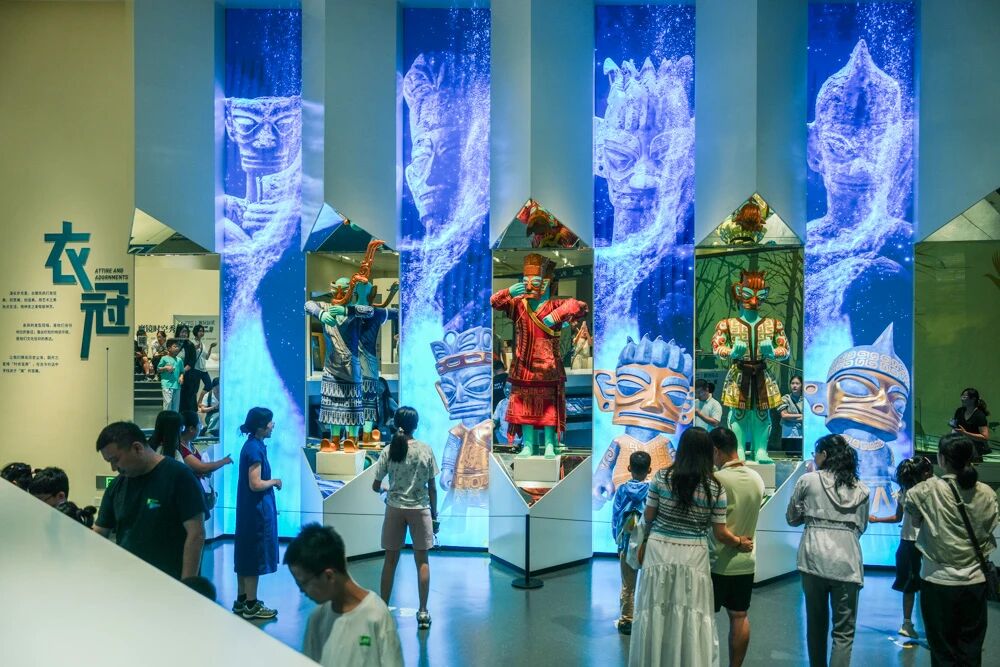
What if museum visitors could truly interact with cultural relics rather than merely observe them through glass displays? At the Sanxingdui Museum in southwest China’s Sichuan province, a specially designed interactive hall is revolutionizing cultural engagement.
Within this 1,300-square-meter space, nearly every exhibit invites touch, operation, or participation. Visitors immerse themselves in installations inspired by the ancient Shu civilization, blending education with entertainment.
By trying on replicas of headwear on bronze statues discovered in Sanxingdui Ruins, for example, visitors can not only take photos of themselves but also learn about the symbolic meanings behind different headpieces.
Guests can don replicas of bronze statue headwear from the Sanxingdui Ruins, learning their symbolic meanings while capturing photos. Augmented reality allows dancing alongside virtual Sanxingdui figures for social media sharing. A creation zone even enables “time travel” to experience ancient bronze-casting and construction techniques.
These innovations transform traditional museum visits, offering deeper cultural understanding through hands-on interaction. “This hall emerged from extensive brainstorming,” explained Zhu Yarong, deputy director of the management committee of the Sanxingdui Ruins site.
“We’re transitioning from passive relic viewing to interactive engagement, bridging the gap between audiences and history.”
Previously, museum experiences were largely one-directional with limited engagement. Visitors viewed relics through display cases, usually stopping mainly to take photographs, with relatively limited forms of engagement. By liberating artifacts from display cases into interactive settings, Sanxingdui is pioneering a shift from didactic presentation to open cultural dialogue.
Traditional exhibition spaces remain popular, while digital innovations attract growing interest. A VR project employs digital twin technology to recreate 1:1 scale excavation sites — complete with protective shelters and cabins — placing visitors at the archaeological forefront.
Another project, Heaven and Earth Echoes — Sanxingdui Panoramic Sound and Vision Digital Art Theater, features an interactive panoramic LED dome with a diameter of 20 meters and a resolution approaching 16K. The massive dome creates a deeply immersive atmosphere. By waving digital torches in their hands, visitors can trigger sacred birds to circle above them across the dome, experiencing the ancient Shu civilization through an interplay of sound and imagery.
“The digital technology made me feel as if I were racing across the Mamu River. That sense of traveling through time was incredible,” said Hao Yong, a tourist from southwest China’s Chongqing municipality who came specifically to experience a virtual reality program.
From passive observation to active participation, Sanxingdui Museum continues introducing new interactive experiences that transform cultural relics into living carriers of dialogue and engagement, helping keep the sparks of Chinese civilization alive for new generations.

My people of Benue State,
I am not speaking to you today as a politician. I am speaking as a brother whose family was held up by Chief Mike Kaase Aondoakaa, MKA, when we had no one else to hold onto.
My elder brother, Verem Ukaa-Ikuan, was not just my blood. He was a very dear and close friend to Chief MKA. When my brother fell ill and was diagnosed with liver damage caused by poisoning, MKA didn’t treat it as someone else’s problem. He took it on as his own.
He worked closely with Verem during his time as Attorney General of the Federation, and when the sickness came, he moved immediately. Searches were conducted, and Apollo Hospital in India was earmarked for a liver transplant. Every travel arrangement was made personally by Chief MKA.
But we hit a wall. Verem was too weak to fly a long commercial flight. Only an air ambulance could get him to India alive. At that time, there was only one functional air ambulance in the entire country, owned by Julius Berger. It was completely out of reach for even the most high-profile citizens.
Chief MKA went all out. He did not give excuses. He did not delay. He used every connection and every ounce of influence he had to secure that air ambulance for my brother.
On the day it was secured, Barr. Terna Yaji, his Senior Special Assistant, called me a few minutes after 6pm. He told us to prepare Verem for departure and take him to Makurdi airport very early the following morning. I informed him, my brother passed on at exactly 6 o’clock a few minutes ago. I told Barr. Terna Yaji, and I saw a devastated MKA.
During the burial, Chief MKA was out of the country on national assignment. He was pained that he could not be there physically. His entire team, led by the late Onov Tyuulugh, represented him fully. And his message to us at the burial has never left me:
“If death were law, as the Attorney General, a law would have been made no matter what to ensure Verem will just not die but live forever.”
That is who Mike Kaase Aondoakaa is when nobody is watching. He does not abandon his people. He does not forget. He stood with our family then, and he has stood with us till date.
Now he is asking for the chance to govern Benue State.
Benue needs a governor with a heart like that. A governor who fights for you even when there’s no political gain. A governor who sees you as family, not as a vote.
I am standing with Chief Mike Kaase Aondoakaa for Governor of Benue State.
For compassion that moves to action.
For loyalty that does not fade.
For leadership that proves itself in the darkest hour.
Join me. Let us give Benue a leader who has already shown what he will do for us.
God bless Chief Mike Kaase Aondoakaa.
God bless Benue State.
Brahms Tor-Ikuan, a beneficiary of MKA’s benevolence writes from Makurdi


AONDOAKAA’S LAWYERS URGE COURT TO DISMISS SUIT CHALLENGING HIS GOVERNORSHIP CANDIDACY

“WIKE CANNOT CHOOSE A GOVERNOR FOR US!” — Group Rejects Alleged Rainbow Coalition Plot in Benue

2027: Group Defends INEC, Urges Evidence-Based Scrutiny of Staff Redeployments

-
 Uncategorized6 years ago
FG, states urged to harness flooding for ranching, others with technology – Agbaje
-
 Headlines11 years ago
Breaking: EFCC seals Borno House of Assembly, as Hon members take to their heels
-
 News12 years ago
Nigeria Security Operatives Stage Manhunt For Homosexual Perpetrator
-
 News10 years ago
How 21-year-old Girl fled community over accusation of lesbianism
-
 News11 years ago
Yobe Gov Moves Against Deputy
-
 Opinion7 years ago
7 signs she has friend zoned you
-
Technology5 years ago
Online job placement company headhunts women
-
 Headlines10 years ago
Borno Dep Gov Abducts Another Church Leader