
Uncategorized
Why Matrix Energy Should Stop Dancing Naked

By David Tunde
In a flagrant and audacious exhibition of corporate greed and regulatory failure, Matrix Energy Limited, a prominent player in Nigeria’s petroleum industry, led by CEO Abdulkadir Adisa Aliu, has become embroiled in a scandal of monumental proportions involving the importation of subpar fuel products. This disturbing revelation, compounded by the company’s alleged complicity in illicit activities, raises grave concerns regarding the integrity of the Nigerian fuel supply chain and the potential perils to public health and safety.
Through the deliberate importation of blended low-grade petroleum products, which are subsequently sold as high-quality fuel, Matrix Energy is not only jeopardizing lives but also subverts the country’s economic governance framework. Abdulkadir Adisa Aliu, a member of the esteemed Presidential Economic Coordination Council (PEEC), is exploiting his position of influence and proximity to powerful and corrupt individuals in the Nigerian Midstream and Downstream Petroleum Regulatory Authority (NMDPRA) , and The Nigerian National Petroleum Corporation (NNPC) Limited to perpetuate these nefarious activities with unbridled impunity.
Matrix Energy’s operations have been irrefutably linked to Malta, a preeminent European hub for the clandestine blending and ship-to-ship (STS) transfers of sanctioned Russian oil and petroleum products. A staggering 35% of shipments arriving in Malta comprise naphtha and other components, which are subsequently blended into petrol to produce “African Spec” products. These products are then transshipped into various vessels for ultimate delivery into Nigeria, perpetuating a complex web of clandestine transactions.
Further investigation reveals that the products from Malta are transported through a labyrinthine network of intermediate ships and companies, including Poly Pro Trading in Dubai. Notably, the listed office of Poly Pro Trading is merely a business center devoid of any physical presence, thereby obfuscating the trail of accountability. This is further complicated by the forgery of paper works and the representation of non-existent companies, which serve as a conduit for these surreptitious transactions and movements.
The fact that Malta, a country devoid of any known oil refineries, has emerged as the top European destination for blending and ship-to-ship transfers of sanctioned Russian oil and petroleum products is a damning indictment of the lack of regulation and oversight in Nigeria’s oil and gas sector. The Nigerian Midstream and Downstream Petroleum Regulatory Authority (NMDPRA) has demonstrably failed in its duty to regulate fuel quality, thereby enabling international commodity traders and Nigerian marketers to exploit this regulatory vacuum and import low-quality fuels with impunity.
Regrettably, the presence of unpatriotic individuals such as Adisa Aliu, Farouk Ahmed, Mele Kyari, and their cohorts in positions of decision-making ensures the perpetuation of the rot in our oil and gas sector, which will continue to thrive on a “balanced diet” of corruption and malfeasance. These are people that are ready to run our economy aground with unbridled greed, bigotry, nepotism, and illegalization of Institutional corruption from one catastrophic selfish agenda to the other, under the guise of improving the Oil and gas sector.
It is intriguing to ponder the rationale behind the selection of Russia and Malta as key players in this illicit operation. However, it is hardly surprising, given that these regions, being under international sanctions, lack stringent measures to curb illegal activities, thereby becoming a haven for corrupt individuals worldwide to converge and indulge in nefarious pursuits for their selfish interests.
The fact that Russia was expelled from the SWIFT global banking framework, comprising nearly 12,000 banks, renders any oil and gas transactions between Nigerian companies and Russian refineries illicit, as Russian banks are unable to open letters of credit for exports. This exposes Nigeria to diplomatic crises that could further compound all that we are going through. Consequently, it is no wonder that Malta has emerged as the premier European destination for blending and ship-to-ship (STS) transfers of sanctioned Russian oil and petroleum products, following the Greek navy’s decision to prohibit such activities in their offshore zone.
Notably, diesel from Russia is notoriously off-spec, and diesels from Matrix filling stations have failed the ASTM D4294 test method, which provides a rapid and precise measurement of total sulfur in petroleum and petroleum products with minimal sample preparation. This egregious situation has led to Matrix Energy peddling flammable diesel with toxic fumes to unsuspecting Nigerians, while reaping enormous profits.
The sheer magnitude of Matrix Energy’s operations is staggering, with over 200,000 tons of gasoline products from Malta allegedly discharged into a Jetty owned by Matrix Energy in July 2024. This represents a staggering 25 percent of Nigeria’s monthly PMS consumption, channeled to a relatively small player with a mere 150 retail stations, highlighting the vast scope of this illicit operation.
The Nigerian Midstream and Downstream Petroleum Regulatory Authority (NMDPRA) is undoubtedly complicit in the importation of substandard diesel and jet fuel into the country, thereby fueling concerns regarding the quality of products utilized in Nigeria. It is a travesty that Africa’s largest oil-producing nation has been importing inferior petroleum products from Malta, a country devoid of any known oil refineries. The evidence of this egregious act is ubiquitous and glaringly apparent to the federal government, unless they choose to willfully ignore it, even without conducting a thorough investigation into the operations of Adisa Aliu and Matrix Energy.
A cursory examination of the cargo trails, the non-existent Dubai business location, and the Malta-Russia adulterated imported fuel, would reveal the extent of this malfeasance. Furthermore, an investigation into the quality of fuel being dispensed at Matrix Filling stations would provide additional evidence of the nefarious activities. If these investigations are thoroughly conducted, the evil nature of Abdulkadir Adisa Aliu’s actions will be laid bare for all to see. His genocidal actions, posing a significant health hazard to Nigerian citizens, increasing the potential mortality rate due to accidents caused by adulterated fuel, and dilapidating the economy for selfish gains, will be exposed.
Matrix Energy’s recent maneuver to seek judicial protection and restrain media houses and other entities from further publishing revelatory stories about its oil shipping business is a farcical spectacle that ranks as one of the most absurd jokes of the century. This attempt to stifle the dissemination of incriminating information constitutes a blatant assault on the sacrosanct right to free expression, a fundamental tenet of democratic societies. By seeking to muzzle the media and suppress the truth, Matrix Energy is attempting to circumvent accountability and perpetuate its nefarious activities, thereby undermining the very fabric of transparency and public discourse.
Aliu’s “dance of shame” must be met with severe consequences. The shame and disdain brought upon Nigeria must be addressed forthwith. Nigeria must not be perceived as a country of fools. We are aware of the situation, and the President must take decisive action to address this madness. The weakness in regulating fuel quality poses a grave health risk to Nigerians. International commodity traders and Nigerian marketers are exploiting this regulatory vacuum to import low-quality fuels. This is grounds for the President to immediately sanction the regulators responsible for policing the midstream and downstream sector and take action concerning the leadership of the Oil and Gas sector in Nigeria.
It is hardly astonishing that Matrix Energy would resort to extreme measures to protect and shield certain influential benefactors, whose identities and interests remain shrouded in secrecy. The primary motivation behind their decision to institute this lawsuit is to insulate and shield their accomplices within the Nigerian National Petroleum Company Limited (NNPCL) and other members of their clandestine cabal from the scrutiny of the media. By doing so, Matrix Energy seeks to conceal the complicity of these individuals and entities in their illicit activities, thereby perpetuating a culture of impunity and shielding them from accountability. This desperate attempt to gag the media and suppress the truth is another evidence to the company’s desperation to maintain the veil of secrecy surrounding their nefarious operations and protect their cohorts from exposure. This audacious move is an affront to the principles of openness and accountability, and it is imperative that it be vehemently resisted to safeguard the integrity of free expression and the public’s right to know.
To effectively mitigate this crisis, the Nigerian government must adopt a resolute and proactive stance. The leadership of the Nigerian Midstream and Downstream Petroleum Regulatory Authority (NMDPRA) and the Nigerian National Petroleum Corporation (NNPC) must be held accountable for their failure to safeguard the interests of Nigerian consumers. Furthermore, the government should undertake a comprehensive overhaul of the regulatory framework governing the importation and distribution of petroleum products to prevent future recurrences of this nature.
Moreover, a thorough investigation into Matrix Energy Limited , and their Cabal’s involvement in illicit activities, including the importation of sanctioned Russian oil, is imperative. If found culpable, the company should face severe penalties, including the revocation of its operating license. It is imperative that Matrix Energy ceases its egregious activities and is held accountable for its actions. The Nigerian people deserve a safe, reliable, and uninterrupted fuel supply, and it is the government’s responsibility to ensure that this is achieved.
The issue at hand extends beyond the mere importation of substandard fuel; it encompasses a complex web of illicit activities, including the importation of sanctioned products, falsification of documents to facilitate smooth operations, and the deliberate alteration of product origin. It is high time that Matrix Energy assumes responsibility for its actions and ceases its exploitative practices.
Nigerians deserve better and demand immediate action from the President to sanction the regulators responsible and address the leadership of the Oil and Gas sector in Nigeria. Matrix Energy’s exploitation of Nigeria’s fuel market and the manipulation of our Judiciary must be halted, and those responsible must be held accountable. The citizens of Nigeria will no longer tolerate being treated as guinea pigs for corporate greed and regulatory failure.
Tunde is an oil and gas expert writing from Dundee, United Kingdom.

A legal practitioner, Mr M. D. Zarewa, has said that a bank cannot freeze or restrict a customer’s account without a valid court order.
Zarewa said it was prevalent in the society for law enforcement agencies to give directives to banks to freeze customers’ accounts whenever there was a pending case before them, adding that banks often complied with such directives.
He, however, said such practice was alien to Nigeria’s jurisprudence, stressing that banks were enjoined not to interfere with or restrict the activities of any customer’s account without a valid court order.
According to him, it is trite law and settled beyond argument that a bank cannot freeze a customer’s account without a valid court order.
He said the position was entrenched in the case of GTB Plc v. Olachi & Anor (2025) LPELR-81833(CA), where the Court of Appeal held that “whether frozen or restricted, neither can be done without the valid order of a Court of Law.”
Zarewa further cited GTBank v. Adedamola (2019) 5 NWLR (Pt. 1664) 30 at 43, Paras. E-F, where the court held:
“Before freezing customer’s account or placing any form of restraint on any account, the bank must be satisfied that there is an Order of Court.
“By the provisions of Section 34 of the Economic and Financial Crimes Commission Act 2004, the Economic and Financial Crimes Commission has no power to give direct instructions to banks to freeze the account of a customer without an Order of Court. So doing, constitutes a flagrant disregard and violation of the rights of a customer.”
The lawyer said any customer whose account had been frozen or restricted without a valid court order could institute a suit against the bank for grossly violating his or her rights.
He said such a customer could particularly seek redress for the violation of the right to own movable and immovable property and seek compensation from the court.
Furthermore, Zarewa said the law was trite that where there was a wrong, there was a remedy, as captured in the Latin maxim, Ubi jus ibi remedium.

Stephen Olufemi Oni, Ilorin
Kwara State Governor AbdulRahman AbdulRazaq has inaugurated the ‘AbdulRahman AbdulRazaq Morire Housing Estate’ in Ijagbo, Oyun Local Government Area of the State.
Speaking at the groundbreaking of the housing estates, which included 210 units of two-bedroom terrace apartments, 200 units of three-bedroom units and 54 units of four-bedroom terrace duplexes, the
Governor, noted that housing should not be seen or regarded as a luxury, but rather as a fundamental human requirement and cornerstone of dignity, security, and family stability, lamenting the daunting challenge of addressing housing deficits across the country.
He said: “Dear Kwarans, housing is not a luxury. Basic housing is a
fundamental human need and a cornerstone of dignity, security,
and family stability. Yet, across Nigeria and indeed in Kwara State,
the challenge of addressing housing deficit is daunting.
“This administration believes that inadequacy of proper shelter
for Nigerians is not merely a problem of not building enough
houses. Indeed, several studies have attributed the housing deficit in Nigeria to a complex mix of causes, key among them being high costs and rising costs of building materials, weak finance, difficult land systems, infrastructure gaps, institutional limitations, among others.
“On behalf of the people of Kwara, I thank the management of ISHI
Homes Limited for this partnership and for choosing Kwara State
as the location for this important development.”
Represented by the Commissioner for Housing and Urban Development, Dr Segun Ogunsola, the Governor applauded the developer for recognising his administration’s contributions to mass housing development in the State.
“The administration has consistently placed housing development high on its agenda. The government recognises access to decent and affordable housing as essential to the wellbeing of the people.
“The State Government has also been in active collaboration with
institutional partners including the Federal Ministry of Housing
with a view to increasing housing stock in the State.
“Recently, we acquired a housing estate with over 130 flats at
Ogbondoroko in Asa LGA of the State. Government has approved
that the estate be onboarded onto the administration’s social
support scheme,” he disclosed.
AbdulRazaq said the commitment was reflected in the development of the Kwara Smart City and other mass housing initiatives across the State.
The Governor disclosed that his reforms in land administration have reduced the processing time for Certificate of Occupancy (C of O) from 180 days to 35 days.
AbdulRazaq said the improved turnaround time demonstrated the administration’s commitment to making land administration more transparent, efficient and investor-friendly.
Earlier in his remarks, the Chief Executive Officer (CEO) of ISHI Homes, Dr Olayinka Ilufoye, said the project was intended to democratise home ownership and make decent and affordable housing accessible to the people of Kwara South senatorial district.
Ilufoye said the estate was meant for civil servants, traders and other Nigerians who can access it through the National Housing Fund (NHF).
“The name AbdulRahman AbdulRazaq Morire, which translates to ‘I have seen goodness’, is a deliberate expression of our faith, hope and expectation.
“We believe this estate will become a testimony of prosperity, progress and abundance in Kwara South,” he said.
Ilufoye pledged that the company would remain committed to transparency, accountability, quality construction and timely delivery.
The Executive Chairman of the Kwara State Geographic Information Service (KWGIS), Alhaji Sulyman Abdulkareem said the state government has consistently placed housing development high on its development agenda.
He commended the state government for ensuring access to land, facilitating the prompt issuance of titles and certificate of occupancy.
Abdulkareem pointed out that by providing timely approval for mortgage transactions, the Governor is creating the conditions necessary for housing development to thrive in Kwara State.
Stephen Olufemi Oni, Ilorin
Nigeria, and the world at large, are in dire need of exemplary leaders like the late Founder of the Ansarul Islam Society of Nigeria, Sheik Muhammad Kamalu-deen al- Adabbiy.
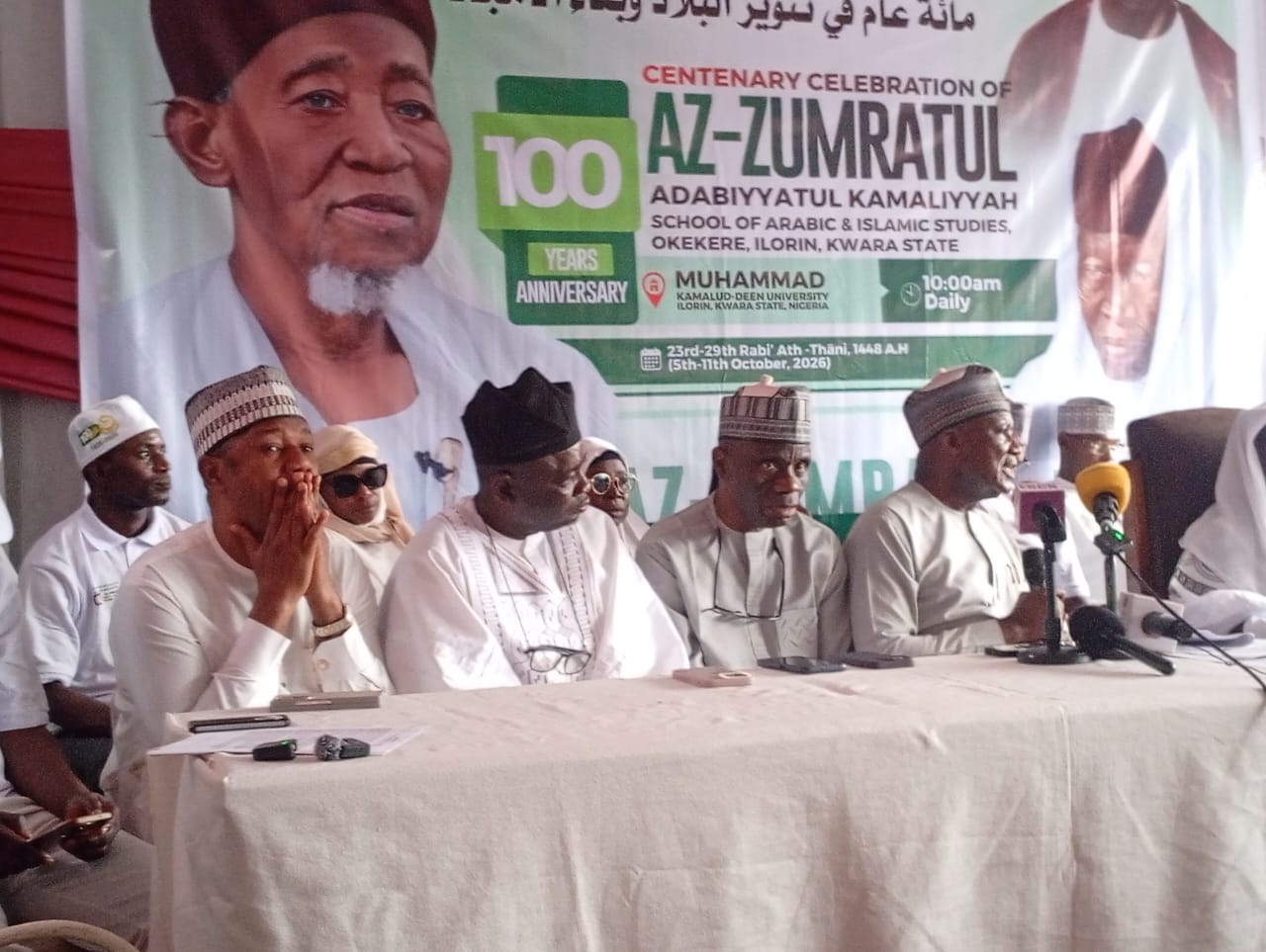
This was the submission of various scholars at a media briefing in ilorin, the Kwara State capital, to usher in the Society’s week-long activities to commemorate the 100 years of the establishment of the Az-Zumratul Adabiyatul Kamaliyyah School of Arabic and Islamic Studies, in Okekere, Ilorin.
The school was fouded by the late Sheik Kamalu-deen in 1942.
Born in 1905, the late Sheik Kamalu-deen was one of Nigeria’s foremost Islamic scholars and educational piooneers who transformed deep Islamic religoius learning into education and also advocated the acquisition of western education .
He also served as a Councillor and Member of the Ilorin Native Authority Transition Committee between 1958 and 1961and was appointed as the first grand mufti of Ilorin by the Emir of Ilorin.
The late Kamalu-deen al- Adabbiy died in 2005 at the aged of 100 years, leaving behind impactful legacies in the propagation of Islamic religion, scholarship, education and leadership.
Addressing journalists at the ancient hall of the Az-Zumratul Adabiyatul Kamaliyyah School of Arabic and Islamic Studies in Okekere, Ilorin, the spokesperson, Prof Kamil Kamaldeen, said the late sheikh was “non discriminatory” in all his policies, a virtue he said was lacking in most leaders today.
“We are here to celebrate the legacies of the late Sheikh Muhammad Kamalu-deen al-Adabbiy not to tell his history, at a time when the world continues to need what he stood for. We are in a world today that we are looking for leaders who will serve without puting themselves first, no matter where we come from,” he said
The Registrar was flanked by the Vice Chancellor of the Muhammad Kamalu-deen University, Prof AbdulRasheed Jimoh, General Overseer of the Az-Zumratul school, Sheik Mustapha Kamalu-deen al- Adabby, Grand Khadi of the Kwara State Sharia Court of Appeal, Justice Abdulateef Kamaldeen, National Missioner of Ansarul Islam Society of Nigeria, Sheik Abdulmumini Ayara, retired Grand Khadi of the Kwara state Sharia Court of Appeal, Justice Idris Haroon and a foremost islamic Scholar, Sheik Sharafadeen Ajara .
Others included the President of Az-Zumratul alumni association, Ustaz Abdullahi Oni-Tolotolo, and the Principal of the School.
They noted that the late Sheikh Kamalu-deen had through his preachings, established educational structures and selfless leadership qualities, produced worthy ambassadors in all spheres of disciplines, urging leaders at all levels to invest heavily in education .
“No society loses from investing in education, it can only gain, no society loses when you build skills, you can only gain,” they added.
The Scholars also charged leaders to take a cue from the late Sheikh Kamalu-deen whom they said was always willing to collaborate with scholars and leaders of like minds in a bid to bring advancement and progress to his community, citing his link with Al-Ahhar University, Cairo, as beneficial in advancement of higher Islamic studies in Ilorin.


Bank Cannot Freeze Customer’s Account Without Valid Court Order — Zarewa

Gov AbdulRazaq Inaugurates 464-Unit Housing Estate In Kwara

Scholars Hail Late Sheik Kamalu-deen’s Legacies iN Education, Leadership

-
 Uncategorized6 years ago
FG, states urged to harness flooding for ranching, others with technology – Agbaje
-
 Headlines11 years ago
Breaking: EFCC seals Borno House of Assembly, as Hon members take to their heels
-
 News12 years ago
Nigeria Security Operatives Stage Manhunt For Homosexual Perpetrator
-
 News10 years ago
How 21-year-old Girl fled community over accusation of lesbianism
-
 News11 years ago
Yobe Gov Moves Against Deputy
-
 Opinion7 years ago
7 signs she has friend zoned you
-
Technology5 years ago
Online job placement company headhunts women
-
 Headlines10 years ago
Borno Dep Gov Abducts Another Church Leader