
education
UNILORIN don urges collaboration in tackling zoonotic diseases

Stephen Olufemi Oni, Ilorin
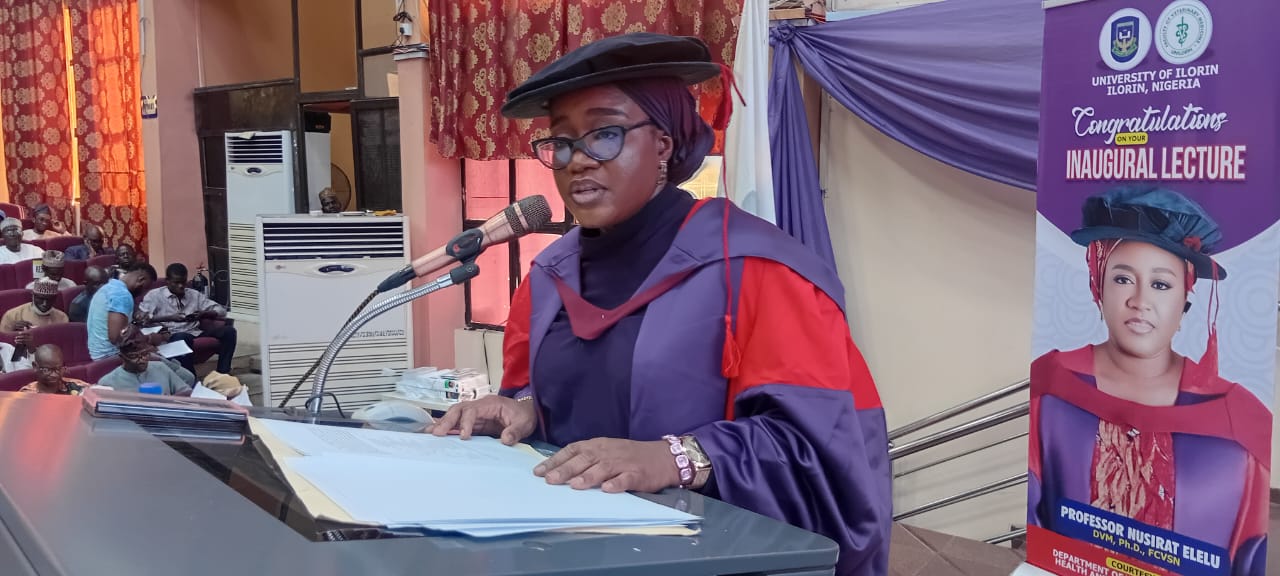
A Professor of Veterinary Medicine in the Department of Veterinary Public Health and Preventive Medicine, Universities of Ilorin, Nusirat Elelu, has called on the three tiers of government in Nigeria to adopt a more holistic and collaborative approach in tackling zoonotic diseases, particularly those that are transmitted between animals and humans.
Elelu, who made this call while delivering the 283rd inaugural lecture of the University of Ilorin, titled “The Public Health Veterinarian Through Ticks, Snails, and Community Service”, emphasised the need for stronger coordination between veterinary and human health sectors, stressing that certain diseases like zoonotic tuberculosis and avian influenza cannot be effectively controlled by the human health sector alone.
“Veterinarians must be at the table, not as support, but as partners,” she said.
Prof. Elelu, who cited the effective containment of avian influenza in Nigeria between 2006 and 2010 as evidence of the power of collaboration between medical doctors and veterinarians, advocated the adoption of a “One Health” strategy, an integrated model that brings together human, animal, and environmental health professionals to tackle complex health challenges.
To strengthen Nigeria’s disease prevention and control capacity, she called for a robust surveillance system that collects and shares data across hospitals, abattoirs, and veterinary clinics, saying many zoonotic diseases lack effective vaccines for humans and must be intercepted early at the animal level through routine inspections and monitoring.
“Prevention at the farm is cheaper than treatment at the hospital,” she added, while also urging the training of livestock owners in proper farm management practices, including improved biosecurity, animal vaccination, vector control, and waste management.
She also urged government and health agencies to enhance communication between animal and human health sectors, pointing out that timely and accurate information sharing could help prevent or quickly contain outbreaks, especially in rural and vulnerable communities.
The Inaugural Lecturer, however, stressed the need for targeted public awareness campaigns, especially for groups most at risk, including herders, dairy farmers, and rural dwellers.
“We must go beyond general messages and deliver culturally appropriate, specific education to those who need it most,” she said.
Warning against the dangers of misinformation, she also advocated stronger regulation of health information, particularly on social media.
“During the 2020 pandemic, everyone turned into a doctor overnight. The viral spread of misleading information delayed lifesaving actions and cost lives,” she added.
Prof. Elelu’s lecture served as a passionate appeal for policy reforms, community education, and inter-professional synergy, reinforcing the urgent need for Nigeria to prioritise a unified public health strategy that bridges the gap between humans, animals, and the environment in the face of growing zoonotic threats.
End


By: Fabian Apechihin
The Benue State Government has intensified its crackdown on illegal fees in public schools, declaring a zero-tolerance policy against unauthorized charges by school administrators.
The Executive Secretary of the Benue Education Quality Assurance and Examination Board (BEQAEB), Dr. Terna Francis, issued the warning during a meeting with principals of public and private schools in Makurdi.
He announced that the government has made the e-Dossier platform compulsory for all learners. The digital system, he explained, was introduced to serve as an automated performance tracker, providing credible records of students’ progress from Basic 1 to Basic 9 and SS1 to SS3.
According to Dr. Francis, the platform will also help the board rank schools by performance and track student transfers across the state.
He revealed that all payments for BEQAEB examinations have now been fully automated and must be completed online or through the banking system to eliminate corruption and other financial irregularities.
“Staff of the board are no longer authorized to collect payments, issue receipts, or act as agents for any school or candidate,” he stated, directing school heads to channel all complaints and inquiries strictly through official communication lines.
Dr. Francis emphasized that the restructured BEQAEB represents a “total rebirth” focused on efficiency, integrity, and accountability within the education system.
“Our examination system lost credibility. The defunct Benue State Examinations Board became synonymous with corruption, inefficiency, and loss of public confidence,” he said.
“We witnessed delays in the release of results, unissued certificates, exam irregularities, and a deep erosion of trust. These failures embarrassed our education system and robbed our students of the dignity of genuine assessment.”
The new reforms, he added, are aimed at restoring transparency, rebuilding confidence in public examinations, and ensuring every student in Benue State receives fair and credible assessment.

By: Fabian Apechihin
The Federal Government has officially abolished the national policy requiring the use of indigenous languages as the medium of instruction in schools, directing teachers nationwide to adopt English as the primary language for teaching and learning.
Minister of Education, Dr. Tunji Alausa, announced the policy shift during the Language in Education International Conference 2025, organised by the British Council in Abuja.
Alausa explained that the decision was taken to enhance learning outcomes and promote uniformity in classroom instruction across Nigeria.
While acknowledging the importance of indigenous languages in preserving cultural identity, the minister stressed that English remains essential for comprehension, national cohesion, and global competitiveness.
“English language should be used as the medium of instruction at all levels of education. For years, the use of mother tongues has contributed significantly to mass failures in national examinations,” Alausa said.
“The national policy on language has been cancelled. English now stands as the sole medium of instruction across all tiers of education.”
He added that available data indicated that excessive reliance on local languages for teaching had negatively impacted students’ performance in key national exams such as WAEC, NECO, and JAMB.
The two-day conference, themed “Language, Education and Inclusion: Empowering Every Learner,” gathered educators, policymakers, and development partners from Africa, South Asia, and the United Kingdom to discuss effective language strategies for inclusive education.
Stephen Olufemi Oni, Ilorin
The University of Ilorin will this week graduate over 14,000 students as part of its 40th Convocation and 50th Anniversary celebrations, marking another milestone in the institution’s steady rise as one of Nigeria’s most stable and innovative universities.
The Vice Chancellor, Professor Wahab Olasupo Egbewole (SAN), who announced this on Monday during the convocation press briefing, said the university would award degrees and diplomas to 14,682 students across various programmes for the 2024/2025 academic session.
He said: “We are proud to be graduating 316 First-Class students, 4,120 in Second Class Upper Division, 5,939 in Second Class Lower, 1,078 in Third Class and 11 with Pass degrees. In the professional category, we have 175 MB;BS, 94 Nursing, 36 Veterinary Medicine, 64 Physiotherapy and 13 Diploma graduands.”
Egbewole further disclosed that 1,520 higher degrees would be awarded, including 182 postgraduate diplomas, 916 Masters, 188 professional Masters, and 234 PhDs across various faculties.
He also revealed that President Bola Ahmed Tinubu, the Visitor to the University, would commission several completed projects on Thursday, October 23, 2025, as part of the convocation events. These include the newly built Faculty of Social Sciences complex, the English Drama Studio, the remodelled Innovation Hub, and the Technical and Entrepreneurship Centre Road.
“The President’s presence underscores the federal government’s faith in our contribution to national development,” he said.
Highlighting recent achievements, the Vice Chancellor noted that the University received a N4 billion Special High Impact Project fund from TETFund for the upgrade of facilities at the College of Health Sciences, in addition to N750 million for hostel construction. He also confirmed the disbursement of N1.59 billion in student loans from the Nigerian Education Loan Fund (NELFUND) to 12,983 students.
“These interventions have ensured that no student drops out because of financial hardship. It shows government’s commitment to inclusive education,” Egbewole added.
On research and innovation, he announced that 81 academic staff received a total of N177 million in Senate Research Grants, while the University also secured N220.5 million from the National Research Fund for eight major projects.
“Our researchers are gaining international recognition. For instance, Dr. Ismail Odetokun from the Faculty of Veterinary Medicine leads our Google Scholar citation list with over 11,800 citations, while several others have crossed 6,000. This visibility shows the impact of Unilorin on the global research community,” he said.
Egbewole listed other milestones, including the unveiling of 30 campus shuttle buses managed under a student-led cashless system, the establishment of a Science, Technology, and Innovation Park to link the University with industries, and the creation of the U-INSPIRE entrepreneurship programme, which has already trained 9,929 students, with 7,290 graduating this year.
The Vice Chancellor also celebrated the University’s 100% success rate in the last NUC accreditation exercise and multiple international collaborations with universities in Kenya, South Africa, Malaysia, and the United States.
UNILORIN students, the VC said, also recorded national and global achievements, including Miss Faith Aduragbemi Olabisi, who became a Chartered Accountant at 18; Sanusi Akanbi Kazeem, who broke the Guinness World Record for the longest mathematics lesson; and Hannah Bolawatife Oladele, who won the national campus journalism award.
In sports, he added, three UNILORIN athletes represented Nigeria at the World University Games in Germany, while the institution’s staff athletes won six medals at the Nigeria University Staff Sports Association Games in Kano.
Reflecting on the university’s progress, Professor Egbewole said: “The ‘Better by Far’ slogan has evolved from a motto into a live reality of excellence, stability, and innovation. We are not just producing graduates, but problem solvers and leaders for Nigeria and beyond.”
He, however, acknowledged challenges such as funding constraints and the need for more infrastructural expansion, adding that his administration remains focused on deepening digital transformation, staff welfare, and inclusive access to education.
The VC called for sustained support from all stakeholders, saying: “As we celebrate 50 years of academic distinction, we are reminded that transformation is a continuous journey. With vision, courage, and collaboration, the University of Ilorin will remain a model of excellence for generations to come.”
End


Changsha brings millennia-old heritage into modern life

Gov AbdulRazaq Lauded Over Conferment Of Sadauna Of Ilorin Title

FG Commissions KWASU ICT Centre To Enhance Graduates Employability

-
 Uncategorized6 years ago
FG, states urged to harness flooding for ranching, others with technology – Agbaje
-
 Headlines11 years ago
Breaking: EFCC seals Borno House of Assembly, as Hon members take to their heels
-
 News12 years ago
Nigeria Security Operatives Stage Manhunt For Homosexual Perpetrator
-
 News10 years ago
How 21-year-old Girl fled community over accusation of lesbianism
-
 News11 years ago
Yobe Gov Moves Against Deputy
-
 Opinion7 years ago
7 signs she has friend zoned you
-
Technology5 years ago
Online job placement company headhunts women
-
 Headlines10 years ago
Borno Dep Gov Abducts Another Church Leader