
News
Imo AG Cites Constitution, Court Rulings to Challenge NJC’s Directive on Chief Judge

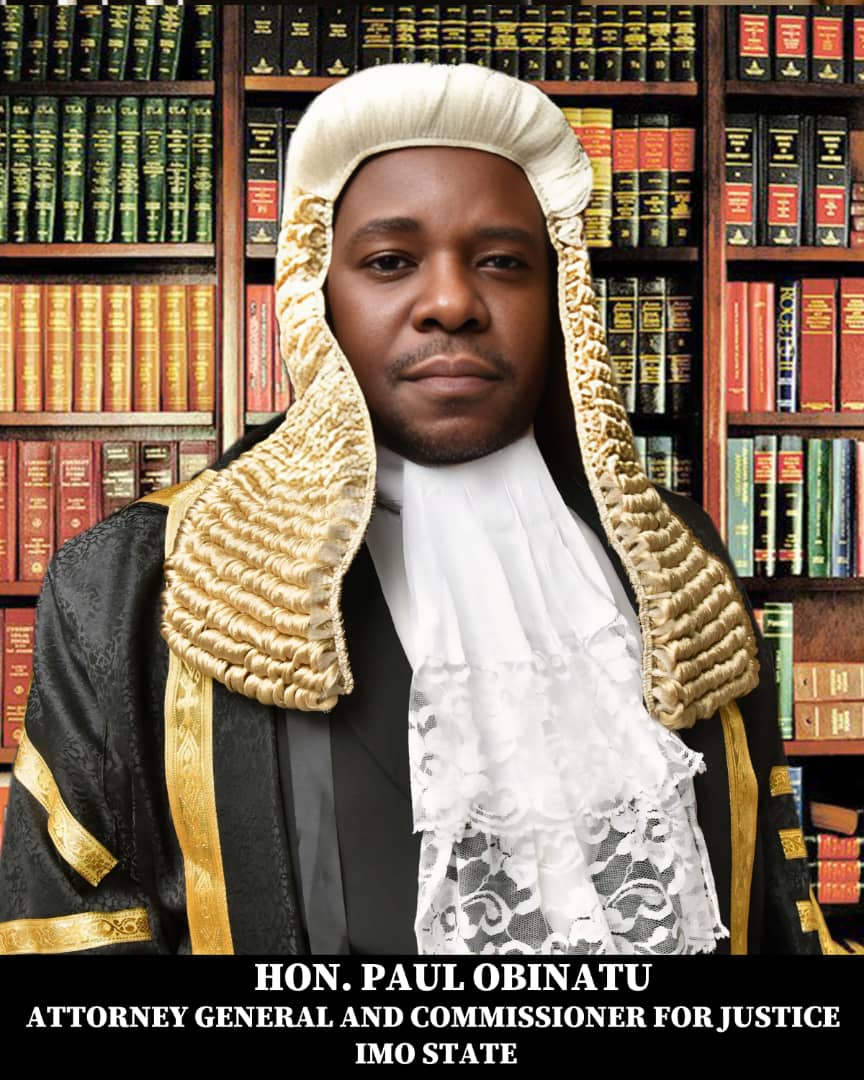
- Insists Imo Judicial Service Commission is constitutionally independent; invokes Section 202, says NJC lacks powers to nominate a candidate for Imo State JSC for appointment as Chief Judge
The Imo State Attorney-General and Commissioner for Justice, Hon. Paul Obinatu has challenged the constitutional authority of the National Judicial Council (NJC) to direct the Imo State Judicial Service Commission (JSC) on the candidate whose name it should submit for consideration in the appointment of a substantive Chief Judge of the state, describing such an intervention as an encroachment on the constitutionally guaranteed independence of the State Commission.
In a statement issued on November 6, 2026, the Attorney-General maintained that the NJC lacks the constitutional authority to dictate, control or substitute its preferred candidate for the independent assessment and recommendation process entrusted to the Imo State JSC under the 1999 Constitution, as amended.
The objection follows a directive reportedly issued by the NJC to the Imo State JSC at its 112th meeting held on November 3, 2026, concerning the appointment of a substantive Chief Judge for the state.
The Attorney-General argued that the NJC’s constitutional responsibility to recommend a candidate to the Governor does not confer on it the additional power to determine or dictate the candidate the State Judicial Service Commission must submit to it. He maintained that the directive is constitutionally untenable because it interferes with a responsibility expressly vested in the State Judicial Service Commission.
SECTION 202 GUARANTEES IMO JSC’S INDEPENDENCE
Central to the Attorney-General’s objection is Section 202 of the Constitution, which expressly provides that the State Judicial Service Commission shall not be subject to the direction or control of any other authority or person in exercising its constitutionally assigned powers.
He argued that this provision establishes a clear constitutional safeguard against external interference in the Commission’s responsibilities and cannot be overridden by the NJC through administrative directives or procedural guidelines.
According to him, the NJC cannot invoke its national institutional status or its recommendation powers to exercise control over the Imo State JSC in a manner inconsistent with the Constitution.
Consequently, any directive requiring the State JSC to submit a particular candidate or dictating the outcome of its independent assessment would, in the Attorney-General’s interpretation, amount to unconstitutional interference.
CONSTITUTION ASSIGNS DISTINCT RESPONSIBILITIES TO NJC AND STATE JSC
The Attorney-General anchored his position on Section 271(1) and the relevant provisions of the Third Schedule to the Constitution.
Paragraph 6(a) of Part II of the Third Schedule empowers the State Judicial Service Commission to advise the NJC on suitable persons for nomination as Chief Judge of the state.
Conversely, Paragraph 21(c) of Part I of the Third Schedule empowers the NJC to recommend to the Governor, from among the list of persons submitted by the State JSC, a candidate for appointment as Chief Judge.
Section 271(1) further provides that the appointment shall be made by the Governor on the recommendation of the NJC, subject to confirmation by the State House of Assembly.
According to the Attorney-General, these provisions establish a clear constitutional sequence: the State JSC identifies and advises on suitable candidates, the NJC considers the submitted names and makes its recommendation to the Governor, while the Governor exercises the appointing authority subject to legislative confirmation.
He insisted that the NJC’s recommendation powers cannot be interpreted as authority to dictate which candidate the State JSC must select or submit, as doing so would effectively transfer the Commission’s constitutional responsibility to the NJC and render Section 202 meaningless.
NJC GUIDELINES CANNOT OVERRIDE THE CONSTITUTION
Addressing the NJC’s Guidelines and Procedural Rules for the Appointment of Judicial Officers, the Attorney-General acknowledged the Council’s authority to prescribe and enforce procedural requirements for judicial appointments.
However, he maintained that such guidelines cannot confer powers beyond those granted by the Constitution or be used to compromise the independent functions of the State JSC.
He stressed that the NJC’s responsibility to ensure compliance with appointment procedures must not be extended to usurping the constitutional authority of the Imo State Judicial Service Commission.
COURT DECISIONS REINFORCE ATTORNEY-GENERAL’S POSITION
In support of his argument, the Attorney-General cited several judicial authorities which he said affirm the importance of constitutional boundaries and institutional independence.
They include Elelu-Habeeb & Anor. v. Attorney-General of the Federation & Ors. (2012) LPELR-15515(SC), Kano State Public Complaints and Anti-Corruption Commission & Anor. v. Salisu & Ors. (2019) LPELR-47107(CA), and Bamisile v. National Judicial Council & Ors. (2012) LPELR-8381(CA).
Other authorities referenced are FRN v. Nganjiwa (2022) LPELR-58066(SC), NJC & Ors. v. Senlong & Ors. (2010) LPELR-4582(CA), and Attorney-General of the Federation v. Attorney-General of Abia State & Ors. (2024) LPELR-62576(SC).
The Attorney-General maintained that these authorities reinforce the principle that every constitutional institution must exercise its powers strictly within the limits prescribed by law, irrespective of its institutional standing.
IMO CHIEF JUDGE APPOINTMENT MUST FOLLOW CONSTITUTIONAL PROCEDURE
The Attorney-General warned that allowing the NJC to assume functions constitutionally assigned to the State JSC would undermine the integrity of the judicial appointment process and compromise the independence of the Commission.
He maintained that the issue is not a contest for institutional superiority between the NJC and the State JSC, but the need for each institution to respect the constitutional boundaries of its authority.
He further emphasised that the NJC’s responsibility to recommend a candidate to the Governor must not be confused with the power to control the independent selection and submission process of the State Commission.
The Attorney-General insisted that the ongoing appointment process must be conducted strictly in accordance with the Constitution, without interference that could undermine public confidence in the judiciary.
For the Imo State Attorney-General, the constitutional position is clear: while the NJC has the responsibility to recommend a candidate to the Governor, it has no authority to dictate to the Imo State Judicial Service Commission the candidate whose name it must submit in the exercise of its independent constitutional mandate.
A youth-focused empowerment movement spearheaded by the Dr. Nafiu Sankara Youth Foundation is steadily gaining momentum across Kano Central Senatorial District, attracting increasing participation from students, young professionals, and community stakeholders.
The initiative, coordinated through the Kano Central Youth Mobilization and Enlightenment Coalition, is aimed at promoting educational advancement, leadership development, and active youth participation in community affairs.
As part of efforts to strengthen its reach, the foundation has launched an expanded volunteer and partnership drive targeting all fifteen local government areas within the district. The programme seeks to bring together students, educators, professionals, and development advocates committed to supporting youth-focused interventions and educational initiatives.
Organizers say the coalition is founded on the belief that investing in young people remains one of the most effective pathways to sustainable development. Through mentorship programmes, digital literacy campaigns, leadership training, and student support initiatives, the platform aims to equip youths with the tools required to succeed in a rapidly changing world.
The movement has continued to gain visibility among students of major tertiary institutions in Kano Central, including Bayero University Kano, Yusuf Maitama Sule University Kano, Kano State Polytechnic, Sa’adatu Rimi University of Education, and the Federal College of Education, Kano.
Education stakeholders have welcomed the initiative, noting that platforms which encourage learning, innovation, and civic engagement are increasingly important in developing future leaders and strengthening community participation.
Observers also point to the coalition’s grassroots approach as one of its major strengths. Through campus ambassador networks, outreach campaigns, and student engagement forums, the initiative has created opportunities for direct interaction between young people and development-minded stakeholders.
Supporters describe the programme as a practical response to challenges facing many youths, particularly in the areas of skills development, access to mentorship, and leadership exposure. They argue that empowering students today will ultimately contribute to stronger and more resilient communities in the future.
The foundation has continued to encourage collaboration among volunteers, community leaders, professionals, and civil society organizations, stressing that meaningful progress can only be achieved through collective effort and shared responsibility.
With its growing presence across educational institutions and local communities, the Dr. Nafiu Sankara Youth Foundation is increasingly being viewed as an emerging force in youth mobilization and educational advocacy within Kano Central Senatorial District.
For many participants, the initiative symbolizes a new chapter of opportunity, inclusion, and engagement, where young people are encouraged to take active roles in shaping the future of their communities.
Saddeeq Shuaibu
Director General (ICT)
Dr. Nafiu Sankara Campaign Council

A Federal High Court in Abuja has dismissed a suit seeking to stop former Attorney-General of the Federation, Chief Michael Kaase Aondoakaa (SAN), from contesting the 2027 Benue State governorship election as the candidate of the Peoples Democratic Party (PDP).
Delivering judgment on Friday in suit FHC/ABJ/CS/2125/2026, Justice Joyce Abdulmalik upheld the preliminary objection of the respondents and held that the plaintiff, Adagba Damian Iorhen, lacked the locus standi to institute the action.
Iorhen, a member of Allied Peoples’ Movement (APM), sued the Independent National Electoral Commission (INEC), Aondoakaa and the PDP as first to third respondents.
The judge held that Iorhen, who was not a party to the judgment he sought to enforce, neither obtained the leave of court to do so nor showed that any of the reliefs in that judgment were in his favour.
She ruled that his mere averment that he is a governorship aspirant in Benue State did not vest him with the standing to seek enforcement of a judgment to which he was not a party.
The court also held that the facts of Aondoakaa v. Obot, on which the plaintiff relied, were “violently at variance” with those of the present case.
Justice Abdulmalik further held that Iorhen failed to present cogent evidence to show that the suit was a public interest litigation.
She described his attempt to dress the case in the garb of public interest as a veiled effort, noting that the real aim of the suit was to disqualify Aondoakaa from contesting the Benue governorship election.
The court agreed with the respondents that the plaintiff was a stranger to the affairs of the PDP. Since he was not a member of the party, she held, the law does not permit him to challenge the candidate of another political party.
The judge also held that the action was statute-barred. According to the court, Iorhen commenced the suit on August 30, 2026, outside the mandatory 14-day window for pre-election matters.
Aondoakaa had through his legal team led by Prof. A. A. Ijihor SAN, asked the court to dismiss the suit in limine for want of jurisdiction, arguing that it was filed late, that the plaintiff had no standing, and that it amounted to an abuse of court process.
In his notice of preliminary objection, he relied on Sections 1(3), 36(5), 177, 182 and 285(9) and (14) of the 1999 Constitution (as amended); Sections 29(5) and 84(14) of the Electoral Act, 2026; and Order 26 of the Federal High Court (Civil Procedure) Rules, 2019.
His central argument was that the suit was statute-barred, since Section 285(9) of the Constitution requires pre-election matters to be filed within 14 days of the event complained of.
In his supporting affidavit, Aondoakaa said INEC’s timetable fixed May 1 to May 30, 2026 for party primaries.
He said he was declared winner of the PDP primary on May 24, received his Certificate of Return on June 24, and that the PDP submitted his name to INEC in July. He said each step was public and known to the plaintiff, who “stood by”.
He also said Iorhen was not a PDP member and did not take part in the primary, alleging that the plaintiff joined the Allied Peoples’ Movement (APM) and became its governorship candidate on September 11, 2026, the day the suit was filed. He claimed this was meant “to cause confusion and distraction” to his campaign.
Aondoakaa maintained that the suit was in reality an attempt to enforce the judgment in FHC/CA/CS/50/2009, which went on appeal as CA/C/94/2010 and SC.939/2015.
He argued that an originating summons was not a proper vehicle for enforcing a court order, and that no Certified True Copy of the judgment was exhibited.
He further said the plaintiff misread the Supreme Court decision as a criminal conviction when it arose from a civil suit.
According to him, he was never arraigned, never took a plea and was not convicted of any offence involving dishonesty within 10 years of the 2027 election.
He added that none of the disqualification grounds in Sections 177 and 182 of the Constitution applied to him, and that civil liability is established on the balance of probabilities, whereas a criminal conviction requires proof beyond reasonable doubt.
He also argued that the originating summons was never signed or properly issued by the Registrar of the court, which he said rendered the process incompetent, and described the reliefs as speculative and “overtaken by events”.
The suit is separate from FHC/ABJ/CS/2152/2026, a similar action filed by four Benue indigenes: David Ejembi, Aondoakaa Teryila, Joseph Okpanachi and Benedict Orkume.
The Federal High Court dismissed that suit on November 16, 2026, holding that their status as registered voters gave them no legal right to challenge his nomination.

The Coalition of Civil Society Organisations in Nigeria (COCSON) has rejected a proposed 20 per cent deduction from the Nigerian Content Development and Monitoring Board (NCDMB) to finance the proposed National Research and Innovation Development Fund.
The coalition described the proposed funding arrangement as unacceptable, warning that it could undermine the development of indigenous capacity and local value addition in Nigeria’s oil and gas industry.
Speaking at a press conference in Abuja on Thursday, November 26, 2026, COCSON spokesperson, Tabuko Kennedy, said the coalition was not opposed to the establishment of a national research and innovation fund but strongly objected to the proposed funding mechanism.
Kennedy argued that funds allocated to the NCDMB were specifically meant to develop local capacity, support indigenous companies, train Nigerian engineers and promote value addition within the oil and gas sector.
He warned that diverting 20 per cent of the board’s revenue to finance another institution could weaken its ability to fulfil its statutory responsibilities.
According to him, the funds domiciled with the NCDMB are not surplus government revenue but contributions from companies operating in the oil and gas industry, specifically earmarked for local content development.
He maintained that diverting such funds without the consent of industry stakeholders would amount to a breach of trust and undermine the original purpose for which the resources were collected.
The coalition also warned that the proposed deduction could establish a dangerous precedent where financially viable government agencies would have portions of their revenues diverted to fund newly established institutions.
Kennedy questioned what would prevent similar deductions from other specialised intervention funds, including the Tertiary Education Trust Fund, the Universal Service Provision Fund and the Police Trust Fund.
He said such a practice could discourage revenue-generating agencies from improving their financial performance, create inter-agency rivalry and undermine long-term institutional planning.
COCSON further argued that the proposed deduction could violate the Nigerian Oil and Gas Industry Content Development Act, which provides the legal framework for the management and utilisation of funds accruing to the NCDMB.
The coalition maintained that the legislation did not envisage using the board’s resources to finance an unrelated research and innovation institution, describing the proposed diversion as inconsistent with the original statutory purpose of the funds.
Consequently, COCSON called on the leadership of the National Assembly, relevant committees and the Federal Executive Council to reject the proposed 20 per cent deduction.
It also appealed to President Bola Tinubu not to assent to the bill if the controversial funding provision remains in it.
The coalition disclosed that it had mobilised organised labour, pressure groups, religious organisations and other civil society groups to resist the proposed legislation.
It, however, stressed that it was not against research, innovation or the establishment of a national research funding institution, urging the government and lawmakers to explore alternative funding arrangements that would not undermine existing development agencies.
COCSON also called on Nigerians and industry stakeholders to oppose what it described as a legislative overreach, insisting that the country’s local content development programme should not be weakened to finance a new institution.

Youth Empowerment Drive Gains Momentum as Sankara Foundation Expands Across Kano Central

2027 Poll: Court dismisses suit seeking to stop Aondoakaa, SAN from contesting Benue Guber

Civil Society Coalition Kicks Against Proposed 20% Deduction from NCDMB

-
 Uncategorized6 years ago
FG, states urged to harness flooding for ranching, others with technology – Agbaje
-
 Headlines11 years ago
Breaking: EFCC seals Borno House of Assembly, as Hon members take to their heels
-
 News12 years ago
Nigeria Security Operatives Stage Manhunt For Homosexual Perpetrator
-
 News10 years ago
How 21-year-old Girl fled community over accusation of lesbianism
-
 News11 years ago
Yobe Gov Moves Against Deputy
-
 Opinion8 years ago
7 signs she has friend zoned you
-
Technology5 years ago
Online job placement company headhunts women
-
 Headlines11 years ago
Borno Dep Gov Abducts Another Church Leader