
Uncategorized
OPINION LESSON NOTES FOR GOV SOLUDO


BY Victoria N. Ikeano victoriangozii@gmail.com 08033077519
Re-elected incumbent Anambra state governor, Professor Charles Chukwuma, APGA’s flag bearer, may rightly blow his trumpet about the firsts he and his party recorded in this election. Nevertheless, he should not be blind nor be deaf to the murmurings against his government. In my article on the then approaching poll, I concluded, “Soludo is miles ahead of his closest rival, Ukachukwu of the APC”. True to my projection the governor won with wide margins –422,664 votes to Ukachukwu’s 99,445. He won in all 21 local government councils. What is more, he was victorious in all wards, except six which is over 900 per cent success. Here are more historic statistics, Soludo won with a whopping 71 per cent of the votes cast. The highest for any previous re-elected governor of the state was 31 per cent. Last time in 2021, Soludo coasted to victory with a little over 100,000 votes.
Voter apathy had always characterised elections in Anambra and South east generally. Many people acquire a Voter’s card essentially for identification purposes rather than for voting; especially as a form of identification is required to open a bank account, buy a SIM card for communication with loved ones, friends and associates or to get a lost, damaged SIM replacement, etc. And the attraction is that getting a Voter’s card is absolutely free in comparison to other means of identification like Driver’s licence, international passport and NIN that require some amount of money to get. In 2021 the turnout was just about 10 per cent of registered voters; this time around it rose to 21 percent, the largest so far, though more still has to be done in this regard. This increase is not surprising given APGA’s massive campaigns that penetrated virtually all nooks and crannies of Anambra state. The party deployed all four arms of governance for this, viz, the executive (all appointees of the governor), legislature (members of the state House of Assembly), local government councils (local government chairmen), community leaders (president-generals of communities in the state). Such grassroots penetration has led to the slogan ‘Anambra is APGA, APGA is Anambra’.
As I stated in the opening paragraph, Soludo should not ignore the misgivings against his government despite the high votes. As a matter of fact the single most important factor that worked in his favour is that there were no viable opponents among all those that contested against him. Still, the fact that APC though a distant second, garnered nearly 100,000 votes in this election (given the general disdain for APC here) is a pointer to what might have been if the opposition had a strong candidate. Although the APC candidate, Ukachikwu, is a successful businessman and has done a lot for his community, people, he is not well grounded politically in Anambra. The last election he contested (for a senate seat in the Anambra south zone ended in great failure for him. In fact his running mate for this governorship election, Senator Uche Ekwunife is considered a more tested and popular politician than him. Actually most people believe that if the roles were reversed with Ekwunife as the flag bearer, APC would have fared better in this election.
However, there is little doubt that if late Senator Ifeanyi Uba had been alive, the results would have been different. Uba is a popular, tested and experienced politician. He singly won a senate seat under a little known party, the YPP. He is the strong man of Nnewi politics, hence his boast, “I own Nnewi, Nnewi owns me”. He decamped to the APC soon after the 2023 general election with eyes on becoming governor. He had been working systematically since then towards endearing APC to Anambrarians and further boosting his ambition, through various programmes. However he died suddenly during an overseas trip. It is worth noting that Chief Chukwuma who was in APC with him and reverted to YPP as its candidate when Uba’s name was no longer on the ballot was third in this election. It is believed that Ifeanyi Uba as APC candidate would have given Soludo a run for his money; the contest would have been competitive and the results tighter, not the one sided affair it turned out to be because those that contested against the governor could not match him. Votes cast for APC in the election were more or less, protest votes against APGA.
Many people are disenchanted with Soludo for one reason or other. Among them are those engaged in commercial activity of whatever kind. These feel done in by his tax system, complaining that they are being taxed “left, right and centre”. The recent report by BudgIT that ranked Anambra as the best of all the 36 states in terms of fiscal responsibility apparently strengthens his hands. Then, there are civil servants who lament that despite tripling of federal allocation to states and a number of state governments raising salaries way above the minimum wage, Anambra workers are still being paid “stipends” as take home pay. Third are plenty Igbos generally who are miffed that Soludo is always criticising former Anambra governor and Labour party presidential candidate in the 2023 general elections, Peter Obi but never saying a word against President Bola Tinubu whom they perceive as marginalising Igbos.
Fourthly, many citizens are pissed by his “talkative” character, particularly his perceived penchant for “I koo onu”, that is, besmirching or mocking opponents. The governor accuses APC’s deputy governorship candidate of possessing fake, forged ph.D certificate which she denies. The woman thereafter, fired a salvo of her own at the governor and soon the matter degenerated into dirty exchange of words between Anambra’s First Lady and the APC’s deputy gubernatorial flag bearer, bordering on alleged infidelity. It was embarrassing to womanhood, unbecoming of women in high places. And all fingers pointed to the governor as having started this show of shame. Throughout the campaigns the governor continued to insist that those aspiring to govern Anambra should be people of sound intellect not those who did not make the required papers in their G.C.E. result (referring to the opposition). He stressed the need for current and aspiring leaders to be role models in character and learning.
And just some two days to the poll, the governor made a statement (in answer to the issue of alleged Christian genocide in the country) to the effect that Christians are the ones killing Christians in Anambra state. This angered a lot of persons as they interpreted it to mean that he supports the alleged genocide against Christians. It was considered careless talk by him. Someone swore to me that if there were to be a Sunday service before the votes are cast, (after that statement), word would have gone out from the pulpit to disown the governor as a Christian at the ballot. That is to say that he would have lost the election. The church is powerful in this part of Nigeria. Governor Soludo may do well to be sparing in his speeches, to weigh them before voicing them, to talk only when it is necessary and to shun talks that cause disharmony.
Victoria N. Ikeano writes via victoriangozii@gmail.com 08033077519

Stephen Olufemi Oni, Ilorin
The people of Oke-Ode Community in the Ifelodun Local Government area have commended the Kwara State Governor, Mallam AbdulRahman AbdulRazaq for upgrading the Elesa of Oke-Ode Land, HRH Oba Mufutau Ibrahim Akanbi Adebayo, Ilufemiloye I, to the First Class traditional ruler status.
The National President of the Oke-Ode Community Development Association (OCDA), Alhaji AbdulGaniyu Ajala-Bello, gave the commendation shortly after the presentation of the certificate of upgrading to the royal father.
In a statement made available to newsmen by the National Public Relations Officer of the Community Association, Chief Ganiyu Kunle Akogun, the Community said the upgrading, coming less than a year after the appointment of the Elesa, shows the Governor as a man of his words, having made a firm promise to that effect in October last year during his condolence visit to the town over the bandits attack of September 28, 2025.
The Governor had pledged on that occasion that once the then chieftaincy dispute in the town was settled and a new king appointed, he would upgrade the Elesa stool.
The Community leader expressed gratitude to the Governor for this promise kept and pledged the continuous support of the people of Oke-Ode Land for the Governor.
While wishing Governor AbdulRazaq a successful completion of his tenure and Allah’s assistance for him in his senatorial ambition in 2027, Alhaji Ajala-Bello urged the Sardauna of Ilorin Emirate to return the College of Nursing, Oke-Ode to its Oke-Ode permanent site, noting that the condition that warranted its temporary relocation to Ilorin last year has since normalised, as peace and adequate security have since returned to the community.
The Community leader also appealed to the Governor to look into the need for adequate staffing of the Oke-Ode Specialist Hospital, which has remained grossly understaffed for sometime now.
Alhaji Ajala-Bello also thanked the state Deputy Governor, Elder Kayode Alabi, the Commissioner for Local Government and Chieftaincy Affairs, Alhaji Abdullahi Abubakar Bata, and the Chairman of Ifelodun Local Government Council, Mallam AbdulRasheed Femi Yusuf, for their respective roles in ensuring the elevation of the Elesa to the First Class status.

Stephen Olufemi Oni, Ilorin
In furtherance of its vision to raise tax-compliant citizens and promote tax education among the younger generation, the Kwara State Internal Revenue Service (KWIRS), in collaboration with the State Ministry of Education and Human Capital Development, has concluded the semi-final stage of the 2026 Tax Club Quiz Competition, with six schools emerging as finalists.
The semi-final stage of the competition, according to the Head, Corporate Affairs of the KWIRS, Funmilola Oguntunbi, was conducted via an online Computer Based Test (CBT), involving 12 schools that participated from the comfort of their respective schools, adding that the exercise was conducted with appropriate back-end monitoring by members of the KWIRS Tax Club Advocacy Committee, alongside the representative of the Commissioner, Ministry of Education and Human Capital Development, Mrs Aina Bose Eunice.
At the end of the semi-final exercise, the following six schools emerged as finalists: Oro Grammar School, Oro and Ansar-u-deen College, Offa (Kwara South); Government Secondary School, Lafiagi and Government Secondary School, Ilesha Baruba (Kwara North); and St. Anthony’s Secondary School, Ilorin, and Ebenezer High School, Ilorin (Kwara Central).
The six finalists, the agency’s spokesperson added, would compete for the grand prize of N2.5 million at the grand finale of the competition, scheduled to hold in Ilorin on Wednesday, 4th November, 2026.
The Tax Club Quiz Competition is an annual initiative of the KWIRS, organised in collaboration with the Kwara State Ministry of Education and Human Capital Development, to deepen tax awareness among secondary school students and foster a culture of voluntary tax compliance among the younger generation.
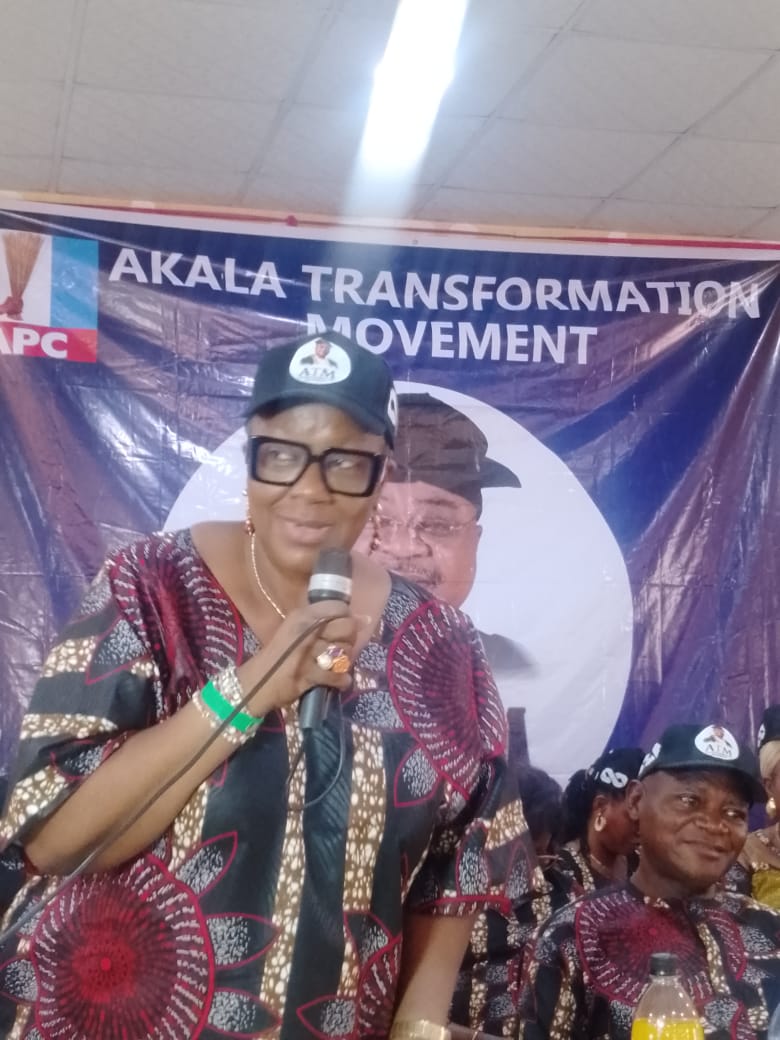
- Drums support for Tinubu, APC candidates
Stephen Olufemi Oni, Ilorin
The Chairperson of the Akala Transformation Movement (ATM) and former First Lady of Oyo State, Chief (Mrs) Oluwakemi Alao-Akala, has called for the full implementation of local government autonomy, saying it will bring governance closer to Nigerians and accelerate development at the grassroots.
Alao-Akala made the call during an ATM outreach held at Equilibrium Resorts, Ojongbodu, Oyo West Local Government Area of Oyo State, where she also urged Nigerians, particularly women, to support the administration of President Bola Tinubu and participate actively in the democratic process.
She said the effective functioning of local governments was crucial because they remained the closest tier of government to the people.
“One important thing I am preaching now is local government autonomy. Obviously, we are going to have our local governments properly elected. They are going to be funded, and they are the closest to the people,” she said.
The former First Lady urged Nigerians to understand and assess the impact of government policies before making political decisions, stressing that the coming years should be devoted to consolidating ongoing reforms and ensuring that their benefits reach ordinary citizens.
She also called on women to remain actively involved in governance and continue supporting leaders through their votes and prayers.
According to her, voting remained a major responsibility of citizens because it determines the quality and direction of leadership at all levels.
Alao-Akala further urged ATM members and supporters to work for the success of the All Progressives Congress (APC) and support its candidates in state and national elections ahead of the 2027 general elections.
She clarified that ATM was a movement and not a political party, adding that its activities were aimed at mobilising support for the APC and its candidates.
Meanwhile, the Director-General of ATM, Mr Demola Alao-Akala, said the movement would continue to preserve and promote the legacy of his late father, former Oyo State Governor, Otunba Adebayo Alao-Akala.
He said the essence of the movement was not merely to remember the late governor but to sustain the values and principles he stood for, particularly people-oriented governance and the welfare of ordinary citizens.
“The concept of remembrance of our father is about making sure that his legacy survives. When he left, he left us a pattern, and we strongly believe that the legacy he left behind can be used to propagate his ideas and keep his memory alive,” he said.
The ATM DG said members of the movement were determined to build on the ideals of service and good governance associated with the late governor.
“We believe strongly that if we are alive, we are going to go back to our lives and continue in the spirit that he showed. We are moving forward, and I think we are supposed to continue,” he added.
Alao-Akala said the late governor’s political philosophy placed the welfare of the people at the centre of governance, noting that democracy should ultimately be judged by its positive impact on citizens.
He assured ATM members that the movement would remain committed to promoting the late governor’s ideals while mobilising support for programmes and candidates it believes can improve the lives of Nigerians.
“We are going forward,” he declared.


Oke-Ode Community Lauds Kwara Gov On Elesa’s Elevation To First Class Status

2026 KWIRS Tax Quiz Competition: Six Schools Emerge As Finalists

NNRA Allegations: IADI Demands Evidence, Says Audit Queries Not Proof of Fraud

-
 Uncategorized6 years ago
FG, states urged to harness flooding for ranching, others with technology – Agbaje
-
 Headlines11 years ago
Breaking: EFCC seals Borno House of Assembly, as Hon members take to their heels
-
 News12 years ago
Nigeria Security Operatives Stage Manhunt For Homosexual Perpetrator
-
 News10 years ago
How 21-year-old Girl fled community over accusation of lesbianism
-
 News11 years ago
Yobe Gov Moves Against Deputy
-
 Opinion7 years ago
7 signs she has friend zoned you
-
Technology5 years ago
Online job placement company headhunts women
-
 Headlines10 years ago
Borno Dep Gov Abducts Another Church Leader