
Uncategorized
OPINION: NIGERIA’S ASSUMED ECONOMIC SIGNIFICANCE TO THE U.S: THE FACTS, FIGURES, AND THE NEED FOR NEW PRAGMATISM

BY: A G Abubakar
Teaser: With a GDP smaller than the budgets of several U.S. states, and an oil export share under 3% Nigeria’s economic weight in Washington remains minimal. In 2024, total U.S. oil imports were valued at about $1.3 trillion, while Nigeria’s crude exports to the U.S. stood at $4.5 billion—barely 3%. The U.S. was not even among the top seven importers of Nigerian crude, which generated ₦45.1 trillion (about $32 b) for Nigeria. Switzerland, Spain, France, Germany, and the UK, led the list (NNPC, 2024). Oil remains Nigeria’s primary foreign exchange earner; others like solid minerals, agriculture, and gas exist largely at the level of potential.
The question, therefore, arises: within the context of the current U.S.–Nigeria relationship, does Nigeria mean much to the United States? Is the perceived “hostile” attitude toward Nigeria driven by economic interest? The answer is both yes and no — yes, perhaps in terms of potential, but no in terms of empirical indicators. Understanding this distinction between reality and potential is crucial for Nigeria to cultivate smarter global engagements and to manage diplomatic frictions such as those experienced in recent times with the United States.
It is true that Nigerians excel globally, but the Nigerian state itself remains a developing country struggling with stability and growth. It stays trapped in a neoliberal global economic structure that divides the world between commodity producers and consumers of finished goods. Occasional low-tech industrial processes — packaging, bottling, assembly, refining — create the illusion of transformation but do not alter the underlying dependency structure. This system, shaped by colonial history, imperial influence, and racialised global hierarchies, continues to function without malice on the part of those who benefit from it.
Industrialised nations negotiate toughly and expect counteroffers; those who fail to negotiate simply get swept aside. In this “global jungle,” survival depends on strategy, not sentiment — and certainly not on boasting about dormant potential. It is the optimal utilisation of productive factors within a given context that engenders economic growth and not potential. A nation’s production possibilities frontier or curve (PPC, PPF), which is a “simplistic” representation of its growth can only shift outward on account of a well tailored economic development framework which is pursued on sustained basis. Nigeria hasn’t been that lucky in this regard for years
Much of the Nigerian public discourse tends to sentimentally assume that the West’s preoccupation with Nigeria is its wealth. This is a misconception. Nigeria is indeed endowed with natural resources, but endowment is not wealth. Wealth is the ability to convert resources into power, productivity, and prosperity — and Nigeria has not done so at scale. It remains a nation full of deprivations.
Nigeria’s potentials are vast: over 200 million people, a landmass of 923,768 square kilometres of which 36.8 million hectares are arable, and enormous mineral wealth including oil, gas, lithium, tin, coal, nickel, cobalt, copper, graphite, rare earth elements, and bitumen worth an estimated $700 billion. Nigeria has 37 billion barrels of proven oil reserves and 210 trillion cubic feet of gas. In agriculture, it leads the world in cassava, yam, and sorghum production and ranks among the top producers of cocoa, cashew, sesame, and shea butter. Its coastline stretches 853 kilometres, hosting vital maritime trade routes and significant offshore oil deposits. Above all is a youthful labour force of 87 million people — a potential demographic dividend.
Yet these remain unrealised. Poverty, insecurity, and weak policy implementation continue to overshadow the country’s prospects. Nigeria’s GDP fluctuates between $188 billion and $250 billion, with the IMF’s 2025 outlook placing it at $188.27 billion — behind South Africa, Egypt, and Algeria The national budget remains below $40 billion, a figure woefully inadequate for a country of more than 200 million people. Daily oil production hovers around 1.5 million barrels, insignificant on the global stage.
Given these realities, the idea that Nigeria holds significant economic relevance for the United States collapses under scrutiny. The U.S. has 55 billion barrels of proven oil, 198 billion technically recoverable barrels, and 322 trillion cubic feet of gas. It produces 13 million barrels of oil daily. Its GDP reached $20 trillion in 2024, and its federal budget stood at $6.8 trillion, with a deficit of $1.8 trillion. Nigeria’s GDP is smaller than the budgets of individual U.S. states such as California, New York, and Texas. Astonishingly, it is also smaller than the personal fortunes of Elon Musk ($342b), Mark Zuckerberg ($216b), and Jeff Bezos ($215b) U.S. corporations like Apple, Microsoft, Alphabet, Nvidia, Amazon, and Tesla, each boast market capitalisations exceeding $1 trillion.
In foreign engagements alone, the U.S. spend amounts that dwarf Nigeria’s entire economy. Over two decades, it has averaged about $400 billion annually on wars and military operations, spent more than $2 trillion in Afghanistan and Pakistan, $3 trillion in Iraq and Syria (2003–2023), $350 billion in support of Ukraine, and $21 billion on Israel’s war in Gaza. It disburses nearly $100 billion every year in foreign aid and humanitarian assistance worldwide.
It is thus unrealistic to claim that the United States is driven by economic considerations or resource desperation toward Nigeria. The purchasing power of Nigerians is weak, and Nigeria’s contribution to global value chains is marginal. The country must accept this reality when shaping foreign policy. The time for playing the victim is over. Nations grow not by proclaiming potential but by converting that potential into economic power and using it to negotiate interest-based alliances.
No economic or ideological system is pure. They do share certain features. China’s “socialist market economy” under Deng Xiaoping embraced foreign investment and private enterprise, propelling China into the world’s second-largest economy. Gorbachev’s Perestroika and Glasnost introduced elements of market liberalisation in the USSR. The market-oriented reform has made the two former socialist economies more resilient and productive. The United States, the acclaimed global symbol of capitalism, equally operates a substantial welfare system — TANF, SNAP, Medicaid, housing assistance, disability support, and more. Ideologically, these schemes fall more to the socialist system.
Great powers also drop allies when interests shift: the USSR’s lukewarm support to Egypt during the 1973 Yom Kippur War; the West’s abandonment of the Shah of Iran; Ghana’s ideological swing from East to West after Nkrumah; Malaysia and Indonesia’s transformation from anti-communist hardliners to deep economic partners of China; and Vietnam’s journey from bitter U.S. enemy to a comprehensive strategic partner with over $150 billion in trade. Maybe to the chagrin of China, its pillar of support throughout the war years.
In the same vein, during the Cold War period, Malaysia under Mahathir Mohamad and Indonesia under Suharto were considered anti communist governments, but today, both maintain robust diplomatic and economic relations with China. By 2024, China was Malaysia’s largest trading partner, while the volume of Indonesia’s trade with China surged to $135 billion. Pragmatism dictates that nations subordinate their ideological inclinations under the goals of national interests – security and development.
Within the same liberal democratic settings, too, the interests/idiosyncrasies of the individual leaders could impact situations. For instance, the same US government that provided massive military support to the Ukraine in war with Russia has seemingly fallen out of favour with Trump, who had since cut it down. A move that has impacted Ukraine’s war campaigns negatived. Trump has equally armtwisted Ukraine to pay back the earlier US support under a mineral-mining rights agreement. The same superpower politics could be a kettle of paradox and irony.
The US and the EU that have been campaigning for sanctions against Russia and “threatening penalty” nations that failed to tow still patronise it. For instance, while the US slaps India with high tariffs for its relationship with Russia, the US still imports Russia’s nuclear fuel. It is also estimated that the UE still imports up to $130 billion worth of natural gas in 2024. That’s how marcky, fluid, and self-serving national interests and global politics could be. The development should also serve as a lesson to Nigeria and other lesser developed nations.
Nigeria must, therefore, widen its focus beyond the myth and fixation of being economically indispensable to the U.S. and indeed any power and rethink the relationship through the broader lens of national interest — particularly security and stability — in an evolving multipolar world. The rise of China and the re-emergence of India and Russia have reshaped global power into a polycentric order. Choices and alliances must be pragmatic, deliberate, and strategic to avoid repeating the mistakes of the Cold War era, when many developing nations merely exchanged one hegemon for another.
Today, the United States remains inclined toward militarised foreign policy, while China is primarily focused on global economic expansion. India and Russia operate on smaller but still consequential scales. By understanding these distinctions and leveraging new platforms such as BRICS+, Nigeria can position itself intelligently in the post-Trump global landscape.
The emerging order is moving toward a post-Western system, where traditional East–West ideological contests give way to new geopolitical realities driven by national interests. Nigeria’s path forward lies in recognising its true position, converting its potential into real economic power, and engaging the world with strategy rather than sentiment.
Nigeria must stop anchoring its foreign relations on assumptions of economic relevance and start negotiating from a clear understanding of its true strengths and vulnerabilities. In a world tilting towards multipolar competition, sentiment is a luxury. Strategy, is survival. Nations rise by reading the global room correctly – and also acting decisively. Powers respect capacity, not potential; results are not rhetoric.
If Nigeria, the 6th populous nation in the world, wants a seat at the global table, it must earn it through smart policies, disciplined execution, and a partnership rooted in sound and realistic vision. A national vision forged in justice, equity, accountability, and sense of proportion in governance. So far these critical elements have been in short supply. Nigeria should therefore wake up and get its act together if it wants to earn respect and relevance in the unfolding new polycentric world order. So far, there’s not a single nation on the planet Earth with over 220 million people that has reduced itself to global ridicule and disrespect like Nigeria. All, on account of decades of bad governance. Things got to change.
A. G. Abubakar
agbarewa@gmail.com

A legal practitioner, Mr M. D. Zarewa, has said that a bank cannot freeze or restrict a customer’s account without a valid court order.
Zarewa said it was prevalent in the society for law enforcement agencies to give directives to banks to freeze customers’ accounts whenever there was a pending case before them, adding that banks often complied with such directives.
He, however, said such practice was alien to Nigeria’s jurisprudence, stressing that banks were enjoined not to interfere with or restrict the activities of any customer’s account without a valid court order.
According to him, it is trite law and settled beyond argument that a bank cannot freeze a customer’s account without a valid court order.
He said the position was entrenched in the case of GTB Plc v. Olachi & Anor (2025) LPELR-81833(CA), where the Court of Appeal held that “whether frozen or restricted, neither can be done without the valid order of a Court of Law.”
Zarewa further cited GTBank v. Adedamola (2019) 5 NWLR (Pt. 1664) 30 at 43, Paras. E-F, where the court held:
“Before freezing customer’s account or placing any form of restraint on any account, the bank must be satisfied that there is an Order of Court.
“By the provisions of Section 34 of the Economic and Financial Crimes Commission Act 2004, the Economic and Financial Crimes Commission has no power to give direct instructions to banks to freeze the account of a customer without an Order of Court. So doing, constitutes a flagrant disregard and violation of the rights of a customer.”
The lawyer said any customer whose account had been frozen or restricted without a valid court order could institute a suit against the bank for grossly violating his or her rights.
He said such a customer could particularly seek redress for the violation of the right to own movable and immovable property and seek compensation from the court.
Furthermore, Zarewa said the law was trite that where there was a wrong, there was a remedy, as captured in the Latin maxim, Ubi jus ibi remedium.
Stephen Olufemi Oni, Ilorin
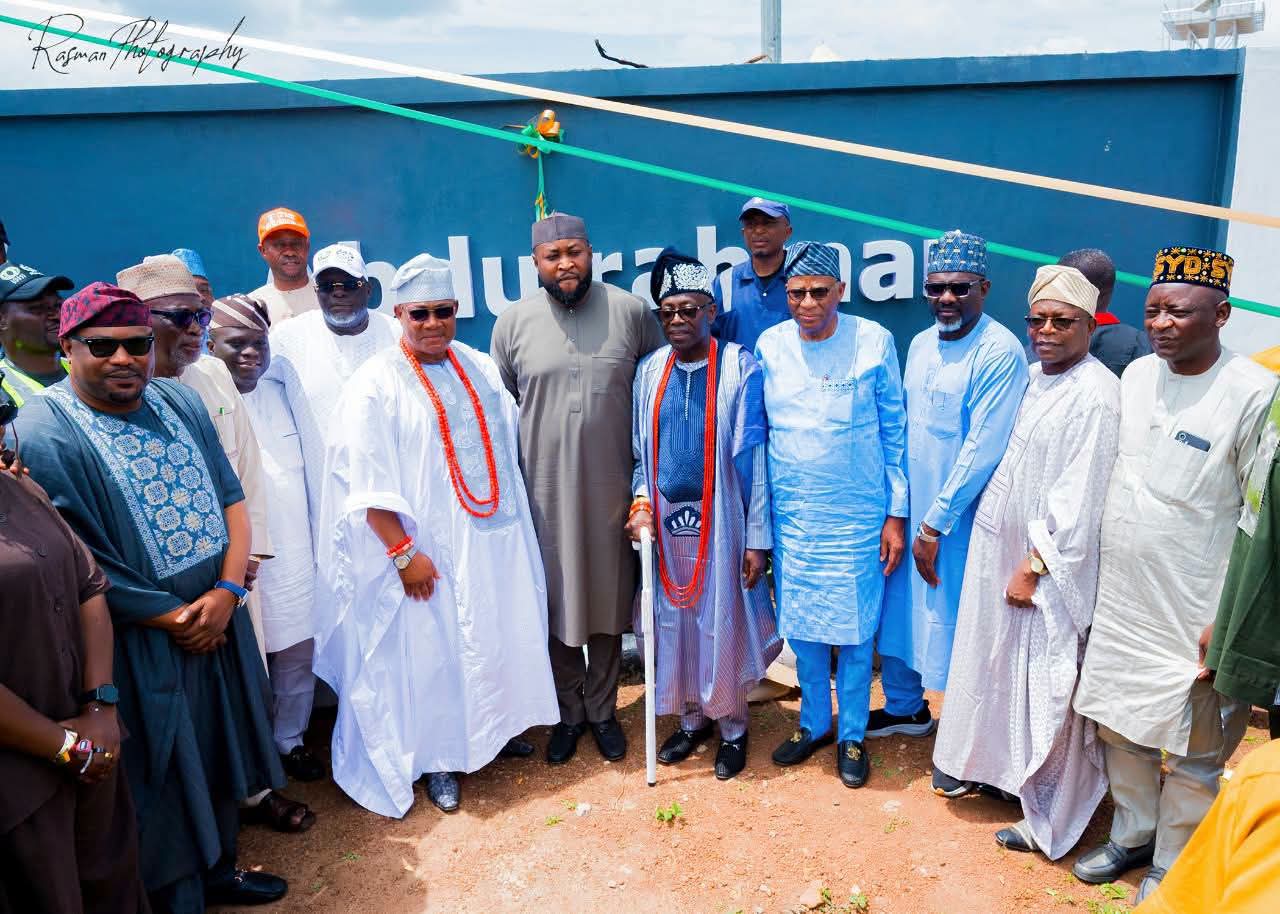
Kwara State Governor AbdulRahman AbdulRazaq has inaugurated the ‘AbdulRahman AbdulRazaq Morire Housing Estate’ in Ijagbo, Oyun Local Government Area of the State.
Speaking at the groundbreaking of the housing estates, which included 210 units of two-bedroom terrace apartments, 200 units of three-bedroom units and 54 units of four-bedroom terrace duplexes, the
Governor, noted that housing should not be seen or regarded as a luxury, but rather as a fundamental human requirement and cornerstone of dignity, security, and family stability, lamenting the daunting challenge of addressing housing deficits across the country.
He said: “Dear Kwarans, housing is not a luxury. Basic housing is a
fundamental human need and a cornerstone of dignity, security,
and family stability. Yet, across Nigeria and indeed in Kwara State,
the challenge of addressing housing deficit is daunting.
“This administration believes that inadequacy of proper shelter
for Nigerians is not merely a problem of not building enough
houses. Indeed, several studies have attributed the housing deficit in Nigeria to a complex mix of causes, key among them being high costs and rising costs of building materials, weak finance, difficult land systems, infrastructure gaps, institutional limitations, among others.
“On behalf of the people of Kwara, I thank the management of ISHI
Homes Limited for this partnership and for choosing Kwara State
as the location for this important development.”
Represented by the Commissioner for Housing and Urban Development, Dr Segun Ogunsola, the Governor applauded the developer for recognising his administration’s contributions to mass housing development in the State.
“The administration has consistently placed housing development high on its agenda. The government recognises access to decent and affordable housing as essential to the wellbeing of the people.
“The State Government has also been in active collaboration with
institutional partners including the Federal Ministry of Housing
with a view to increasing housing stock in the State.
“Recently, we acquired a housing estate with over 130 flats at
Ogbondoroko in Asa LGA of the State. Government has approved
that the estate be onboarded onto the administration’s social
support scheme,” he disclosed.
AbdulRazaq said the commitment was reflected in the development of the Kwara Smart City and other mass housing initiatives across the State.
The Governor disclosed that his reforms in land administration have reduced the processing time for Certificate of Occupancy (C of O) from 180 days to 35 days.
AbdulRazaq said the improved turnaround time demonstrated the administration’s commitment to making land administration more transparent, efficient and investor-friendly.
Earlier in his remarks, the Chief Executive Officer (CEO) of ISHI Homes, Dr Olayinka Ilufoye, said the project was intended to democratise home ownership and make decent and affordable housing accessible to the people of Kwara South senatorial district.
Ilufoye said the estate was meant for civil servants, traders and other Nigerians who can access it through the National Housing Fund (NHF).
“The name AbdulRahman AbdulRazaq Morire, which translates to ‘I have seen goodness’, is a deliberate expression of our faith, hope and expectation.
“We believe this estate will become a testimony of prosperity, progress and abundance in Kwara South,” he said.
Ilufoye pledged that the company would remain committed to transparency, accountability, quality construction and timely delivery.
The Executive Chairman of the Kwara State Geographic Information Service (KWGIS), Alhaji Sulyman Abdulkareem said the state government has consistently placed housing development high on its development agenda.
He commended the state government for ensuring access to land, facilitating the prompt issuance of titles and certificate of occupancy.
Abdulkareem pointed out that by providing timely approval for mortgage transactions, the Governor is creating the conditions necessary for housing development to thrive in Kwara State.
Stephen Olufemi Oni, Ilorin
Nigeria, and the world at large, are in dire need of exemplary leaders like the late Founder of the Ansarul Islam Society of Nigeria, Sheik Muhammad Kamalu-deen al- Adabbiy.
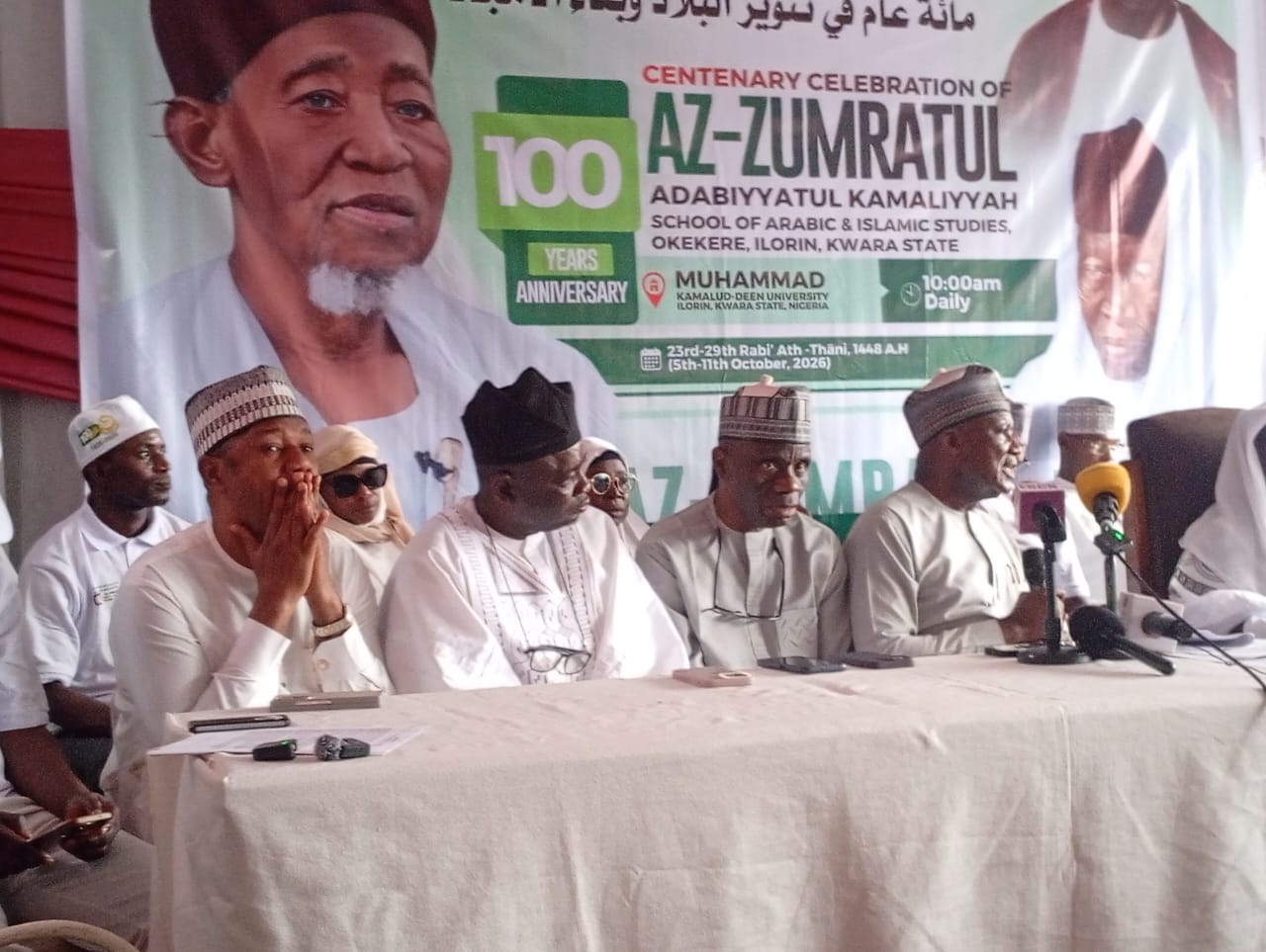
This was the submission of various scholars at a media briefing in ilorin, the Kwara State capital, to usher in the Society’s week-long activities to commemorate the 100 years of the establishment of the Az-Zumratul Adabiyatul Kamaliyyah School of Arabic and Islamic Studies, in Okekere, Ilorin.
The school was fouded by the late Sheik Kamalu-deen in 1942.
Born in 1905, the late Sheik Kamalu-deen was one of Nigeria’s foremost Islamic scholars and educational piooneers who transformed deep Islamic religoius learning into education and also advocated the acquisition of western education .
He also served as a Councillor and Member of the Ilorin Native Authority Transition Committee between 1958 and 1961and was appointed as the first grand mufti of Ilorin by the Emir of Ilorin.
The late Kamalu-deen al- Adabbiy died in 2005 at the aged of 100 years, leaving behind impactful legacies in the propagation of Islamic religion, scholarship, education and leadership.
Addressing journalists at the ancient hall of the Az-Zumratul Adabiyatul Kamaliyyah School of Arabic and Islamic Studies in Okekere, Ilorin, the spokesperson, Prof Kamil Kamaldeen, said the late sheikh was “non discriminatory” in all his policies, a virtue he said was lacking in most leaders today.
“We are here to celebrate the legacies of the late Sheikh Muhammad Kamalu-deen al-Adabbiy not to tell his history, at a time when the world continues to need what he stood for. We are in a world today that we are looking for leaders who will serve without puting themselves first, no matter where we come from,” he said
The Registrar was flanked by the Vice Chancellor of the Muhammad Kamalu-deen University, Prof AbdulRasheed Jimoh, General Overseer of the Az-Zumratul school, Sheik Mustapha Kamalu-deen al- Adabby, Grand Khadi of the Kwara State Sharia Court of Appeal, Justice Abdulateef Kamaldeen, National Missioner of Ansarul Islam Society of Nigeria, Sheik Abdulmumini Ayara, retired Grand Khadi of the Kwara state Sharia Court of Appeal, Justice Idris Haroon and a foremost islamic Scholar, Sheik Sharafadeen Ajara .
Others included the President of Az-Zumratul alumni association, Ustaz Abdullahi Oni-Tolotolo, and the Principal of the School.
They noted that the late Sheikh Kamalu-deen had through his preachings, established educational structures and selfless leadership qualities, produced worthy ambassadors in all spheres of disciplines, urging leaders at all levels to invest heavily in education .
“No society loses from investing in education, it can only gain, no society loses when you build skills, you can only gain,” they added.
The Scholars also charged leaders to take a cue from the late Sheikh Kamalu-deen whom they said was always willing to collaborate with scholars and leaders of like minds in a bid to bring advancement and progress to his community, citing his link with Al-Ahhar University, Cairo, as beneficial in advancement of higher Islamic studies in Ilorin.


Bank Cannot Freeze Customer’s Account Without Valid Court Order — Zarewa

Gov AbdulRazaq Inaugurates 464-Unit Housing Estate In Kwara

Scholars Hail Late Sheik Kamalu-deen’s Legacies iN Education, Leadership

-
 Uncategorized6 years ago
FG, states urged to harness flooding for ranching, others with technology – Agbaje
-
 Headlines11 years ago
Breaking: EFCC seals Borno House of Assembly, as Hon members take to their heels
-
 News12 years ago
Nigeria Security Operatives Stage Manhunt For Homosexual Perpetrator
-
 News10 years ago
How 21-year-old Girl fled community over accusation of lesbianism
-
 News11 years ago
Yobe Gov Moves Against Deputy
-
 Opinion7 years ago
7 signs she has friend zoned you
-
Technology5 years ago
Online job placement company headhunts women
-
 Headlines10 years ago
Borno Dep Gov Abducts Another Church Leader