
Uncategorized
OPINION: IS NO ONE SAFE ANYMORE IN NIGERIA?

By: A G Abubakar
The first duty of government is neither politics nor propaganda. It is protection. Section 14(2)(b) of the 1999 Constitution of the Federal Republic of Nigeria (as amended) states unequivocally: “The security and welfare of the people shall be the primary purpose of government.” This is not a suggestion; it is a constitutional command.
Beyond Nigeria’s domestic law, international human rights instruments reinforce the same obligation. The Universal Declaration of Human Rights (Article 3) affirms that “Everyone has the right to life, liberty and security of person.” Even under conditions of war, international humanitarian law insists on the protection of civilian life and property. Protection, therefore, is not optional; it is mandatory. Yet, for more than a decade and a half, Nigeria has drifted dangerously away from this foundational obligation. What we have witnessed is not merely insecurity, but the gradual normalization of insecurity — and worse still, a culture of official denial.
The gory stories that gained headlines include the cold-blooded murder of 162 people in Woro and Nuku, Muslim-majority communities in Kaiama LGA of Kwara State; the abduction of 177 worshippers from a church in Kajuru LGA of Kaduna State; and coordinated attacks on two military bases in Mandragirau (Biu) and Pulka (Gwoza), rural settlements in Borno State. The military lost personnel and critical equipment. Some members of the supporting Civilian JTF also lost their lives. Around the same time, Professor El-Jumma, an erudite scholar from the University of Maiduguri, sadly died under Boko Haram/ISWAP captivity.
Within the same period, 10 people were killed in Barkin Ladi LGA of Plateau State, and several others in Apa LGA of neighbouring Benue State. In a bizarre show of audacity, armed bandits reportedly demanded N100 million from Muslim faithful in Ngaski LGA of Kebbi State before allowing them to continue this year’s Ramadan tafsir (exegesis). At the rate things are going, it may only be a matter of time before criminals take over vast swathes of the country.
The relationship between citizens and the state is governed by what political philosophers have long described as the social contract. Thinkers such as Thomas Hobbes, John Locke, and Jean-Jacques Rousseau articulated the idea that individuals surrender certain freedoms to a sovereign authority in exchange for protection and the advancement of collective wellbeing.
Simply put, citizens give up the right to self-help violence; the state assumes responsibility for protection. To execute this contract, governments establish institutional frameworks — security architecture, judicial systems, regulatory bodies, and administrative structures — designed to guarantee order and justice. These pillars give legitimacy to authority, especially when they are not highly compromised or self-serving, as is currently the case in Nigeria.
No region of Nigeria is immune. The insurgency that erupted in 2009 in Borno and Yobe under Boko Haram — later morphing into factions aligned with ISWAP — ignited a security inferno in the North East. What began as an extremist uprising evolved into a prolonged insurgency with devastating humanitarian consequences. These groups now operate with military precision and sophistication. They increasingly take the offensive to the military, rather than the reverse.
In the North West, a parallel crisis emerged: a lethal blend of banditry, mass kidnapping, rural terrorism, and creeping ideological radicalization. Entire communities have been displaced. Farming economies have collapsed. Kidnapping has become industrialized criminality. Islamist groups such as Lakurawa, Ansaru, JNIM, and Mamuda have reportedly infiltrated the region, with franchises extending into parts of Niger, Kogi, and Kwara States. They have gradually turned parts of the zone into a vast killing field. Portions of Oyo and Ekiti may be future targets.
The spillover effects have intensified pre-existing ethno-religious tensions in North Central states such as Plateau and Benue, where communal conflicts over land, identity, and political representation have become more deadly and entrenched. Armed herdsmen and local opportunists now operate with impunity, treating human lives as disposable, as the security system fails to rein them in effectively.
The South East has battled its own cycle of unrest. The Movement for the Actualization of the Sovereign State of Biafra (MASSOB), the Indigenous People of Biafra (IPOB), and the emergence of the Eastern Security Network — alongside the phenomenon of “unknown gunmen” — have created a security environment that has severely disrupted economic life.
The South-South region continues to grapple with the long shadows of militancy led by groups such as MEND and Asari Dokubo’s NDPVF. Although large-scale hostilities have subsided, oil theft and pipeline vandalism persist at alarming levels. Dokubo, too, has since become a power broker unto himself, ready to challenge anyone who dares to cross his “oily path.”
Even the South West, long perceived as relatively stable, has begun to experience spillover insecurity, though at comparatively lower levels.
Tens of thousands have lost their lives, and millions have been displaced needlessly. Security and economics are inseparable. Where life is insecure, opportunity shrinks. At one point in the early 2010s, Nigeria’s GDP rose above $400 billion, making it Africa’s largest economy. Today, the figure fluctuates at nearly half that level, battered by currency depreciation, reduced oil output, and structural weaknesses.
Oil production — the backbone of foreign exchange earnings — fell drastically below OPEC allocations in recent years due to theft, sabotage, and infrastructural decay. Billions of dollars have been lost to crude oil bunkering networks.
Meanwhile, poverty has deepened. By World Bank estimates, tens of millions of Nigerians — roughly 80 percent — live below the poverty line. Youth unemployment and underemployment remain persistently high, exceeding 30 percent, fueling frustration and vulnerability to criminal recruitment. Even the celebrated 4 percent GDP growth has largely been jobless growth. It is not driven by high labour-absorption sectors such as agriculture and manufacturing — sectors constrained by chronic electricity shortages and insecurity.
The crisis is not fundamentally one of resources. Nigeria possesses manpower, military structures, intelligence agencies, and financial capacity. The deeper deficit is political will — the disciplined consistency required to enforce the law without fear or favour. Where willpower weakens, improvisation replaces strategy.
In the fight against insurgency and banditry, the state has increasingly shifted operational burdens to civilian auxiliaries — Civilian JTF units, vigilantes, hunters, forest guards — and even ad hoc negotiations with violent actors. While local defense initiatives may be understandable in emergencies, they are not substitutes for a coherent national security doctrine. Encouraging communities to negotiate with terrorists or bandits who have not been decisively degraded may embolden them to terrorize civilians with reckless abandon. Experiences in Katsina, Kaduna, and Zamfara illustrate this risk.
In the Niger Delta, pipeline protection contracts were awarded to former militant leaders, including Government Ekpemupolo (Tompolo). The paradox is stark: individuals once accused of destabilizing national infrastructure now serve as its custodians — at significant public cost. Oil theft has not disappeared; it may simply have been reorganized under more complex patronage systems. The masked losses may, in fact, be greater this time.
In the South East, it required assertive subnational leadership to challenge economically destructive “stay-at-home” enforcement. The national security apparatus appeared hesitant, reactive, and politically cautious. It took political courage from Governor Soludo of Anambra State to confront IPOB’s enforcement mechanisms after years of limited federal success.
Nigerian cities are not left out of security challenges as urban violence and criminality have steadily been rising, making streets and homes unsafe.
Internal weakness invites external leverage. As Nigeria’s security and governance challenges have deepened, foreign actors have intensified their scrutiny and influence. Allegations of religious persecution, genocide narratives, and ideological extremism have gained international traction. Whether framed as advocacy or geopolitical calculation, such interventions expose domestic fractures.
Today, Nigeria’s security, economic, and intelligence ecosystems are increasingly entangled with, and/or outsourced to external “partnerships.” The US has already hijacked the nation’s intelligence and security system to manipulate and exploit at will. France has expanded its economic footprint by cornering the Nigerian fiscal space by taking charge of the taxation system. China and India remain major buyers of Nigeria’s primary commodities and key infrastructure financiers. Often on unequal economic terms. The UK continues to exert economic and diplomatic influence consistent with its historical ties.
International cooperation is not inherently problematic. In a globalized world, strategic partnerships are necessary. However, when dependence flows from internal dysfunction rather than deliberate strategic choice, sovereignty becomes fragile and hollow; defined merely by national anthem and flag and characterised by debt burden and sustained dependence. A dwarfed nation.
Perhaps the most troubling feature of the crisis is not the violence itself, but the reflex of denial that often accompanies it. Official statements frequently minimize severity, deflect blame, or shift responsibility to citizens, state governments, or vague conspiracies. Denial deepens distrust. The social contract weakens not only when government fails, but when it refuses to acknowledge failure.
Nigeria stands at such a threshold. The crisis before it is not merely about insurgents, bandits, militants, separatists, or oil thieves. It is about the integrity of the Nigerian state itself. A government that cannot effectively protect its citizens forfeits moral authority. A state that outsources its coercive powers mortgages its sovereignty. And a leadership that denies reality weakens the very foundation it claims to defend.
The social contract is not a ceremonial clause in a constitution; it is the living covenant that binds a people together. When citizens begin to doubt that the state can secure their lives, they retreat into ethnic, religious, and regional fortresses. Trust evaporates. Loyalty fractures. The very idea of nationhood thins.
Nigeria still possesses the capacity to reverse course — but only through deliberate courage: the courage to confront uncomfortable truths, reform broken institutions, enforce justice without bias, and rebuild public trust through measurable action rather than reassuring speeches.
Without these, governance becomes performative. Security becomes rhetorical. Sovereignty becomes negotiable. If the present trajectory persists, Nigeria risks existing in name while eroding in substance — a state recognized on maps but weakened in authority.
The social contract can still be repaired. But repair requires honesty and decisive action. As a way forward, the government should declare a national state of emergency on insecurity. It should recalibrate its security architecture and strategize a calculated, all-out offensive against criminal networks across the country.
Many nations have adopted emergency measures to confront domestic insecurity — France in 2015, Turkey in 2016, and the US, after the 9/11 attacks. However, such measures must be implemented within the ambit of the law and backed by an appropriate social safety net to mitigate unintended consequences. Time is of the essence before the crisis tears the nation apart irretrievably.
A. G. Abubakar
agbarewa@gmail.com
I hardly know the author of the so-called rejoinder, but I know we are classes apart.
Looking into his peice, it seems he does not have a good tutelage in public communication. And I dare say he needs better tutorials in the art.
For a toddler to attrmempt drawing a qualified athlete into a race, is to me the height of self delussion.
In the first place, what I wrote was neither a letter nor a rejoinder, rather,
it was an opinated analysis, from a partisan viewpoint, because I am a stakeholder, as a member of the APC.
I cannot remember having mentioned the ADC anywhere, and for party’s spokesman to assume the position if the defender of all opposition parties, makes it look desperate in wanting to come out of obsecurity, as the spokesman of a party, in a state.
I did not have to write opinions before I was picked to serve in several capacities in government. I did not need to write one to remain on board. For the svoidance of doubt, I am an insider in government and do not need to court patronage or seek a return into government, because I am into it. Having served as two times commissioner, to two different governors, two times S A Media to two different governors, including one outside Borno:one time media adviser to the national chairman of a party that has history and class, and two times Local Government Chairman, makes me tower above the Ahmed of a man.
I do not need to air an opinion to be noticed, because I did not write an opinion to serve in all these capacities. I can see that, his emotions are not only short on facts, and logic, but for the sake of the public record, let me state clearly, that, I still hold the opinion I expressed and do not owe any political party, including the lameduck ADC, about it.
The so-called rejoinder is a classic case of playing victim while deliberately misrepresenting facts.
It is not my duty to explain the circumstances surrounding Hon. Atom Magira’s Plaza, as that has already been dine by the appripriate authoruties.
The ADC is being economical with the truth, to the effect that, the said property was demolished because he is in the opposition. The Borno State Urban Planning Board (BOSEPA) had issued multiple notices over clear violations of building approval and right-of-way encroachment in that corridor. The government has demolished properties belonging to even staunch APC members who violated the same rules. To reduce an urban renewal enforcement to “opposition witch-hunt” is mischief, no matter what coloration you try to give it.
If ADC has evidence that due process was not followed, let them publish the court judgment in their favour, not social media sentiments.
And on the alleged threat by the Commissioner for Youths, which has since been recanted, I believe no responsible government endorses threats. The video being circulated was an out-of-context political appeal at a youth rally, where the Commissioner warned youths against political violence and thuggery. He has since clarified his statement. The ADC is stretching a political statement into a threat to gain sympathy. If there was a genuine threat, the right place is to report to the Police, not to issue press statements.
The “Tinubu Must Go” protesters, which was the subject of my piece, is to me where the ADC is most mischievous. The arrest of persons carrying placards was done by security agencies in the course of maintaining public order during a period of heightened tension. Professor Zulum did not order any detention, and I chalkebge the ADC to orove otherwise. As you well know, the Governor as Chief Security Officer does not control Police remand processes. The State Government actually facilitated their release after preliminary investigations. Let the spokesman of the ADC, contradict these facts.
To blame Zulum for every Police action in Maiduguri is a sign of political defeatism.
Borno is perhaps the only state in the North-East where opposition parties held their major rallies in 2023 without any attack. ADC is barely four months and should asjed questions, or could have rallied for a joint press statement with other political parties. That may have been more credible, than taking the gaunlet on behalf of small, even as the youngest in the contraption called coalition in Borno.
If they were denied any venue, let them publish the application letter with an official stamp of rejection from the stadium manager or hotel, and the BOSEPA receipt for any billboard they claim was pulled down. Democracy does not mean impunity to deface Maiduguri with unapproved billboards.
Professor Babagana Umara Zulum has shown tolerance that is rare. He has openly told opposition members to criticize his government constructively. He has not sponsored any bill to suppress opposition like we see in other climes.
Governor Zulum’s passion for the Tinubu/Shettima 2027 is not about patronage. It is about conviction that at a time of national challenges, Borno stands with continuity, stability and a Vice President who is our son. That is not anti-democratic. That is political alignment, which the Constitution of Nigeria guarantees.
My advice to ADC Borno, especially this greenhorn spokesman is not built on press statements every week. Build structures in wards, sensitize your members, and stop looking for relevance by attacking Inuwa Bwala or Professor Zulum. Borno people know the difference between governance and propaganda.
Professor Zulum will not be distracted. He is focused on resettlement, security, and rebuilding Borno.
Hon. Inuwa Bwala
Stephen Olufemi Oni, Ilorin
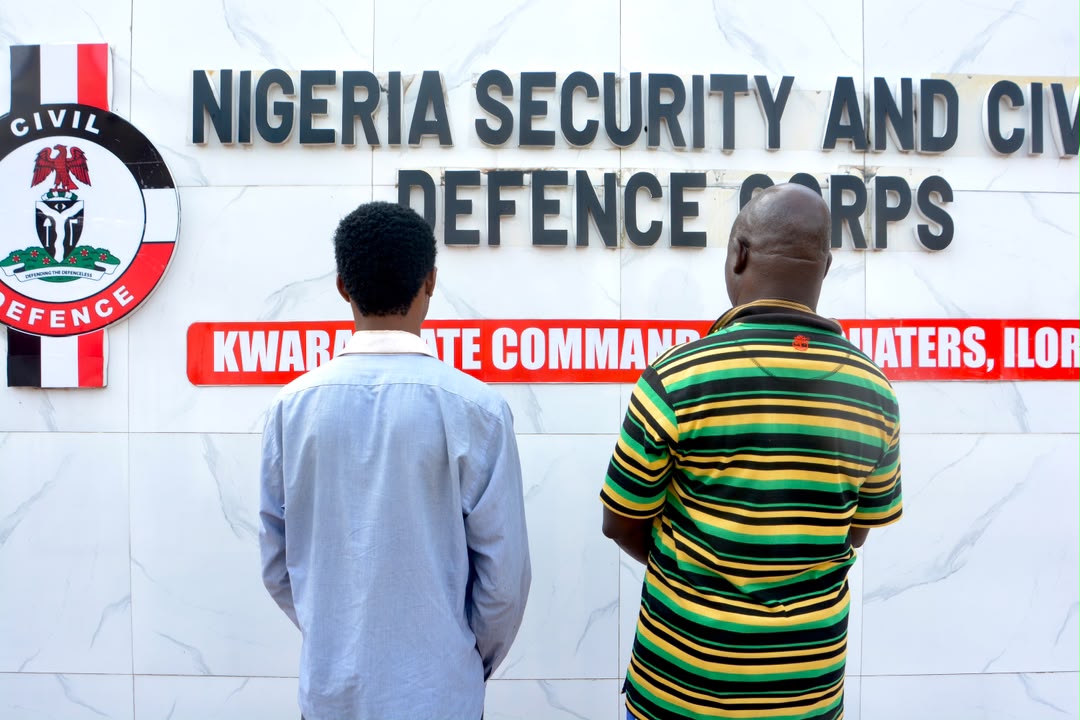
The Nigeria Security and Civil Defence Corps (NSCDC), Kwara State Command, has arrested two suspects in separate operations involving alleged human trafficking and illegal medical practice, reaffirming the Command’s resolve to protect vulnerable persons and tackle criminal activities across the State.
A statement by the spokesman for the NSCDC, ASC 1 Ayoola Michael Shola, said the Command arrested one Victor Barry, 22-year-old, for alleged trafficking of a 17-year-old girl from Amoyo, Kwara State, to Mali under the pretext of securing employment for her in Senegal.
The case, according to the Command’s spokesman, was reported by the victim’s mother at the NSCDC Amoyo Division on the 9th of October 2026 before it was transferred to the State Headquarters in Ilorin.
He said: “Preliminary findings indicate that the suspect allegedly met the girl at his shop on the 5th of October 2026 when she visited to purchase noodles and subsequently offered her an opportunity to travel to Senegal for employment.
“The suspect reportedly took the girl to Lagos on the 7th of October 2026 and handed her over to an unidentified individual at Mile 2 for onward transportation abroad. He later informed NSCDC operatives that the girl had arrived in Mali on the 12th of October 2026.
“The suspect further alleged that an agent identified as Joy redirected the girl’s destination to Mali, contrary to their initial arrangement for her to travel to Senegal.
“The suspect’s parents have pledged to cooperate with the Command to facilitate the girl’s return to Nigeria within two weeks. The Command is pursuing the necessary steps to establish the full circumstances of the case and secure her safe return.”
Also, in another separate operation on the 13th of October 2026, NSCDC operatives, acting on intelligence, arrested Bello Maruf, 56yrs, for allegedly operating an unauthorised medical facility and performing abortions without any recognised medical qualifications or a valid licence.
“During preliminary investigations, the suspect reportedly admitted to performing multiple abortions but failed to produce any certificate or licence authorising him to practise medicine. Medical instruments suspected to have been used in the procedures were recovered during the operation.
“The suspect will be charged to a court of competent jurisdiction upon completion of the investigation,” ASC 1 Ayoola stated.
Meanwhile, the State Commandant, Commandant Abbas Ndah Mohammed, has reaffirmed the Command’s commitment to protecting lives, safeguarding vulnerable persons and ensuring that individuals suspected of criminal activities are brought to justice in accordance with the law.
He urged parents and guardians to exercise caution over overseas employment offers made to young people and called on members of the public to promptly report suspected human trafficking, illegal medical practices and other criminal activities to the nearest NSCDC office.
The Command has, however, assured residents of Kwara State of its continued commitment to public safety and called for credible, timely intelligence to support its operations.
Uncategorized
Kwara: Physically challenged man, two others held for alleged arms supply to criminals
Stephen Olufemi Oni, Ilorin
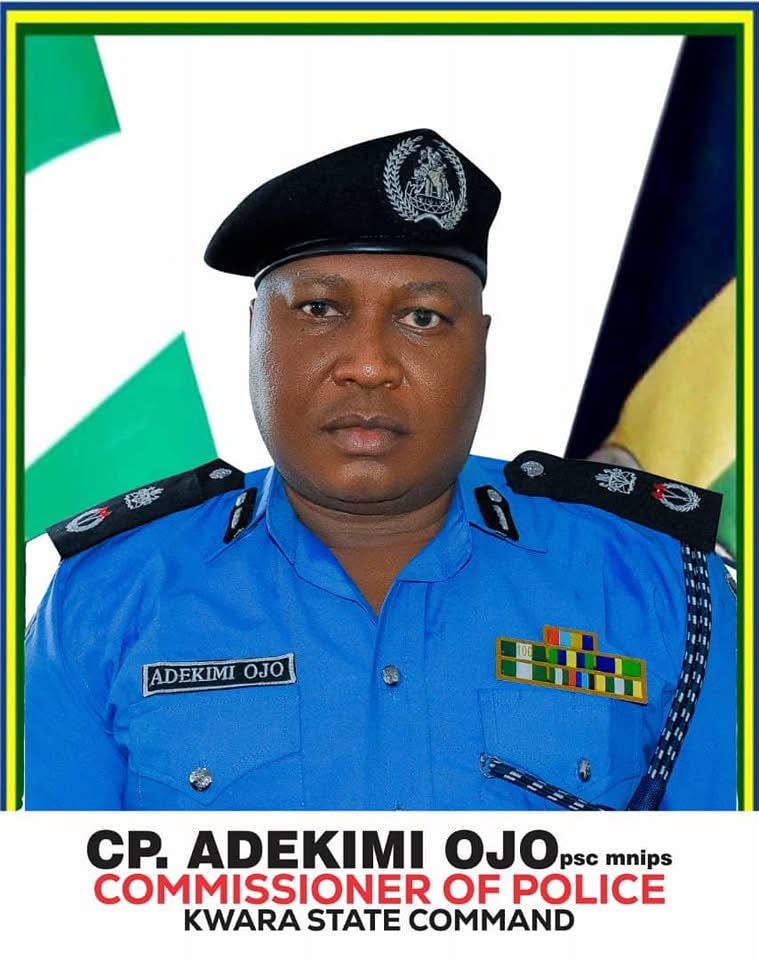
The Kwara State Police Command has arrested a physically challenged man, Joseph Adeoye, 52, and another suspect, Issa Fatai, 35, for alleged illegal possession and attempted purchase of a locally made pistol.
The arrests were among several criminal cases presented by the state Commissioner of Police, Adekimi Ojo, during a press briefing in Ilorin on Tuesday, October 13, 2026.
According to Ojo, police operatives intercepted Adeoye at a drinking spot around Ojatuntun Market during a surveillance operation and recovered a locally made cut-to-size pistol from him.
Further investigations led to the arrest of Fatai, who was allegedly identified as the intended buyer of the firearm.
The Commissioner of Police said both suspects reportedly admitted their involvement in the transaction during interrogation, adding that investigations were ongoing.
The suspects remain in police custody and are expected to be arraigned upon the conclusion of investigations.
Ojo said the arrests formed part of the command’s intensified efforts to tackle illegal firearms possession, kidnapping, armed robbery and other violent crimes across Kwara State.
In another development, the Command arrested Abubakar Usman, also known as Jaye, a wanted suspect allegedly linked to kidnapping incidents in Oke-Ode and Oro-Ago, as well as the killing of members of the Vigilante Group of Nigeria in Oke-Ode, Ifelodun Local Government Area.
The suspect was arrested at Jebba Cattle Market on October 11 following sustained efforts by security operatives.
The Commissioner of Police said investigations also linked him to a May 2025 incident in Labaka village, where four suspected kidnappers arrested by local vigilantes reportedly escaped after a group allegedly led by him arrived and fired gunshots into the air.
Usman was also accused of threatening to kidnap a prominent member of a cattle-rearing association and demanding N10 million.
Ojo said the suspect had reportedly confessed to his involvement in the crimes under investigation and was assisting the police in identifying other persons connected to the incidents.
The Command also arrested Ahamdu Dahiru, a suspected kidnapper allegedly linked to a wanted kidnapping kingpin known as Aro.
According to the commissioner, Dahiru confessed to leading four kidnapping operations in Eruku, Oke-Ode, Idofin and Babanla, during which large sums of money were collected.
The suspect subsequently led police operatives and members of the Vigilante Group of Nigeria to a forest between Bani and Kaiama, where four AK-47 rifles allegedly used in the operations had been buried.
However, the weapons were no longer at the location, as the suspect’s alleged accomplices, identified as Aminu, Sani, Yellow and Dogo, had reportedly moved them to an unknown destination.
A bag containing suspected hard drugs, chains and a padlock believed to have been used to restrain hostages was recovered at the location.
The police said Dahiru remained in custody and was providing information to assist efforts to apprehend the fleeing suspects and recover the firearms.
In another case, two suspects, Kamalden Lukmon and AbdulGaniyu Ibrahim, were arrested along Bakase Road, Alapa, on October 8, following the recovery of two suspected human hands.
Ojo said preliminary interrogation indicated that the suspects allegedly intended to use the body parts for money-making rituals.
The suspects reportedly claimed that a vigilante member, identified as Abdulraf Apata, handed the body parts to them. The police said the allegation was being investigated to establish the circumstances surrounding the incident and determine whether other persons were involved.
The commissioner also disclosed the arrest of three suspected motorcycle thieves, Mohamed Umar, 20; Aliyu Aliyu; and Babuga Umar, 30, at Dankurumi Settlement, Kosa, through an operation involving police operatives, local hunters and vigilantes.
A red Bajaj motorcycle allegedly stolen from the Daba area of Bani was recovered, while efforts were ongoing to arrest another suspected accomplice identified as Hanaruwa.
On child protection, Ojo said three suspects, including a 12-year-old girl’s biological father, stepmother and their neighbour, had been arraigned over alleged cruelty and physical abuse of the child.
The incident came to light on September 30 after a concerned resident of the Idigba area of Adewole, Ilorin, questioned the girl after seeing her buying a solution from a chemist late at night.
The child reportedly disclosed that she had been beaten with an electrical wire and burnt with a hot coal-pot over the loss of N100 while hawking soya beans for her stepmother.
The suspects were subsequently remanded at the Oke-Kura Correctional Centre, according to the police.
The command further reported the arrest of Saba Ismail, 25, over an alleged N10 million kidnapping threat against a resident of Batakan, via Tsaragi, in Edu Local Government Area.
Investigators reportedly traced the telephone number used to make the threat to the suspect, who allegedly confessed to the offence.
Other cases presented by the commissioner included the arrest of Umaru Ahmadu over an alleged kidnapping in Okeya, the arrest of Musa Hussein over suspected kidnapping activities, and the apprehension of three suspects in connection with an armed robbery at Gure Fulani Camp.
The police also arrested three suspects over the alleged exhumation of graves and removal of human heads at a cemetery in Omupo, Kwara State.
Ojo said the investigation into the cemetery incident began after community members discovered in May 2026 that some graves had been disturbed and the heads of bodies buried there were missing.
Two suspects, Abu Jimoh and Ayo Jimoh, were arrested on October 8 while allegedly digging graves at the cemetery. They reportedly identified a herbalist, Mukaila Bello, as the alleged buyer of the missing body parts.
The commissioner urged residents to provide credible information to security agencies, stressing that public cooperation remained critical to preventing crime and bringing suspected offenders to justice.
He also commended Governor AbdulRahman AbdulRazaq for donating 25 brand-new Hilux vehicles to the police, saying the gesture would strengthen operational mobility, improve police visibility and enhance responses to security threats across the state.
Ojo assured residents that the command would continue to pursue intelligence-led operations, professional investigations and community engagement to protect lives and property.
He, however, urged the media to report cases still under investigation accurately and responsibly, while assuring the public that suspects would be dealt with in accordance with due process.


APC PCC Appoints Hafiz Kawu Director of Grassroots Engagement, Mobilisation

ON BORNO ADC’S LAME REJOINDER: MY RESPONSE.

Alleged Human Trafficking: Two Suspects In NSCDC’s Net

-
 Uncategorized6 years ago
FG, states urged to harness flooding for ranching, others with technology – Agbaje
-
 Headlines11 years ago
Breaking: EFCC seals Borno House of Assembly, as Hon members take to their heels
-
 News12 years ago
Nigeria Security Operatives Stage Manhunt For Homosexual Perpetrator
-
 News10 years ago
How 21-year-old Girl fled community over accusation of lesbianism
-
 News11 years ago
Yobe Gov Moves Against Deputy
-
 Opinion7 years ago
7 signs she has friend zoned you
-
Technology5 years ago
Online job placement company headhunts women
-
 Headlines10 years ago
Borno Dep Gov Abducts Another Church Leader