
Uncategorized
Olawepo-Hashim’s Lauded For Longstanding Support for Igbomina

Stephen Olufemi Oni, Ilorin
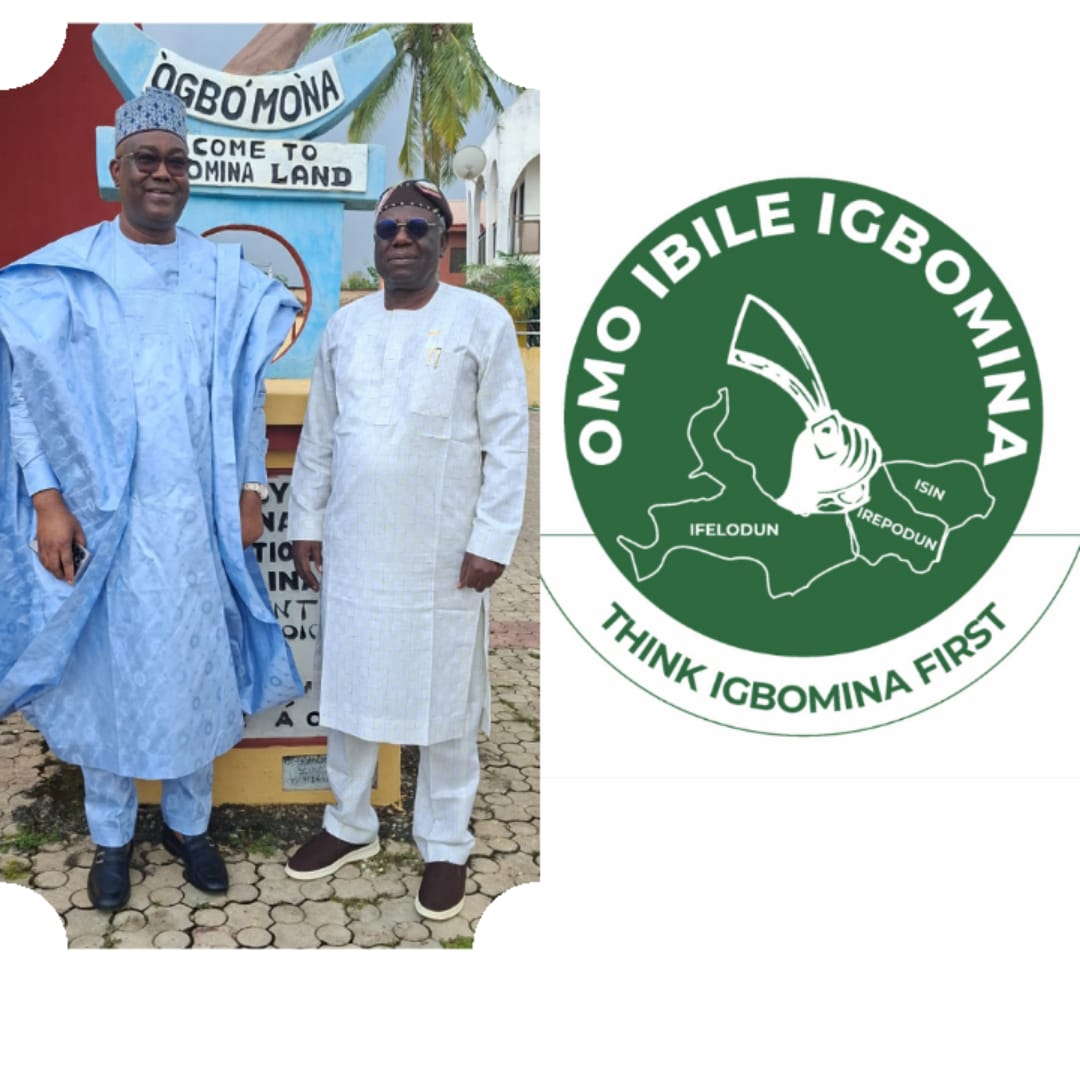
The National President of Omo Ibile Igbomina, Sir Bisi Fakayode, has received Dr. Gbenga Olawepo-Hashim on a courtesy visit, reflecting on their longstanding relationship, the progress recorded by Omo Ibile Igbomina and ongoing initiatives aimed at strengthening the institution and advancing the development of Igbomina.
During the visit, the National President conducted Dr. Olawepo-Hashim around the Igbomina House, showcasing the renovation, rehabilitation and other improvement projects undertaken under his leadership, while also taking him on an inspection tour of the adjoining hospitality facility and other areas where development works are ongoing.
Speaking during the visit, Sir Fakayode expressed profound appreciation for Olawepo-Hashim’s longstanding support and encouragement, recalling that he was one of the first three prominent supporters of the present Omo Ibile Igbomina leadership from its formative stage.
The National President described Dr. Olawepo-Hashim as a friend, supporter and valued stakeholder of Igbomina, noting that although his ancestral origin may not be from present-day Kwara State, his upbringing and longstanding relationship with Igbomina have created a strong bond with the people and their aspirations.
“What we are witnessing today did not start today. You supported and encouraged this journey from the beginning. From my days as a Local Government Chairman to where God has brought me today as National President of Omo Ibile Igbomina, your support and encouragement have been part of this journey,” Sir Fakayode stated.
Responding, Dr. Olawepo-Hashim commended the National President for the transformation taking place at Igbomina House and expressed appreciation for the opportunity to see the projects firsthand, acknowledging the progress being recorded under Sir Fakayode’s leadership.
He, therefore, urged the leadership to remain committed to its vision of strengthening the institution and promoting the collective interests of Igbomina.
Olawepo-Hashim also reflected on the journey of Sir Fakayode, noting the remarkable progression from his earlier public service and local government leadership to his present position as National President of Omo Ibile Igbomina, acknowledging the importance of the encouragement and support that accompanied the journey, while expressing goodwill towards the leadership as it continues to pursue its development agenda.
Sir Fakayode further appreciated Olawepo-Hashim for his continued goodwill towards the leadership and people of Igbomina, stressing that strong relationships, unity of purpose, mutual respect and constructive engagement remain essential to the advancement of the Igbomina nation.
The visit ended on a warm and cordial note, with both personalities reaffirming the importance of sustained engagement and collective commitment to the progress, unity and development of Igbomina.
Uncategorized
OPINION: OF DEMOCRACY, INTRIGUESAND THE OFFICE OF VICE-PRESIDENT: THE CASE OF KASHIM SHETTIMA.
.
BY: A G ABUBAKAR.
Democracy, as a system of government, is both a beautiful and a funny concept. Its beauty is often skin-deep and, more importantly, dependent on the people who operate it. Democracy provides institutions, procedures and restraints, but it does not automatically produce good governance. The same democratic framework can produce a statesman in one country, a strongman in another and, under different circumstances, an outright despot. The difference is often not the architecture of the system but the character, interests, competence and intentions of those entrusted with its operation.
Perhaps nowhere is this paradox more evident than in the office of the Vice-President of Nigeria. It is a distinct feature of the presidential system of governance adopted by the country after jettisoning the parliamentary system it operated between 1960 and 1966. Both the 1979 and 1999 (as amended) Constitutions provided for this presidential model of governance, which has been in place since 29 May 1999.
Under this arrangement, the President and Vice-President are elected on the same ticket. The Vice-President is therefore not merely another political appointee. He or she is part of the electoral mandate that produces the President.
Since the return to democratic rule in 1999, six people have occupied the office: Atiku Abubakar (1999–2007), Goodluck Jonathan (2007–2010), Namadi Sambo (2010–2015), Yemi Osinbajo (2015–2023), and Kashim Shettima (from 2023)—with Jonathan serving first as Vice-President to Umaru Musa Yar’Adua before succeeding him as President in May 2010. More precisely, Atiku Abubakar served under President Olusegun Obasanjo; Goodluck Jonathan under President Umaru Musa Yar’Adua; Namadi Sambo under Jonathan; Yemi Osinbajo under Muhammadu Buhari; and Kashim Shettima under Bola Ahmed Tinubu.
That history reveals something important: Nigeria has had Vice-Presidents of very different personalities, political weights and relationships with their principals. Consequently, the office has never operated according to one fixed template. Some Nigerians have famously described the Vice-President as a “spare tyre.” Others have reduced the office to that of an “errand boy.” Both descriptions are politically colourful but constitutionally inadequate. The Vice-President is a constitutionally established office with important responsibilities, including succession in circumstances provided for by the Constitution.
The 1999 Constitution, as amended, establishes the office of the Vice-President in Section 141, which provides that there shall be a Vice-President of the Federation. Section 142 deals with the nomination and election of the Vice-President, while Section 146 provides for the discharge of the functions of the President in circumstances such as death, resignation, removal or permanent incapacity.
There is, however, an important constitutional nuance. The Constitution does not prescribe a long, detailed list of executive functions that the Vice-President must independently perform every day. Section 148 provides that the President may, in his discretion, assign responsibility for any business of government to the Vice-President or a minister. This is where the funny side of the Nigerian presidential system begins.
The Vice-President is constitutionally important, electorally important and potentially politically consequential, yet much of the office’s day-to-day executive relevance depends on what the President chooses to delegate. In other words, the Vice-President possesses constitutional stature without necessarily possessing an autonomous executive portfolio. That distinction matters. A Vice-President can be extraordinarily influential without controlling a major ministry. Conversely, a Vice-President can occupy one of the highest offices in the land and still appear politically peripheral, which many insinuate has been the case with Shettima.
Under the Constitution, the President and Vice-President campaign together. They present themselves to the electorate as a political partnership. Their election is based on a common mandate, based on the perceived need for loyalty and regional and ethno-religious balance. That’s what made the Muslim-Muslim ticket of Tinubu and Shettima generate so much debate in 2023.
Whatever one’s interpretation, the episode demonstrated a fundamental truth about Nigerian democracy: political tickets are rarely constructed merely around constitutional requirements. They are also instruments for managing interests.
The same logic applies to ministers, commissioners, special advisers, party officials and other political appointments. Representation is often expected to perform several functions simultaneously: reward loyalty, accommodate constituencies, maintain political equilibrium, broaden legitimacy and strengthen the governing coalition. But once the election is over, another reality emerges. There cannot be two captains commanding the same ship.
The first structural problem confronting every Nigerian Vice-President is therefore simple: how does one exercise influence without appearing to compete with the President?
A Vice-President who becomes too assertive may be perceived as ambitious.
One who is too passive may be perceived as irrelevant.
One who develops an independent political network may be considered a threat.
One who refuses to develop one may become politically dependent.
One who publicly disagrees with the President risks undermining the administration.
This is the paradox of the office. Several factors can determine how much space a Vice-President like Shettima occupies.
First is the President’s personality and governing philosophy. Some Presidents delegate extensively; others centralise authority.
Second is the relationship of trust between the President and Vice-President. Presidential systems are intensely personal. Constitutional provisions matter, but political trust often determines how those provisions operate in practice.
Third is the influence of the President’s inner circle. The “kitchen cabinet”—whether formal or informal—can become a powerful filter through which information, access and influence flow. It is also where people could easily knock heads for their self-serving interests while dressing them up as protection for the President. It has been alleged that the VP has been angling to succeed his boss in the event that he failed to complete his tenure on account of being incapacitated or gone. Such a story got spun, according to the VP, to the extent that an ordinary gift to his boss was seen with suspicion.
Fourth is the Vice-President’s own personality and political ambition. Every Vice-President knows that the office is constitutionally positioned immediately below the presidency. The possibility of succession is therefore built into the architecture of the office.
Fifth is the politics of succession. The closer a government moves towards the end of its constitutional tenure, the more complicated the relationship can become, particularly in the North, where political actors begin positioning themselves for what comes next: a post-Tinubu era in either 2027 or 2031.
This brings us to Kashim Shettima, who did not enter the Vice-Presidency as an unknown political quantity. He had served as Governor of Borno State from 2011 to 2019, during one of the most difficult periods in the state’s modern history. He subsequently served as a senator representing Borno Central. His political experience, particularly his years as governor during the Boko Haram insurgency, gave him a profile different from that of several previous Vice-Presidents.
From the beginning of the administration, Shettima appeared eager to project himself as an active participant in government. He spoke frequently about economic issues, national development and the direction of the administration. His public interventions sometimes gave the impression of a Vice-President prepared to occupy considerable political space. Remember his famous appropriation of managing the national security and economy himself and the principal at the inception of his tenure.
Yet the subsequent question has been: how much of that space has actually translated into institutional influence and measurable policy ownership? This is where the assessment becomes more complicated. Shettima’s defenders can reasonably argue that the Nigerian Constitution does not make the Vice-President an independently empowered executive. Without presidential delegation, a Vice-President cannot simply appropriate ministries, agencies or policy portfolios to himself. His critics, however, can equally argue that constitutional limitation does not necessarily prevent political leadership.
A Vice-President can build initiatives.
A Vice-President can convene stakeholders.
A Vice-President can become the administration’s principal advocate on particular issues.
A Vice-President can use his office to elevate neglected national problems.
And a Vice-President can become the political bridge between the presidency and a particular constituency.
The question, therefore, is not simply whether Shettima possesses independent constitutional executive powers. He does not. The more important question is how effectively he has used the political space available to him to impact the people who see him as one of the powerful moderators of government policy and policy directions.
This question becomes particularly significant because Shettima is not merely Vice-President in the abstract. He is a Northerner, a Muslim and a former governor of Borno State operating in a government whose political coalition is national but whose leadership arrangement has generated considerable discussion about regional and religious representation, with all its challenges.
The Vice-President occupies a unique position from which he can continually place these problems at the centre of national policy. This does not mean he should be partial in favour of the North, but rather that he shouldn’t stand by aloof or be a party to making the region’s plight worse. This is where the question of political visibility and impact becomes legitimate.
One useful way of assessing any Vice-President is to ask a simple question: What major national initiative will history associate with each of the five Vice-Presidents to date? The comparison is not necessarily about who was “better” or “worse.” It demonstrates that the office can be made politically visible when circumstances, presidential delegation, personality and institutional opportunity converge.
Shettima’s challenge is therefore not merely constitutional. It is one of political ownership.
What major policy initiative can Nigerians unmistakably associate with his office?
What major national problem has he persistently championed?
What institutional mechanism has he built?
What enduring programme will remain associated with the Vice-Presidency?
Has Shettima’s impact been felt so far, even within his immediate constituency, the North? Or is he simply content with being Vice-President—a feeling of power for its own sake? How else does one explain the deterioration of insecurity in Borno and across the North-East? The continued captivity of the Mussa and Lassa children in the hands of Boko Haram/ISWAP remains troubling. His response to the carnage in the North-West and North-Central zones could also be more forceful. His contribution to efforts to stem the rising number of out-of-school children in the North is hardly visible.
It is also troubling that Maiduguri, the VP’s home-state capital, can now be accessed through only one—western—corridor out of four. The Maiduguri-Damaturu-Biu highways, which once provided vital links through Biu and Damaturu, remain either closed or too dangerous to ply. Job opportunities are equally scarce, leaving large numbers of unemployed young people vulnerable to recruitment by insurgents and terrorists. It is also unclear whether the rehabilitation of the Alau Dam has been completed.
The North’s deeper crisis is also a larger issue. The region’s insecurity has disrupted agriculture, displaced communities, destroyed businesses and weakened local economies. The education crisis is equally alarming. That is why the North needs more than political representation in Abuja. It needs a development strategy built around security, education, energy, agriculture, industrialisation, healthcare, infrastructure and employment. And this is precisely where a Vice-President with Shettima’s background could potentially make a difference—if sufficient political space is created and if he chooses to occupy it. For now, it would seem he is little more than a presidential representative who attends ceremonies, delivers speeches and occasionally speaks on behalf of the President, as he just did at UNGA 81. The office is too important for that.
The Vice-President is constitutionally the second-highest elected executive official in the country. He is elected by the same electorate, on the same ticket, under the same national mandate. He should not be confused with a minister, special adviser, or presidential spokesman. At the same time, the Vice-President cannot be expected to behave like a second President.
That is the delicate balance.
The Vice-President must be sufficiently influential to contribute meaningfully to governance but sufficiently disciplined to respect the authority of the President. The President, in turn, must be sufficiently confident to allow his deputy meaningful space without interpreting every expression of initiative as competition. This is not merely a matter of personality. It is an institutional question.
The same Constitution can accommodate an activist Vice-President and a ceremonial one. It can produce a President who delegates and another who centralises. It can create space for vigorous debate and space for political conformity. The system provides the framework. Human beings determine what happens inside it.
That is why democracy can be both beautiful and funny. It gives people power and then trusts them to decide what to do with it. It creates institutions but depends on institutional culture. It distributes authority but leaves enormous room for political interpretation. It provides succession arrangements but simultaneously creates incentives for political ambition. It puts a President and Vice-President on the same ticket and then expects them to navigate the inevitable tension between cooperation and succession.
Perhaps the most important lesson from Nigeria’s experience is therefore that the strength of an office cannot always be measured by the number of powers expressly written into the Constitution. Rather, it’s about personality, confidence, instinct and political networks. Whether Kashim Shettima, as a Vice-President, is viewed through the optics of these sociopolitical values is a matter of debate, made very complicated by the very democracy that threw him up.
The Constitution creates the office. The President creates much of its operating space. The Vice-President determines how much of that space he is prepared to occupy. And history ultimately decides whether he merely occupied the office—or actually used it.
A.G. Abubakar
agbarewa@gmail.com
Stephen Olufemi Oni, Ilorin
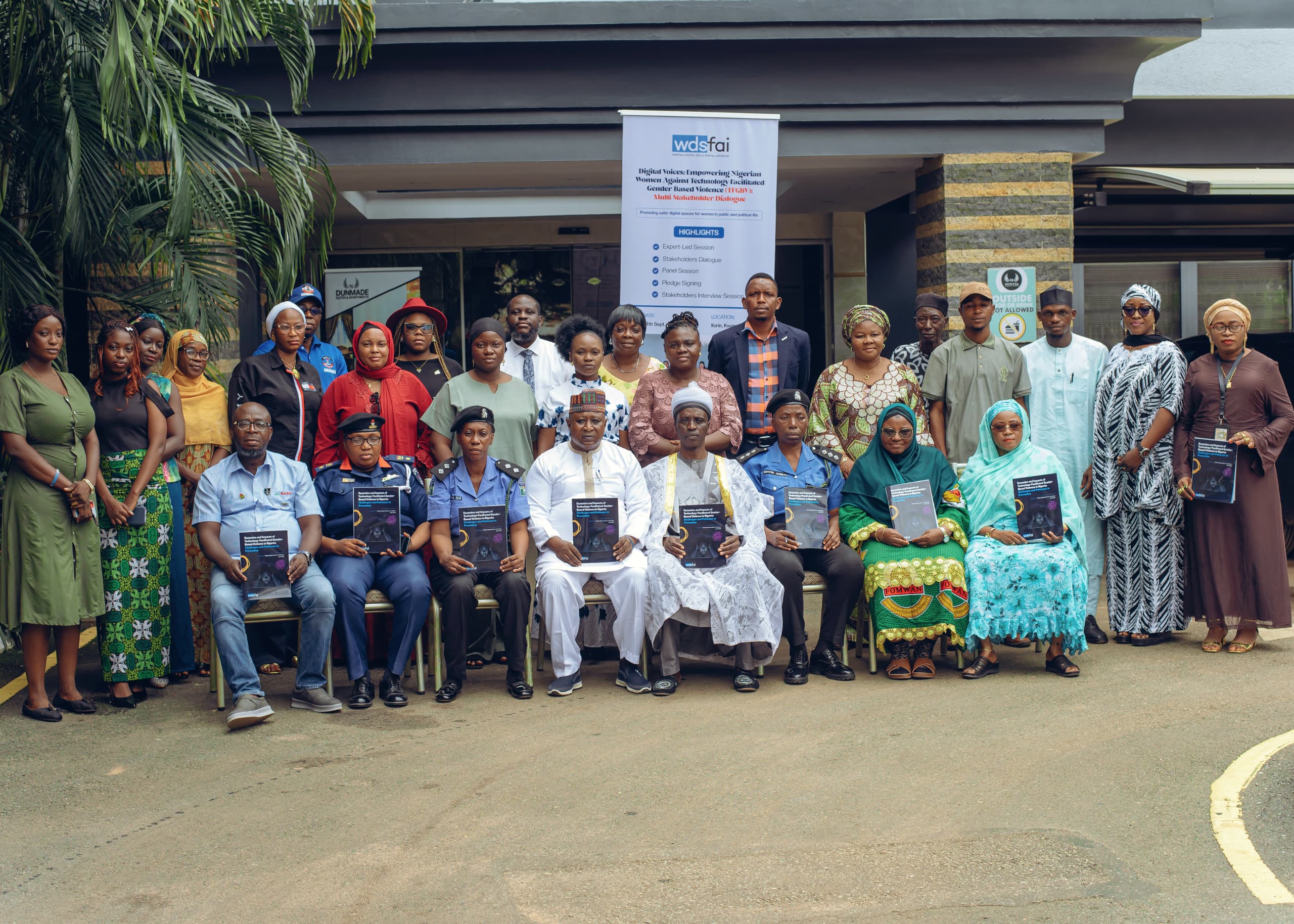
Stakeholders, including representatives of security agencies, civil society organisations, electoral officials, traditional chiefs, and media practitioners, have converged on Ilorin, the Kwara State capital, for a multi-stakeholders’ dialogue on Technology-Facilitated Gender-Based Violence (TFGBV).
Participants at the important forum warned that the growing menace of TFGBV poses a great threat to women’s participation in the forthcoming 2027 general elections.
The multi-stakeholders’ dialogue was organised by the Webfala Digital Skills for All Initiative (WDSFAI) as part of its “Digital Voices: Empowering Nigerian Women Against TFGBV” initiative, supported by the Urgent Fund for Africa.
The event follows a workshop held last month that brought together young women in politics, public leadership, and the media to examine the impacts of TFGBV on women and its potential consequences for their electoral participation.
Speaking on the process of reporting gender-based violence cases, ASP Fatima Isa, Head of the Gender Unit of the Nigeria Police Force, Kwara State Command, outlined the steps taken when survivors approach the police, including private listening sessions, evidence admission, statement-taking, and the commencement of investigations.
She urged victims to document all evidence and resist the urge to delete it, stressing that reporting is not the end of the process but the beginning of the journey towards justice.
“Victims should not stay silent. They should report to law enforcement agencies as soon as the violence is committed. We are ready to listen, and we are ready to act,” ASP Isa said, adding that the police are fully prepared to provide protection for women before, during, and after the 2027 general elections.
Dr. Adeleye Abosede, Programme Manager at Olive Community Development Initiative (OCDI) identified fear of stigmatisation, deep-rooted patriarchal norms that normalise gender-based violence, concerns about privacy breaches, and distrust of the justice system as some of the reasons many victims of TFGBV choose not to report their experiences.
While urging survivors to report to law enforcement agencies and organisations handling GBV cases without fear, Abosede said: “We must stop being judgmental toward survivors. The burden of shame belongs to the perpetrator, not the victim. We must listen to them, assess their cases and determine the appropriate interventions to be carried out.”
The Head of the Gender Unit at the Independent National Electoral Commission (INEC) in Kwara State, Mr. Ohiani Albert, raised alarm over the disproportionate impact of TFGBV on electoral participation, noting that women constitute a larger percentage of the electorate and that technology-facilitated violence could significantly undermine their ability and willingness to engage in the electoral process.
Albert called on INEC to formally classify TFGBV as a form of electoral violence, attracting severe consequences for perpetrators. He also disclosed that INEC would consider conducting digital safety training for women aspirants and confirmed that the commission would collaborate with fact-checking organisations to address the growing threats posed by fake news and deepfakes to the integrity of the electoral system.
Mrs. Dada Racheal, Head of the Gender Unit at the Kwara State Command of the Nigeria Security and Civil Defence Corps (NSCDC), encouraged victims to confide in trusted persons and report to security agencies, while also advising young people to be mindful of the personal information and location data they share online.
Obasa Olubanke, a reporter at Flow FM Ilorin, urged journalists to prioritise the protection of survivors’ identities in their coverage, cautioning against the circulation of pictures, videos, or information that could further violate or endanger victims.
“We must put ourselves in the shoes of survivors. The craze for traction and engagement must never push the media into becoming instruments of further harm,” she said.
In her remarks, the Kwara State Commissioner for Women Affairs, Chief (Mrs) Opeyemi Afolashade, said the multi-stakeholder dialogue underscored the urgent need for coordinated action among government agencies, civil society, the media, and security forces to combat TFGBV and create a safer environment for women’s political participation ahead of the 2027 elections.
She also restated the commitment of the state government to eliminating all forms of GBV through strengthened response mechanisms, improved support for survivors, intensified public awareness campaigns, and collaboration with stakeholders to ensure enforcement of relevant laws.
By: Kashim Shettima At UNGA: A STRONG VOICE FOR NIGERIA AND AFRICA.
By: Inuwa Bwala
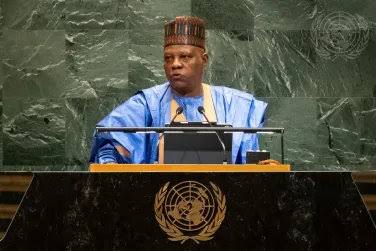
Vice President Kashim Shettima’s appearance on September 24, 2026, delivering Nigeria’s National Statement for the third consecutive year on behalf of President Bola Ahmed Tinubu, was a demonstration of consistency, confidence and statesmanship.
At the risk of sounding immodest, I dare say, that, President Bola Tinubu could not have done it better.
The Vice President’s central message was clear and powerful, to the effect that, “Nigeria believes in multilateralism, but the institutions that govern our world must become more representative, equitable, and responsive to the realities of today.”
This is a positive and mature foreign policy posture. It shows Nigeria is not isolationist, but reformist. Shettima affirmed Nigeria’s commitment to the UN system while boldly advocating for President Tinubu’s long-standing call for reform of global institutions, particularly the UN Security Council and international financial architecture, so as to give developing countries a stronger voice.
To me, it remains Nigeria’s strongest and clearest articulation of where our national interest targets.
His declaration that “Our engagements will be guided by Nigeria’s national interest” resonated well at home and abroad. It frames Nigeria not as a passive aid-recipient, but as a strategic partner negotiating firmly for trade, investment, technology transfer and climate finance. This is exactly the tone Nigerians want to hear on the world stage and the intermitent applause from the delegates was a testimony to this.
Beyond the General Assembly Hall, Shettima scored a major point at the Third High-Level Roundtable of the Africa Minerals Strategy Group. He called for an end to Africa’s dependence on raw mineral exports and advocated for processing and manufacturing industries within Africa.
His argument that Africa’s mineral wealth must translate into jobs, industrial growth and improved living standards is a forward-looking, pan-African economic vision. It positions Nigeria as a leader in the new scramble for critical minerals, demanding value-addition, not exploitation.
The Vice President’s sideline engagement with Nigerians in Diaspora in New York, calling on them to support the economic transformation agenda, shows a holistic approach — using UNGA not just for speeches, but for investment mobilization.
To me, and of vourse many Nigerians, including critics of the Bola Tinu u administration, the verall Verdict, is that, Shettima’s performance at UNGA 81 was presidential, articulate and strategically aligned with the Renewed Hope Agenda. He projected Nigeria as stable, confident, reform-minded, and ready to lead Africa’s demand for a fairer world order, under the UNGA 81 theme of “Restoring trust, managing transformation.”
It was a positive outing that strengthened Nigeria’s image as the voice of Africa and the Global South.
Vice President Kashim Shettima’s appearance on September 24, 2026, delivering Nigeria’s National Statement for the third consecutive year on behalf of President Bola Ahmed Tinubu, was a demonstration of consistency, confidence and statesmanship.
At the risk of sounding immodest, I dare say, that, President Bola Tinubu could not have done it better.
The Vice President’s central message was clear and powerful, to the effect that, “Nigeria believes in multilateralism, but the institutions that govern our world must become more representative, equitable, and responsive to the realities of today.”
This is a positive and mature foreign policy posture. It shows Nigeria is not isolationist, but reformist. Shettima affirmed Nigeria’s commitment to the UN system while boldly advocating for President Tinubu’s long-standing call for reform of global institutions, particularly the UN Security Council and international financial architecture, so as to give developing countries a stronger voice.
To me, it remains Nigeria’s strongest and clearest articulation of where our national interest targets.
His declaration that “Our engagements will be guided by Nigeria’s national interest” resonated well at home and abroad. It frames Nigeria not as a passive aid-recipient, but as a strategic partner negotiating firmly for trade, investment, technology transfer and climate finance. This is exactly the tone Nigerians want to hear on the world stage and the intermitent applause from the delegates was a testimony to this.
Beyond the General Assembly Hall, Shettima scored a major point at the Third High-Level Roundtable of the Africa Minerals Strategy Group. He called for an end to Africa’s dependence on raw mineral exports and advocated for processing and manufacturing industries within Africa.
His argument that Africa’s mineral wealth must translate into jobs, industrial growth and improved living standards is a forward-looking, pan-African economic vision. It positions Nigeria as a leader in the new scramble for critical minerals, demanding value-addition, not exploitation.
The Vice President’s sideline engagement with Nigerians in Diaspora in New York, calling on them to support the economic transformation agenda, shows a holistic approach — using UNGA not just for speeches, but for investment mobilization.
To me, and of vourse many Nigerians, including critics of the Bola Tinu u administration, the verall Verdict, is that, Shettima’s performance at UNGA 81 was presidential, articulate and strategically aligned with the Renewed Hope Agenda. He projected Nigeria as stable, confident, reform-minded, and ready to lead Africa’s demand for a fairer world order, under the UNGA 81 theme of “Restoring trust, managing transformation.”
It was a positive outing that strengthened Nigeria’s image as the voice of Africa and the Global South.


Olawepo-Hashim’s Lauded For Longstanding Support for Igbomina

OPINION: OF DEMOCRACY, INTRIGUESAND THE OFFICE OF VICE-PRESIDENT: THE CASE OF KASHIM SHETTIMA.

TINUBU AND THE AUDACIOUS NORTHERN TRAJECTORYPART (1)

-
 Uncategorized6 years ago
FG, states urged to harness flooding for ranching, others with technology – Agbaje
-
 Headlines11 years ago
Breaking: EFCC seals Borno House of Assembly, as Hon members take to their heels
-
 News12 years ago
Nigeria Security Operatives Stage Manhunt For Homosexual Perpetrator
-
 News10 years ago
How 21-year-old Girl fled community over accusation of lesbianism
-
 News11 years ago
Yobe Gov Moves Against Deputy
-
 Opinion7 years ago
7 signs she has friend zoned you
-
Technology5 years ago
Online job placement company headhunts women
-
 Headlines10 years ago
Borno Dep Gov Abducts Another Church Leader