
Uncategorized
ABS Foundation Appoints Ex-Kwara SSG, Gold As Ag. Executive Director

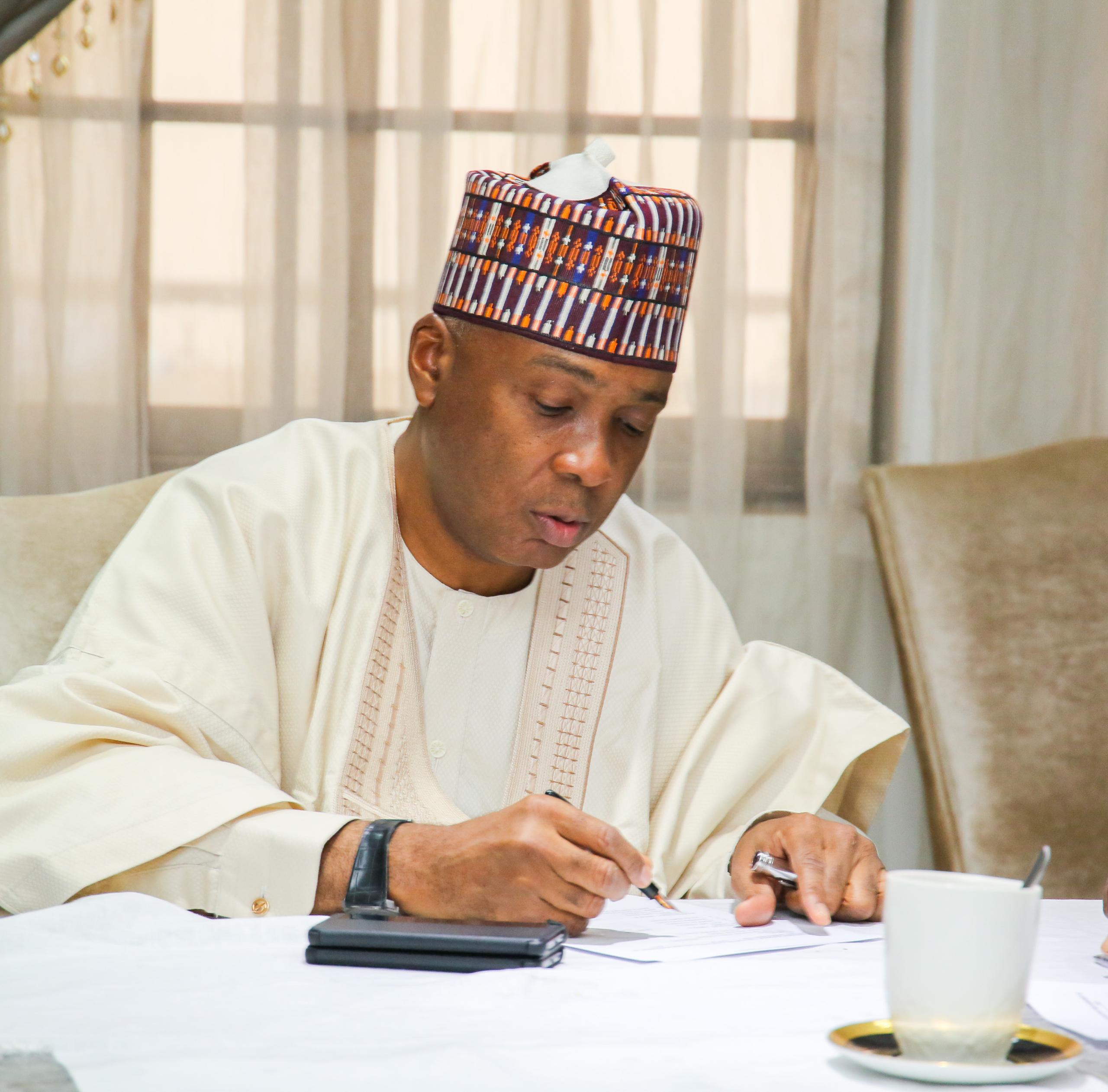
- Dismisses political claims for exit of its former Executive Director
Stephen Olufemi Oni, Ilorin
Former Secretary to the Government (SSG) of Kwara State, Alhaji Isiaka Sola Gold, has been appointed the Acting Executive Director of the Abubakar Bukola Saraki Foundation.
Gold, who retired as a Permanent Secretary in the Kwara State Civil Service, served as SSG between 2011 and 2019, after heading various Ministries and Agencies, including the State’s Liaison Office in Abuja.
A statement by the Regional Director, North Central of the
Abubakar Bukola Saraki Foundation, Mr. Lawal Olanrewaju Temitayo, said Gold’s new appointment takes immediate effect.
With this appointment, Gold is expected to draw on his wealth of experience as a public administrator to coordinate the activities, projects, and initiatives of the Foundation across the country and to ensure that the Foundation continues to make meaningful impacts in its core areas, the statement added.
It would be recalled that the Foundation was established in 2019 as a philanthropic, non-partisan, and apolitical organisation to contribute to the growth and development of Nigeria in a manner that would ensure optimal deployment of available resources towards creating opportunities that would yield maximum benefits for all Nigerians without prejudice to ethnicity, religion, or political leanings.
According to Temitayo, the Foundation has over the years translated that objective into visible, measurable community-centre interventions such as access to potable water, education, healthcare, rural electrification, livelihood support, and humanitarian relief.
Meanwhile, the Foundation has dismissed claims linking the exit of its former Executive Director, Dr. Audu Musa Idowu, to his political differences with the Peoples Democratic Party (PDP), insisting that the Foundation’s programmes and finances are solely funded by its Founder, Dr. Abubakar Bukola Saraki.
The Foundation said Idowu’s departure should be treated strictly as an employment matter and not connected to his decision to leave the PDP after failing to secure the party’s ticket for the Irepodun/Isin/Oke-Ero/Ekiti Federal Constituency seat in the House of Representatives.
In a statement by its Regional Director, North Central, Mr. Lawal Olanrewaju Temitayo, the Foundation clarified that Idowu was a salaried employee whose position did not confer ownership or financial responsibility for the organisation.
“For the avoidance of doubt, the Foundation wishes to state unequivocally that its establishment, funding, programmes, and financial sponsorship are solely the responsibility of its founder, Dr. Abubakar Bukola Saraki,” the statement said.
It added that Idowu neither funded nor sponsored the Foundation and was not responsible for its financial sustenance.
Established in 2019, the Foundation said it was created to promote Nigeria’s development through the effective use of available resources to create opportunities and deliver benefits to citizens, irrespective of ethnicity, religion or political affiliation.
It maintained that it operates as a philanthropic, non-partisan and apolitical organisation, with its activities deliberately separated from partisan politics, political mobilisation and electoral activities.
According to the statement, the Foundation has pursued its objectives through community-based interventions in potable water, education, healthcare, rural electrification, livelihood support and humanitarian relief.
The organisation further disclosed that it had removed politically exposed persons and aides associated with its founder from its operational structure to reinforce its neutrality and institutional independence.
Those affected, it said, included Alhaji Nasir Subair, Hon. Oye Adetula, Abdulganiyu Abdulqadir, Ibrahim Olayinka Otukoko and Kawu Ndanusa, among others, who were replaced with neutral, non-partisan outsourced personnel and professionals.
The Foundation stressed that neither its programmes nor its humanitarian interventions were personally funded by any former or serving staff member.
It reiterated that Saraki’s commitment to philanthropy predated and remained independent of the political activities and ambitions of individuals who had worked with the organisation.
While acknowledging Idowu’s right to make personal political decisions, including his resignation from the PDP, the Foundation urged the public not to conflate such choices with its ownership, funding or administration.
“The Foundation respects Dr. Audu Musa Idowu’s right to make personal political decisions, including his decision to resign from the PDP. However, such political decisions should not be conflated with the ownership, funding, and administration of the Foundation,” the statement added.
The organisation reaffirmed its commitment to philanthropy, professionalism, neutrality and service to humanity, saying it would continue to pursue its humanitarian objectives independently of individual political interests.
- We pleaded for power rotation, we’ll back President, all APC candidates: Kwara South monarchs
Stephen Olufemi Oni, Ilorin
Kwara State Governor AbdulRahman AbdulRazaq on Wednesday led the APC campaign train to Kwara South, hinging his call for support for the party on the many achievements of the government in the region over the last seven years.
The Governor said the administration has delivered at least 219.5km of state roads — apart from the 42-kilometre Eiyenkorin-Ojoku-Offa Road which he had also facilitated to the region or other forms of infrastructure like bridges and river crossings.
He also said the APC tickets satisfied the calls for equity, fairness, and justice, referring to the party ceding its governorship ticket to Kwara North and senatorial ticket to the Igbomina bloc in Kwara South after 12 years of the Ibolo bloc.
“There is no opposition party here. Who is the presidential candidate of PDP? Basically, no opposition in this state. This state is clearly open for President Bola Ahmed Tinubu. Now, let’s not be complacent that we have this in the bag. Let’s make sure we all come out to vote. We must make our vote count. We want to surpass the previous vote. We want to make sure we get more votes than in the previous elections,” the Governor said.
“As we all know, the Presidential and National Assembly elections will hold first. We must make sure we double our votes. We double our efforts. We double our canvassing. We double our door-to-door campaigns. Make sure you knock on your neighbors’ doors and go to the next door and the next door after that. I urge you all to become canvassers today.
“This is a government with a visionary leader, a leader of purpose, a leader that is leading Nigeria in the right direction. In Kwara State, you have seen the effect of leadership of President Tinubu. And you have seen what has been done in this state, from healthcare to education.”
He enjoined all Kwarans to reflect on the roles the previous government had played in promoting thuggery, saying kwara must not entrust ‘irresponsible’ people with power.
Held at the Ajase-ipo Comprehensive High School, in Irepodun LGA, the party stalwarts gathered in their large numbers in solidarity for re-election of President Bola Ahmed Tinubu, the governorship ticket of Rt Hon Salihu Yakubu Danladi and other national and state assembly candidates from that axis.
Top attendees included the Deputy Governor Mr Kayode Alabi; Rt. Hon Danladi; his running mate Hon Seun Oguniyi Adato; National and State House of Assemblies candidates; cabinet members; APC chieftains led by the state party Chairman Prince Sunday Fagbemi; Director General APC Campaign Committee (South), Engr Nurudeen Adeyemi Balogun; and Chairman Federal Character Commission (FCC), Dr. Muheeba Farida Dankaka; Founder Thomas Adewumi University Teaching Hospital Omu-aran, Dr Johnson Adewumi; and Oloriewe Raheem Adedoyin; among others.
“What we are going to do is APC, APC is the only party in this state. APC is the party with a clear leader. We are going to vote APC from top to bottom. I want to thank the people of Kwara South for this mammoth crowd. We saw what happened last week in Kwara North, it was unprecedented, and this one is huge,” the Governor said
“This mammoth crowd is due to the policies of the Federal Government, which has impacted wonderfully on the state, releasing funds to the state for us to execute the beautiful projects that we see, the functional projects we see, and the needful projects that we see across the state, especially in Kwara South.
“In Kwara South, we’ve done about 219 kilometres of road, which I must say is more than the kilometers the last administration did in the entire Kwara State. We will continue to do more. We will continue to invest in healthcare and education.”
AbdulRazaq pledged to upgrade the International Vocational, Technical & Entrepreneurship College (IVTEC) in Ajase-ipo to a tertiary institution, having commissioned the Kwara State University campus (KWASU) in Osi, Ekiti LGA.
On the security challenge in the district, AbdulRazaq appreciated the efforts of the Federal Government to salvage the situation, noting that things have significantly improved.
The Governor earlier paid homage to the Palace of the Olupo of Ajase-ipo Oba Ismail Yahaya Alebiosu, where all Kwara South Traditional rulers were largely present.
“We are here to seek your blessing and support, and the support of your communities in the journey ahead with respect to the elections. We are here to seek support for the national leader of our party, President Bola Ahmed Tinubu, who is also the presidential candidate of the APC,” the Governor said at the Palace.
“Now, the journey so far has been good for us, if I must say it myself. We are campaigning on our record, on what we have done so far, because I’d like you to reflect on what existed before we came in 2019.
“At some point, I had announced a candidate from Kwara Central as a candidate of our party. But the party was superior, and the party insisted on rotation. That’s why our candidate is now from Kwara North. And that candidate is Engineer Salihu Yakubu Danladi. On this note, I beg you for support for all our candidates.”
Olupo of Ajase-ipo, Oba Alebiosu attested that the idea of power shift to the Kwara North was initiated by the traditional institution in the state, recalling how the northern monarchs sought their (Southern Kings) support for equity, fairness and justice.
He thanked Mr President and the Governor for acceding to their request.
“Today. We have seen it all. Where is equity, justice and fairness being done? It is up to us. Our destiny is in our various hands. It is for us to vote and vote rightly. The traditional institution has mandated me to thank His Excellency for doing what is right at this point in time in the history of the state of harmony,” Olupo said, praying to God to continually protect and strengthen the Governor.
“It is our resolve as a region that this good job by Governor AbdulRahman AbdulRazaq should continue. Let’s continue to pray and support our God-sent Messiah in the person of Governor AbdulRazaq.”
Prince Fagbemi, while at the Palace, said the Kwara South for Kwara North campaign is for mutual benefits of both regions, specifically the southerners, who he declared, will produce governor after the northerners will have served out their terms.
He told the royal fathers to support the arrangement and help speak to their subjects to key in by voting massively for all APC candidates.
The party Chairman presented Rt. Hon Danladi and other candidates of the party from district to the royal fathers, and did the same later to the party faithful at the venue of the flag off ceremony.
Stephen Olufemi Oni, Ilorin
Three inmates of the Okekura Correctional Centre, Ilorin, Kwara State, have died from the injuries they sustained while attempting to escape from the facility alongside five other inmates.
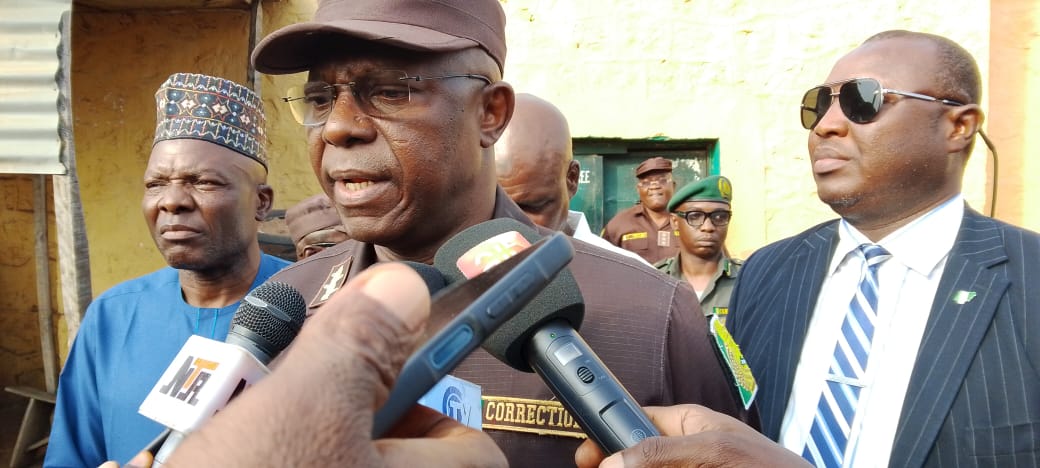
The Controller-General of the Nigerian Correctional Service (NCoS), Sylvester Nwakuche, who visited the facility on Wednesday confirmed that three inmates died from the injuries they sustained while trying to escape from the Ilorin Correctional Centre .
Nwakuche told journalists after inspecting the Ilorin Correctional Centre that:” Yes, three inmates out of the seven inmates that tried to escape from the Ilorin Correctional Centre last Wednesday have died. They died from the injuries they sustained while trying to escape.
He said the other two inmates that sustained injuries while trying to escape from the facility were receiving treatment at government hospitals.
He added: “I left Abuja to come in here to assess the situation and you recall that I addressed you and I left to Abuja. I’m here back again under the directive of the Hon. Minister of Interior, Dr. Lubomitun Jojo because we had a disturbing incident and news . So he asked me to immediately come over to find out what happened to assess the situation and report back to him and that is why I’m here. What I’ve discovered was that seven condemned inmates tried to breach security of this custodial facility and they couldn’t make their way out. Seven of them, two succeeded in making their way out of the facility. The remaining five could not based on the intervention of our personnel . So they were taken back, but unfortunately we were informed that three out of the five that could not access the scene lost their lives and that’s an unfortunate incident and the minister wanted us to come immediately to assess the situation.
“So a team has been set up to investigate the matter thoroughly and report back and if we find out that anybody was involved in that, naturally the law will take its course and we need to subject also this matter to both clinical and medical and intelligent processes. That is the situation.
“We have over 70 waiting trial, I mean sorry, condemned inmates, inmates on death row and some of them unfortunately have stayed over 10 years as inmates on death row. That is a terrible situation. You can see that this facility that is built during the colonial era is locking almost 685 inmates. The place is congested, terribly congested.
We are also making plans. We’ve been talking actually about this inmates on death row. Throughout the federation we have over 4,000 plus inmates on death row and we’ve been appealing to the necessary authorities, the governors, to do what the law permits them to do but eventually they can’t.
“Can they commute them into life sentences so that we’ll be able to distribute them to less congested facilities where we can also subject them to treatment regime to learn a trade, to be useful to the society upon discharge.
“So I want to believe that also the necessary authorities, the governors will listen and come to our rescue because it’s not the easiest of things to take care of a congested facility. It puts stress on the personnel, it puts stress on the infrastructure, it puts stress in classification, it’s putting stress also in the separation and training.”
On the two inmates that escaped, the Controller General said: “Naturally, we are following them. We are working with other sister security agencies on their trail and we can assure the intruders that they have no hiding place. It might take time but we’ll get them. There are two inmates who tried to escape but couldn’t make it. They are also being taken care of very well within the government hospital which we cannot disclose now for security reasons but they are being well medically taken care of.”

By: A G Abubakar.
In broad terms, a political campaign is a series of organised activities undertaken to achieve a specific goal, primarily by influencing public opinion to support a candidate, ticket, or measure. In politics, it is an organised and deliberate effort by an individual, political party, group or coalition to persuade voters and secure public support for a candidate, political party, policy or political objective, particularly during an election.
Political campaigning in Nigeria has its roots in the nationalist movement and the struggle for self-government during the colonial period. However, its evolution into a recognisable electoral and party-based activity began in the 1920s and became more pronounced in the 1940s and 1950s, as political consciousness, organised political parties and demands for independence gained momentum.
Unlike in older nations with longer democratic histories, where campaigns largely centred on competition for public office, political campaigning in Nigeria initially developed around two interconnected objectives: the struggle for political independence and the mobilisation of Nigerians behind competing visions of political leadership and constitutional development. The process gained momentum after independence, particularly with the adoption of the presidential system in the Second Republic.
The major political parties after the short-lived First Republic were the NPN, UPN, NPP, GNPP and PRP. These parties were formed with little colonial influence. The PRP, a radical left-wing party, held sway in the political heartland of the North, particularly Kaduna State. The NPN, with its greater national spread, enjoyed aggregate dominance in the region generally.
The PRP had a photograph of a door key as its symbol, while the NPN adopted a house. The PRP wanted to unlock the masses (talakawa) from oppression and poverty, particularly oppression by feudal lords, as it asserted. The NPN, on the other hand, promised to provide Nigerians with houses and their accompanying entanglements.
Now, to the campaigns. The PRP observed that the NPN’s house had no windows, which signified either a prison or a warehouse. It argued that the NPN wanted to consign Nigerians to a warehouse or prison of poverty. The electorate, therefore, should reject the party. In response, the NPN argued that owning a key without having a house meant that the holder was a thief. It asked Nigerians to beware of the party. Besides, if the party’s leadership could not improve their own circumstances, how could they improve those of an entire nation? This was a reference to Aminu Kano’s chosen modest lifestyle.
Within the PRP itself, the “yabis” never ceased. When a faction led by Rimi left the party, its members were referred to as those swept away by a slippery surface (santsi). In turn, Rimi referred to his estranged political colleagues as ‘yan taɓo (mud), suggesting that they were responsible for creating the slippery surface. It might also have implied persons with soiled hands or thoughts. When the party formed governments in Kano and Kaduna, those who had hoped to secure appointments but were overlooked, despite their critical contributions to nurturing the PRP to electoral success, lamented their fate through parables and metaphors.
One famous expression, which I believe was coined by Malam Musa Musawa, was to the effect that they had pushed the car they were supposed to travel in, only for it to speed off, leaving them behind in a cloud of dust. In Hausa: “Mun tura mota an bar mu da ƙura.”
In Biu, Borno State, the leader of the PRP, Mal.P.Bassi, told supporters after losing to the GNPP that they should not despair. He told them that the PRP was like local potash: if you refused to include it among the ingredients for soup, people would one day need it to treat stomach pains (ma mda gəla kəlbu akwa səkwar, mda dzə bara nə ka kəra kudzuku). It was a way of motivating his followers to keep hope alive.
Down South, Mbadiwe referred to the executive members of the NPN, to which he belonged, as “Men of Timber and Calibre.” He also called the party a political “juggernaut” and a moving “train.” When K. O. Mbadiwe, fondly called K. O., lost his electoral contest in his home state of Imo, newspaper headlines screamed poetically: “K.O. Is Not O.K.!” Later, when his party tried to forge an alliance with the dominant NPP in the region, K. O. told Nigerians that they were working on an “accord concordial.”
Across the Niger to the West, overtures to the UPN to work with the NPN were rebuffed by its leader, Awo. The party said it did not want to be part of a “leprous finger.” He also referred to the NPN’s victory as a sign of an “ominous cloud over Nigeria.” These were fun and colourful expressions that made political campaigns and interactions interesting, despite the usual pockets of crisis that sometimes spilled over into serious violence.
The fun extended to the electoral courts, too. Lawyers who lost cases claimed that “it was a setback that would facilitate their comeback even stronger.” Another counsel said their client “was down but not out.” In challenging FEDECO’s declaration of the NPN’s Shagari as the duly elected president, following the declaration that he had won in 12 and 2/3 of the then 19 states of the federation, the UPN’s counsel contested the interpretation.
A non-legal mind, but a world-renowned Professor of Engineering and Applied Mathematics, Ayodele Awojobi, was invited by Awo to challenge Shagari’s victory, which was based on the controversial interpretation of 12⅔ of the then 19 states of the federation. Awojobi set out to prove that the decision was mathematically wrong.
To paraphrase him, he argued that “states are a legal whole, just as the human being is a single biological organic entity. If you can not have two-thirds of a human being and still consider it complete, then you can not have two-thirds of a state and consider it a whole.” As a result, he maintained that the decision to interpret 12⅔ states as constituting the required two-thirds was wrong. The Court was not convinced, and the UPN lost the case.
In the realm of alliance-building, the NPP, under Zik, kept talking to both the NPN and the UPN. When challenged over his apparent inconsistency, he declared that he was “the beautiful bride of Nigerian politics.” Newspapers, in their graphic cartoons, loved depicting him as such. When the pact with the NPN eventually collapsed, he told Nigerians that “they agreed to disagree.” The GNPP leader, Waziri Ibrahim, was an articulate man of few words who preached political moderation and understanding. He eventually became the apostle of “politics without bitterness.”
Again, part of the GNPP logo featured a palm tree. A witty journalist wanted to know whether it was an oil palm or a date palm (dabino), given that the former is generally cultivated in the South (also part of the Central Region), while the latter is predominantly found in the North. Sensing the trap, Waziri responded by asking, “Did I hear you say oil palm and date palm?” The journalist answered in the affirmative. “Which word is common to both?” Waziri asked. “Palm,” the journalist replied. “Do they both bear fruits? And what do they look like?” he continued.
The journalist explained that both bore nuts of similar sizes. Waziri then told him to consider his own palm a hybrid: he could regard it as an oil palm if he was in the South or a date palm (dabino) if he resided in the North. Both the interviewer and the interviewee laughed it off.
During the impeachment trial of Governor Balarabe Musa of Kaduna State, the judge asked his lead counsel why his client was not in court. The witty but technically sound legal response was: “The summons was issued to Balarabe Musa, whereas his client is Abdulƙadir Balarabe Musa, the Governor of Kaduna State.”
When Ojukwu returned to Nigeria after years in exile and joined the NPN, a party perceived as Northern-dominated—the very region that had fought and crushed his Biafran dream—he was asked why. The Ikemba philosophically replied: “If the Creator had wanted us to keep looking at the past, He would have placed our two eyes at the back of our heads.” Terse, profound and final.
Prior to all these, during the 1978 Constituent Assembly debate on the provision for Sharia in the Nigerian Constitution, Aminu Kano joined other Muslim faithful in the now-famous “Sharia walkout.” A journalist accosted him, asking whether his action was not contrary to his nationalist credentials. Aminu Kano retorted:
“Nigeria ɗaya ce, amma kowa ya san gidan ubansa.”
Meaning, “Nigeria is one, but everyone knows where he comes from.” Simple.
In general, aside from colourful language, campaign seasons in Nigeria provided fun and economic opportunities. As campaign trains moved from one location to another, party faithful danced along the streets and on floats, often decorated with banners and posters. Flags waved, flyers were tossed into the air, and juveniles watched in excitement. At the podium, party programmes and manifestos were reeled out with pomp and pageantry. And, above all, convictions. As the fun continued, petty food vendors, cold-drink sellers, party souvenir hawkers and others did brisk business. Transporters, hoteliers and tailors also enjoyed huge patronage.
Party members were, in general, ideologically grounded. UPN and PRP supporters were proud to be identified as progressives or socialists, while NPN members felt dignified by the capitalist or conservative label. The GNPP and NPP, on the other hand, were comfortable being seen as operating “a little to the left and a little to the right,” as Zik famously put it. There was a discernible level of political consciousness, even when society was supposedly less “educated.” This was an era when it was humorously alleged that Governor Bakin Zuwo had listed Coke, Fanta and Maltina as some of the minerals found in Kano. Or Adegoke Adedibu’s reference/reading of the words “peculiar mess” as “penkelemesi.”
Beneath the somewhat colourful, fun-filled, and sometimes acrimonious dispositions, the governors, in general, worked and delivered. Very few governors nowadays could match the performances of Rimi (PRP) in Kano, Goni (GNPP) in Borno, Tatari Ali (NPN) in Bauchi, Jakande (UPN) in Lagos, Nwobodo (NPP) in Anambra, among others. Apart from infrastructure development, they developed human capital and maintained peace and stability to an appreciable degree. Many states are alleged to be largely following the development blueprints of those early leaders.
The story has now changed. Campaign outings have lost their lustre. They have become mere rituals performed to fulfil electoral requirements. They are conducted without excitement, inspiring speeches, or enthusiasm, often under the shadow of insecurity. All those involved are usually eager to get them over with.
Campaign venues usually assume the ambience of military zones. Police officers, civil defence personnel, vigilantes, party thugs and rented crowds tend to outnumber the party faithful present. This sad development and the lack of enthusiasm at electoral campaign venues are symptomatic of what happens even before the occasions themselves.
The build-up to campaigns has been characterised by ethno-religious bigotry, lies, corruption, and the absence of meaningful improvements in people’s living conditions. In short, economic deprivation, insecurity of life and property, and the poor performance of elected officials have undermined what used to be exciting milestones in electoral journeys: campaigns for votes.
You hear statements such as:
“Even if he brings a bad candidate, we will vote for him.”
“Our candidate can do no wrong.”
“Whether he performs or not, we stand by him.”
“We will vote for him even if he does not campaign.”
“He is our choice, and that is final.”
“We don’t need a manifesto; we know our leader.”
“Anybody who criticises our leader is our enemy.”
“Our leader is the only hope of the country.”
“Whether by trouble or by violence, deliver your ballot box.”
“Cut off or break the fingers of those who oppose us and the party.”
“Either support the party or leave the area.”
“The monkey and baboon will be soaked in blood.”
“If you don’t agree, let’s meet in court.”
“Kill them.”
Even the humour sounds dry these days. Consider these expressions:
“Our turn to chop!”
“The opposition is in disarray!”
“We are not desperate for power; we are only desperate to serve!”
“The mandate is non-negotiable!”
“We have the structure!”
“The masses are with us!”
“The election is already won!”
“We are going to shock them!”
“The votes are already secured!”
The discussions have become pedestrian and primordial, often ending with such expressions as: “Your people did the same thing, so why not us now?” It is never about bringing positive change. There is no longer a serious desire to perform better or take the nation to a higher level.
Rather than focusing on critical issues such as putting food on the table, childcare programmes, accessible and affordable healthcare and medical services, subsidising production, and securing the nation, campaigns have become marketplaces for the worship of candidates and political leaders.
Nowadays, one hears expressions such as:
“No vacancy!”
“It’s a do-or-die affair.”
“Emilokan!”
“I have no shoes.”
“Sai Baba!”
“Atikulated!”
“Obidient!”
“Jagaba!”
“O to ge!”
“Gida-Gida!”
“Four plus four!”
“On your mandate!”
“Ba mu yi (Bamayi)!”
These expressions are actually detached from the serious issues affecting the people and the need to galvanise them to be part of the solutions. Nigerian slogans cannot compare favourably with motivational ones such as “Leave No Citizen Behind” (China), “India on the Rise” (India), “Make America Great Again” (USA), and “Yes, We Can!” (USA), among others. It is understandable if the young and exuberant sing those hollow songs, but certainly not individuals in their 60s, 70s and 80s. Ordinarily, the responsibility of nation-building should not allow them to be so unserious. Well, Nigerian politicians are no ordinary species. Things, however, have got to change.
The change should start with the political class because its members are relatively few and easier to rein in. A perceived change at the top would devolve downwards more effectively than the reverse. Waiting for the larger population to change on its own first is, therefore, not the way to go. When people rise under pressure, the result can be a mass uprising with unpredictable outcomes, as happened in Sudan, Libya, Somalia, and elsewhere. That is why the unacceptable spates of stone-throwing and aspersions must be stopped while not ignoring the root causes.
Nigeria can avoid such a cataclysm by tackling corruption, religious extremism, iniquities, injustice, and other factors that threaten security. Nigerians are missing the fun, glamour, and inspiring messages aimed at addressing the challenges. Pragmatic messages that arouse the citizens’ sense of patriotism and also elicit their support for building good governance, based on equity. Political campaigns should be about a vision for a better society under a new or renewed social contract.
A. G. Abubakar
agbarewa@gmai.com


2027: Kwara South APC Campaign Flagged Off

Kwara Jailbreak: Three Inmates Die

Political Campaigns: A Nolstagic View.

-
 Uncategorized6 years ago
FG, states urged to harness flooding for ranching, others with technology – Agbaje
-
 Headlines11 years ago
Breaking: EFCC seals Borno House of Assembly, as Hon members take to their heels
-
 News12 years ago
Nigeria Security Operatives Stage Manhunt For Homosexual Perpetrator
-
 News10 years ago
How 21-year-old Girl fled community over accusation of lesbianism
-
 News11 years ago
Yobe Gov Moves Against Deputy
-
 Opinion8 years ago
7 signs she has friend zoned you
-
Technology5 years ago
Online job placement company headhunts women
-
 Headlines11 years ago
Borno Dep Gov Abducts Another Church Leader