
Foreign
China’s Demographic Crossroads: Can High-Quality Development Offset an Ageing Population?

By Liu Nian, People’s Daily
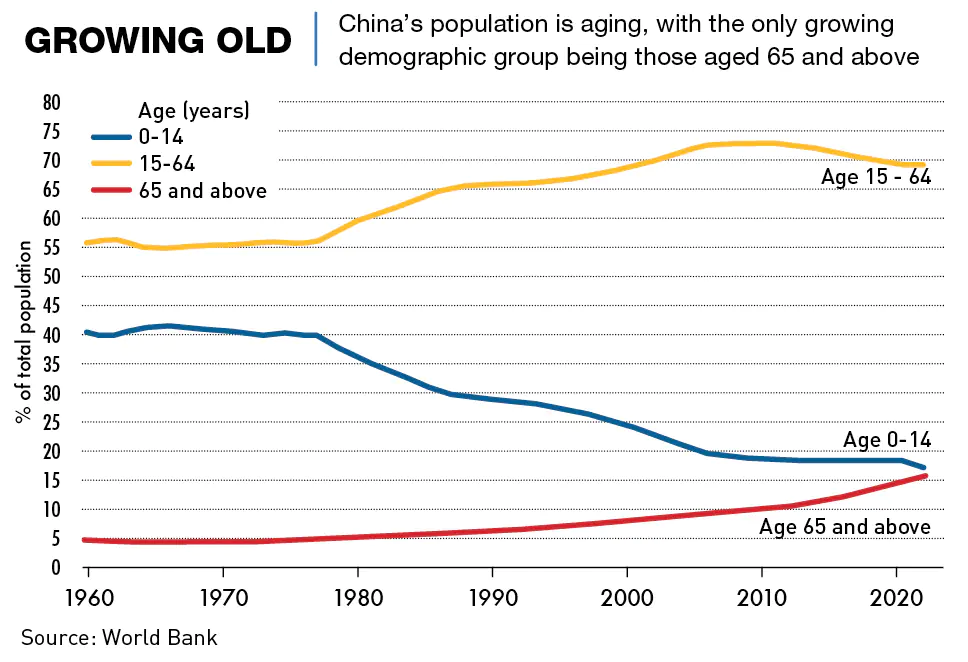
China stands at a pivotal juncture as its demographic landscape shifts: birth rates continue to fall while the proportion of citizens aged 60 or older has surpassed 20% of the total population, according to its National Bureau of Statistics. This “silver wave” coincides with the nation’s push toward common prosperity, yet it raises a pressing paradox—how to reconcile rapid ageing with the challenge of achieving widespread affluence.
Does this demographic transition signal the erosion of China’s famed population dividend? Or can evolving definitions of productivity and innovation redefine its economic trajectory?
The answer lies in untangling the interplay between demographic trends, policy frameworks, and economic resilience. While China’s meteoric rise since the 1980s was undeniably fueled by its vast labor pool, analysts argue that institutional strengths—from socialist governance with Chinese characteristicsto decades of reform and opening-up—unleashed an economic miracle no less critical than sheer workforce size.
Quantity alone no longer dictates prosperity. Even as the working-age population contracts, policymakers emphasize that technology investment, upskilling initiatives, and capital inflows can mitigate labour shortages. A case in point is China’s burgeoning talent reservoir: over 240 million citizens now hold higher education qualifications, fostering a skilled workforce driving sectors from AI to green energy.
This pivot from “population dividend” to “talent dividend” underscores a strategic bet—that quality, not just numbers, will sustain China’s modernization. As automation and innovation hubs like the Greater Bay Area expand, the narrative shifts from demographic anxiety to human capital’s transformative potential. The ultimate test? Whether high-quality development can turn an ageing society into an engine of sustainable progress.
The correlation between population structures and economic dividends defies reductionist arithmetic. It demands the analytical rigour of multivariate calculus, where shifting age coefficients interact with technological vectors and institutional constants. This complexity necessitates a systems-level perspective to truly decipher the demographic dividend equation.
Contemporary economic modelling reveals a paradigm shift: the dividend manifests not merely through crude growth metrics, but through strategic activation of latent human capital. While youth demographics remain crucial, a silent revolution is emerging from an unexpected quadrant – silver-haired populations redefining post-retirement economic agency.
Historical anxieties about elderly technological alienation now confront empirical contradictions. The digital metamorphosis of China’s elderly cohort has become a socioeconomic epiphany. Where pundits once predicted generational obsolescence, silver-haired netizens now dominate Douyin livestreams, orchestrate Taobao storefronts, and curate Xiaohongshu tutorials with the acuity of digital natives.
China’s silver wave of 170 million senior netizens is reinvigorating the digital ecosystem, proving the nation’s demographic dividend maintains potent socioeconomic currency.
This cohort’s renaissance extends far beyond screens. From mist-shrouded Huangshan peaks where septuagenarians clad in Arc’teryx gear deploy DSLR rigs, to Beijing’s frost-kissed ski slopes where grandmothers carve parallel turns, their vitality mirrors youth culture’s intensity. The lifelong learning revolution sees retired accountants mastering Python through digital lecture while former teachers monetize calligraphy tutorials – wisdom economies thriving.
Official metrics quantify the movement: China’s post-retirement cohort channels over700 billion yuan ($96.31 billion) yearly into cultural pursuits and wanderlust, with 35 million silver-haired scholars crowding digital academies and marathon finish lines witnessing a surge of septuagenarian sprinters – concrete manifestations of a nation where sunset years glow brightest.
China’s sunset years fuel economic engines rather than brake them, as evidenced by the phenomenon achieving statecraft recognition. The codified “silver economy” now anchors national policy blueprints, while its lexical zeitgeist cousin “silver power” penetrated mainstream discourse through annual buzzword rankings. Concurrently, medical chaperone services and biographical scribing emerge as legitimate professions among youth entrepreneurs – tangible proof that demographic shifts birth new economic ecosystems.
China has unveiled a national geriatric framework blueprint, mandating creation of multi-tiered, equitable geriatric care apparatus spanning megacities to agrarian counties. The policy white paper prioritizes market-driven eldercare industrialization to address China’s “grey wave” – the coalescing demands of pensioners seeking tailored retirement ecosystems.
By tapping into the potential of an aging society, China aims to generate new economic dividends. The country’s top-level policy design is providing clear direction for future development.
A broader perspective reveals that addressing both the declining birth rate and population aging requires a balanced approach. Further deepening reforms and expanding opening up will provide fresh momentum for Chinese modernization, even amid demographic shifts.
In today’s China, whether young or old, the common goal is to move forward with confidence and live a better life.


By Li Gang, People’s Daily
As artificial intelligence (AI) accelerates the transformation of global industries, a new form of digital trade is emerging in the southern Chinese city of Shantou: exporting computing services measured not in physical goods, but in AI tokens.
In late April, Shantou, Guangdong province completed full-chain verification for what has become known as “token exports” — a model in which computing power remains within China while high-value AI services are delivered to overseas users. Within just one month, average daily token usage surged from 100 million to the tens-of-billions level.
The practical application of this model is already well underway.
Recently, when a user in Singapore activated an AI-powered toy and gave a simple command — “Tell me a fairy tale” — the spoken command traveled through the network directly to a dedicated overseas computing zone inside a computing center in Shantou.
Local deployed AI agents wrap up speech recognition in under one second and craft custom story content, firing the finished audio back to the Singapore-based toy device in as little as 0.1 seconds.
The user repeated the process multiple times, eventually listening to five stories in total. Approximately 100,000 tokens were consumed during the interaction and billed in real time at a rate of 2 yuan ($0.3) per one million tokens.
When payment arrived, a complete commercial cycle was achieved, marking the successful realization of Shantou’s “token export” model.
Tokens represent the smallest discrete calculation unit for large AI models to process information. They have become a key indicator of intelligent computing capacity and, increasingly, a new carrier of value in the digital economy.
Inside the China (Shantou) Pilot Zone for Economic and Cultural Cooperation with Overseas Chinese, token exports are already transforming the economics of electricity.
Today, overseas users across multiple countries and regions in Southeast Asia are accessing token services generated in Shantou.
“Data flows in from abroad and all processed outputs head back overseas, with zero compromise to end-user experience,” explained Cai Qichen, an engineer at the Shantou Branch of wireless carrier China Mobile. “Token costs have already been integrated into product service packages, making future usage more convenient.”
According to estimates from toy manufacturer SHOWMAC based in Shenzhen, Guangdong province, using Shantou’s computing services reduces costs by more than 30 percent compared with directly purchasing overseas computing resources.
Meanwhile, inside computing centers, turning electricity into AI tokens delivers dramatic value appreciation. A kilowatt-hour of electricity, which comes at a cost of roughly 0.5 yuan($0.07) , can be transformed through AI computing into tokens and then exported at a price of 11 yuan($1.6), representing a twenty-two-fold increase.
As one of eastern Guangdong’s major offshore wind power bases, Shantou has already connected 1.2 million kilowatts of installed capacity to China’s power grid.
The electricity itself does not need to cross borders. Computing power remains within China. What gets exported instead are high-value digital services, turning electricity into a form of hard currency for cross-border digital trade.
Ultra-low network latency forms the technical backbone making token exports feasible.
“More than half of China’s outbound bandwidth carried by international submarine cables lands in Shantou, and the city is also home to five undersea trunk cables linking destinations worldwide,” said Hong Zhebin, chief technology officer of the international submarine cable landing station operated by the Shantou branch of wireless carrier China Telecom.
“The latency between Shantou and Singapore is only 32.7 milliseconds, quicker than the blink of an eye,” Hong added.
Hong Yu with the Shantou Branch of China Mobile, added that Shantou’s overseas computing services offer stable response speeds, regulatory compliance, and substantial cost advantages.
“Our pricing is only 1/3 to 1/2 that of mainstream international platforms, while customer retention exceeds 70 percent,” Hong told People’s Daily.
Yet building a complete end-to-end system is only the starting point. Shantou is now attempting to transform itself from a transit city for digital infrastructure into an ecosystem hub.
Leading computing companies and developers are gathering rapidly. Pilot platforms have passed acceptance reviews. Commercial closed loops have already emerged in applications ranging from AI toys to intelligent manufacturing, with large-scale operations expected soon.
Shantou’s Chenghai district has long been known as the “toy capital of China.” As AI becomes increasingly integrated with the toy industry, the city has launched an AI toy innovation center and the Shantou AI Laboratory, striving to become the “AI toy capital of China.”
At the exhibition space of one local tech firm sits Amy, an AI desktop robot capable of fluid multilingual conversation.
“It is equipped with a multilingual intelligent voice interaction system capable of real-time recognition and conversation in dozens of languages,” said the company’s general manager Chen Ruifeng.
The technology has already been integrated into multiple AI toy products exported to countries including the United Kingdom, Russia, and Japan.
Shantou’s token export model allows AI toy manufacturers to access domestic large language models at costs far below those of overseas alternatives.
“The cost of using overseas AI models can be dozens of times higher than domestic models,” Chen said. The company’s AI toys currently run on Chinese large models including DeepSeek and Doubao.
“Token exports have significantly increased both product value-added and international competitiveness,” he said.
The Shantou branch of wireless carrier China Unicom, together with a Guangdong-based tech firm, has established dedicated lines connecting Shantou and Vietnam, delivering cross-border computing services to Aachen Sv, a Chinese-invested fiber-optic company operating in Vietnam.
Vietnamese users accessing large models such as DeepSeek and Qwen experience extremely low latency with zero packet loss. “In less than a month, more than a dozen companies have approached us for consultations,” an employee of the Guangdong-based tech firm said.
Meanwhile, the Guangdong branch of China Mobile has launched an OpenClaw intelligent agent framework, providing integrated AI service packages that allow traditional toys to complete intelligent upgrades in as little as 15 days.
From toys to textiles, cross-border e-commerce, and high-end manufacturing, tokens are increasingly becoming the digital fuel powering Shantou’s industrial upgrading.

By Song Haoxin, People’s Daily
What if museum visitors could truly interact with cultural relics rather than merely observe them through glass displays? At the Sanxingdui Museum in southwest China’s Sichuan province, a specially designed interactive hall is revolutionizing cultural engagement.
Within this 1,300-square-meter space, nearly every exhibit invites touch, operation, or participation. Visitors immerse themselves in installations inspired by the ancient Shu civilization, blending education with entertainment.
By trying on replicas of headwear on bronze statues discovered in Sanxingdui Ruins, for example, visitors can not only take photos of themselves but also learn about the symbolic meanings behind different headpieces.
Guests can don replicas of bronze statue headwear from the Sanxingdui Ruins, learning their symbolic meanings while capturing photos. Augmented reality allows dancing alongside virtual Sanxingdui figures for social media sharing. A creation zone even enables “time travel” to experience ancient bronze-casting and construction techniques.
These innovations transform traditional museum visits, offering deeper cultural understanding through hands-on interaction. “This hall emerged from extensive brainstorming,” explained Zhu Yarong, deputy director of the management committee of the Sanxingdui Ruins site.
“We’re transitioning from passive relic viewing to interactive engagement, bridging the gap between audiences and history.”
Previously, museum experiences were largely one-directional with limited engagement. Visitors viewed relics through display cases, usually stopping mainly to take photographs, with relatively limited forms of engagement. By liberating artifacts from display cases into interactive settings, Sanxingdui is pioneering a shift from didactic presentation to open cultural dialogue.
Traditional exhibition spaces remain popular, while digital innovations attract growing interest. A VR project employs digital twin technology to recreate 1:1 scale excavation sites — complete with protective shelters and cabins — placing visitors at the archaeological forefront.
Another project, Heaven and Earth Echoes — Sanxingdui Panoramic Sound and Vision Digital Art Theater, features an interactive panoramic LED dome with a diameter of 20 meters and a resolution approaching 16K. The massive dome creates a deeply immersive atmosphere. By waving digital torches in their hands, visitors can trigger sacred birds to circle above them across the dome, experiencing the ancient Shu civilization through an interplay of sound and imagery.
“The digital technology made me feel as if I were racing across the Mamu River. That sense of traveling through time was incredible,” said Hao Yong, a tourist from southwest China’s Chongqing municipality who came specifically to experience a virtual reality program.
From passive observation to active participation, Sanxingdui Museum continues introducing new interactive experiences that transform cultural relics into living carriers of dialogue and engagement, helping keep the sparks of Chinese civilization alive for new generations.

My people of Benue State,
I am not speaking to you today as a politician. I am speaking as a brother whose family was held up by Chief Mike Kaase Aondoakaa, MKA, when we had no one else to hold onto.
My elder brother, Verem Ukaa-Ikuan, was not just my blood. He was a very dear and close friend to Chief MKA. When my brother fell ill and was diagnosed with liver damage caused by poisoning, MKA didn’t treat it as someone else’s problem. He took it on as his own.
He worked closely with Verem during his time as Attorney General of the Federation, and when the sickness came, he moved immediately. Searches were conducted, and Apollo Hospital in India was earmarked for a liver transplant. Every travel arrangement was made personally by Chief MKA.
But we hit a wall. Verem was too weak to fly a long commercial flight. Only an air ambulance could get him to India alive. At that time, there was only one functional air ambulance in the entire country, owned by Julius Berger. It was completely out of reach for even the most high-profile citizens.
Chief MKA went all out. He did not give excuses. He did not delay. He used every connection and every ounce of influence he had to secure that air ambulance for my brother.
On the day it was secured, Barr. Terna Yaji, his Senior Special Assistant, called me a few minutes after 6pm. He told us to prepare Verem for departure and take him to Makurdi airport very early the following morning. I informed him, my brother passed on at exactly 6 o’clock a few minutes ago. I told Barr. Terna Yaji, and I saw a devastated MKA.
During the burial, Chief MKA was out of the country on national assignment. He was pained that he could not be there physically. His entire team, led by the late Onov Tyuulugh, represented him fully. And his message to us at the burial has never left me:
“If death were law, as the Attorney General, a law would have been made no matter what to ensure Verem will just not die but live forever.”
That is who Mike Kaase Aondoakaa is when nobody is watching. He does not abandon his people. He does not forget. He stood with our family then, and he has stood with us till date.
Now he is asking for the chance to govern Benue State.
Benue needs a governor with a heart like that. A governor who fights for you even when there’s no political gain. A governor who sees you as family, not as a vote.
I am standing with Chief Mike Kaase Aondoakaa for Governor of Benue State.
For compassion that moves to action.
For loyalty that does not fade.
For leadership that proves itself in the darkest hour.
Join me. Let us give Benue a leader who has already shown what he will do for us.
God bless Chief Mike Kaase Aondoakaa.
God bless Benue State.
Brahms Tor-Ikuan, a beneficiary of MKA’s benevolence writes from Makurdi


Yakubu Hails China’s Zero-Tariff Initiative as Catalyst for Economic Transformation
THE BOLD SHIFT:BETWEEN REFORMS ANDTHE REALITY OF THE BROKEN EGGS:
WHO: Nigeria Records Zero Ebola Cases After Evacuation of Swiss Couple

-
 Uncategorized6 years ago
FG, states urged to harness flooding for ranching, others with technology – Agbaje
-
 Headlines11 years ago
Breaking: EFCC seals Borno House of Assembly, as Hon members take to their heels
-
 News12 years ago
Nigeria Security Operatives Stage Manhunt For Homosexual Perpetrator
-
 News10 years ago
How 21-year-old Girl fled community over accusation of lesbianism
-
 News11 years ago
Yobe Gov Moves Against Deputy
-
 Opinion7 years ago
7 signs she has friend zoned you
-
Technology5 years ago
Online job placement company headhunts women
-
 Headlines10 years ago
Borno Dep Gov Abducts Another Church Leader