
Uncategorized
Kidnapping: Senate Insists on Death Penalty for Perpetrators, Financiers, Informants

By Hassan Taiye
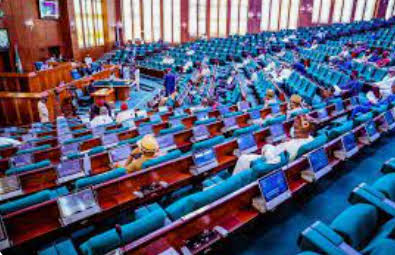
In its efforts to decisively address the spate of insecurity nationwide, the Senate Wednesday extensively debated the proposed amendment to the 2022 Terrorism (Prevention and Prohibition) Act, insisting on prescribing death penalty for kidnappers and anyone who knowingly assists, facilitates, or supports kidnapping operations.
The upper chamber also unanimously agreed to the proposals that would authorise law enforcement agencies to dismantle kidnapping networks by enabling stronger enforcement as well as placing kidnapping under the terrorism framework anywhere in the federation.
Led by Leader of the Senate, Senator Opeyemi Bamidele, the debate took place at the plenary on Wednesday with contributions from Chairman, Senate Committee on Interiors, Senator Adam Oshomhole; Chairman, Senate Committee on South-East Development Commission, Senator Orji Uzor Kalu and Minority Leader of the Senate, Senator Abba Moro, among others.
After exhaustive debates across the political divides at its Chamber, the senate, presided over by the President of the Senate, Senator Godswill Akpabio, unanimously approved amendments to the he Terrorism (Prevention and Prohibition) Act as proposed by the senate leader.
Consequently, Akpabio referred the bill to the Committee on Judiciary, Human Rights and Legal Matters, Committee on National Security and Intelligence as well as the Committee on Interior for further consultation and fine tuning at the public hearing.
While he noted that the Committee on Judiciary, Human Rights and Legal Matters would be the lead committee, Akpabio mandated the committees to report back to the Senate in two weeks.
Leading debate on the bill Wednesday, Bamidele explained the essence of the amendment was to designate kidnapping, hostage-taking and related offences as acts of terrorism and prescribe the death penalty for such offences without option of fine or alternative sentence; and for related matters.
He justified the gravity of the prescribed penalty for kidnapping, hostage-taking and other related offences, noting that such offences “have become one of the most pervasive and destructive crimes in our nation today. What were once isolated incidents have escalated into coordinated, commercialised, and militarised acts of violence perpetrated by organised criminal groups .
Across every region of our country, the senate leader argued that kidnapping “has instilled widespread fear in communities; undermined national economic activities and agricultural output; interrupted children’s education; bankrupted families forced to pay ransom; overstretched our security forces, and claimed countless innocent lives.
He, further, argued that the patterns of organisation, brutality, and destabilisation associated with kidnapping “now carry all the characteristics of terrorism. It is no longer adequate to treat these acts as ordinary criminal offences. The legal framework must reflect the true magnitude of the threat.”
Having the collateral consequence of kidnapping and hostage-taking on family, economy and polity, Bamidele said the bill was designed to designate kidnapping and hostage-taking as acts of terrorism.
He, therefore, noted that classifying kidnapping, hostage-taking and other related offences as acts of terrorism would no doubt empower our security agencies with broader operational authority, intelligence capabilities, and prosecutorial tools available under counter-terrorism law.
Besides designating kidnapping as acts of terrorism, Bamidele said the bill prescribed death penalty “not only for the perpetrators and financiers of such heinous acts, but also for their informants, logistics providers, harbourers, transporters, and anyone who knowingly assists, facilitates, or supports kidnapping operations.
“Attempt, conspiracy, or incitement to kidnap attracts the same penalty. This strong deterrent is necessary to confront kidnapping at the scale it currently operates,” the senate leader pointed out with the resolve to strengthen internal peace and stability.
He also noted that the bill was aimed “at dismantling kidnapping networks by enabling stronger enforcement: By placing kidnapping under the terrorism framework, agencies can pursue asset tracing and forfeiture, intelligence-led operations, inter-agency coordination, swift pre-trial procedures under terrorism laws and disruption of funding and logistics chains.”
While urging his colleagues, Bamidele pointed out that Nigerians “are kidnapped on highways, in schools, in homes, on farms, and in markets. Innocent children, vulnerable women, hardworking men, traditional rulers, travelers, and public servants have all become targets.
“These criminals kill victims even after ransom is paid; subject victims to brutal torture; rape, mutilate, and starve hostages and use ransom proceeds to fund more weapons and more crimes. This is not a mere crime. It is terrorism in its purest form.
“Our moral, constitutional, and legislative duty is to protect Nigerian lives. If an offence repeatedly results in mass murder, mass fear, mass displacement, and systemic destabilization, then the strongest legal sanction becomes necessary
“This Bill does not target communities or innocent persons. It targets violent offenders and the networks that enable them. All prosecutions will still comply with constitutional guarantees, due process, rights to fair trial, and judicial oversight.”
“The menace of kidnapping has reached a level that threatens our national unity, our economic stability, and the safety of every Nigerian family. It is a war on the people, and our response must be firm, decisive, and unambiguous.
Also at the plenary Wednesday, Oshiomole threw his weight behind Bamidele’s amendment to the Terrorism Act, though faulted the deradicalisation programmes, which according to him, had not prevented extremists, hostage takers, kidnappers and terrorists from such heinous crimes.
Oshiomole, thus, said the bill would end mischief in the act of terrorism in which “a terrorist will be arrested and allowed to go without facing consequence of his crimes in the name of deradicalisation
“Some of these guys went back to their crimes. We should not continue with deradicalisation programmes again. We cannot spend so much money on prosecution and the suspects will not face the wrath of law.
“Even the Bible and Quran say those who are killed have no right to be alive.. No more de-radicalization. If you are caught and convicted for acts of terrorism, then the penalty should be death,” Oshiomole said.
Contributing to the debate,Kalu observed that the senate unanimously “agreed with this bill. It is a natural thing for us to approve the bill. As a consequence, informants, sponsors and everybody involved in kidnapping, hostage and other related offence must face the consequence,
“Nigerians have suffered in the hands of kidnappers. Young girls have been raped. Women have become widows for no reason. This must not continue again,” Kalu called attention of his colleagues to untold and grievous pains that Nigerians had suffered.
The minority leader also lent his voice to the bill, pointing out that the bill “is a unanimous decision of the Senate. It is a very straightforward bill, I think we should go ahead and allow this bill to be passed into second reading with the hope that kidnappers will face capital punishment.”
Although he noted that kidnapping had become a business enterprise. More firmly observed that the senate “can never continue to terrorise. Hence, this bill becomes expedient as one of the measures that the senate will come up with to address kidnapping, hostage-taking and other related offenses.
In his presentation, Chairman, Senate Committee on National Population and NIMC. Senator Victor Umeh condemned in strong terms kidnapping and gruesome murder of victims for no just cause.
He added that the trend of such crimes “will no doubt compel men of conscience to rise in support of the bill. They will collect ransome and still kill their victims. We should do everything to amend the Terrorism Act to classify kidnapping, hostage-taking and other related offences as acts of terrorism. We have to go dig into the people who facilitate this criminal enterprise. Financial institutions are also part of it.”
Stephen Olufemi Oni, Ilorin
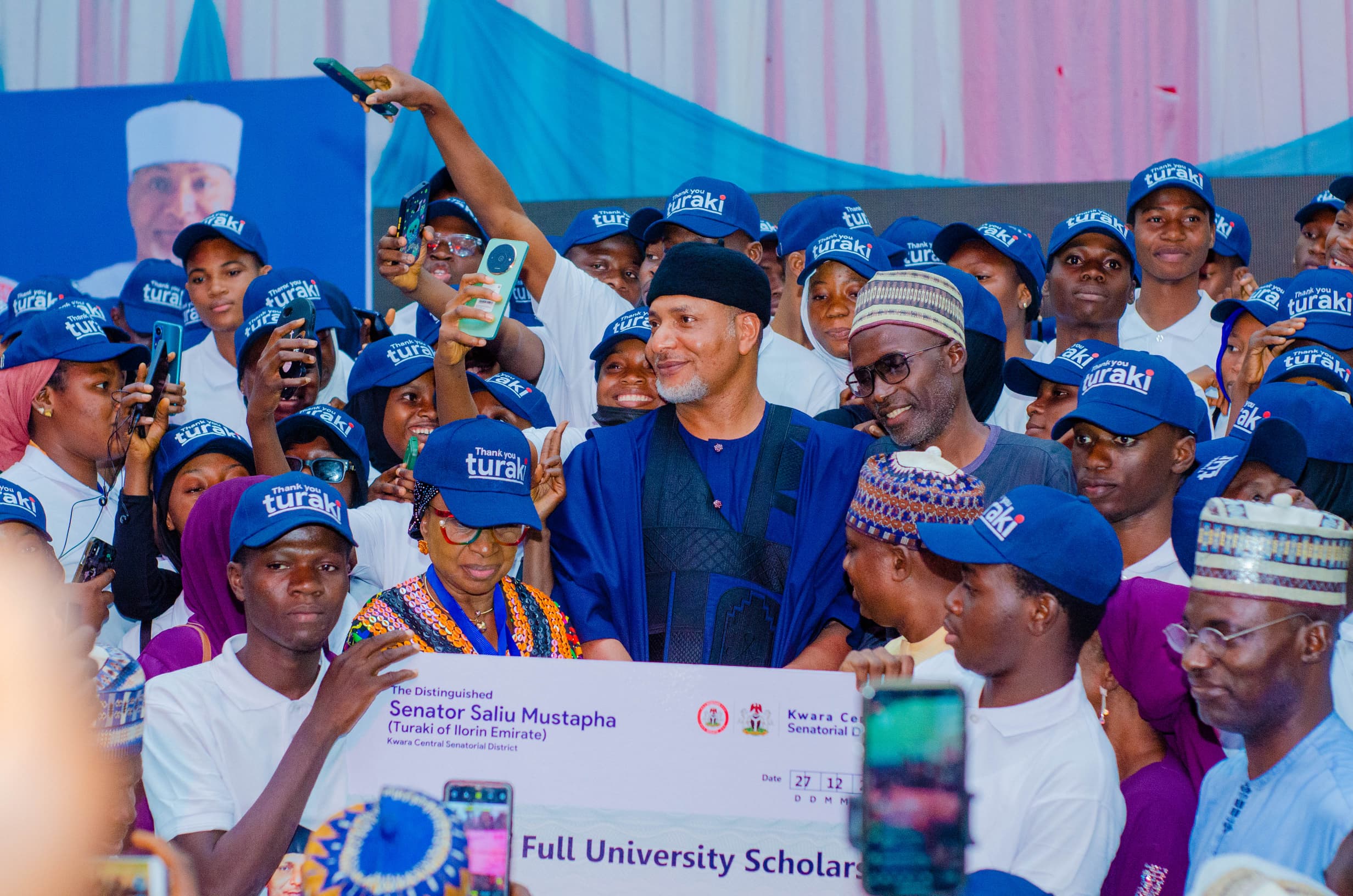
The Senator, representing Kwara Central Senatorial District on the National Assembly, Mallam Saliu Mustapha, has awarded scholarships worth N300 million to 300 indigent but brilliant students of his district.
According to the Senator, the gesture, being an improvement on last year’s event when the Senator facilitated a sum of N200 million worth of scholarships for the students of the District, would reduce the illiteracy level in the area and boost the competences of their youths in Western Education.
Saliu, who spoke at the annual scholarship event in Ilorin, the Kwara State capital, assured his people that, investment in educational development would continue to be sustained as one of his legacies as a law maker, adding that high educational society would never breed banditry and other social . menaces threatening the peace of the nation.
He said: “This initiative by me and to my knowledge is the first of its kind in the state. My aim is to use it to break the financial barrier bedeviling our society and to promote smooth access to quality higher education among brilliant but less privileged children in my District and beyond.
“The annual scholarship programme we launched last year with 200 beneficiaries, has now expanded its reach, under my unrelenting commitment to human capital development and youth empowerment.”
The Chairman of the Scholarship Committee, Prof. Binta Sulyman, announced prompt payment of tuition fees to the beneficiaries in compliance with the rules and regulations of the designated higher institutions.
She emphasised that the scheme is strictly merit-based, stating that every recipient who scored 250 and above in the JAMB UTME, was selected from across the four Local Government Areas (LGAs) of Kwara Central, representing the District. These are; Ilorin-West, Ilorin-East, Ilorin -South and Asa LGAs.
According to her, the scholarship would cover the tuition fees of the recipients from first year to final year, but with a caveat that such tertiary institutions must be based in Kwara state.
“The goal is to create equal opportunities. These students have shown academic excellence, and we are determined to ensure that dearth of finances do not hinder their dreams,” Prof. Sulyman said.
She urged the beneficiaries to remain focused, excel academically, and justify the investment made in their future.
The Secretary of the Committee, Comrade Yakub Ishowo, disclosed that the beneficiaries are already students of institutions such as the University of Ilorin, Kwara State University, Malete, Kwara State University of Education, Ilorin and the University of Offa.
Besides, Ishowo added that a monitoring framework has been established to track their academic performances throughout their studies.
Some of the parents of the beneficiaries at the epoch making event, praised Senator Mustapha for the gesture, describing it as a life-changing intervention that would ease their economic burden on the educational pursuits of their children.
According to Sheikh Usman AbdulRahman Yasin, who spoke on behalf of the parents, many families would not have been able to afford university tuitions due to the prevailing global economic recession.
“We pray for divine guidance and blessings upon Senator Mustapha for remembering the less privileged. This scholarship has brought relief to our homes,” the Islamic scholar said.
Besides, he commended the merit-driven selection process, noting that it rewarded hard work and renewed a brighter hope across the community.
Representing the beneficiaries, Amirah Suleiman and AbdulAzeem Muhammed expressed joy and appreciation to the Senator, promising not to disappoint the Senator or their families while living out the scholarships.
They said the opportunity would go a long way in shaping their future.
End
By: Fabian Apechihin
Constitutional lawyer and public affairs analyst, Barrister Buhari Yusuf, has raised concerns over what he described as increasing international pressure on Nigeria regarding the enforcement of Sharia law in northern states.
Speaking in a December 7, 2025 interview with TrustTV News, Yusuf criticised attempts by the United States to influence Nigeria’s legal and religious systems, insisting that Sharia law remains an internal constitutional matter beyond foreign interference.
He argued that while foreign countries are free to express their opinions, decisions on Sharia must be guided strictly by Nigeria’s constitution and cultural realities.
“We reacted hastily; more than eight states have been designated, but this was kept out of the media. Suddenly, Nigerians began sending messages and now the U.S. is trying to dictate terms to us, which is unreasonable. They can demand whatever they like, but Sharia is non-negotiable,” Yusuf said.
His comments follow renewed calls from the U.S. Congress urging Nigeria to abolish Sharia criminal law in 12 northern states and dismantle the Hisbah religious enforcement agencies.
The U.S. Commission on International Religious Freedom (USCIRF) has also listed Nigeria as a Country of Particular Concern (CPC), citing alleged systematic attacks on Christian communities, widespread killings, and strict blasphemy laws that limit freedom of worship for both Christians and Muslims.
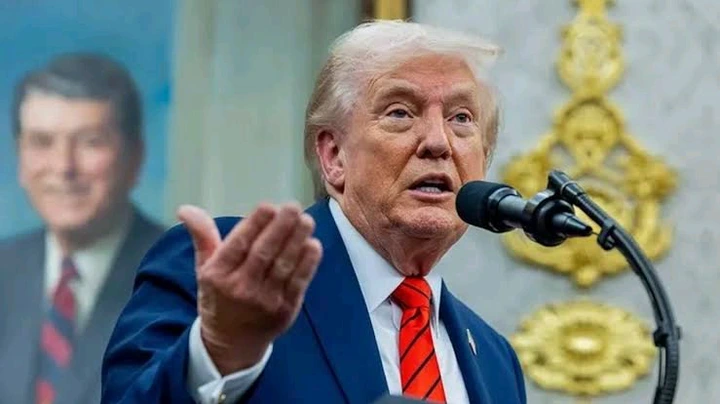
In response to Nigeria’s CPC designation, U.S. President Donald Trump reportedly warned of possible punitive measures, including the suspension of aid and potential military intervention, if the Nigerian government fails to curb the violence.
During a briefing at the U.S. House of Representatives, Dr. Ebenezer Obadare, Senior Fellow at the Council on Foreign Relations, stated that extremist groups such as Boko Haram and ISWAP exploit Sharia structures to enforce ideological conformity, carry out forced conversions, and operate with near impunity. He proposed stronger military cooperation with Nigeria and increased pressure on President Bola Tinubu to repeal Sharia law and disband Hisbah groups.
However, Yusuf maintained that regardless of foreign influence, Nigeria’s sovereignty over its legal and religious affairs must not be compromised.

By: Fabian Apechihin
The Central Bank of Nigeria (CBN) has granted fresh operating licences to 82 Bureaux De Change (BDCs) as part of its ongoing efforts to restructure and sanitise the retail foreign exchange market.
The approvals, which took effect from November 27, were confirmed on Monday in Abuja by the Acting Director of Corporate Communications at the CBN, Mrs. Hakama Sidi-Ali. She said the licences were issued under the powers conferred on the apex bank by the Banks and Other Financial Institutions Act (BOFIA) 2020 and in line with the 2024 Regulatory and Supervisory Guidelines for BDC Operations in Nigeria.
Sidi-Ali emphasised that only BDCs whose names appear on the CBN’s official website are authorised to operate under the new regime.
“Only BDCs listed on the Bank’s website are authorised to operate from the effective date,” she said, adding that the online register would be updated regularly for public verification.
She further warned Nigerians against engaging with black market dealers or unlicensed operators, noting that running a BDC without CBN approval is a criminal offence.
According to her, operating without a valid licence attracts sanctions under Section 57(1) of BOFIA 2020.
Nigeria’s BDC sector has undergone significant reforms in the past year. At its peak, about 5,690 operators were registered nationwide. However, on March 1, 2024, the CBN revoked the licences of 4,173 BDCs for regulatory breaches, leaving about 1,517 in good standing.
The approval of the new 82 operators is viewed as part of the apex bank’s broader strategy to consolidate the sector, strengthen supervision and enforce stricter compliance with the new FX market rules. The CBN advised the public to always confirm the licensing status of any BDC on its website before conducting foreign exchange transactions.


Senator Mustapha Gives Scholarships To 300 Varsity Students

Sharia Law Is Non-Negotiable Despite U.S. Pressure — Buhari Yusuf

CBN Approves 82 New BDC Licences Under Fresh Regulatory Framework

-
 Uncategorized5 years ago
FG, states urged to harness flooding for ranching, others with technology – Agbaje
-
 Headlines10 years ago
Breaking: EFCC seals Borno House of Assembly, as Hon members take to their heels
-
 News11 years ago
Nigeria Security Operatives Stage Manhunt For Homosexual Perpetrator
-
 News9 years ago
How 21-year-old Girl fled community over accusation of lesbianism
-
 News10 years ago
Yobe Gov Moves Against Deputy
-
 Opinion7 years ago
7 signs she has friend zoned you
-
Technology4 years ago
Online job placement company headhunts women
-
 Headlines10 years ago
Borno Dep Gov Abducts Another Church Leader