
News
U.S. double standards in Ukraine crisis testify to sole purpose of global domination

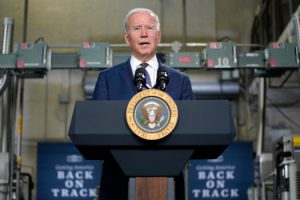
President Joe Biden speaks at Tidewater Community College, Monday, May 3, 2021, in Portsmouth, Va. Biden and the first lady are in coastal Virginia to promote his plans to increase spending on education and children, part of his $1.8 trillion families proposal announced last week. (AP Photo/Evan Vucci)
A month into the Russia-Ukraine conflict, picturing an endgame is challenging, with the White House poised to heap more pressure on the Kremlin while ignoring Moscow’s demands for security.
During the crisis, the United States, guided by its self-interests, has added fuel to the fire by delivering lethal weapons to Ukraine and imposing unprecedented sanctions on Russia.
All U.S. moves run counter to global efforts to de-escalate the conflict and won’t inspire an urgently needed ceasefire. Instead, Washington’s actions aim to shore up its global domination, and other countries are paying the price.
“STRATEGIC MISTAKE”
Before the fighting broke out, the United States had intentionally hyped up tensions between Russia and Ukraine instead of pooling efforts to smooth things over. With the situation worsening, the country is wielding its political heft and flexing its economic muscles to corner Russia, many experts have said.
For the United States, “the relative ease of imposing economic sanctions has made them the foreign-policy option of first resort, despite a growing body of evidence that they often fail to achieve their goals,” Fortune magazine wrote on Feb. 24, when Russia launched the special military operation.
“In some cases, experience has shown that sanctions only entrench undesirable behavior from the parties they target,” it added.
“The tool of sanctions has become a tired tool,” Stephen Biegun, former U.S. deputy secretary of state under ex-president Donald Trump, was quoted in the report as saying.
The use of sanctions, Biegun added, “has not seemed to significantly alter the behavior of any foreign party whose actions are of concern to the United States.”
Michael O’Hanlon, a senior fellow at the Brookings Institution, said in an interview with Xinhua on Wednesday that the continuous expansion of the North Atlantic Treaty Organization (NATO) has reached an “extreme” point and that the Russian reaction of launching its military operation “was predictable.”
“In that sense, we made a strategic mistake,” he said.
To further isolate Moscow, the United States has proposed excluding Russia from the Group of 20, attempting to blur the line between global economic cooperation and political security.
The U.S.-led response to Russia laid bare double standards and was “hysterical,” which even includes sanctions on cats and dogs, Jin Canrong, professor at the School of International Studies of Renmin University of China, told Xinhua on Thursday.
U.S. DOUBLE STANDARDS
The double standards employed by Washington on Ukraine have once again revealed the essence of its foreign policy — which put America’s interests first — despite politically-glorified slogans of defending peace, democracy, human rights and freedom.
While chanting freedom of speech, the United States forced Russia’s English news channel RT America to cease production earlier this month as part of its whole-of-the-system information campaign to mute Russia. Furthermore, several U.S. social media platforms have rushed to close accounts and delete content seen as pro-Moscow.
“They’re afraid of even a single voice coming out as challenging the power elite, questioning them, daring to hold a dissenting view,” former Democratic Representative Tulsi Gabbard said recently. “And they’re afraid because their arguments are so weak that they know they will not withstand the light of the truth.”
Ted Galen Carpenter, a senior fellow for defense and foreign policy studies at the Cato Institute, a think tank headquartered in Washington, D.C., concluded as early as 2018 that the United States has had “too many foreign policy double standards.” However, its leaders like to portray the nation “as an exemplar of ethical conduct in the international system.”
“Such blatant hypocrisy and double standards continue today,” Carpenter said. “U.S. leaders need to be candid with the American people and acknowledge that their decisions are based on cold calculations of national interest, not ethical considerations.”
Double standards were boldly on display when the U.S. urged European countries to absorb people fleeing Ukraine while indifferent to refugees from certain war-torn places in the Middle East and parts of Asia, whose suffering has stemmed mainly from years-long, hegemony-sustaining military operations led by the United States.
Residents of Kabul, the capital of Afghanistan, took to the streets in mid-February to condemn the White House for its decision to free up 3.5 billion U.S. dollars in Afghan assets held in the United States for families of 9/11 victims and urged America to provide financial compensation for the tens of thousands of Afghans killed during 20 years of war in the landlocked nation.
“Money stolen from Afghans, an economy destroyed,” tweeted Sana Saeed, a host and senior producer of AJ+, a social media publisher owned by Al Jazeera Media Network. “The depravity of this current crisis could have been avoided but instead the U.S. chose to starve an entire people.”
Since the end of the Cold War, the United States has waged numerous wars under the guise of “human rights over sovereignty,” putting hegemonism above the international order and domestic law above international law, Jin said.
DANGERS OF U.S. SELF-ABSORPTION
With a fixation on political coercing and economic bullying, Washington has tried to shore up its leadership while letting European countries foot the bill for soaring energy prices, rising military expenses and the heavy burden of absorbing a massive influx of refugees.
The United States is the “remote controller” of the current Russia-Ukraine crisis while Ukraine has become the “cannon fodder,” Chen Fengying, a researcher with the China Institutes of Contemporary International Relations, said in a recent interview with Xinhua.
Chen said “the sanctions imposed by the United States on Russia are limitless and unprecedented,” adding that the current international order has been “disrupted,” which might make more countries take an interests-first stance.
William Jones, Washington bureau chief of the U.S. publication Executive Intelligence Review, told Xinhua in a recent interview that Russia’s main concern about NATO eastward expansion has never been heeded by the United States, “which is only interested in maintaining its hegemonic status in Europe, and which has been steadily retreating from that collaborative policy which the West committed itself to after the Cold War.”
A major exporter of some of the world’s most essential commodities as Russia is, massive U.S. economic sanctions would undoubtedly shock the trade in commodities, disrupt global supply chains and thus weigh heavily on the fragile post-pandemic recovery of the global economy.
Ira Kalish, the chief global economist at Deloitte Touche Tohmatsu Limited, said the sanctions “create a risk that trade in commodities could become disrupted, especially exports of oil and gas commodities to Europe.”
“This risk is manifested in a sizable increase in the prices of key commodities, potentially leading to even higher global inflation and weaker global growth,” said Kalish.
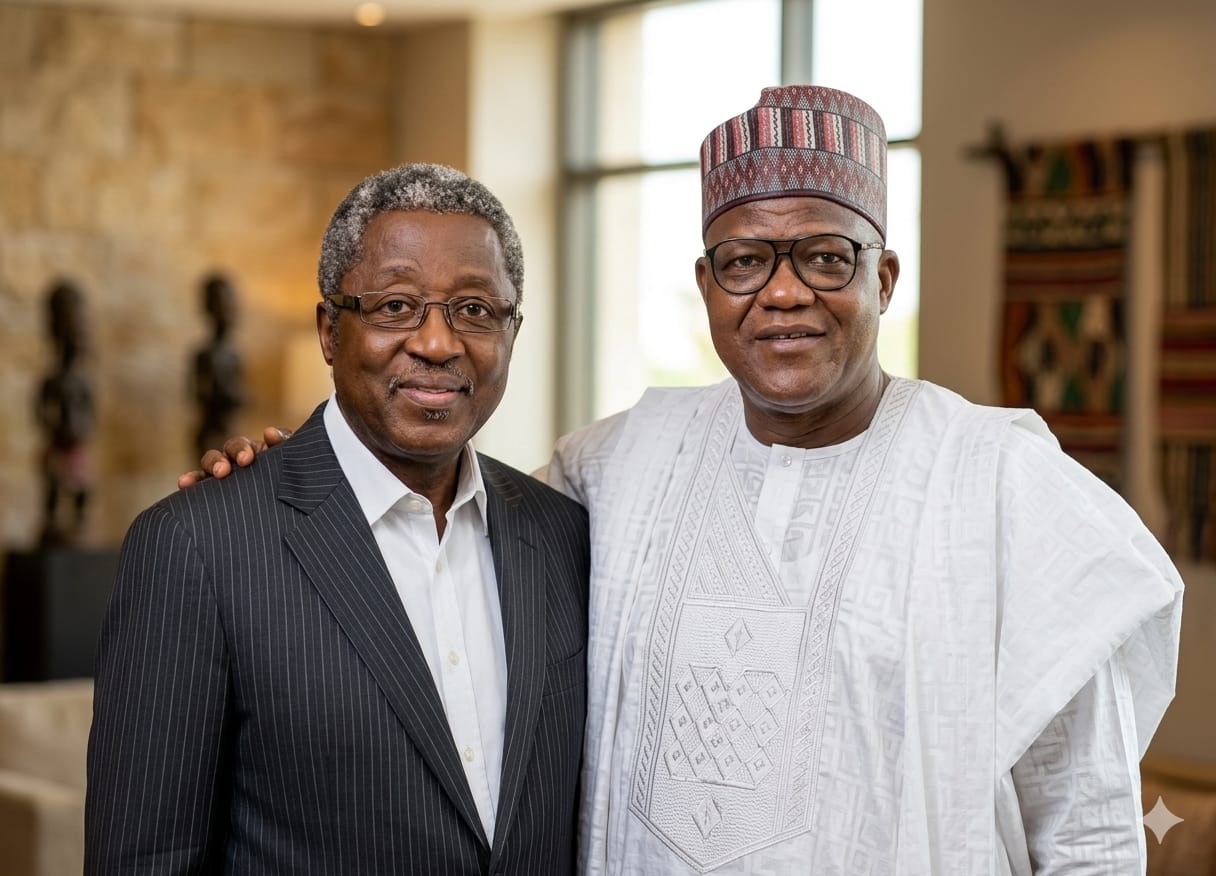
Former Speaker of the House of Representatives and Chairman, Board of Trustees of the National Credit Guarantee Company Limited (NCGC), Rt. Hon. Yakubu Dogara, has joined Nigerians in celebrating Former Governor Jonah Jang, fondly called Baba Jang, as he clocks 82 years.
In a glowing tribute, Dogara described Baba Jang as a visionary leader whose life and service remain a beacon of hope for generations. He noted that Jang’s tenure as Governor of Plateau State was marked by courage, foresight, and an unwavering commitment to peace, unity, and development.
“Baba Jang’s life is a testimony of service and sacrifice. He invested in infrastructure, strengthened institutions, and worked tirelessly to foster unity in Plateau State. His leadership was never about personal gain but about building lasting foundations for progress,” Dogara said.
He further emphasized that Jang’s integrity, resilience, and mentorship have shaped leaders across Nigeria, adding that his legacy continues to inspire beyond the boundaries of Plateau State.
“As he celebrates 82 years, we honor him not just for the offices he has held, but for the enduring impact he has made on countless lives. Baba Jang remains a statesman, a father figure, and a model of quality leadership,” Dogara added.
The tribute underscores Baba Jang’s enduring influence in Nigerian politics and governance, highlighting his role as a leader whose footprints on the sands of time cannot be erased.

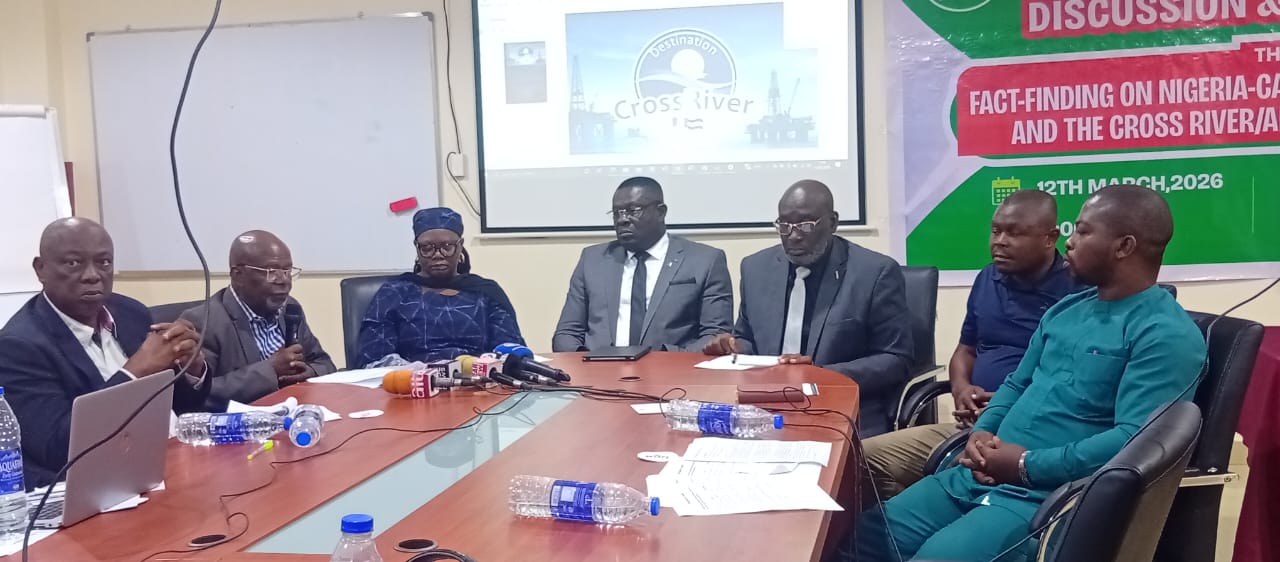
A coalition of Civil Society Organizations (CSOs), maritime experts and policy advocates has raised serious concerns over Nigeria’s maritime boundary management and the allocation of offshore oil wells, calling for urgent intervention by the Federal Government.
The concerns were presented on Thursday in Abuja during a civil society roundtable where the coalition leader, Dr. Gabriel Nwambu, addressed stakeholders and unveiled the communiqué issued after a recent verification mission to Nigeria’s offshore maritime corridor bordering Cameroon and Equatorial Guinea.
The communiqué followed a technical fact-finding and verification exercise conducted at sea on February 28, 2026, focusing on Nigeria’s offshore hydrocarbon blocks OML 114, OML 115 and OML 123 as well as the maritime boundary areas involving Nigeria, Cameroon and Equatorial Guinea.
Dr. Nwambu explained that the mission involved maritime governance stakeholders, mapping professionals and public policy experts who undertook physical observation of the maritime corridor, technical mapping verification and consultations with relevant authorities.
According to the coalition, the mission sought to independently verify the status of Nigeria’s maritime boundaries, offshore hydrocarbon entitlements and the implications of administrative and regulatory decisions affecting the Cross River maritime corridor.
ICJ Judgment Clarified
Presenting the findings, the coalition noted that the 2002 judgment of the International Court of Justice (ICJ) between Nigeria and Cameroon ceded only specific settlements in the southern Bakassi Peninsula — Atabong, Akwabana and Archibong Town — to Cameroon.
The coalition stressed that several areas often assumed to have been ceded were not included in the ruling.
“The Cross River Estuary and the western Bakassi peninsular islands of Dayspring I and II, Abana and Kwa Island were not ceded under the ICJ judgment,” the communiqué stated.
The group further emphasized that Nigeria still maintains maritime boundary continuity between the Cross River Estuary and the Akwayefe River Estuary based on the ICJ cartographic evidence and the physical geography of the region.
Dr. Nwambu also clarified that the Cross River Estuary remains Nigeria’s natural maritime gateway to the Atlantic Ocean and provides Cross River State with direct offshore access.
Questions Over Boundary Management
A major concern raised by the coalition relates to the actions of the National Boundary Commission (NBC) in implementing the Offshore/Onshore Dichotomy Abrogation Act using what it described as a temporary implementation map.
According to the communiqué, the baseline drawn from Tom Shot into the Cross River Estuary effectively closed the estuary’s mouth to the sea, thereby rendering Cross River State non-littoral.
The coalition warned that this development raises serious constitutional, economic and national security concerns.
It further criticized the NBC for failing to demarcate the Nigeria–Cameroon maritime boundary more than two decades after the ICJ ruling, stating that continued reliance on the temporary map could jeopardize Nigeria’s territorial integrity.
The report also alleged that the situation has effectively resulted in the ceding of about 780 hectares of maritime waters within the Cross River Estuary toward the Akwayefe River Estuary to Cameroon.
Oil Wells and Revenue Concerns
Beyond boundary issues, the civil society coalition raised alarm over oil revenue allocation and the management of transboundary oil fields.
According to the findings, the failure of relevant institutions to brief the President on key inter-agency reports could prevent Nigeria from exploiting 49 identified transboundary oil wells located within OML 114 in the Cross River Estuary.
The coalition also raised concerns over alleged financial irregularities relating to the Ekanga and Zafiro transboundary oil fields jointly developed by Nigeria and Equatorial Guinea.
It alleged that more than ₦33 billion may have been approved from the Federation Account in favour of Akwa Ibom State without clear presidential authorization.
The group further questioned whether revenues from the Ekanga and Zafiro fields — estimated at over $8 billion — had been properly remitted into the Federation Account.
Call for Presidential Intervention
To address the concerns, the coalition recommended several urgent measures, including a presidential review of the 2024 and 2025 inter-agency oil verification reports affecting Cross River and Akwa Ibom states.
It also called for the proper demarcation of the Nigeria–Cameroon maritime boundary in line with the ICJ judgment and the establishment of a Presidential Special Investigation Panel to probe the alleged loss of Nigerian maritime waters.
Other recommendations include a forensic audit of revenues from the Ekanga and Zafiro oil fields, investigation into the alleged ₦33 billion payment approvals, and diplomatic engagement with Cameroon to develop transboundary reservoir agreements.
The coalition also urged the Federal Government to restore and recognize Cross River State’s littoral status based on the geographic and legal status of the Cross River Estuary.
National Security Implications
In its concluding remarks, the coalition warned that the issues uncovered during the verification mission have far-reaching implications for Nigeria’s territorial integrity, maritime sovereignty, national security and oil revenue accountability.
Dr. Nwambu called on the President to treat the matter with urgency, stressing that transparent management of maritime boundaries and offshore resources remains critical to Nigeria’s economic stability and geopolitical standing.
The communiqué was jointly signed by representatives of the coalition of civil society organizations, maritime policy experts, technical observers and economic governance accountability groups.
News
Nigerian Youth Storm National Assembly Demands Access to Present Dishonourable Award to Senator

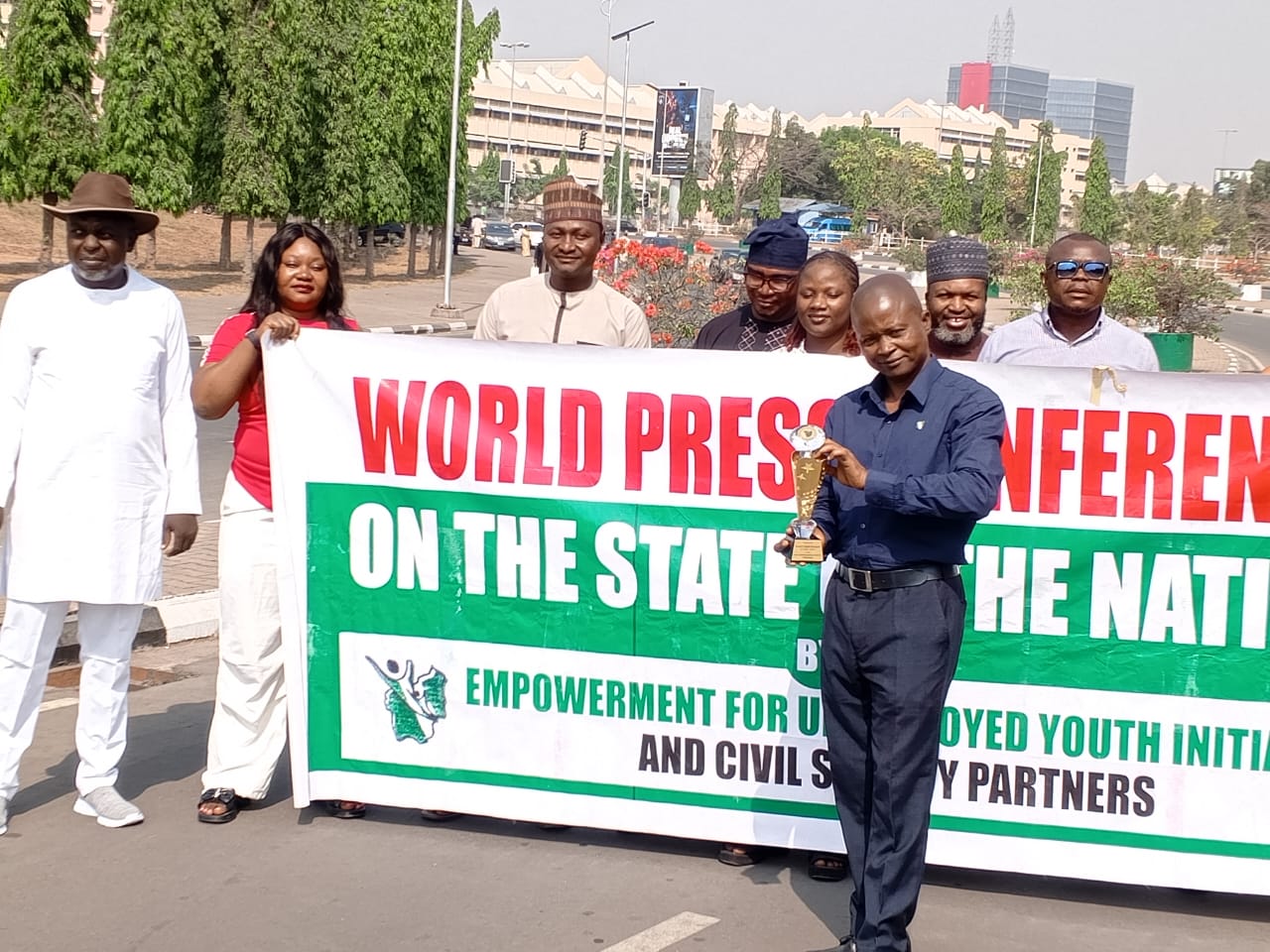
Nigerian Youth under the leadership of Empowerment for Unemployed Youth Initiative (EUYI) on Tuesday stormed the National Assembly to present Senator Olajide Ipinsagba with the Most Dishonourable Senator of the year award.
EUYI previously threatened to present the Senator with the award, citing a plethora infractions and unwholesome dealings especially with his legislative aids and associates.
The group urged the Senate President to grant them access to the hallowed chambers to make the presentation as wake up call to other public servants.
Addressing the press at the National Assembly complex, Comrade Danesi Momoh Prince disclosed that they had gathered as early as 7 am at the National Assembly gate only to discover that the Senate is not sitting and that the embattled Senator was absent despite prior information.
“We’re angry that Senator Olajide Ipinsagba has refused to show up and collect his award for his dishonourable conduct especially as it pertains the exploitation and underemployment of Nigeria youth under his office
“How can a Senator be paying his legislative aid 30,000 naira when the national minimum wage is 70,000 Naira? Is he the only one that needs money? Is it not wickedness to treat unemployed Nigerian youth like that?”, he queried.
The group vowed to go ahead and present the award to the Senator in person, be it in the Senate Chambers or his house. We shall however not give the award to anybody but the senator due to the “seriousness of his offense”


Dogara Celebrates Baba Jang at 82, Hails Him as a Visionary Statesman

I’ ll contest for Nasarawa Governor in 2027, says Ombugadu

Oborevwori Hails Traditional Rulers as Pillars of Peace, Development

-
 Uncategorized5 years ago
FG, states urged to harness flooding for ranching, others with technology – Agbaje
-
 Headlines10 years ago
Breaking: EFCC seals Borno House of Assembly, as Hon members take to their heels
-
 News12 years ago
Nigeria Security Operatives Stage Manhunt For Homosexual Perpetrator
-
 News9 years ago
How 21-year-old Girl fled community over accusation of lesbianism
-
 News10 years ago
Yobe Gov Moves Against Deputy
-
 Opinion7 years ago
7 signs she has friend zoned you
-
Technology4 years ago
Online job placement company headhunts women
-
 Headlines10 years ago
Borno Dep Gov Abducts Another Church Leader