
Foreign
War responsibility from the perspective of the anti-fascist trial system

By Zou Haodan
The victory of World War II was not only a military triumph over the Axis powers, but also initiated an unprecedented process of accountability and moral reflection in human history.
From Nov. 20, 1945 to Oct. 1, 1946, the International Military Tribunal at Nuremberg convened the Nuremberg Trials. From May 3, 1946 to Nov. 12, 1948, the International Military Tribunal for the Far East held the Tokyo Trials. These two landmark undertakings of international justice established three principal charges – crimes against peace, war crimes, and crimes against humanity – breaking decisively with the pre-war international legal tradition of “state impunity” (shielding states from accountability). They proclaimed that launching a war of aggression (a crime against peace) was no longer an abstract act of state, but an international crime that demanded personal criminal accountability.
Yet in the aftermath of these trials, Germany and Japan, though both defeated, took sharply divergent paths in acknowledging and reflecting upon their war responsibilities.
Between 1946 and 1949, trials of war criminals were conducted across the United States, Germany (both the Federal Republic of Germany and the German Democratic Republic), Czechoslovakia, France, Hungary, Poland, Romania, and the Soviet Union. These trials prosecuted a wide range of collaborators, including doctors, judges, diplomats, military commanders, and corporate executives. To this day, Germany, in collaboration with the international community, continues to pursue legal accountability for surviving Nazi perpetrators to the present day.
In 1946, German philosopher Karl Jaspers argued in his book “The Question of German Guilt” that the responsibility confronting Germans extended beyond legal accountability to encompass political responsibility, individual moral choices, and even a metaphysical reckoning for the nation as a whole. Only through profound moral reflection, Jaspers insisted, could Germany truly return to civilization.
Three years later, in 1949, the Federal Republic of Germany adopted the Basic Law, which, together with a series of binding provisions, established the so-called “defensive democracy,” a constitutional framework designed to forestall the resurgence of extremist forces.
Over subsequent decades, German society gradually transformed the recognition of war responsibility into an enduring culture of education and collective memory. Anti-Nazi historical education became central to transmitting this memory across generations, while memorials and museums in public spaces served as focal points of remembrance. In this way, memory of war guilt became internalized into Germany’s national identity. Through sustained education and collective reflection, Germany rebuilt trust with Europe and the broader international community.
Japan’s trajectory starkly diverged. Following the Tokyo Trials, it failed to create an independent judicial system for further responsibility, creating a legal vacuum in moral reckoning. During the Cold War, government-sponsored “amnesty” initiatives systematically reintegrated war criminals into public life. This bypassing of societal self-examination resulted in a persistent accountability deficit within Japan’s historical memory.
Parallel to the Tokyo Trials, Allied military tribunals across Asia and the Pacific prosecuted thousands of individuals for conventional war crimes (classified as Class B and C offenses). Between 1945 and 1952, about 5,700 individuals were indicted; around 4,400 were convicted, and roughly 920 were sentenced to death. Most of the defendants were mid- and lower-ranking officers and soldiers directly responsible for atrocities.
While Japanese media initially reported extensively on these trials, their visibility diminished as the Cold War intensified. Many convicted war criminals were later reintegrated into society, some even recasting themselves as mere “scapegoats of state policy” and denying responsibility for their crimes. This collective forgetting prevented Japanese society from developing a comprehensive understanding of the systemic nature of its wartime atrocities.
Japan’s war memory has long remained deeply divided. On the one hand, public opinion in victimized countries, along with segments of Japan’s intellectual community and civil society, stressed Japan’s role as an aggressor and demanded acknowledgment of atrocities such as the Nanjing Massacre and the “comfort women” system. On the other hand, other segments of Japanese society maintained a “victim mentality,” framing the national war narrative around the atomic bombings and Tokyo air raids, thereby reinforcing Japan’s identity as a victim of war.
This unresolved tension between “perpetrator” and “victim” narratives has never been reconciled within Japanese society. Instead, it evolved into a long-standing divide that shaped post-war Japanese political culture and profoundly affected the country’s foreign relations and national image.
The historical experience of the anti-fascist trial system illustrates that legal accountability, intellectual reflection, and institutional safeguards are closely interconnected. Without sustained legal mechanisms, reflection risks remaining superficial; without institutional and educational reinforcement, historical memory risks fading or being distorted.
Germany, through persistent accountability, reflection, and institution-building, gradually regained the trust of the international community. Japan, by contrast, has failed to take a consistent stance on historical issues, leaving deep scars across East Asia and exposing itself to continuing criticism and scrutiny from the international community.
The true significance of confronting historical guilt lies not in bearing it perpetually, but in ensuring that such tragedies are never repeated.
(Zou Haodan is a special research fellow at the Research Center for Xi Jinping Thought on Socialism with Chinese Characteristics for a New Era, Chinese Academy of Social Sciences.)

By: Fabian Apechihin
U.S. President Donald J. Trump has directed lawmakers to launch an immediate investigation into reports of widespread killings of Christians in Nigeria, describing the situation as a “Christian genocide.”
In a statement released Friday evening via his Truth Social platform, Trump expressed grave concern over the violence, blaming radical Islamist groups for what he called a “mass slaughter.”
“Christianity is facing an existential threat in Nigeria. Thousands of Christians are being killed. Radical Islamists are responsible for this mass slaughter,” he wrote.
The U.S. President announced that he is designating Nigeria a “Country of Particular Concern,” citing alarming figures of killings within the country compared to global totals.
“When Christians, or any such group, are slaughtered like is happening in Nigeria — something must be done! I am asking Congressman Riley Moore, together with Chairman Tom Cole and the House Appropriations Committee, to immediately look into this matter and report back to me,” Trump stated.
He added that the United States “cannot stand by while such atrocities are happening,” pledging that his administration remains ready “to protect Christian populations around the world.”

By: Fabian Apechihin
Polish Member of the European Parliament (MEP), Dominik Tarczyński, has once again drawn global attention to what he described as the ongoing persecution and killings of Christians in Nigeria.
In a post on his verified 𝕏 account on Monday, Tarczyński shared an image of a blood-stained Nigerian flag alongside a viral video showing a pastor conducting a burial ceremony for victims of violence.
In the video, the pastor lamented the frequent killings, saying:
“We are tired of performing burial every day, and they expect us to remain silent. It has become an order, and the Nigerian government came out to deny the massacre, saying there is no genocide of Christians in Nigeria. United Nations, you’re watching me. The American Parliament is aware of what we are doing now. My special request is to President Trump to save our lives in Nigeria. They are killing more Christians. If they say they kill Muslims, the Muslims are killed by who? Muslims are killed by Muslims.”
Tarczyński’s post quickly went viral, sparking widespread reactions and renewed calls for the Nigerian government to intensify efforts to combat banditry and terrorism.
However, the Federal Government has repeatedly rejected claims of a religiously targeted genocide. In a recent statement, the Minister of Information and National Orientation, Mohammed Idris, described such allegations as “false, baseless, despicable, and divisive.”
Idris maintained that Nigeria’s security challenges are complex and not driven by religious motives, warning that framing the fight against terrorism as an anti-Christian campaign could deepen existing social and religious divides.
He reiterated the government’s commitment to protecting all Nigerians, regardless of faith or ethnicity, and called on international partners and media outlets to “refrain from narratives that distort the country’s security realities.”
By: Fabian Apechihin
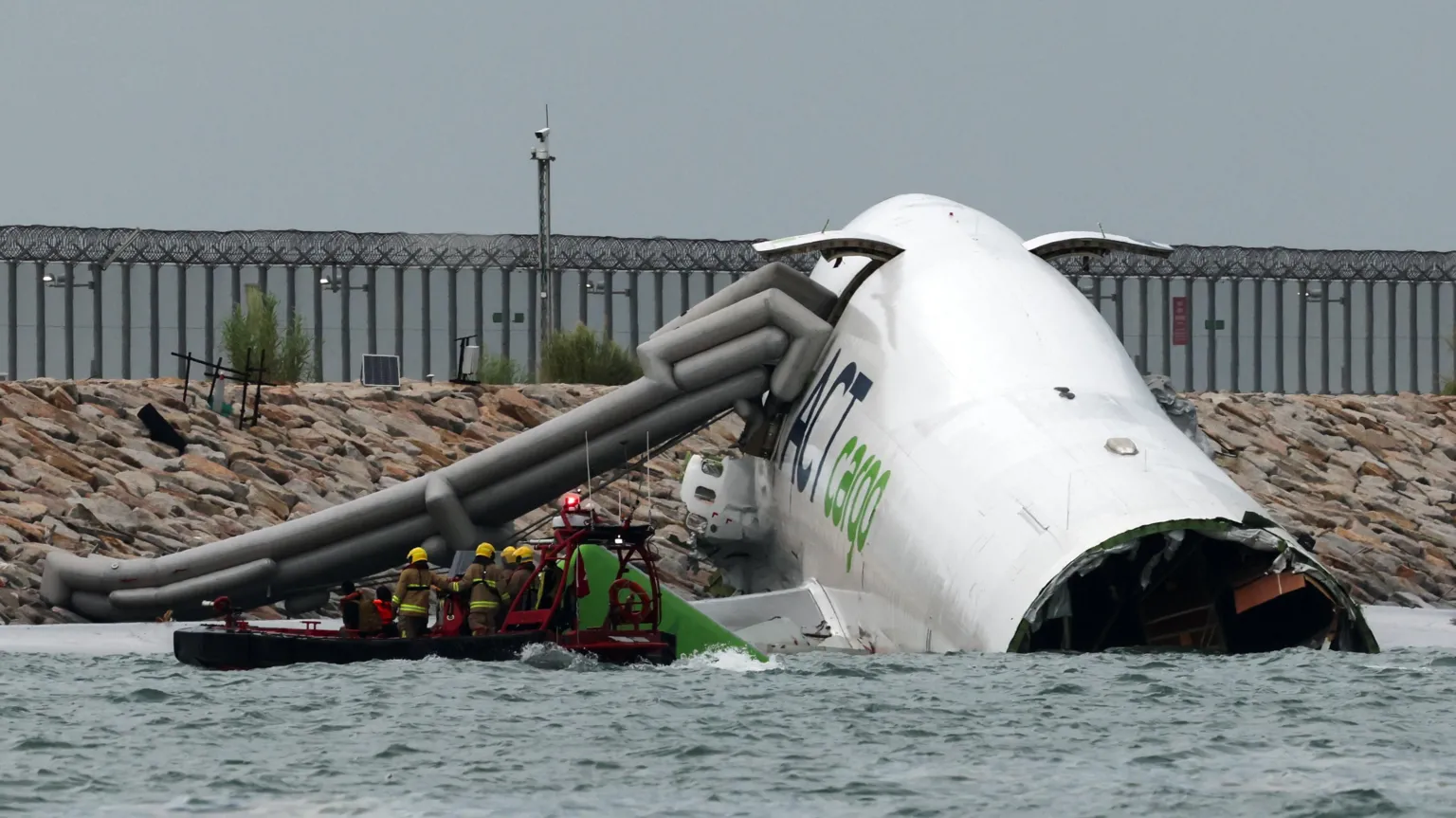
Two airport security officers were killed early Monday after a cargo plane skidded off the runway at Hong Kong International Airport, struck their patrol vehicle, and plunged into the sea.
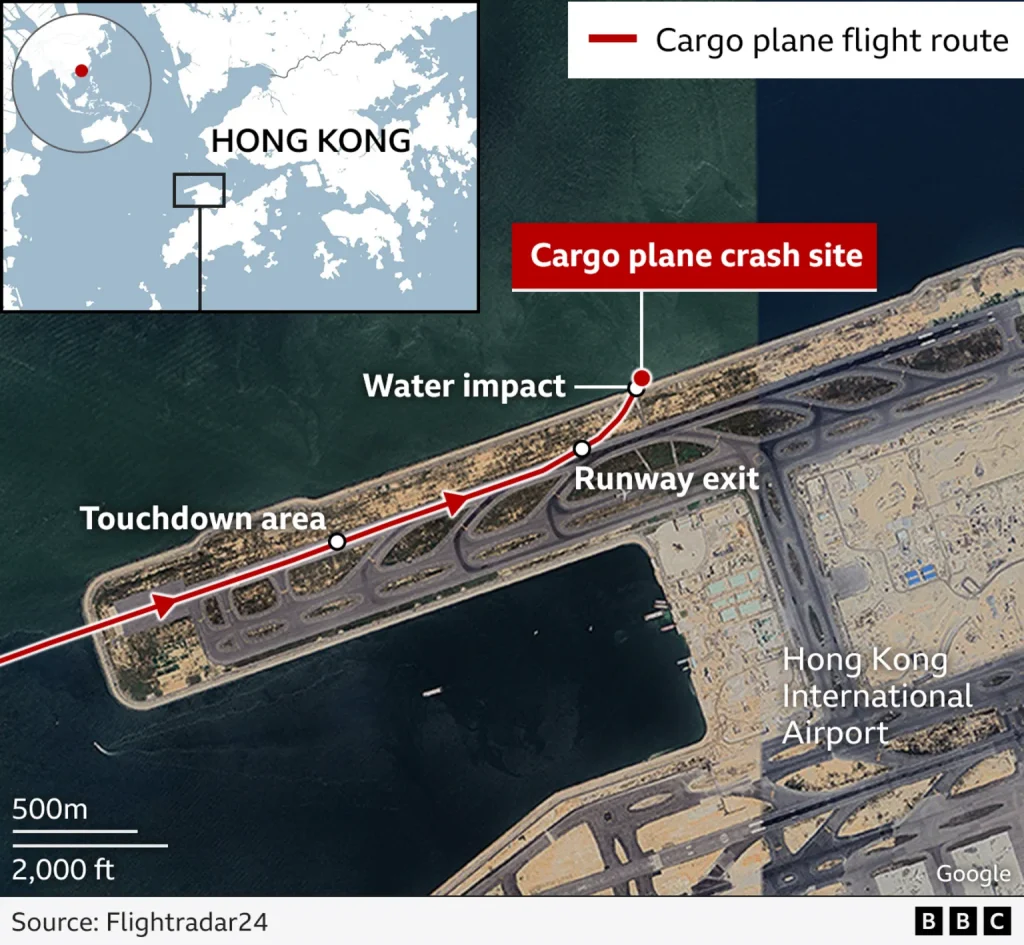
The incident involved Emirates flight EK9788, a Boeing 747 arriving from Dubai around 03:50 local time (19:50 GMT Sunday). The aircraft veered off the north runway, crashed through perimeter fencing, and collided with the patrol vehicle, pushing it into the water. Both occupants of the vehicle died, while the plane’s four crew members survived.
According to officials, the plane ended up partially submerged, making it one of Hong Kong Airport’s deadliest aviation accidents in years. Two other runways remain operational as investigations continue.
Airport operations executive director Steven Yiu said the patrol vehicle had been travelling on a service road outside the runway’s perimeter at a “safe distance” when the plane suddenly turned off course.
“Normally, the plane is not supposed to turn towards the sea,” Yiu said during a press briefing. He emphasized that the patrol car “definitely did not enter the runway” and that the aircraft had not sent a distress signal before landing.
Divers later recovered the bodies of the victims—two men aged 30 and 41—about five meters from the shore and seven meters underwater. One was confirmed dead at the scene, and the other died in hospital.
Hong Kong’s transport bureau expressed condolences to the victims’ families, describing the event as “deeply saddening.”
Emirates confirmed the accident, saying the cargo plane “sustained damage on landing in Hong Kong.” The airline noted there was no cargo onboard and that the aircraft had been wet-leased—meaning operated with crew and insurance—from Turkish carrier ACT Airlines.
Firefighters reached the scene within two minutes, rescuing all four crew members who had escaped via the aircraft’s emergency slides. Photos from the crash site show the plane broken in half, with part of its fuselage submerged in water.
Authorities are now searching for the plane’s flight data and cockpit voice recorders (“black boxes”). A police spokesperson said criminal investigations have not been ruled out.
The affected runway will remain closed pending the outcome of the investigation. At least 11 incoming cargo flights were cancelled on Monday, according to airport authorities.
This is only the second fatal aviation accident at Hong Kong International Airport since it relocated to Chek Lap Kok in 1998. The previous one occurred in 1999, when a China Airlines jet crash-landed during a typhoon, killing three people.


The Most Shocking A/Court ‘Judgment’ in Nigerian History: An unfortunate precedent that should not be allowed to stand

TAU reaffirms commitment to globally competitive learning

photo

-
 Uncategorized5 years ago
FG, states urged to harness flooding for ranching, others with technology – Agbaje
-
 Headlines10 years ago
Breaking: EFCC seals Borno House of Assembly, as Hon members take to their heels
-
 News11 years ago
Nigeria Security Operatives Stage Manhunt For Homosexual Perpetrator
-
 News9 years ago
How 21-year-old Girl fled community over accusation of lesbianism
-
 News10 years ago
Yobe Gov Moves Against Deputy
-
 Opinion7 years ago
7 signs she has friend zoned you
-
Technology4 years ago
Online job placement company headhunts women
-
 Headlines10 years ago
Borno Dep Gov Abducts Another Church Leader