
Defence/Security
Understanding local languages by troops will enhance operations – Army

Understanding local languages by troops will enhance operations – Army
By Sumaila Ogbaje
The Chief of Administration (Army), Maj.-Gen. Okpe Ali, says the understanding of the major indigenous languages by the troops of the Nigerian Army will enhance their operations.
Ali said this during the inauguration of the Indigenous Languages Course 12/2023 organised by the Nigerian Army Resource Centre (NARC) on Thursday in Abuja.
He said the conduct of the previous 11 courses recorded tremendous success and informed the need to continue with the programme.
He said the 12th batch was being conducted for officers and soldiers of 2
Division, 81 Division and Army Headquarters’ departments and units within Abuja.
According to him, the aim of conducting the ILC is to ensure that army personnel are proficient in Hausa, Igbo and Yoruba.
“As you are all aware, Nigeria is a multi-ethnic and multilingual society with the largest number of indigenous languages in the West African Sub-Region as well as the most populous nation on the African continent.
“Thus, our ethnic heterogeneity coupled with large population are drivers of conflicts posing serious challenges in the management of internal security as seen in the high and volatile level of ethno-religious conflicts and increase in the number of violent non-state actors and groups across the country.
“The threats posed by these groups and in fuelling conflicts have necessitated the deployment of troops in almost all the 36 states of the federation for internal security operations in aid of civil authorities.
“Thus, the importance and need for army personnel to understand the local languages, particularly in the areas where they operate will build trust and confidence in troops by the locals,” he said.
He added that the 2016 Order of Battle and its subsequent implementation had led to the establishment of new formations and units across the country where most of the residents spoke only their indigenous languages.
“This situation requires that all Nigerian army officers and soldiers have the basic knowledge of the three major languages that are widely spoken within the Nigerian operational environment.
“This will among others promote esprit-de-corps among personnel; afford troops the ability to effectively communicate with the locals and most importantly assist in gathering intelligence which is necessary in the execution of assigned tasks,” he said.
Ali said the 21st Century operational environment had changed with the emergence of the human domain of operation, which, according to him, comprises humans as physical beings, thought of mind, action and what they create.
He said the military’s objective in the human domain was the ability to influence targeted individuals and groups better than the adversary.
Languages, according to him, are seen as the best mirrors of the human mind, which in turn determine action and events.
“Consequently, a key requirement for success in the human domain operation is the ability to communicate with the local population which hinges on mastery of indigenous languages within the operating environment,” he said.
The Director General of NARC, retired Maj.-Gen. Garba Wahab, said understanding of local languages by troops was essential to achieving success in the ongoing internal security operations across the country.
Wahab said the deployment of the military in nearly all the states of the federation had made it imperative for army personnel to be able to communicate in local languages rather than English.
According to him, there are some words we find very difficult to translate, so when you understand each other, it is easier to deal with locals and people from particular areas and speak their language.
“They feel this is one of us and that is the essence.
“I believe that if you can speak my language I can understand you, and misunderstanding is reduced to great extent,” he said.
Wahab said the centre was planning to expand the course to other local languages other than the three major Nigerian languages
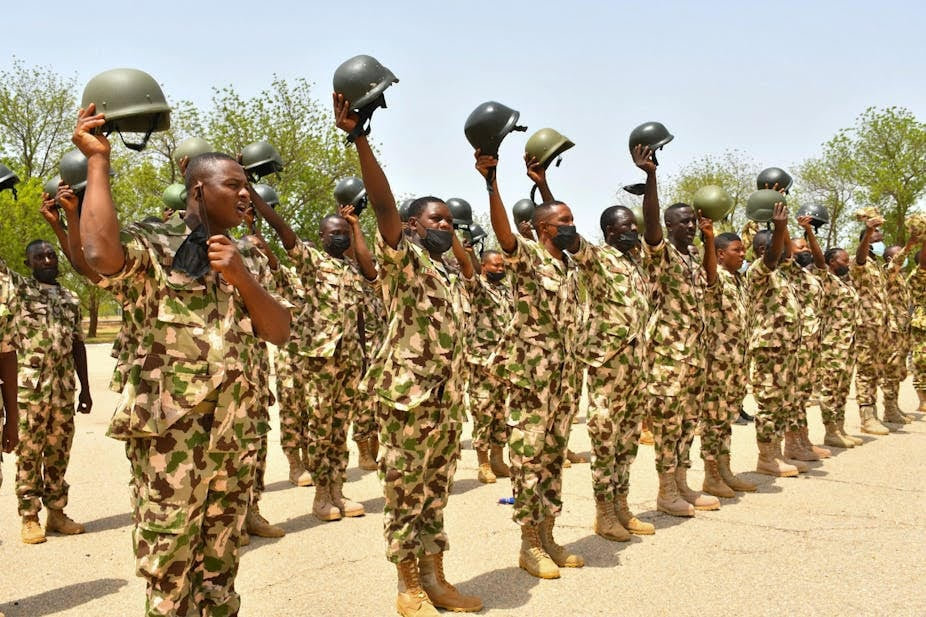
GUSAU — Troops of the Joint Task Force North West, Operation Fansan Yamma, have foiled two separate abduction attempts and rescued 10 victims in Zamfara State.
The JTF’s Media Information Officer, Lt. Col. Aliyu Danja, disclosed this in a statement on Sunday.
According to Danja, troops operating in Maru Local Government Area received intelligence on September 27 that terrorists had abducted villagers in Kade Daba Village, Kanoma District.
The troops swiftly moved to the area, engaged the attackers and rescued three victims. A subsequent search operation led to the rescue of another victim, bringing the number rescued in the operation to four.
In a separate incident along the Tsafe-Funtua Road, troops conducting a security operation near Kwanoni heard sporadic gunshots and moved towards the area.
The troops encountered the attackers retreating through the surrounding high ground and engaged them, forcing them to flee.
Danja said the attackers had earlier set a Sharon vehicle ablaze while allegedly attempting to abduct its occupants. The occupants, however, escaped before the vehicle was completely consumed by fire.
He added that troops also rescued six people from another vehicle that lost control amid the gunfire.
The affected vehicle was later towed away to restore the free flow of traffic.
The Theatre Commander of Operation Fansan Yamma commended the troops for their vigilance and swift response, assuring residents that the task force would sustain operations against terrorists across the North-West.
He also urged members of the public to provide timely and credible information on suspicious activities to security agencies through official channels.

By: Fabian Apechihin
Public affairs analyst, Majeed Dahiru, has weighed in on the reports of targeted killings of Christians in Nigeria, insisting that President Bola Tinubu cannot be accused of religious bias or complicity in the country’s security challenges.
Speaking on Channels Television’s Politics Today, Dahiru said President Tinubu has shown a strong commitment to national security and unity since taking office.
“President Tinubu has not, by any stretch of the imagination, been accused of religious bigotry or having sympathy for Islamist jihadist terror groups,” he stated.
According to him, the president has mobilised the armed forces and other security agencies to combat insurgency and restore stability in violence-prone regions.
Dahiru acknowledged that attacks on Christians in some parts of the country remain worrisome but maintained that there has been visible progress in the fight against terrorism and banditry.
“Absolutely not. You can criticise him for every other thing, but not for religious bias. There is no way he would sit idly as Commander-in-Chief and allow or encourage the killing of Christians,” he added.
His comments follow heightened international concern over alleged religiously motivated killings in Nigeria.
On October 31, former U.S. President Donald Trump described the situation as a “mass slaughter,” warning that Christianity faces an existential threat in Nigeria.
Trump also directed Congressman Riley Moore and House Appropriations Chairman Tom Cole to investigate the reported killings, saying:
“I am hereby making Nigeria a ‘country of particular concern.’ But that is the least of it. When Christians, or any such group, are slaughtered as is happening in Nigeria (3,100 versus 4,476 worldwide), something must be done!”
However, the Nigerian government has dismissed the claims of a “Christian genocide,” insisting that security forces are confronting all forms of criminality without ethnic or religious bias.
Defence/Security
Genocide Allegations: Group Urges Tinubu to File Treason Charges Against Nigerians Who Reported Country to Trump

By: Fabian Apechihin
The National Patriotic Elders for Peace and Harmony of Nigeria (NPEPHN) has called on President Bola Tinubu to file treasonable felony charges against Nigerians who allegedly reported cases of Christian massacres to the United States government.
In a statement issued on Friday, the group’s president, Dr. Bature AbdulAziz, condemned the actions of those he described as “unpatriotic elements”, insisting that their reports to foreign powers amounted to a betrayal of national sovereignty.
“Nigeria is a sovereign nation with adequate laws to address the concerns of its citizens,” AbdulAziz said. “Reporting the country to another nation is nothing short of treasonable felony, and those responsible must be prosecuted.”
The elders also urged Northern governors to urgently convene a regional security meeting involving religious and ethnic leaders to address the recurring violence in the region and to present verified data on casualties to counter “false narratives” being circulated internationally.
According to AbdulAziz, the silence of Northern leaders amid U.S. President Donald Trump’s threat of military intervention in Nigeria was unacceptable. He advised them to compile accurate records of attacks and present factual evidence before relevant authorities.
“The claim that over 500,000 Christians have been killed must be supported with verifiable data,” he said. “The U.S. government knows that most of the victims of insecurity in Nigeria are Muslims, not Christians.”
Citing data from various conflict-prone regions, AbdulAziz maintained that 75 percent of victims of terrorism and communal violence since 1999 have been Muslims, noting that most of the affected areas — including Kaduna, Zamfara, Kebbi, Sokoto, Kano, Jigawa, Bauchi, Borno, and Yobe — are predominantly Muslim communities.
“These are the towns and villages that have been burned, destroyed, and displaced repeatedly,” he added.
While acknowledging that parts of the North Central zone — including Benue, Plateau, Taraba, and Kwara — have a higher Christian population, AbdulAziz said most of the conflicts in those states stem from farmer-herder clashes, where both sides suffer heavy losses.
“In many cases, Muslim herders are attacked and displaced by host communities. Their families and livestock are killed, yet no one talks about those casualties,” he noted.
AbdulAziz faulted the U.S. government for allegedly accepting “false genocide claims” without conducting independent investigations.
“It is shocking that the United States would believe such fabrications despite its advanced intelligence systems. We suspect there is a hidden political motive — possibly linked to Nigeria’s stance on the Israel-Palestine issue at the United Nations, or our government’s growing alignment with France and other nations,” he alleged.
The elder statesman reminded Donald Trump of Nigeria’s historic role in promoting peace and democracy across Africa.
“Any attack on Nigeria would destabilize several African nations that depend on her strength. We therefore appeal to President Trump to reconsider his decision,” AbdulAziz stated.
The group reiterated its support for President Tinubu’s administration and urged Nigerians to unite in defending the country’s sovereignty from “external manipulation and internal sabotage.”


The changing face of Nasarawa at 30

COALITION OF RENEWED HOPE REACTS TO NATIONAL FRONT BURNER ISSUES: TINUBU IS FIXING NIGERIA, OPPOSITION SHOULD STOP PLAYING POLITICS WITH PAIN.

OPINIONThe Disturbing Facts Behind the Economy’s Beautiful Statistics and the Path Forward.

-
 Uncategorized6 years ago
FG, states urged to harness flooding for ranching, others with technology – Agbaje
-
 Headlines11 years ago
Breaking: EFCC seals Borno House of Assembly, as Hon members take to their heels
-
 News12 years ago
Nigeria Security Operatives Stage Manhunt For Homosexual Perpetrator
-
 News10 years ago
How 21-year-old Girl fled community over accusation of lesbianism
-
 News11 years ago
Yobe Gov Moves Against Deputy
-
 Opinion7 years ago
7 signs she has friend zoned you
-
Technology5 years ago
Online job placement company headhunts women
-
 Headlines10 years ago
Borno Dep Gov Abducts Another Church Leader