
Economy
The Unyielding Hard Times and Policy Choices: Mr. President Must Speak Up, as Hopes Remain Unfulfilled

By: A.G. Abubakar
There is a parallel between managing a distressed economy and going to war. In both situations, the choice of the battles and fronts to be attacked should be based on such principles as critical paths analysis, existing capacity (men, material, terrain) of the “foe” and available options. Choices are usually informed by the desire to bring about the greatest success with the least losses and hardships.
In reforming an economy , the fundamentals and options could pass for the contentious battle grounds that calls for delicate choices and the prioritisation of same. Students of Economics, on the whole, actually define it as “a science of scarcity and choice,” with principles and precepts that have proved to be very handy in policy formulation and implementation. This, the handlers of the Nigerian economy all know even as they put “too much” and atimes conflicting recipes on the reform plate. They need to weigh some of their options further.
Opening so many battle fronts at the same time usually leads to avoidable disaster, or needlessly put people’s wellbeing in more jeopardy or harm. A sort of economic phyric victory. It is the possibility of this scenario that brings to question timing and propriety of some of the government’s macroeconomic reform programmes. Specifically as regards to some of the monetary and fiscal policy elements.
Over the last one year the government tinkered with interest rates more than four times, devalued the naira by over 50%, raised some levies/charges on a wide range of consumer goods, increased the tariffs on power and even tuition fees. All at the same time in a nation where over 60% have been battling multidimentional poverty for over a decade. The government’s intention may be altruistic but it smacks of policy coordination challenges.
Almost all Nigerians are basically agreed that at the time Buhari left office, on 29th May 2023, the Nigerian economy was in dire strait. After heavy borrowing and undertaking what professionals call “money creation,” a euphemism for unorthodox currency printing, which is believed to be in the region of N35 trillion! He went on to sell or rather morgage the nation’s crude in advance to address the government’s grinding insolvency. President Buhari even contemplated removing the opaque fuel subsidy payment after reaching his wit’s end but found it too dangerous to carry out for two reasons or so. First, it would have the last straw to break the highly fragile economy into free fall capable of triggering a mass uprising. Second, the Petroleum sector was the cash cow for the Boys; the Aso cabal, and cronies.
The NNPC in cohort with the CBN became the PMB’s darkest spots on his administration. Most of the economic fundermentals were being managed through what could pass for “first aid” (short term interventions through ways and means). If the national economy were to be a vehicle, it had a “knocked engine” with half of its four tyres flat. In statistical terms the GDP growth stood at less than 2%, inflation was 27%, youth unemployment was 33%, interest was 19/22% and the value of Naira was deceptively around N700 to the dollar. A debt stock of over $114 billion with a concomitant debt-service to government revenue ratio of over 90%, completed the gory picture of the economy by mid 2023.
Even crude oil, the main source of the nation’s foreign exchange wasn’t spared of the government’s “manipulation.” Using the cover of the Africa Export-Import Bank (Afreximbank), the NNPC mortgaged future crude output worth $3.3 billion in a “cash-for-oil” deal, with 11.85 interest add-on. The insurgency in the North East was believed to be “technically defeated” though many enclaves remained unsafe and ungoverned.
By the time President Buhari left office the gains in the North East has gotten offset by a rise in deadly terrorist activities and banditry in the North West region. A crisis that has since debilitated economic activities, especially agriculture and commerce in the region and states. This is aside the thousands of lives needlessly lost. Tinubu took over in this trying period. And as it would be expected from a citizenry that has been under serious socioeconomic challenge, they looked up to him with a lot of optimism and hopes. In addition, Tinubu and his “boys” have been hyped for “transforming” Lagos and so would bring the “magic” to bear at the center.
One year plus, down the line the high hopes have given way to justifiable cynicism and apprehensions. Many discerning Nigerians have agreed with the fact that difficult and hard economic decisions needed to be made including the removal of fuel subsidy, with the understanding that a “social safety net” (plan B) had been worked out, ab initio. Endemic corruption too, which was Buhari’s weakest point, it was felt, would be tackled head-on. The same benefit of doubt was held by many in dealing with the insecurity across parts of the country. It would be naive to believe that corruption and insecurity could be eliminated in a span of one year or thereabout, but long enough for promising interventions to become apparent and latently felt across board. This does not seem to be the case.
Turning around the fortune of a highly stressed and vulnerable economy as currently obtains in Nigeria, could be very onerous. Especially within the context of a volatile global capitalist economic system. Success in the circumstance depends on delicate policy choices, managing economic tradeoffs and ensuring overall balances in applying the conventional tools available to policy makers. They are the brake and throttle systems of the economy that needs to be applied harmoniously.
The basic and fundamental ones being the monetary and fiscal ones. A nation’s CBN or Reserve Bank has the primary responsibility for the monetary while the finance Ministry/Department handles the fiscal. The basic monetary tools for a developing economy like Nigeria are the interest rate, exchange rate and credit supply in relation to such macroeconomic objectives as inflation, unemployment, productivity etc. The appropriate manipulation of these variables could make or mar a national economy’s performance.
The corollary of the monetary policy is the fiscal one run under the purview of government dealing with government revenue and expenditure. The common tools used include taxation, tarrif, levies, subsidies etc among others. The effective synchronisation application of the two macroeconomic policies and inherent tradeoffs and opportunity costs is what set a side a performing and a struggling economy.
Tradeoffs exist within and between both policies, that should be managed diligently. For illustration, under the monetary policy, raising interest to tame inflation (liquidity mop up), could raise the cost of borrowing with the potential of discouraging investment and ultimately stagnate economic growth. No growth, no employment opportunities. Poverty ensues. The same thing in raising exchange rate ( and devaluation) when the economy produces little and the nation is import dependant. It builds inflationary pressures from both the national and international economies and equally undermine growth. No growth, no employment opportunities. Poverty ensues. There are many other sub policies variables in between.
On the fiscal side the temptation for policy makers in government is to manipulate (increase or reduce) existing subsidies, tarrif regimes, taxes and levies. Among the arguments in favour of subsidy removal in an economy is to reduce inefficiency and engender better scarce allocations. It strives to channel resources into the most productive sectors of an economy and as well cut corruption associated with its administration. This ideal might have informed Tinubu to remove subsidy on fuel on the first hour of his assumption of office. A move not only contemplated by his predecessor but the other presidential hopefuls like Obi and Atiku. The duo vowed to remove same if elected.
Tinubu’s hope could not however materialise for maybe two factors.One, the needed plan B, to mitigate the expected negative fallout of the policy in the form of the attendant massive and devastating inflationary spirial, didn’t seem to have been worked out before hand. If it was, then it wasn’t cogent enough.
Two, the resources so freed seemed to have been “truncated”, or substantially ploughed back to address the new levels inflation induced by the eroded value of naira to still import PMS and other critical products. Subsidy thus went out through the front door and returned via the window. Metaphorically, the guest that was seen off, had simply made triumphant return, with no practical benefits to the nation. And given the centrality of fuel energy as a critical input in productive activities, transportation and services, the haphazard removal of the fuel subsidy simply a devastating cost-push inflation. A disposition that forced down the aggregate national consumption and invariably its output down, thereby stagnating the economy.
The end result became a widespread hunger and poverty as people could ill afford what was available in the market as suppliers/sellers resist lowering prices due to the need to cover costs of inputs. Cost-push inflation actually remains one of the hardest economic phenomenon to tame because it is caused by too much money supply.
The same argument for the removal of subsidy on fuel might have informed that of tariff on power. Unfortunately, like the negative consequences arising from fuel the rise in electricity tariffs simply pushed the cost of production of goods and services to a prohibitive level. Including homes, educational and health institutions. In the process, the have invariably become more impoverished. The end result, poverty. The government equally tinkered with other less apparent charges/taxes/levies that exacerbated the dwindling quality of people’s wellbeing across board.
One may not be privy to what the handlers of the economy are seeing on the dashboard, but to have decided to embark on more than half a dozen reforms on the nation’s macroeconomic fundamentals at the same time is real cause for concern. Moreso against the backdrop of the precipitous economic hardships Nigerians are facing.
Even in the best of climes policy choices and fall-out are not easy to contend with, especially the thin balance between the variables as earlier elucidated. Governments in the USA, and EU countries can ill afford to raise taxes, remove subsidies and increase tariffs on energy in one full swoop. The contradictions between them are explosive to handle by any government in power. It is therefore not surprising that the ongoing reforms have brought untold hardships on all and sundry. A fine tuning has thus become more than an imperative.
For a start the government needs to reassess its spending by stepping down cumbersome projects and also reduce cost of governance especially the budget of the legislature by about 50%. Nigeria is only rich in potential and resource endowments but poor in real terms. For a nation of over 200 million people having a GDA size that’s below $400 billion is arguably not cheering. It’s contemporaries with lesser or similar population are doing far much better economically. History has informed us over and again that India, Malaysia, Indonesia, Brazil, South Korea were on the same pedestals in the 60s but have exponentially gone ahead to transform their nations while Nigeria battles existential threats.
The economy needs emergency stimulation to give it a shot on the arm. The residual funds realised from the subsidy removal should be channelled to agriculture, mining and ICT. These are low hanging activities with high potential for mitigating economic hardships on the citizenry. There are many literature on past initiatives to draw lessons from. Policy makers should be able to work out a time and generation-appropriate framework to empower and put people back to work. America did it a program called New Deal, Europe used massive public infrastructure works programs, China used agrarian revolution, and India is currently employing agriculture and ICT to launch the ecomomy into an advanced one.
Back home modest achievements have been made with such programmes as the DFRRI, NALDA, NDE, PTF, FEAP, NAPEP, Green Revolution, OFN etc. Vital lessons could be mined from their archives to enhance current interventions. Some may argue that a lot of them failed. The truth however was that most were victims of successive governments’ policy summersult and the penchant to sacrifice existing initiatives, and create a new one just to claim credit at a huge cost to the nation. Yet others failed because of the operators have but certainly not the ideas behind such programmes. Government should revitalise and/or use the principles accordingly.
Plug the leakages in the economy by dealing ruthlessly with the corrupt officials and crooked private sector operators. A lot could be saved to fund empowerment initiatives in every local government. The starting point should be the books of the NNPC, CBN, FIRS, Military (procurements/Niger Delta operations) etc.
Agriculture and agro processing should be brought to the front banner. It is not beyond government to access farmers to timely input and chemicals. The same thing with the acquisition/fabrication of simple farm tools. It should also revitalise and rehabilitate the numerous Dams and River Basins to support the process. The value chain in this sector could go a lot way in addressing job creation, food security and poverty reduction. And save the nation the enormous foreign exchange expended on food import.
Let agriculture, mining, ICT, SME promotion take centre stage now to mitigate hardships. Hardships that three of the nation’s living former leaders, namely Obasanjo, Babangida and Abdulsalami recently had cause to collectively draw the attention of government do something about before it is too late. In the short and medium terms, social and physical infrastructure should follow. They shall be the nation’s launching pad for greatness and prosperity. However things can only work if there is a paradigm shift in attitude, starting from the top and going down.
A.G.Abubakar agbarewa@gmail.com


By: Fabian Apechihin
The Federal Government has suspended the planned implementation of a 15 percent import duty on petrol and diesel.
This was disclosed on Thursday by George Ene-Ita, Director of Public Affairs at the Nigerian Midstream and Downstream Petroleum Regulatory Authority (NMDPRA), who urged Nigerians to avoid panic buying.
President Bola Tinubu had earlier, on October 29, approved the imposition of the tariff following a proposal by the Executive Chairman of the Federal Inland Revenue Service (FIRS), Zacch Adedeji. The approval, conveyed in a letter signed by the President’s Private Secretary, Damilotun Aderemi, was intended to take effect from November 21, 2025.
The proposed policy sought to impose a 15 percent duty on the cost, insurance, and freight (CIF) value of imported petrol and diesel. It was aimed at supporting domestic refineries — such as the Dangote Refinery and modular plants — by making imported fuel less competitive. However, experts cautioned that the move could lead to an increase of up to ₦150 per litre in pump prices and further fuel inflation and transportation costs.
In its latest update, the NMDPRA confirmed that the import duty is no longer under consideration.
“It should also be noted that the implementation of the 15% ad-valorem import duty on imported Premium Motor Spirit (PMS) and Automotive Gas Oil (Diesel) is no longer in view,” the Authority stated.
The agency further assured the public of adequate fuel availability across the country, noting that national stock levels remain within the required sufficiency threshold.
“There is a robust domestic supply of petroleum products — including PMS, AGO, and LPG — from both local refineries and imports, ensuring timely replenishment of depots and retail stations,” the statement added.
NMDPRA cautioned marketers against hoarding, panic buying, or arbitrary price increases, emphasizing that it will continue to monitor the market to prevent any disruption in supply.
“While appreciating the efforts of stakeholders in maintaining smooth and uninterrupted supply, the public is assured of NMDPRA’s commitment to safeguarding national energy security,” the statement concluded.
From Hassan Taiye
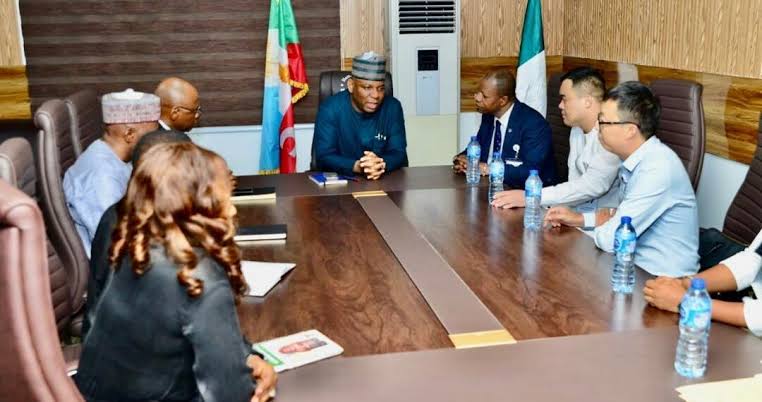
The Federal Government of Nigeria, FGN, through the Ministry of Steel Development, has signed a Joint Strategic Cooperation Declaration with Stellar Steel Company Limited.
Stellar Steel Company Limited is a steel-manufacturing enterprise established to operate in Nigeria, with major investment backing from Chinese parent groups: Galaxy Group and RSIN Group based in Fuzhou, Fujian Province, China.
The company has committed approximately US$450 million for a steel plant project in Ogun State, Nigeria, scheduled to begin operations by mid-2026.
This landmark partnership is aimed at revitalising Nigeria’s steel industry and reducing the nation’s dependence on imported steel products, according to a statement signed by the the Principal Information Officer, PIO, Ijomah Opia, for the director, Information and Public Relations in the ministry.
The agreement, signed in Abuja, on Tuesday 28th October, 2025 will see Stellar Steel invest $400 million in the construction of a modern Steel Plant in Ewekoro, Ogun State. The project will be developed in three phases, with the first phase expected to begin production by 2026.
The Minister of Steel Development Prince Shuaibu Abubakar Audu signed the agreement when he hosted Mr Li, President of Inner Galaxy Group and other members of the Stellar Steel Company Limited in the Ministry’s Headquarters in Abuja.
According to Prince Audu, the collaboration aligns with the federal government’s goal of achieving 10 million tonnes of crude steel production per annum by 2030, a major step toward industrial self-reliance and economic diversification.
The minister further stated that the Federal Ministry of Steel Development would facilitate policy and infrastructure support, including inclusion of Stellar Steel’s logistics projects in the National Infrastructure Plan and access to available fiscal incentives.
Highlights of the cooperation includes the followings:
1.Development of a localised iron ore supply chain to reduce import dependence and save over $1 billion in foreign exchange annually.
- Creation of more than 2,000 direct and 20,000 indirect jobs across the steel value chain.
- Promotion of green steel production using clean and energy-efficient technologies.
- Strengthening of Nigeria’s position as a regional steel manufacturing hub in West Africa.
Audi also said that in return, Stellar Steel would prioritise local recruitment and training, partnering with Nigerian universities to build technical and managerial expertise in steel production.
Prince Shuaibu emphasised that this strategic cooperation marks a new era for Nigeria’s steel industry and demonstrates the government’s commitment to sustainable industrial growth and economic transformation.
In his remarks the leader of the delegation, Mr Li assured the minister that Stellar Steel would respect all agreements reached and would ensure the completion of the project in record time and assured that all safety standards will be observed.
Mr Li was accompanied during the visit by Mr You Xiastian, Vice Chairman of RSIN Group, Mr Jackie Den, Vice President of Inner Galaxy Group and Mr Yin, Director of RSIN Group.
He recalled that the Minister of Steel Development, Prince Audu, performed the groundbreaking ceremony of the Steel Plant in Ogun State sometime in April, 2025.
Speaking at the signing, representatives of both parties emphasised that the partnership would strengthen Nigeria’s industrial base, create jobs, and foster technology transfer in the sector.
From Hassan Taiye
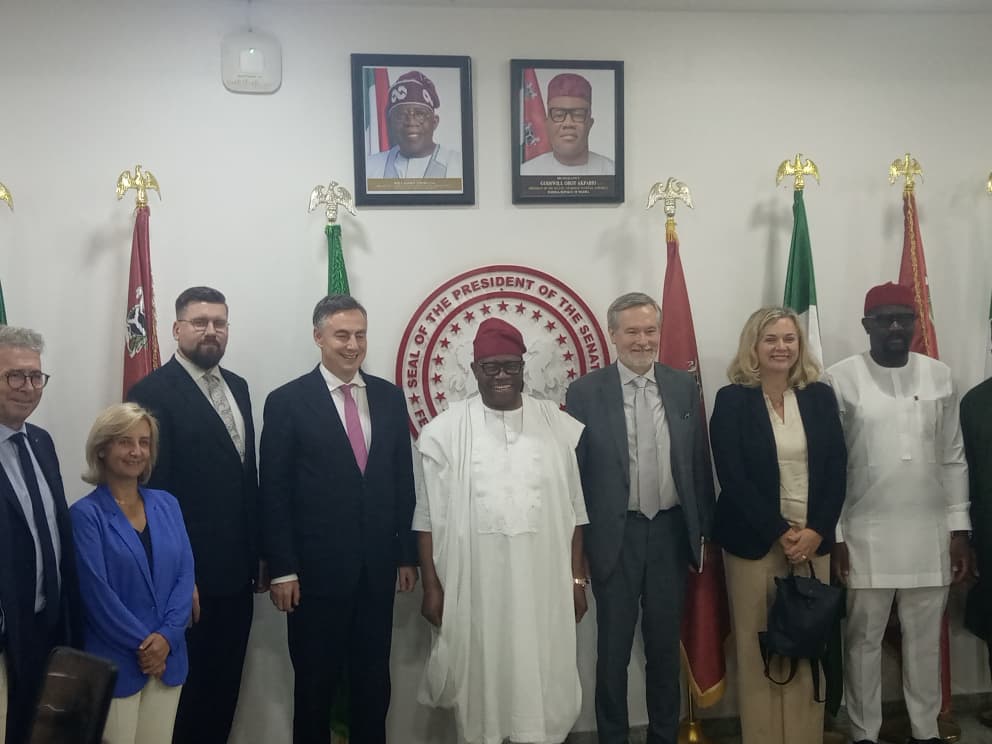
A high-level delegation from the European Union (EU) Parliament’s Foreign Affairs Committee, led by Mr. David McAllister, paid a courtesy visit to the Nigerian Senate today October 28, 2025.
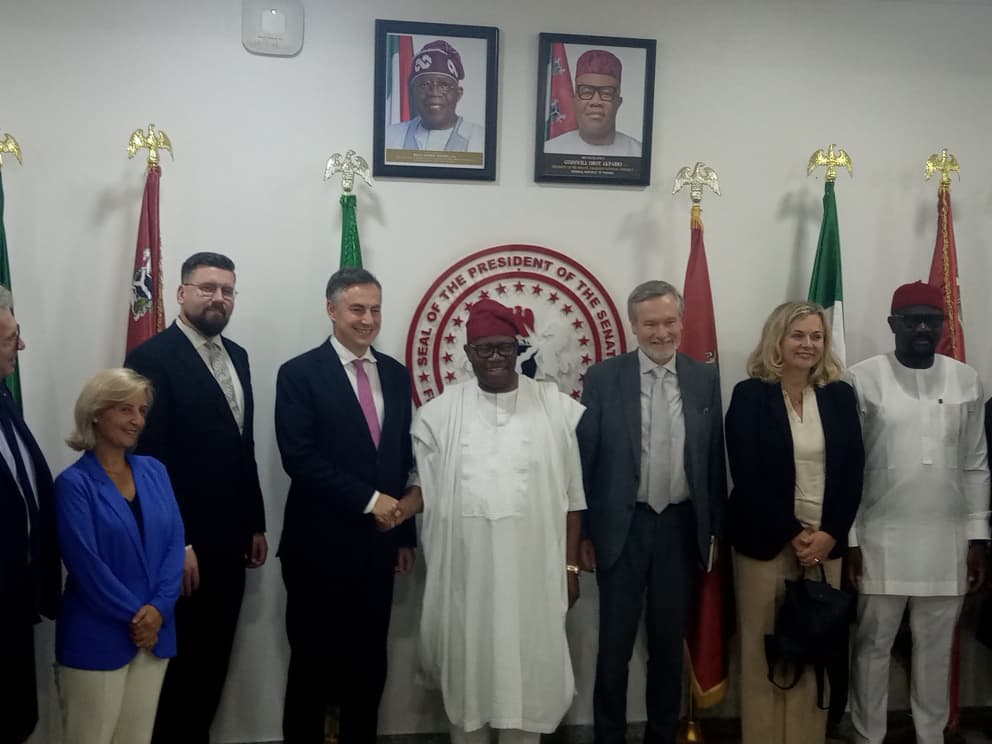
“We are here to deepen our understanding of the situation in West Africa and strengthen our partnership with Nigeria,” McAllister said.
Senate President Godswill Akpabio welcomed the delegation, emphasizing Nigeria’s strategic partnership with the EU. “Nigeria is committed to strengthening ties with the EU, highlighting areas of mutual interest, including security, trade, and governance,” Akpabio said.
The delegation, comprising Ambassador Greta Mylott, EU Ambassador to Nigeria and ECOWAS, Miss Zelaya Zorko, Miss Mata Tamido, Sebastian Tankman, General Christophe Gomart, and Sebastian Buharo, is undertaking a comprehensive tour of West Africa, with stops in Nigeria and Ghana.
During the visit, Akpabio shed light on the challenges facing female representation in Nigeria’s parliament. “Women often vote for male candidates, making it difficult for female candidates to win elections,” he noted.
“The Senate is exploring innovative solutions, including constitutional amendments, to boost female participation in the legislative process, with support from organizations like the Black Women’s Forum.”
The EU delegation’s visit aims to foster greater understanding and cooperation between the EU and Nigeria, addressing shared concerns, such as terrorism, climate change, and economic development.
“The EU is committed to supporting Nigeria’s development efforts,” McAllister assured the Senate, emphasizing the bloc’s interest in seeing a stable, prosperous, and democratic Nigeria.
Their visit also includes participation in the forthcoming International Islamic Conference on Security and Governance in West Africa and the Sahel, scheduled for November 4-6, 2025 at ECOWAS Commission.
Akpabio expressed optimism about the potential for enhanced cooperation, highlighting Nigeria’s readiness to work with the EU to address common challenges.

WHO: Nigeria Records Zero Ebola Cases After Evacuation of Swiss Couple

Kwara celebrates Fela’s legacy with retrospective exhibition

2027: Ilorin West LG Boss Leads APC Mega Rally In Ubandawaki

-
 Uncategorized6 years ago
FG, states urged to harness flooding for ranching, others with technology – Agbaje
-
 Headlines11 years ago
Breaking: EFCC seals Borno House of Assembly, as Hon members take to their heels
-
 News12 years ago
Nigeria Security Operatives Stage Manhunt For Homosexual Perpetrator
-
 News10 years ago
How 21-year-old Girl fled community over accusation of lesbianism
-
 News11 years ago
Yobe Gov Moves Against Deputy
-
 Opinion7 years ago
7 signs she has friend zoned you
-
Technology5 years ago
Online job placement company headhunts women
-
 Headlines10 years ago
Borno Dep Gov Abducts Another Church Leader