
News
Exclusive: Massive reshuffling of civil servants hit Zamfara Civil Service after leaked memo showing financing of terrorism, banditry hits media space.

Zamfara State has been thrust into a maelstrom of political upheaval following the emergence of a leaked memorandum purportedly implicating senior government officials, including the Governor, in the financing of terrorism and banditry. This bombshell revelation has ignited widespread indignation and outrage, both domestically and internationally. The fallout from this explosive expose has led to an unprecedented and abrupt reshuffling of key civil servants across the state, in a move that has sent shockwaves through the bureaucracy.
Sources within the Zamfara State Government House have revealed that the Governor was visibly incensed upon learning of the leaked memo, which allegedly detailed financial transactions facilitating banditry and further entangling high-ranking government officials in the scandal.
At the epicenter of the Governor’s anger was reportedly the Commissioner of Finance, who, as the overseer of the state’s financial management, is responsible for orchestrating the movement of accounting staff within the bureaucracy.
A Strategic Move or A Defensive Maneuver?
In an attempt to mitigate the fallout from the public embarrassment and intense backlash from international human rights organizations, Governor Dauda Lawal swiftly initiated a comprehensive reorganization of civil servants within the state bureaucracy, specifically focusing on the treasury department. This strategic move was formally communicated through a subsequent memo, meticulously outlining the extensive reshuffling of civil servants.
According to credible sources, the Governor’s office, in an unconventional and unexpected maneuver, sidestepped the Commissioner of Finance and instead entrusted the Head of Service, Ahmad Aliyu Liman, with the sensitive task of orchestrating the “special” redeployment of treasury staff.
This unusual deviation from established protocol has raised eyebrows, sparking speculation about the motivations behind this decision and the extent of the Governor’s involvement in the treasury department’s affairs.
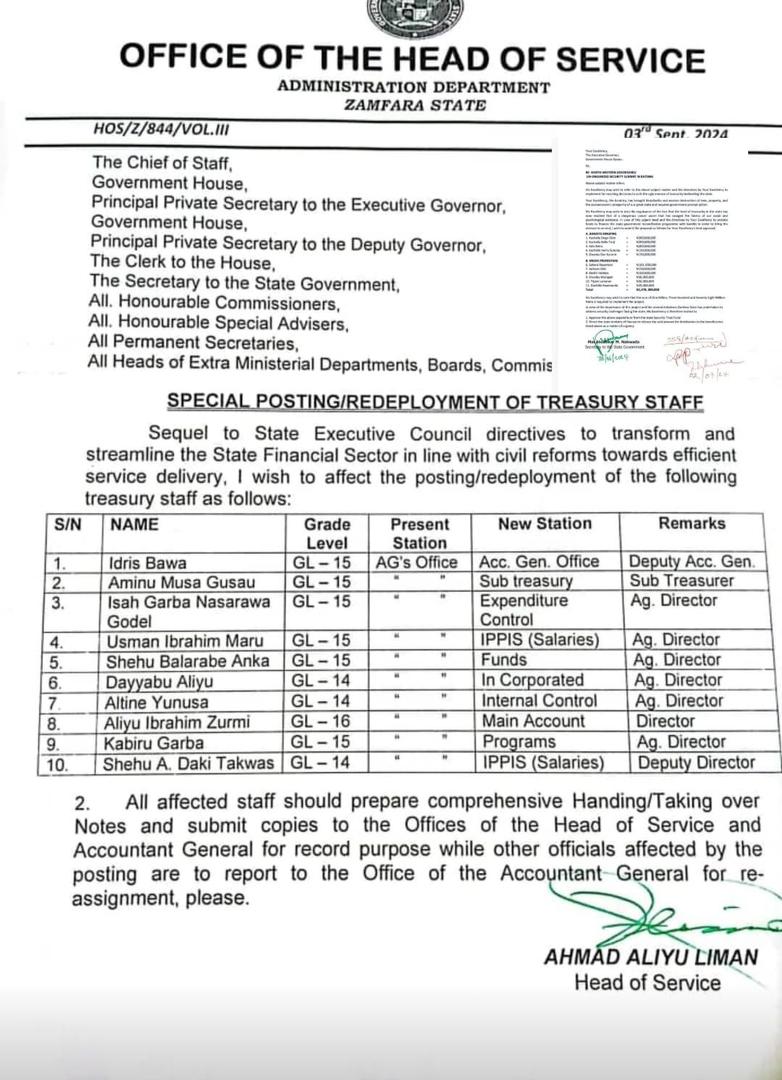
The follow-up memo obtained by our investigative team, with the reference number HOS/Z/844/VOL.III, outlines the redeployment of various senior treasury staff, including directors and deputy directors in key financial departments.
Here are some of the notable redeployments:
-Idris Bawa (GL-15): Moved from the Accountant General’s Office to a new post in the same office.
Aminu Musa Gusau (GL-15): Shifted from the Sub-Treasury to become the Deputy Accountant General.
Isah Garba Nasarawa Godel (GL-15): Appointed Acting Director of Expenditure Control.
Shehu Balarabe Anka (GL-15): Moved to the IPPIS (Salaries) department as Acting Director of Funds.
The comprehensive reshuffling affected over a dozen senior civil servants, many of whom held critical positions in the state’s financial management and control systems. Sources inside the government claim that these postings are part of a broader move to sanitize the state’s financial sector in line with civil service reforms. However, the sudden nature of the redeployment raises questions about its true intent.
An Act of Reform or Damage Control?
Interestingly, the Commissioner of Finance, typically entrusted with overseeing the assignment of accounting staff within the state bureaucracy, was conspicuously bypassed in this reshuffling exercise. According to well-placed sources, this decision stemmed from a profound lack of confidence in his office, coupled with deep-seated concerns that sensitive documents may continue to surface in the media.
The strategic redeployment of key financial personnel coincides with escalating suspicions that the Governor’s office is endeavoring to conceal the damning allegations outlined in the initial leaked memo.
While the government asserts that these personnel changes constitute part of comprehensive financial sector reforms, critics vehemently argue that the Governor’s true intention is to insulate himself from intensified scrutiny. The timing of this reshuffling has also raised significant concerns. If, as the Governor’s office maintains, the initial allegations of financial support to bandit leaders were entirely fabricated, it beggars the question: why the apparent haste to reassign key staff and prevent further leaks?
The emergence of the leaked documents has galvanized international and local organizations to demand a thorough, impartial investigation into the state’s financial dealings.
Zamfara’s Dark Web of Terrorism Links?
Zamfara State’s troubles have intensified with the surfacing of fresh allegations linking Governor Dauda Lawal to Farouq Abdulmutallab, the infamous perpetrator of the 2009 ”ailed terrorist attack. Although the specifics of this purported link remain unsubstantiated, the mere mention of Abdulmutallab’s name in conjunction with Zamfara’s escalating crisis has significantly exacerbated suspicions of the Governor’s involvement in terrorism financing.
Local leaders and astute political observers are gravely concerned that should these allegations be validated, Zamfara, already a volatile hotbed of banditry and insecurity, may descend into even greater instability.
The confluence of events – the leak of sensitive documents, the ensuing reshuffling of key personnel, and the Governor’s alleged ties to global terrorism – raises profoundly disturbing questions about the quality of governance and security apparatus in the state. The potential implications of these allegations are far-reaching, threatening to undermine the fragile stability of the region and perpetuate an environment conducive to terrorist activities.
Political Fallout and the way Ahead
To date, the Governor’s office has remained conspicuously silent, failing to issue an official statement addressing the leaked memo or the recent reshuffling, beyond the dubious assertion that these measures constitute part of broader “civil service reforms.”
Nevertheless, pressure continues to intensify from diverse quarters, with numerous voices demanding the Governor’s immediate resignation and a comprehensive, impartial investigation into the financial transactions of the Zamfara State Government. The strategic redeployment of key treasury personnel may temporarily appease certain elements within the government, but it will do little to dispel the pervasive specter of alleged corruption and complicity in terrorist activities now hanging over the state administration.
As the situation continues to unfold, attention remains fixed on Zamfara State, with all eyes watching for developments.
The true intentions behind the government’s actions, whether genuine reform or an intricate cover-up will likely become increasingly transparent as investigations progress, shedding light on the veracity of the allegations.
The Unanswered Questions
The question remains: if the initial memo alleging the Governor’s collusion with bandit leaders was indeed fabricated and tampered with, why the abrupt shift in focus towards preventing government document leaks, implicitly acknowledging the veracity of the prior accusations?
The swift reshuffling of civil servants and the deliberate bypassing of the Commissioner of Finance in this process betray a state of palpable panic and desperation, suggesting a frantic endeavor to reassert control and contain potential damage. This sudden and drastic action raises more questions than answers, casting doubt on the Governor’s professed innocence and fueling speculation about his actual involvement in the allegations.
The haste with which the Governor’s office has moved to reorganize key personnel and sidestep established protocols implies a profound sense of vulnerability, underscoring the likelihood that the initial memo struck closer to truth than initially acknowledged.
The Governor of Zamfara stands at a precarious juncture, faced with a daunting decision that will determine the fate of his administration and the state’s role in combating terrorism. The recent reshuffling, ostensibly presented as a facet of civil service reform, appears to be a strategic maneuver aimed at mitigating the fallout from the damning allegations contained in the leaked memo.
As clamors for accountability intensify, both domestically and internationally, the leadership of Zamfara State teeters on the brink of collapse, its credibility severely compromised. The citizens of Zamfara have lost faith in Governor Dauda Lawal’s ability to ensure their safety and security, which now seems an elusive dream on the verge of extinction.
The state’s pleas for help have become a desperate cry, borne out of frustration and despair. The people’s aspirations for a leader who would usher in an era of peace and stability, freeing them from the scourge of insecurity, have been cruelly dashed.
The lingering questions remain: Will terrorism ever be eradicated in Zamfara State? Will a worthy leader emerge to rescue its people from this abyss of fear and uncertainty?
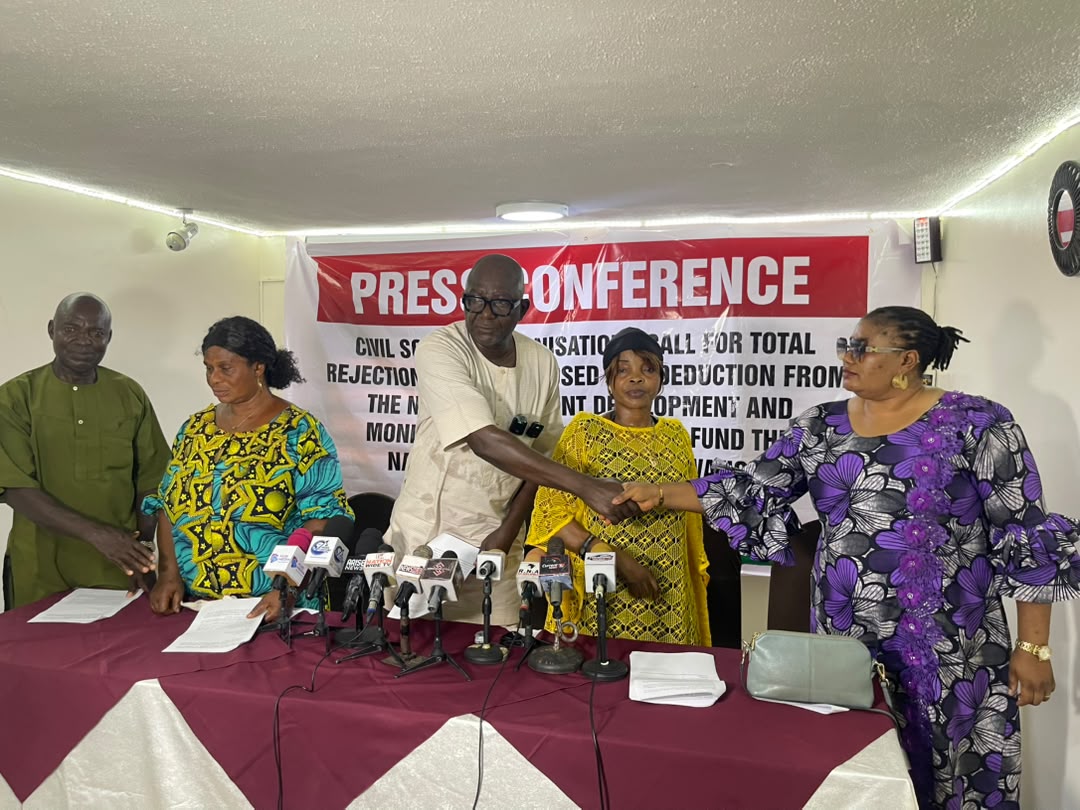
The Coalition of Civil Society Organisations in Nigeria (COCSON) has rejected a proposed 20 per cent deduction from the Nigerian Content Development and Monitoring Board (NCDMB) to finance the proposed National Research and Innovation Development Fund.
The coalition described the proposed funding arrangement as unacceptable, warning that it could undermine the development of indigenous capacity and local value addition in Nigeria’s oil and gas industry.
Speaking at a press conference in Abuja on Thursday, November 26, 2026, COCSON spokesperson, Tabuko Kennedy, said the coalition was not opposed to the establishment of a national research and innovation fund but strongly objected to the proposed funding mechanism.
Kennedy argued that funds allocated to the NCDMB were specifically meant to develop local capacity, support indigenous companies, train Nigerian engineers and promote value addition within the oil and gas sector.
He warned that diverting 20 per cent of the board’s revenue to finance another institution could weaken its ability to fulfil its statutory responsibilities.
According to him, the funds domiciled with the NCDMB are not surplus government revenue but contributions from companies operating in the oil and gas industry, specifically earmarked for local content development.
He maintained that diverting such funds without the consent of industry stakeholders would amount to a breach of trust and undermine the original purpose for which the resources were collected.
The coalition also warned that the proposed deduction could establish a dangerous precedent where financially viable government agencies would have portions of their revenues diverted to fund newly established institutions.
Kennedy questioned what would prevent similar deductions from other specialised intervention funds, including the Tertiary Education Trust Fund, the Universal Service Provision Fund and the Police Trust Fund.
He said such a practice could discourage revenue-generating agencies from improving their financial performance, create inter-agency rivalry and undermine long-term institutional planning.
COCSON further argued that the proposed deduction could violate the Nigerian Oil and Gas Industry Content Development Act, which provides the legal framework for the management and utilisation of funds accruing to the NCDMB.
The coalition maintained that the legislation did not envisage using the board’s resources to finance an unrelated research and innovation institution, describing the proposed diversion as inconsistent with the original statutory purpose of the funds.
Consequently, COCSON called on the leadership of the National Assembly, relevant committees and the Federal Executive Council to reject the proposed 20 per cent deduction.
It also appealed to President Bola Tinubu not to assent to the bill if the controversial funding provision remains in it.
The coalition disclosed that it had mobilised organised labour, pressure groups, religious organisations and other civil society groups to resist the proposed legislation.
It, however, stressed that it was not against research, innovation or the establishment of a national research funding institution, urging the government and lawmakers to explore alternative funding arrangements that would not undermine existing development agencies.
COCSON also called on Nigerians and industry stakeholders to oppose what it described as a legislative overreach, insisting that the country’s local content development programme should not be weakened to finance a new institution.
…Praises Alia For Restoring Residents To Ancestral Homes
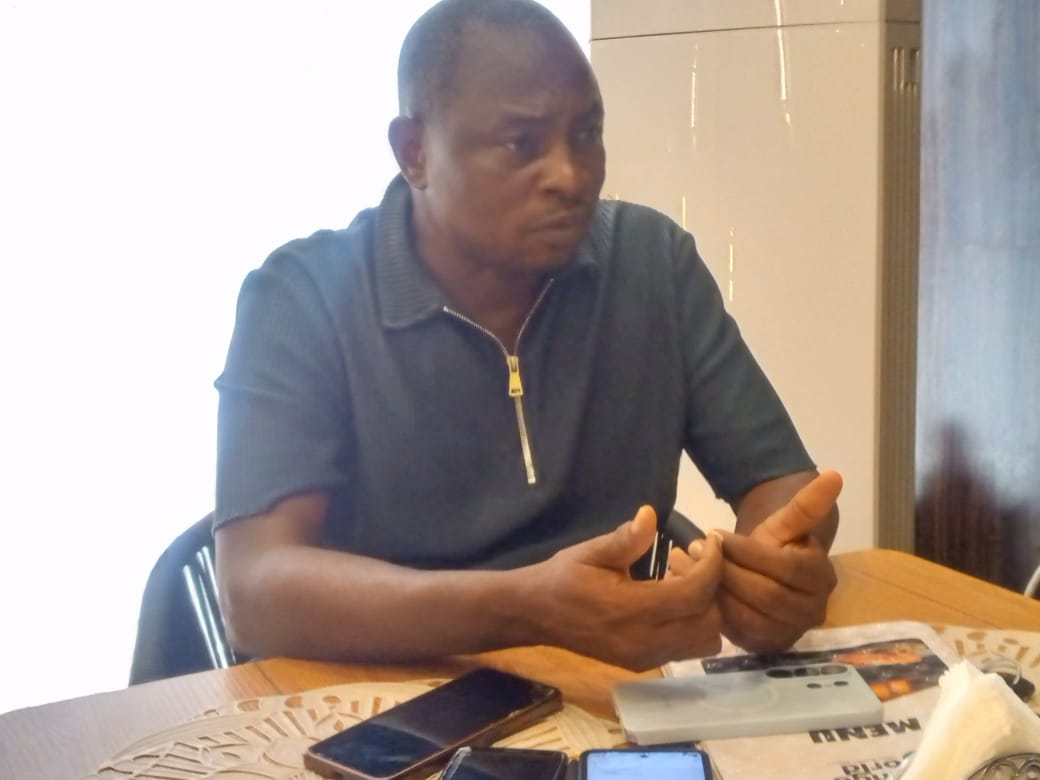
A former Commissioner for Lands and Survey in Benue State, Surveyor John Tondu, has accused the immediate past administration of failing to protect communities ravaged by insecurity, alleging that his people were effectively ranched instead of cattle, contrary to the objectives of the state’s anti-open grazing law.
Tondu, a former governorship aspirant, said residents of his local government endured years of displacement and were unable to access their ancestral homes despite the enactment of the Open Grazing Prohibition and Ranches Establishment Law in 2017.
The former commissioner who disclosed this while speaking with newsmen in Makurdi on Tuesday, also stated that one of the things that endeared him to Governor Hyacinth Alia, of Benue state, was his ability to ensure that his people who were living in Internally Displaced Persons (IDP) camps have return to their ancestral homes.
He alleged that while the law was intended to prohibit open grazing and provide for the establishment of ranches for livestock, the reality in his community was that human beings became victims of displacement and confinement instead of animals being accommodated in ranches.
According to him, “First, I come from a local government area that had the privilege of producing a governor who served the state for eight years. Yet, if you visit my local government, you would hardly believe that somebody from that area had occupied the office of governor for that length of time.”
Reflecting on the security situation during the previous administration, Tondu lamented that his community was among those severely affected, with residents effectively cut off from their ancestral homes for years.
“In 2017, the Open Grazing Prohibition and Ranches Establishment Law was enacted. The implication was that open grazing would no longer be allowed and livestock would have to be ranched.
“But, in reality, it was human beings who were ranched instead of animals. My people were effectively confined to displacement for eight years. Nobody could freely access his ancestral home,” he alleged.
The former commissioner, however, observed that the situation began to change following the inauguration of Governor Hyacinth Alia on May 29, 2023, disclosing that by September of the same year, displaced residents had started returning to their communities.
He pointed out that some of the residents were returning to homes they had been unable to visit for about five years, adding that members of his community had since resumed normal family and social activities.
“By September 2023, just a few months after Governor Alia assumed office on May 29, 2023, my people had started returning to their communities. They were returning to homes they had not visited for about five years,” he said.
Furthermore, Tondu stated that “As I speak, members of my community have returned home to live peacefully and carry on their normal family activities.
“Nobody is living in the ranch that was supposed to accommodate animals. My people were the ones who ended up living in what I describe as a human ranch.”
Tondu said the return of his people to their ancestral homes was a major consideration in his decision to identify with the Alia administration, insisting that the government needed sustained support to consolidate the security gains.
“This development alone has endeared me to the present administration. I believe we must give the government every necessary support to ensure that my people continue to enjoy the freedom and peace they have experienced over the years,” he said.
Beyond security, the former commissioner cited improvements in urban infrastructure and workers’ welfare as other reasons for his support for the governor.
He recalled that during his tenure as Commissioner for Lands and Survey, he took steps to address indiscriminate building in Makurdi, where some property owners allegedly ignored approved government layouts and development plans.
According to him, enforcing the opening of access roads in affected areas generated resistance from some individuals at the time, but he was pleased that the present administration had subsequently opened, tarred and constructed some of the roads.
“Today, if you visit those areas, you will see that some of the access roads we insisted should be opened have been opened, tarred and constructed by the present administration.
“That means I can physically see the impact of my own contribution to the state because somebody is providing the leadership needed to build on it,” he emphasised.
On workers’ welfare, Tondu observed that the payment of salaries and pensions was particularly important in Benue, which he described as essentially a civil service state.
He said delayed salaries and pensions had consequences beyond the immediate beneficiaries, affecting families, dependants and the wider economy.
He noted that “Benue is essentially a civil service state, and when salaries and pensions are not paid, you can imagine the consequences for families and the wider economy.
“Even if I do not have parents who are pensioners, I have relatives and friends whose parents are pensioners and civil servants. Civil servants are now being paid their salaries, while pensioners are also receiving their pensions.”
Tondu maintained that the Alia administration was addressing issues he had considered priorities when he aspired to govern the state, arguing that political ambition should be driven by the desire to serve rather than the personal quest to occupy public office.
“The governor is addressing these issues. So, what reason would I have not to support him?
“These were some of the priorities I had when I aspired to become governor. If somebody occupying that office is providing the services I would have provided had I been elected, refusing to support him would suggest that my own ambition was personal rather than driven by service,” he stated.
Tondu consequently pledged his commitment to supporting Alia’s re-election bid, saying the governor should be given the opportunity to consolidate the administration’s programmes and do more for the people.
“It is in that spirit that I am supporting the government with every commitment and assistance I can offer so that Governor Alia can be re-elected and do more for the people of Benue State,” the former governorship aspirant stated. End
News
Hon. Jafaaru Yakubu Commends China Harbour on Makurdi-Enugu Road Project, Urges FG to Release Funds for Completion
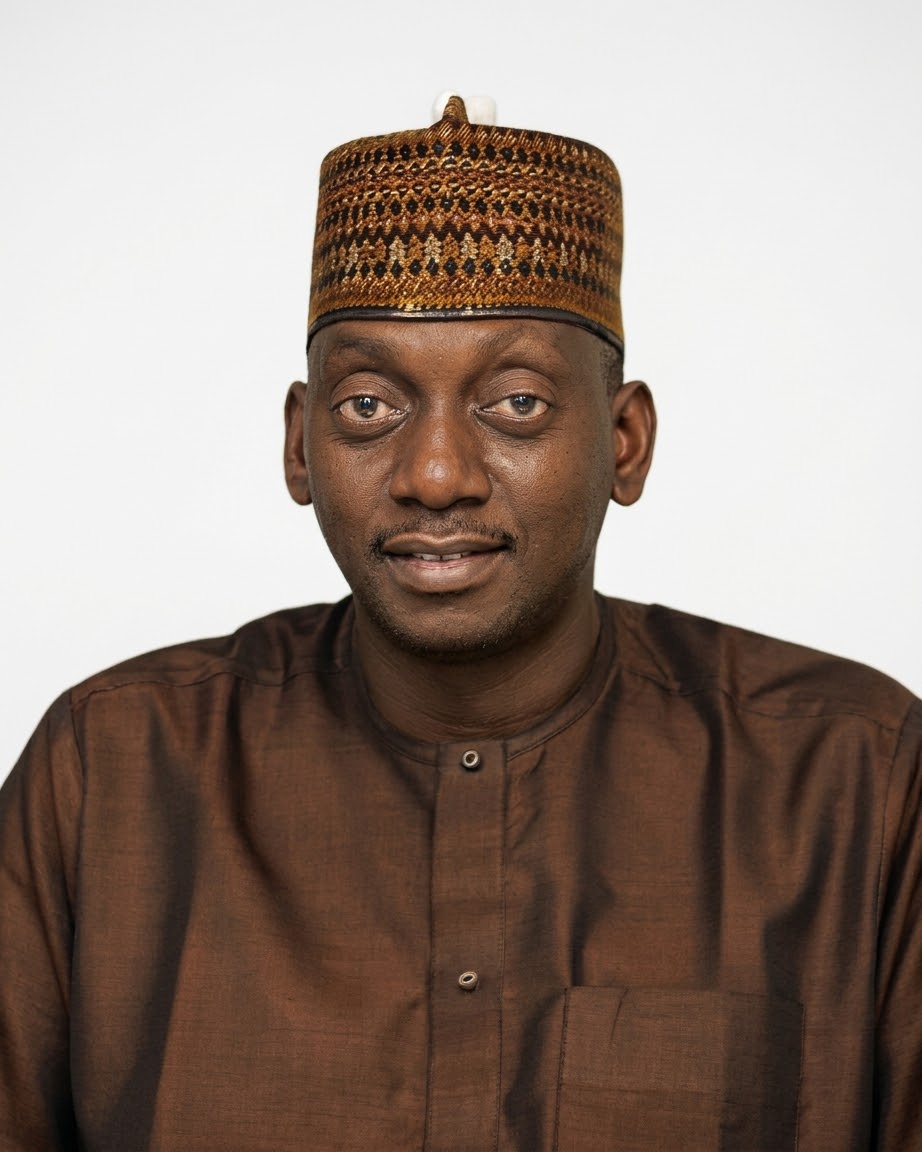
The Chairman of the Nigeria-China Friendship Relationship Group, Hon. Jafaaru Yakubu, has commended China Harbour Engineering Company for the remarkable progress recorded on the ongoing Makurdi-Enugu Road Expansion Project, noting that the construction has attained about 70 percent completion.
Hon. Yakubu gave the commendation during an inspection visit to the project site, where he expressed satisfaction with the quality of work executed by the construction firm and called on the Federal Government to expedite the release of funds to ensure the timely completion of the strategic highway.
Speaking after touring various sections of the road, the chairman described the project as a critical infrastructure development that would significantly improve transportation, enhance economic activities, and facilitate the movement of people and goods across the region.
According to him, the level of professionalism displayed by China Harbour Engineering Company is evident in the quality of the construction work, the durability of the pavement structure, and adherence to modern engineering standards.
“I am highly impressed with what I have seen on the ground. The quality of work being carried out by China Harbour is commendable. The road is being constructed to international standards, and the progress achieved so far demonstrates the company’s commitment to excellence and value delivery,” he said.
Hon. Yakubu noted that upon completion, the expanded highway would reduce travel time, improve road safety, boost interstate commerce, and open up new economic opportunities for communities along the corridor.
He further praised the construction company for maintaining a high standard of workmanship despite prevailing economic challenges, stressing that the project stands as a testament to the growing cooperation between Nigeria and China in the area of infrastructure development.
“The attention to detail, the engineering quality, and the pace of work are highly encouraging. This project is a shining example of the positive outcomes that can be achieved through strong bilateral cooperation and commitment to development,” he added.
The Nigeria-China Friendship Relationship Group chairman, however, appealed to the Federal Government to ensure the prompt release of outstanding funds required for the completion of the project.
He emphasized that timely funding would enable the contractor to sustain the current momentum and deliver the road within the stipulated timeframe.
“I want to respectfully appeal to the Federal Government to provide the necessary financial support and release funds as required. This will help ensure that the project is completed without unnecessary delays, allowing Nigerians to fully benefit from this important infrastructure investment,” he stated.
Hon. Yakubu described the Makurdi-Enugu Road Expansion Project as a vital national asset capable of transforming economic activities across the North Central and South Eastern regions, adding that its completion would further strengthen connectivity and promote national development.
He therefore urged all stakeholders to continue supporting the project, expressing confidence that the road would become one of the country’s most enduring and impactful infrastructure achievements when completed.
The Makurdi-Enugu Road Expansion Project is regarded as a key transportation corridor designed to enhance regional integration, improve access to markets, and stimulate socio-economic growth across several states along its route.


Civil Society Coalition Kicks Against Proposed 20% Deduction from NCDMB

2027: Kwara South APC Campaign Flagged Off

Kwara Jailbreak: Three Inmates Die

-
 Uncategorized6 years ago
FG, states urged to harness flooding for ranching, others with technology – Agbaje
-
 Headlines11 years ago
Breaking: EFCC seals Borno House of Assembly, as Hon members take to their heels
-
 News12 years ago
Nigeria Security Operatives Stage Manhunt For Homosexual Perpetrator
-
 News10 years ago
How 21-year-old Girl fled community over accusation of lesbianism
-
 News11 years ago
Yobe Gov Moves Against Deputy
-
 Opinion8 years ago
7 signs she has friend zoned you
-
Technology5 years ago
Online job placement company headhunts women
-
 Headlines11 years ago
Borno Dep Gov Abducts Another Church Leader