
Uncategorized
OPINION:

SOKOTO FIRST WHERE NEXT?
INTEROGATING THE BIGGER PICTURE.
By: A G Abunakar
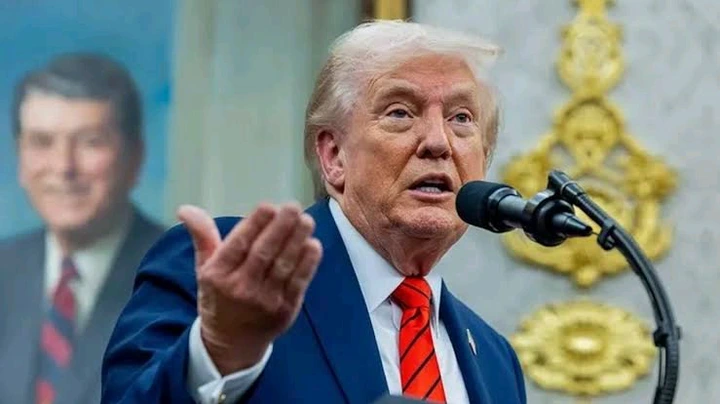
When Donald Trump mooted the idea of coming into Nigeria to smoke out jihadists allegedly killing Christians, public reactions were as diverse as Nigerian society itself. And, when he followed through his threats by striking Jabo, a village in Sokoto state, with drones and missiles, the reactions haven’t been less diverse either. Not many people fathomed that Sokoto was going to be high on the pecking order of strike in view of the fact that the killings from the area on account of terrorism and insurgency are much lower than what obtain in the North East and North Central regions of the country. Others, welcomed the strike and maintained that after Sokoto, it can be extended accordingly.
Why did the US pull the trigger now? The answer lies in the alleged genocide against Christians and global geopolitics. As regards the alleged carnage, many perceived it as affecting both Christians and Muslims alike. Others, however, saw the killings as bearing distinct markings of genocide. The few who attempted to express concern for some of the Muslim communities impacted by the crises tended to blame them, for not speaking out forcefully enough about their plight.
They maintained that the Christian communities —genocide or not —have been able to voice out their concerns, which consequently got escalated to the global stage. From there it found receptive ears among evangelical groups in the United States and influential members of Congress. Following two fact-finding missions, Trump decided to make good his threat to strike Nigeria, from its Navy warship in the Gulf of Guinea and related operational base in Ghana. A total of sixteen GPS-guided precision munitions were reportedly pumped into Jabo village.
The build-up followed a familiar U.S. pre-strike pattern: ramp up verbal attacks, repeat accusations relentlessly, and deploy charged descriptors such as “disgrace,” “weak,” and “ineffectual.” This is usually followed by threats capped with ultimatums, before eventual military action. The host nation, usually the weaker partner, is informed as fait accompli out of courtesy and the need for cooperation should the need arises.
A few weeks ago, Trump reiterated his description of Nigeria as a disgrace, accusing the government of failing to halt killings within four weeks—violence that, in reality, has persisted for nearly two decades. While warnings and diplomatic engagements were ongoing, U.S. surveillance reportedly operated freely over Nigerian airspace as the country watched helplessly.
Meanwhile, at home, groups sympathetic to the genocide narrative mounted campaigns against a nonexistent Sokoto Caliphate, accusing it of perpetuating the alleged genocide For the record, the Sokoto Caliphate existed between 1804 and 1903. Its formal end came with the killing of Sultan Attahiru at Burmi while he sought refuge. Burmi is located in the present-day Gombe State in northeastern Nigeria. From that point onward, British colonial rule took over, and in 1960, Nigeria emerged as a sovereign constitutional state. The role of successive paramount rulers in Sokoto—styled as Sultans—has since been largely symbolic and ceremonial: a unifying figure for social and religious cohesion, devoid of executive authority.
Under the 1999 Constitution, traditional rulers possess no autonomous power. Their authority is subordinate even to local government chairmen—not governors. Emirs, Obas, Shehus, Ezes, Sultans, Tor Tivs, Kuthlis, Och’Idomas, and others must obtain concurrence from their local councils before moving outside their domains. That is how hamstrung traditional institutions have become. Indeed, the Nigerian Constitution provides no clear operational role for royal fathers.
Eventually, the United States struck targets in Sokoto, allegedly based on “credible intelligence” indicating that perpetrators of genocide were located in the region—and that genocide itself was taking place there. Trump announced:
“The United States launched a powerful and deadly strike against ISIS terrorist elements in northwest Nigeria who have been targeting and viciously killing primarily innocent Christians at levels not seen for many years, and even centuries.”
Notably, there was no direct reference to the Nigerian government. Any claim by Nigerian authorities that the strike was conducted under mutual arrangement appeared, at best, face-saving.
Indeed, it could hardly have been otherwise. Had Nigeria been in control, it would have directed the strikes where they mattered most—against Boko Haram and ISWAP in the Northeast or the murderous armed herdsmen in Benue and Plateau States. These two groups – and opportunists in between – have effectively torn the country apart, while successive governments have appeared too apprehensive to decisively confront them for fear of alienating either Christian or Muslim constituencies. In reality, Nigeria doesn’t have nationals. It has only Christians and Muslims, and that’s how they operate. Therefore, leadership, instead of managing citizens, ends up balancing sectarian relations at the expense of development.
This relentless balancing of Christian-Muslim political interests has steadily defanged Nigerian governments, weakening them internally and diplomatically. A fractured home front translates into vulnerability abroad. Trump and other world leaders have perceived this weakness and exploited it through classic “divide and rule” tactics, manipulating mutual suspicion for strategic advantage. Even when external actors act high-handedly, the Nigerian government watches helplessly, trapped in the logic of “the enemy of my enemy is my friend.”
The strike on Sokoto may, therefore, have been strategic. First, to reinforce the perception that genocide is occurring and that the Islamic community—symbolised by the Sultanate—is complicit. Second, Sokoto may simply serve as a launch pad for deeper penetration toward the actual jihadist strongholds in the Northeast. Or perhaps it is merely a case of giving a dog a bad name in order to hang it.
It is also possible that the U.S. sought to test its new National Security Strategy, shaped around Trump’s “America First” vision, and rolled out in November 2025. The strategy describes U.S. foreign policy as “pragmatic without being pragmatist, realistic without being realist, principled without being idealist, muscular without being hawkish, and restrained without being dovish” It further claims to be guided by “flexible realism” and “offensive realism.” Perhaps only the architects of this Trump-inspired doctrine can fully explain why Sokoto became the testing ground for these abstractions—first in Africa.
Outside these explanations, logic dictates that any serious offensive against terrorism should have begun at the epicentres: Boko Haram and ISWAP enclaves in the Northeast, orNorth-Central killing fields. The hills of Mangu, Bokkos, Barkin Ladi, Bassa, and Riyom in Plateau State; the forests of Yelwata, Gwer, Guma, and Akpa in Benue State; and areas such as Shiroro, Mokwa, and the Kainji axis in Niger State, as well as Baruten and Kaiama in Kwara State, where groups like Ansaru, Mamuda, and Lakurawa operate. The U.S. reconnaissance missions to these regions should have yielded sufficient actionable intelligence for pre-emptive strikes.
Killings in Sokoto, Zamfara, Kebbi, Katsina, and parts of Kaduna are largely products of terrorism-fuelled criminality exploiting weak law enforcement They are mostly Muslim-on-Muslim, or Hausa-Fulani-on-Fulani violence, driven by economic or criminal motives rather than ideology. The Lakurawa phenomenon has been a low-level insurgency that got foothold in the zone during Nigeria’s frosty relations with Niger Republic after the military toppled the latter’s civilian government. This sharply contrasts with Boko Haram and ISWAP, which are animated by Sharia-state ideology and territorial ambition.
Lakurawa in Sokoto axis is, in fact, a case of marriage gone sour. Years back, the local communities used to engage them for security and protection against livestock rustling in the absence of an orthodox government security system in the area. In return, the group was given unfettered access to the people for religious preaching and missioning until the cookie crumbled. A case of “those who ride on a tiger’s back may end up in its stomach.”
Boko Haram under Abubakar Shekau was initially aligned with al-Qaeda. Tactical disagreements later produced a splinter faction—ISWAP—led by Abu Musab al-Barnawi, son of Mohammed Yusuf, Boko Haram’s founder ISWAP pledged allegiance to ISIS and became its West African franchise. Since then, rivalry between the two has been fierce, with ISWAP appearing to be gaining the upper hand.
ISWAP now controls strategic locations in the Lake Chad Basin—Damasak, Ngala, Malam Fatori—as well as parts of the Gwoza mountains and Sambisa Forest. It has grown increasingly sophisticated, deploying drones, high-calibre weapons, and effective social-media propaganda. A capacity that the Nigerian army is still grappling to match up, given its disastrous experience with deployment in Tudun Biri on the outskirts of Kaduna, Ran in Borno State and a village in Zamfara State.
The group has recently overrun military bases in Kukawa and Damboa (Borno State) and Buni Yadi (Yobe State). Key highways to Maiduguri-Damboa-Biu and Biu-Damaturu-Maiduguri—have remained unsafe. In fact, the Maiduguri/Damboa/Biu corridor has been closed down for years. And it was around this same axis that the military lost senior officers, including Col. Danladi Bako, Brig-Gen. Dzarma Zirkusu, and Brig-Gen. Musa Uba. The latter was reportedly executed in cold blood and filmed by the insurgents for propaganda purposes.
Against this backdrop, it is baffling that Sokoto was chosen for the first strike. Nigerian authorities claim that “structured security cooperation with international partners, including the United States,” led to “precision airstrikes on terrorist targets in the Northwest,” (MFA, December, 2025).
In reality, the decision was unmistakably American. Otherwise, Nigeria might have prioritised strikes on the Northeast or North-Central terror hubs to send a clearer message. Indeed, the very need for U.S. intervention is itself an indictment. Why should it take American drones and missiles to strike targets in Nigeria when ISWAP itself often deployed drones to dislodge Nigerian military bases. Whatever marginal benefits may arise from this so-called “structured cooperation,” they are temporary. Nations invite partners for international crises—not to resolve internal security failures.
Ultimately, the price of failure is national sovereignty. Sokoto may represent the opening chapter in Nigeria’s gradual devaluation. The same U.S. doctrines of “offensive realism” and “flexible realism” have left deep scars in Iraq, Syria, Afghanistan, DRC, Sudan, Somalia, and Libya. Used and dumped. Nigeria must avoid joining that grim list.
The footprint of such “liberation” carries more blood than any diagram of peace.
Sokoto was struck not because it was the epicentre of terror; it was because Nigeria has lost the moral and strategic control of its own security narrative. When a sovereign state becomes unable to clearly define its enemies and acts accordingly, others will define them for it—and strike where symbolism matters more than substance. The first bomb did not merely hit a target; it exposed a vacuum of authority, coherence, and national will.
This is the danger of a country fragmented along ethno-religious lines and governed by permanent appeasement. In such a state, terrorism mutates, criminality flourishes, and foreign powers find justification to intervene under selectively moral banners. Once sovereignty is subcontracted, it is rarely returned intact.
If Nigeria does not urgently reclaim control of its internal security, intelligence architecture, and national narrative, it risks sliding from partner to project, from state to theatre. History shows that foreign “liberation” rarely ends in peace; it ends in prolonged instability, bloodshed, and regret. Nigeria, should be guided.
A. G. Abubakar
agbarewa@gmail.com
Stephen Olufemi Oni, Ilorin
The Kwara State Government has celebrated the life and enduring influence of Afrobeat legend, Fela Anikulapo-Kuti, with a retrospective exhibition aimed at preserving African cultural heritage and inspiring younger generations.
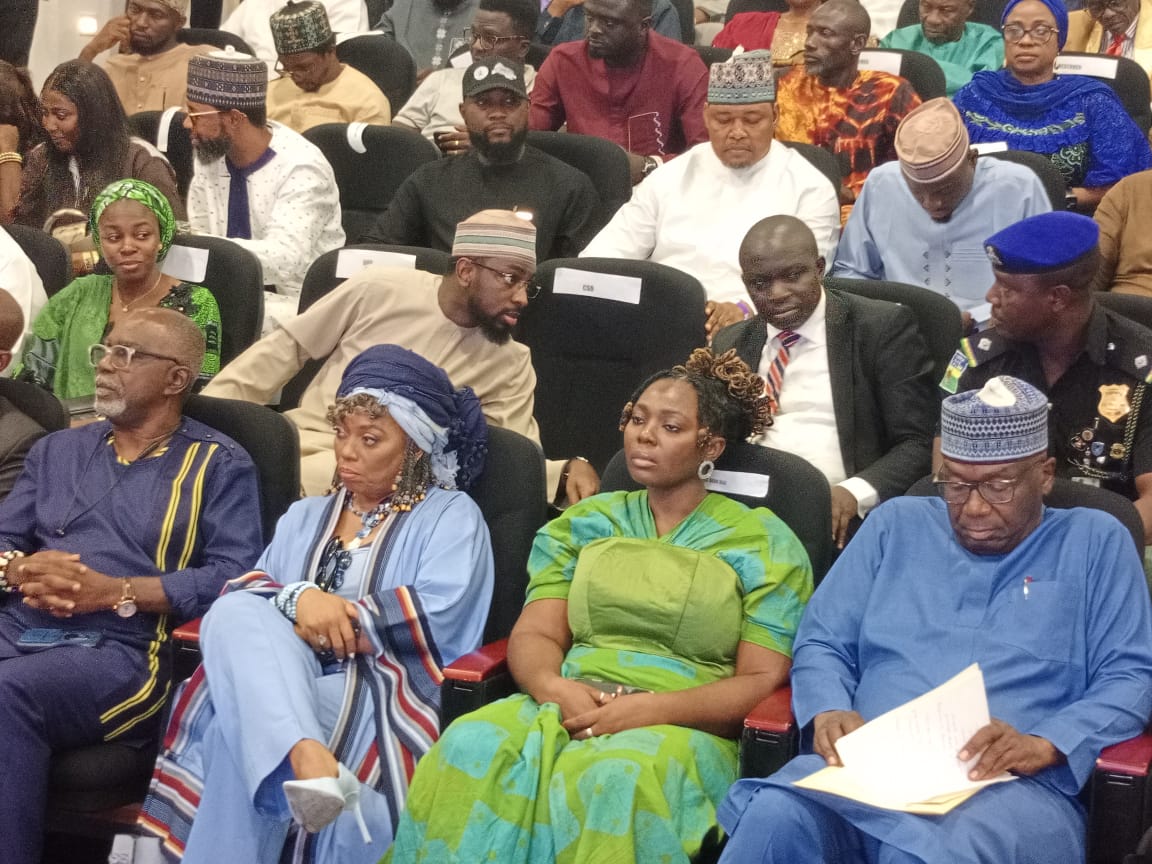
The exhibition, titled Fela Anikulapo-Kuti: A Retrospective, was opened by Governor AbdulRahman AbdulRazaq at the Institute of Contemporary African Art and Film in Ilorin on Monday.
The Governor said the establishment of the institute reflected his administration’s belief that development should extend beyond physical infrastructure to include spaces that promote creativity, knowledge and economic opportunities.
“When we established the Institute of Contemporary African Art & Film, our vision was clear: development must go beyond roads, bridges and buildings to create spaces for creativity, knowledge and opportunity,” AbdulRazaq said.
According to him, cultural infrastructure plays an important role in connecting people to their history, broadening their imagination and encouraging critical thinking.
“Physical infrastructure connects places; cultural infrastructure connects people to their history, expands their imagination and challenges their thinking,” the Governor said.
AbdulRazaq said the institute was established to preserve African stories, nurture talents and showcase the continent’s artists and thinkers to the world,
describing the decision to open the institution with an exhibition dedicated to Fela as significant, given the musician’s contribution to African music, social commentary and cultural expression.
“Fela was more than a musician. Through his music and artistic expression, he challenged conventions and confronted society with questions about power, freedom, identity and justice,” he added.
The Governor added that the late musician’s life demonstrated the capacity of artistic expression to influence public discourse and inspire social change.
The exhibition, curated by June Creative Art Advisory, led by its founder, Mrs Seun Alli, featured photography, archival materials, film, graphic works and other artistic expressions exploring Fela’s life, times and enduring influence.
AbdulRazaq commended the firm for bringing its curatorial expertise and creative vision to the project, while describing the exhibition as an opportunity for different categories of visitors to engage with the musician’s legacy.
He said the exhibition would provide students with learning opportunities beyond the classroom, inspire artists, support researchers and encourage young people to explore the creative industry.
“For students, this is a classroom beyond the classroom; for artists, inspiration; for researchers, an opportunity for deeper inquiry; and for young people, a reminder that creativity offers both self-expression and economic opportunity,” he said.
The Governor clarified that the state government was not claiming ownership of Fela’s story but was providing a platform for younger generations to encounter and learn from his legacy, adding that the state government is optimistic that the institute would promote cultural education, encourage creative enterprise, attract visitors and strengthen Kwara State’s position in Nigeria’s cultural and creative landscape.
According to him, the institution’s success would be measured by the talents it nurtured, the ideas it inspired and the opportunities it created.
“Governments change, but institutions should endure,” the Governor said, expressing the hope that the exhibition would mark the beginning of sustained cultural engagement at the institute.
“May this exhibition begin sustained cultural engagement at ICAAF and inspire our young people to create, question, discover and contribute to society,” he said.
AbdulRazaq added that the initiative reflected his administration’s commitment to building a state where cultural heritage, innovation and economic opportunities complemented one another.
In her address, the Commissioner for Communications, Hon. Bolanle Olukoju, said: “Today’s exhibition offers us an opportunity to revisit the life and works of Fela
Anikulapo-Kuti and appreciate how his music, ideas and artistic expression continue to influence generations.
“For the Ministry of Communications, this occasion speaks to an important part of our
mandate: promoting the stories, talents and creative expressions that shape our identity as a people.”
The Commissioner particularly noted that under Governor AbdulRazaq’s leadership, the State is creating opportunities for young people through investments in sectors such as film, fashion and technology.
She added: “Projects including
the Sugar Film Factory, the Garment Factory and the Ilorin Innovation Hub reflect the administration’s commitment to developing talent and supporting enterprise.
“The Institute of Contemporary African Art & Film, formerly the Ilorin Visual Arts Centre, adds an important dimension to this effort. It provides a platform for artistic expression, cultural learning and creative collaboration.
“We want young Kwarans who are passionate about painting, photography, filmmaking, fashion and design to see ICAAF as a place where they can explore their interests, learn from others and showcase their talents.
“We also encourage students to engage with art and history beyond the classroom. Fela’s story is a fitting subject for this exhibition. It demonstrates how creativity
can go beyond entertainment to shape cultural identity and influence public conversations. There is much for our young people to learn from his artistic journey and enduring impact.
“It might also interest you that kwara state was also part of Fela’s creative showcase during his lifetime.”
•••Says Ward stands with APC
Stephen Olufemi Oni, Ilorin
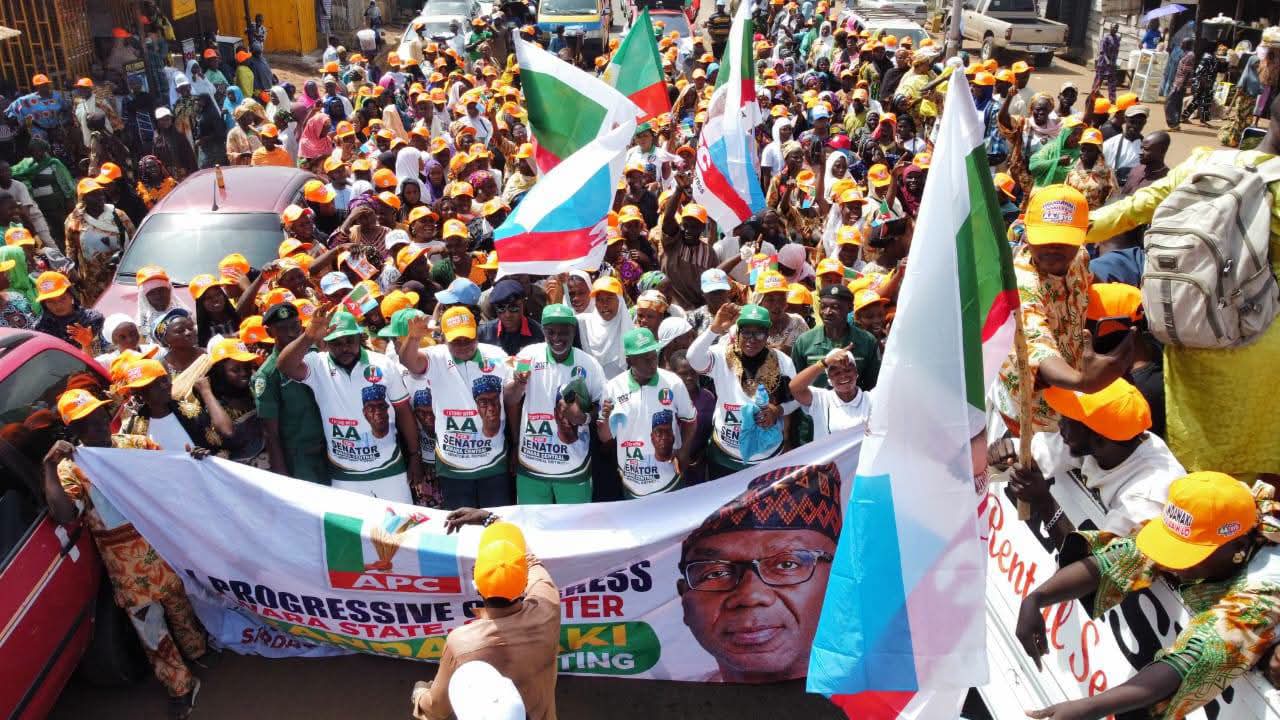
The Executive Chairman of the Ilorin West Local Government, Mallam Shehu AbdulRahman Babatunde Ladan, has led an All Progressives Congress (APC) mega rally in Ubandawaki Ward, reaffirming the commitment of party members and supporters to the APC ahead of the 2027 general elections.
The rally attracted party leaders, grassroots mobilisers, youths, women, and other stakeholders who gathered to demonstrate their support for the party.
Addressing the gathering, Chairman Ladan declared that Ubandawaki Ward remains committed to the APC and its political leadership, expressing support for President Bola Ahmed Tinubu’s Renewed Hope Agenda, Kwara State Governor AbdulRahman AbdulRazaq, and the APC governorship candidate, Rt. Hon. Engr. Yakubu Danladi-Salihu (SYD), alongside other party candidates for the 2027 general elections.
The Chairman emphasised the importance of unity, peaceful political engagement, and sustained grassroots mobilisation in strengthening the party’s structure ahead of the forthcoming elections, urging party faithful to remain united, engage constructively with residents, and work collectively towards the party’s political objectives.
Ladan also acknowledged the importance of Ubandawaki Ward in the political landscape of Ilorin West, encouraging party leaders and supporters to maintain cordial relationships, promote inclusive participation, and sustain engagement with the electorate. He stressed that a united party structure would help strengthen internal cooperation and effective grassroots coordination.
The mega rally renewed calls for unity, loyalty, and peaceful political participation among APC members and supporters, underscoring commitment by participants to mobilising support for the party’s candidates ahead of the 2027 general elections, while promoting peace, development, and responsible democratic engagement across Ilorin West Local Government Area.

- Mgt Accuses Union Of Dishing Out False Staff Remuneration Scale
Stephen Olufemi Oni, Ilorin
The staff of the Kwara State Internal Revenue Service (KWIRS) have lamented poor welfare conditions, rising living costs and stagnant salaries they have been subjected to, despite their contributions to the state’s revenue generation.
In a statement issued by the KWIRS chapter of the Association of Senior Civil Servants of Nigeria (ASCSN), the workers lamented that their sacrifice and professionalism, which have helped to place Kwara State among the more self-reliant states in the country, have not been matched with corresponding improvement in their welfare.
The workers questioned the disparity between their contributions to the state’s revenue and their welfare, saying many of them are battling financial hardship.
“We block leakages. We are posted to hospitals and other MDAs to secure government revenue. We work under pressure day and night but we continue to struggle to meet basic needs due to poor salaries.”
The association further expressed concern that personnel costs had remained unchanged for years while other expenditure heads had continued to increase.
It also cited a salary negotiation agreement dated October 11, 2022, which reportedly stated that the adjustment would be implemented “as soon as it can be accommodated in the budget.”
According to the workers, nearly four years after the agreement, there had been no implementation or clear indication of when the adjustment would take effect, despite the rising cost of living.
The staff said expenses on school fees, house rent, transportation and food had increased significantly while their salaries remained unchanged. “We smile outside but the majority of us are bleeding inside. We cannot continue to generate wealth for the state while we wallow in abject poverty,” they declared.
Urging their colleagues to remain united and resolute in pursuing improved welfare, the association said the workers should not expect better conditions without collectively standing up for their interests.
It called on members to remain calm, vigilant and prayerful as a 14-day period beginning October 15, 2026, counts down, without specifying further details in the statement about the expected action at its conclusion.
Reacting to the KW-IRS staff allegations, the Management, while
reaffirm its commitment to professionalism, political neutrality and its statutory mandate, expressed dismay over public speculation on staff remuneration and attempts to politicise unverified internal administrative communications.
“Management is concerned by attempts to exploit unverified internal administrative communications for political purposes, create unnecessary tension and distract the Service from its responsibilities. KWIRS will not be distracted from its mandate by such narratives,” said the Management.
It added: “The isolated salary figures being circulated on social media do not represent the full remuneration structure or total emoluments of KWIRS staff. Staff compensation extends beyond regular monthly salaries and includes the following benefits, in accordance with applicable policies and approved arrangements:
“Annual and Performance-Related Bonuses: Annual, festive, and situational bonuses linked to revenue performance milestones and staff performance and situational economic palliatives are paid periodically to staff members
“Annual Leave Allowance: A separate annual payment in addition to regular monthly remuneration.
Staff Welfare and Operational Support: Structured measures designed to support staff welfare and professional development throughout their careers.
“Accordingly, assessing staff remuneration solely on selectively circulated salary figures presents an incomplete picture of the Service’s compensation and welfare structure.
“Management remains committed to staff welfare, motivation and professional development. The Service will continue to strengthen policies and operational processes that support staff well-being and performance, within government-approved resource allocations and applicable administrative frameworks. The Service remains one of the Government Institutions with the most recruitment requests and this is a testament of Management’s commitment to staff welfare.
“KWIRS urges members of the public, taxpayers and other stakeholders to disregard unverified and misleading narratives, verify information before sharing it, and rely on official Service communications for accurate information about its operations and staff policies.
“All stakeholders are encouraged to refrain from politicising internal administrative matters or spreading claims capable of undermining institutional harmony and public confidence.
“KWIRS remains focused on its statutory responsibilities and committed to mobilising revenue for the economic growth and sustainable development of Kwara State.”


Yakubu Hails China’s Zero-Tariff Initiative as Catalyst for Economic Transformation
THE BOLD SHIFT:BETWEEN REFORMS ANDTHE REALITY OF THE BROKEN EGGS:
WHO: Nigeria Records Zero Ebola Cases After Evacuation of Swiss Couple

-
 Uncategorized6 years ago
FG, states urged to harness flooding for ranching, others with technology – Agbaje
-
 Headlines11 years ago
Breaking: EFCC seals Borno House of Assembly, as Hon members take to their heels
-
 News12 years ago
Nigeria Security Operatives Stage Manhunt For Homosexual Perpetrator
-
 News10 years ago
How 21-year-old Girl fled community over accusation of lesbianism
-
 News11 years ago
Yobe Gov Moves Against Deputy
-
 Opinion7 years ago
7 signs she has friend zoned you
-
Technology5 years ago
Online job placement company headhunts women
-
 Headlines10 years ago
Borno Dep Gov Abducts Another Church Leader