
News
Kashim Shettima Commissions IDC facility in Katsina, Urge Other States to Emulate Governor Radda’s Initiatives


From Lateef Taiwo
Nigeria’s Vice President, Kashim Shettima, has called on other states of the federation to emulate Katsina State’s MSME initiatives model, describing it as a success. He commended the BOI and SMEDAN for partnering with the state in its MSME development drive.
Shettima made the call while commissioning the remodeled Katsina Industrial Development Centre (IDC) Common Facility Centre and the flag-off of the first Katsina MSME Clinic and Fair in Katsina on Wednesday.
The remodeled IDC, a Public-Private Partnership between the Katsina State Government and the Small and Medium Enterprises Development Agency of Nigeria (SMEDAN), is equipped with modern tools and machinery to enhance productivity and product quality. The upgraded facilities include: Renovated workshops for a conducive working environment, State-of-the-art computer labs and a call center for digital skills training and customer support and an Uninterrupted power supply through a 30KVA hybrid inverter system. Others are Upgraded sanitation facilities and a 1.7km Improved road access.
Represented by his Deputy Chief of Staff, Senator Hassan Haɗeja, VP Shettima lauded Governor Radda’s focus on data-driven decision making for MSME development, mirroring the approach taken at the federal level. He emphasized the significance of MSMEs, accounting for 96% of Nigerian businesses, 84% of the workforce, and nearly half of the GDP.
Applauding the state’s commitment to empowering MSMEs, the Vice President acknowledged their crucial role in job creation, value addition to agriculture, and overall economic development. VP Shettima commended Governor Dikko Radda’s leadership, particularly his impactful tenure as Director-General of SMEDAN (Small and Medium Enterprises Development Agency of Nigeria).
He also commended the appointment of Haj. Aisha Aminu Malunfashi as KASEDA Director-General, recognizing the positive impact women can have on MSMEs.
The Vice President specifically recognized Governor Radda’s creation of a $5 billion MSME fund in partnership with BOI (Bank of Industry) and SMEDAN. He emphasized the importance of providing affordable financing for small businesses, crucial for their sustainability.
He further applauded the establishment of a computer lab and call center at the IDC, acknowledging its potential to enhance digital literacy among beneficiaries, equip them for participation in e-commerce and digital trade, and facilitate nationwide and potentially global marketing opportunities.
Shettima highlighted the Federal Government’s efforts to support MSMEs, including dedicated funding initiatives through partner banks and the appointment of a Senior Special Assistant on job creation and MSMEs.
VP Shettima seized the opportunity to invite attendees to the World MSME Day awards night in Abuja, hinting at a potential award for Governor Radda, in recognition of his efforts. He offered his best wishes for Governor Radda’s continued success in tackling unemployment, insecurity, and promoting progress for the people of Katsina.
Earlier, Mr. Charles Odii, Director General of the Small and Medium Enterprises Development Agency of Nigeria (SMEDAN), commended Katsina State for following a framework similar to SMEDAN’s business processing and sourcing model.
According to him, the upgraded IDC has the potential to accommodate over 500 SMEs trained in business processing and sourcing. It also housed a call center with capacity for over 500 representatives.
These advancements, he said, position Katsina State to become a national leader in business processing. He lauded the Governor’s efforts to revitalize the IDC, creating: a one-stop shop for SMEs, giving access to affordable financing, reduced barriers to obtaining capital, and zero-collateral financing options.
He also commended Governor Radda for the establishment of 136 Business Development Service Providers across Katsina State, providing crucial guidance to entrepreneurs.
Speaking earlier, Katsina State Governor, Malam Dikko Umaru Radda highlighted the critical role MSMEs play in job creation, poverty reduction, and economic diversification. He emphasized that the Katsina SME Clinics and Fair is a platform for entrepreneurs to showcase products, network, and explore business opportunities. It aims to address challenges faced by entrepreneurs by providing training and workshops on financial management, marketing, and technology adoption. It also provides regulatory support, counseling, and mentorship opportunities.
The Katsina Governor expressed deep appreciation to SMEDAN for providing the space and fostering a collaborative relationship that brought the project to fruition, stating that, “The Purpose of remodeling the IDC with a functional Shared Facility Centre is to reiterate our commitment to fostering an environment where micro small and medium enterprises (MSMEs) and local artisans can thrive.
He added that “the center has now been equipped with modern tools and machinery that are often beyond the financial reach of individual artisans. This will enable them to produce higher quality products more efficiently and compete effectively in the market.”
Furthermore, he said “the centre will provide a platform for enhancing skills and knowledge by training and learning new techniques, and stay updated with industry trends. Also based on the report of our cluster mapping, we intend to extend such common facility to the remaining two senatorial districts of the state as soon as possible.”
Governor Radda urged youths in the state to embrace entrepreneurship, take optimal advantage of the platform to learn, collaborate, and innovate in order to create a prosperous future for KATSINA State and its residents.
He further announced the establishment of an annual fair at the center, to be complemented by an annual MSMEs Award Dinner to celebrate achievements in the sector.
Similarly, the Deputy Governor of the state, Hon. Faruk Jobe who doubles as the Chairman Katsina State Council of MSME described the upgrade as a symbol of the Radda-led administration’s commitment to empowering MSMEs to overcome hurdles and reach their full potential.
He emphasized that the facility will equip businesses to compete effectively in the marketplace noting that the IDC’s collaborative environment will further foster innovation and growth.
The Katsina Deputy Governor expressed his sincere appreciation to all those involved in the IDC’s transformation and commended the resilience and innovation of Katsina’s MSMEs. He called for continued collaboration to create a thriving and dynamic MSME ecosystem in the state, that will lead to a brighter future for the state’s residents.
On her part, Hajiya Aisha Aminu, the Director General, Katsina State Enterprise Development Agency KASEDA said the event signifies the beginning of a new era of opportunity, innovation, and growth for local businesses and entrepreneurs in the state.
According to her, the facility is designed to be a hub where ideas are transformed into tangible products, where entrepreneurs can access modern machinery, and where small businesses can thrive through shared resources and expertise. She added, “This center is a strategic investment in the future of our MSMEs. It is a place where dreams are nurtured, skills are honed, and the entrepreneurial spirit is ignited.”
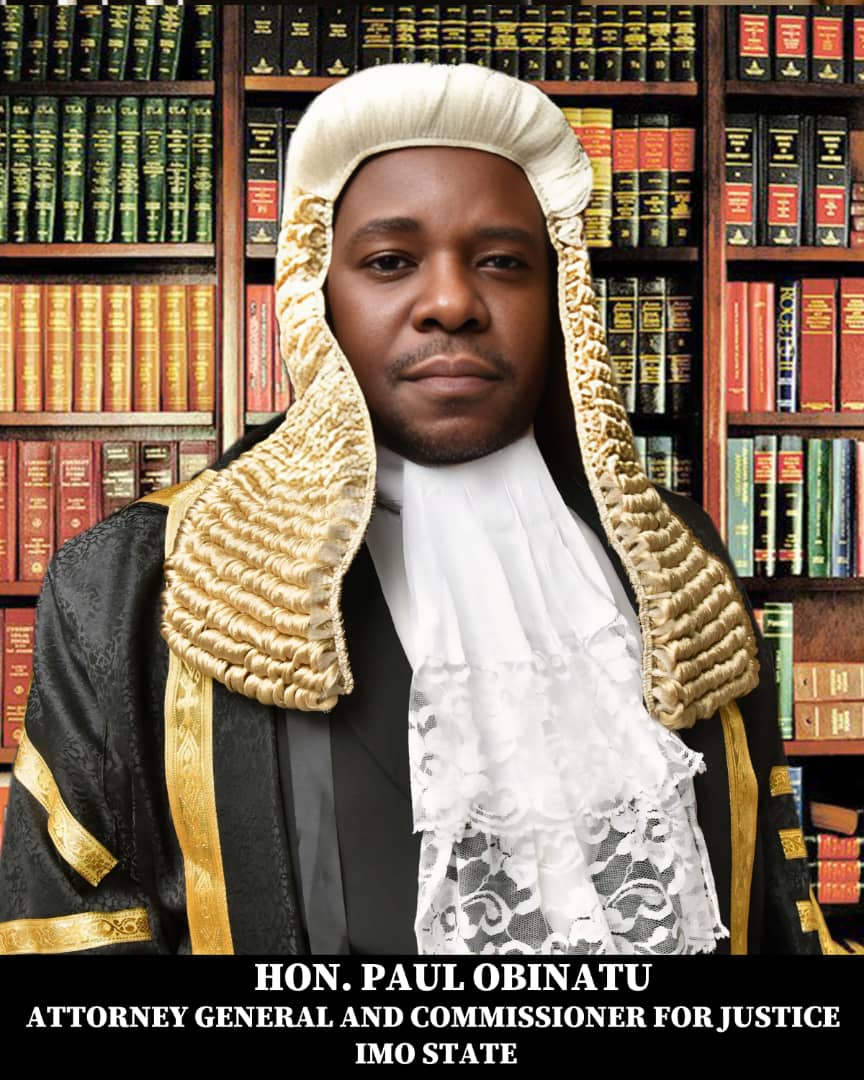
- Insists Imo Judicial Service Commission is constitutionally independent; invokes Section 202, says NJC lacks powers to nominate a candidate for Imo State JSC for appointment as Chief Judge
The Imo State Attorney-General and Commissioner for Justice, Hon. Paul Obinatu has challenged the constitutional authority of the National Judicial Council (NJC) to direct the Imo State Judicial Service Commission (JSC) on the candidate whose name it should submit for consideration in the appointment of a substantive Chief Judge of the state, describing such an intervention as an encroachment on the constitutionally guaranteed independence of the State Commission.
In a statement issued on November 6, 2026, the Attorney-General maintained that the NJC lacks the constitutional authority to dictate, control or substitute its preferred candidate for the independent assessment and recommendation process entrusted to the Imo State JSC under the 1999 Constitution, as amended.
The objection follows a directive reportedly issued by the NJC to the Imo State JSC at its 112th meeting held on November 3, 2026, concerning the appointment of a substantive Chief Judge for the state.
The Attorney-General argued that the NJC’s constitutional responsibility to recommend a candidate to the Governor does not confer on it the additional power to determine or dictate the candidate the State Judicial Service Commission must submit to it. He maintained that the directive is constitutionally untenable because it interferes with a responsibility expressly vested in the State Judicial Service Commission.
SECTION 202 GUARANTEES IMO JSC’S INDEPENDENCE
Central to the Attorney-General’s objection is Section 202 of the Constitution, which expressly provides that the State Judicial Service Commission shall not be subject to the direction or control of any other authority or person in exercising its constitutionally assigned powers.
He argued that this provision establishes a clear constitutional safeguard against external interference in the Commission’s responsibilities and cannot be overridden by the NJC through administrative directives or procedural guidelines.
According to him, the NJC cannot invoke its national institutional status or its recommendation powers to exercise control over the Imo State JSC in a manner inconsistent with the Constitution.
Consequently, any directive requiring the State JSC to submit a particular candidate or dictating the outcome of its independent assessment would, in the Attorney-General’s interpretation, amount to unconstitutional interference.
CONSTITUTION ASSIGNS DISTINCT RESPONSIBILITIES TO NJC AND STATE JSC
The Attorney-General anchored his position on Section 271(1) and the relevant provisions of the Third Schedule to the Constitution.
Paragraph 6(a) of Part II of the Third Schedule empowers the State Judicial Service Commission to advise the NJC on suitable persons for nomination as Chief Judge of the state.
Conversely, Paragraph 21(c) of Part I of the Third Schedule empowers the NJC to recommend to the Governor, from among the list of persons submitted by the State JSC, a candidate for appointment as Chief Judge.
Section 271(1) further provides that the appointment shall be made by the Governor on the recommendation of the NJC, subject to confirmation by the State House of Assembly.
According to the Attorney-General, these provisions establish a clear constitutional sequence: the State JSC identifies and advises on suitable candidates, the NJC considers the submitted names and makes its recommendation to the Governor, while the Governor exercises the appointing authority subject to legislative confirmation.
He insisted that the NJC’s recommendation powers cannot be interpreted as authority to dictate which candidate the State JSC must select or submit, as doing so would effectively transfer the Commission’s constitutional responsibility to the NJC and render Section 202 meaningless.
NJC GUIDELINES CANNOT OVERRIDE THE CONSTITUTION
Addressing the NJC’s Guidelines and Procedural Rules for the Appointment of Judicial Officers, the Attorney-General acknowledged the Council’s authority to prescribe and enforce procedural requirements for judicial appointments.
However, he maintained that such guidelines cannot confer powers beyond those granted by the Constitution or be used to compromise the independent functions of the State JSC.
He stressed that the NJC’s responsibility to ensure compliance with appointment procedures must not be extended to usurping the constitutional authority of the Imo State Judicial Service Commission.
COURT DECISIONS REINFORCE ATTORNEY-GENERAL’S POSITION
In support of his argument, the Attorney-General cited several judicial authorities which he said affirm the importance of constitutional boundaries and institutional independence.
They include Elelu-Habeeb & Anor. v. Attorney-General of the Federation & Ors. (2012) LPELR-15515(SC), Kano State Public Complaints and Anti-Corruption Commission & Anor. v. Salisu & Ors. (2019) LPELR-47107(CA), and Bamisile v. National Judicial Council & Ors. (2012) LPELR-8381(CA).
Other authorities referenced are FRN v. Nganjiwa (2022) LPELR-58066(SC), NJC & Ors. v. Senlong & Ors. (2010) LPELR-4582(CA), and Attorney-General of the Federation v. Attorney-General of Abia State & Ors. (2024) LPELR-62576(SC).
The Attorney-General maintained that these authorities reinforce the principle that every constitutional institution must exercise its powers strictly within the limits prescribed by law, irrespective of its institutional standing.
IMO CHIEF JUDGE APPOINTMENT MUST FOLLOW CONSTITUTIONAL PROCEDURE
The Attorney-General warned that allowing the NJC to assume functions constitutionally assigned to the State JSC would undermine the integrity of the judicial appointment process and compromise the independence of the Commission.
He maintained that the issue is not a contest for institutional superiority between the NJC and the State JSC, but the need for each institution to respect the constitutional boundaries of its authority.
He further emphasised that the NJC’s responsibility to recommend a candidate to the Governor must not be confused with the power to control the independent selection and submission process of the State Commission.
The Attorney-General insisted that the ongoing appointment process must be conducted strictly in accordance with the Constitution, without interference that could undermine public confidence in the judiciary.
For the Imo State Attorney-General, the constitutional position is clear: while the NJC has the responsibility to recommend a candidate to the Governor, it has no authority to dictate to the Imo State Judicial Service Commission the candidate whose name it must submit in the exercise of its independent constitutional mandate.

Benue Equity and Justice Movement has accused the Benue People’s Democratic Party Governorship candidate, Mr. Michael Aondoakaa of plan to manipulate the Judiciary in order to buy the planned November 16 judgement in the eligibility suit against him.
It will be recalled that the Supreme Court had few years ago banned Mr. Aondoakaa from holding public offices for life as a result of his manipulation of justice while he was Attorney General of the Federation under the PDP regime of former President Umaru Yar’Adua.
Justice Kudirat Kekere-Ekun, then a Justice of the Supreme Court and now the Chief Justice of Nigeria (CJN), delivered the Supreme Court’s unanimous judgment on December 10, 2021, affirming the judgment of the Court of Appeal, Calabar Division, which had upheld a Federal High Court decision barring the former minister, who served under the late President Umaru Musa Yar’Adua, from occupying any public office in Nigeria for life.
In the Court of Appeal’s judgement on June 1, 2010, Justice A.F.A. Ademola ordered, “1. A declaration is hereby made that the 2nd Defendant undermined and subverted the rule of law, the due administration of justice and integrity of the judiciary in the letters of 8th January, 2008 and 16th February 2009 written by him in the capacity of the Defendant. “2. A declaration is hereby made that 2nd Defendant is not a competent, fit and proper person to hold office as the 1st Defendant having regards to the oaths of Allegiance and office.
Also recalled that the 2027 governorship candidate of the Allied People’s Movement, Mr. Damian Adagba had in September asked the court to compel the Independent National Electoral Commission to remove Aondoakaa’s name from its official portal as the governorship candidate of the PDP as a result of the Supreme Court Judgement.
Also, in a suit, marked FHC/ABJ/CS/2152/2026 which was instituted by David Ejembi, Aondoaver Teryila, Joseph Okpanachi and Benedict Akaazua Orkume against the Independent National Electoral Commission (INEC), the PDP and Aondoakaa, the plaintiffs urged the Federal High Court in Abuja on October to stop the former AGF from parading himself as the governorship candidate of the PDP.
Following the arguments by the lawyers of the People’s Democratic Party, Mr. Aondoakaa and the plaintiffs, the court adjourned the matter to November 16, 2026, for judgment.
But in a press statement which was sent to reporters this morning, Benue Equity and Justice Movement through its General Secretary, Mr. Kingsley Asema said that the pressure group has received Intel which revealed plans by the embattled PDP governorship candidate to bribe the Judge handling the case.
“We have it on a good authority that Barrister Michael Aondoakaa, having realized that the eligibility suit against him in court would not go in his favour based on various evidences that he had been barred from holding any public office, has been holding series of meetings with his political godfather, Mr. Samuel Ortom and legal team led by a former Secretary to the Benue State Government, Mr. Tony Ijohor on the possible way to bribe the Judge handling the case.
“The final meeting on how to manipulate the planned November 16 judgement was held in Jos last Friday, and in attendance were Chief Aondoakaa, Barrister Tony Ijohor, Barrister Clement Mue, Anthony Malik, and Barrister Matthew Onoja.
“We also have proofs that it was the legal team led by Ijohor that advised Aondoakaa to reach out to the judge through an unnamed Senior Advocate of Nigeria from Jos when it was clear that he may be declared ineligible to contest the 2027 governorship election”
Meanwhile, Benue Equity and Justice Movement in the press statement called on the Chief Judge of the Federal High Court, Abuja as well as the Chief Judge of Nigeria to rescue the Judiciary which is the last succour for a common man from the former AGF who is moving fastly to buy the eligibility judgement which has been fixed for November 16, 2026.
The group stated further that Aondoakaa’s case is a litmus test for the Nigerian Judiciary, noting that selling judgement to him will prove that the Judiciary is no longer a succour for a common man.
News
NCDC: Tinubu’s Youth Development Vision Will Turn Students’ Innovations into Productivity, Says Adodo


…As Commission announces plans for entrepreneurial development centres across North Central, FCT
…NANS Zone C applauds Renewed Hope Agenda, seeks partnership on student empowerment
The North Central Development Commission (NCDC) has reaffirmed its commitment to partnering with Nigerian students to promote innovation, entrepreneurship and economic productivity, declaring that President Bola Ahmed Tinubu’s vision for youth development must translate into practical opportunities that enable young people to turn their ideas into viable enterprises.
The Commission also assured students across the North Central region of their inclusion in its development programmes, disclosing that sufficient funds had been set aside in its budget to support entrepreneurship training and related interventions.
Speaking at the National Association of Nigerian Students (NANS) Zone C Summit, Comrade Solomon Adodo, Board Member representing the FCT on the NCDC Board, who represented the Managing Director and Chief Executive Officer of the Commission, Dr Cyril Yiltsen Tsenyil, said the Commission was determined to ensure that the creativity and innovative ideas of students were given the necessary support to translate into productivity.
The summit, which took place in Kwara State on Saturday, brought together student representatives from the six states of the North Central region and the FCT.
Adodo commended President Tinubu for establishing the regional development commissions, describing the initiative as a strategic intervention to address developmental challenges, strengthen regional growth and ensure that government programmes deliver tangible benefits at the grassroots.
He said the President’s vision for youth development recognises the enormous potential of Nigerian students and the need to create an enabling environment for their creativity, innovation and productive capacities to thrive.
According to him, the NCDC considers education a critical foundation for regional development and is committed to ensuring that students are carried along in the implementation of the President’s development agenda.
Referencing an essay titled Good Intentions Are Not Enough, Adodo stressed that good intentions must be supported by practical action and meaningful collaboration to achieve lasting results.
He said the Commission was determined to establish a stronger partnership with the student community to ensure that innovative ideas are nurtured and translated into productive ventures.
“It is time for us to reverse the old pattern and embrace a new order, to ensure that the innovations of students are not left to rot, but are given wings to fly and ascend from mere potential to productivity,” he said.
Adodo disclosed that sufficient funds had been set aside in the Commission’s budget to support entrepreneurship training and other interventions aimed at strengthening the economic capacity of young people.
He further revealed that the Commission was making plans to establish entrepreneurial development centres across the six states of the North Central region and the FCT to provide students and other young people with opportunities to acquire relevant skills, develop innovative ideas and build sustainable enterprises.
He encouraged students to look beyond academic qualifications and embrace entrepreneurship, innovation and wealth creation, stressing that Nigeria must transition towards a productive economy in which young people are not only equipped to seek employment but also empowered to create jobs and contribute to economic growth.
He noted that President Tinubu’s aspiration to build a productive Nigeria requires deliberate investment in the capabilities of young people, adding that the country must strengthen its capacity to produce goods and services for domestic consumption and export.
The NCDC Board Member further assured students that the Commission would maintain an open-door policy and work closely with relevant stakeholders to ensure that their needs and aspirations are reflected in its interventions.
He explained that the Commission has representation from each state in the region, providing an avenue for engagement, interaction and the identification of development priorities.
“The gates and doors of the North Central Development Commission are open to you. Our duty is not to isolate ourselves from you, but to interact with you and ensure that all your needs are met,” he said.
Meanwhile, NANS Zone C has applauded the student-focused initiatives of President Tinubu’s Renewed Hope Agenda, describing them as encouraging steps towards youth empowerment, economic inclusion and sustainable opportunities for Nigerian students.
The association also announced plans to seek a strategic partnership with the NCDC to establish a regional skills acquisition and entrepreneurship development programme for students across the North Central region.
Speaking on the proposed initiative, the Zone C Coordinator, Comrade Abiola Azeez Babatunde Adigun, emphasised the importance of investing in students’ skills and entrepreneurial capacities as a pathway to sustainable livelihoods and regional development.
The proposed programme is expected to cover Benue, Kogi, Kwara, Nasarawa, Niger and Plateau states, as well as the FCT, with a focus on digital, vocational and technical skills, business development, mentorship and entrepreneurship training.
NANS Zone C said it would engage the Commission’s leadership to discuss the proposed collaboration, develop an implementation framework and identify areas of mutual interest in advancing student empowerment across the region.
The association expressed optimism that a strategic partnership with the NCDC, alongside sustained government interventions under the Renewed Hope Agenda, would create opportunities for students to become skilled professionals, innovative entrepreneurs and active contributors to Nigeria’s economic development.


2027: Borno Stands still As APC Launches campaign.

Gov AbdulRazaq inspects Oluremi Tinubu Hospital, lauds work done

2026 Amuro Day: New Aare Mayerorun, Meseko Urges Unity

-
 Uncategorized6 years ago
FG, states urged to harness flooding for ranching, others with technology – Agbaje
-
 Headlines11 years ago
Breaking: EFCC seals Borno House of Assembly, as Hon members take to their heels
-
 News12 years ago
Nigeria Security Operatives Stage Manhunt For Homosexual Perpetrator
-
 News10 years ago
How 21-year-old Girl fled community over accusation of lesbianism
-
 News11 years ago
Yobe Gov Moves Against Deputy
-
 Opinion8 years ago
7 signs she has friend zoned you
-
Technology5 years ago
Online job placement company headhunts women
-
 Headlines10 years ago
Borno Dep Gov Abducts Another Church Leader